
Avocado and Hemp Oil Salad: A Source of Healthy Fats
Avocado salad with hemp oil dressing: a 10-minute recipe, calculated serving composition, and what studies say about carotenoid absorption.
Avocado and hemp oil bring two different types of fat into one bowl. Avocado is primarily monounsaturated fats: 9.8 g per 100 g of flesh, mainly oleic. Hemp oil goes the other way, as it consists of over 80 percent polyunsaturated fats, and the omega-6 to omega-3 ratio typically falls between 2:1 and 3:1 (Callaway, Euphytica, 2004). There is another benefit, less obvious than taste: the fat from avocado significantly increases the absorption of carotenoids from leafy vegetables, and this has been measured in a way that someone really quantified. Below you will find a recipe for ten minutes, the calculated composition of a serving, and information on which numbers in this topic are backed by sources.
KEY INFORMATION
• Hemp oil is over 80% polyunsaturated fats, and the omega-6 to omega-3 ratio typically ranges from 2:1 to 3:1 (Callaway, Euphytica, 2004).
• 100 g of avocado flesh contains 9.8 g of monounsaturated fats, 6.7 g of fiber, and 485 mg of potassium (USDA FoodData Central).
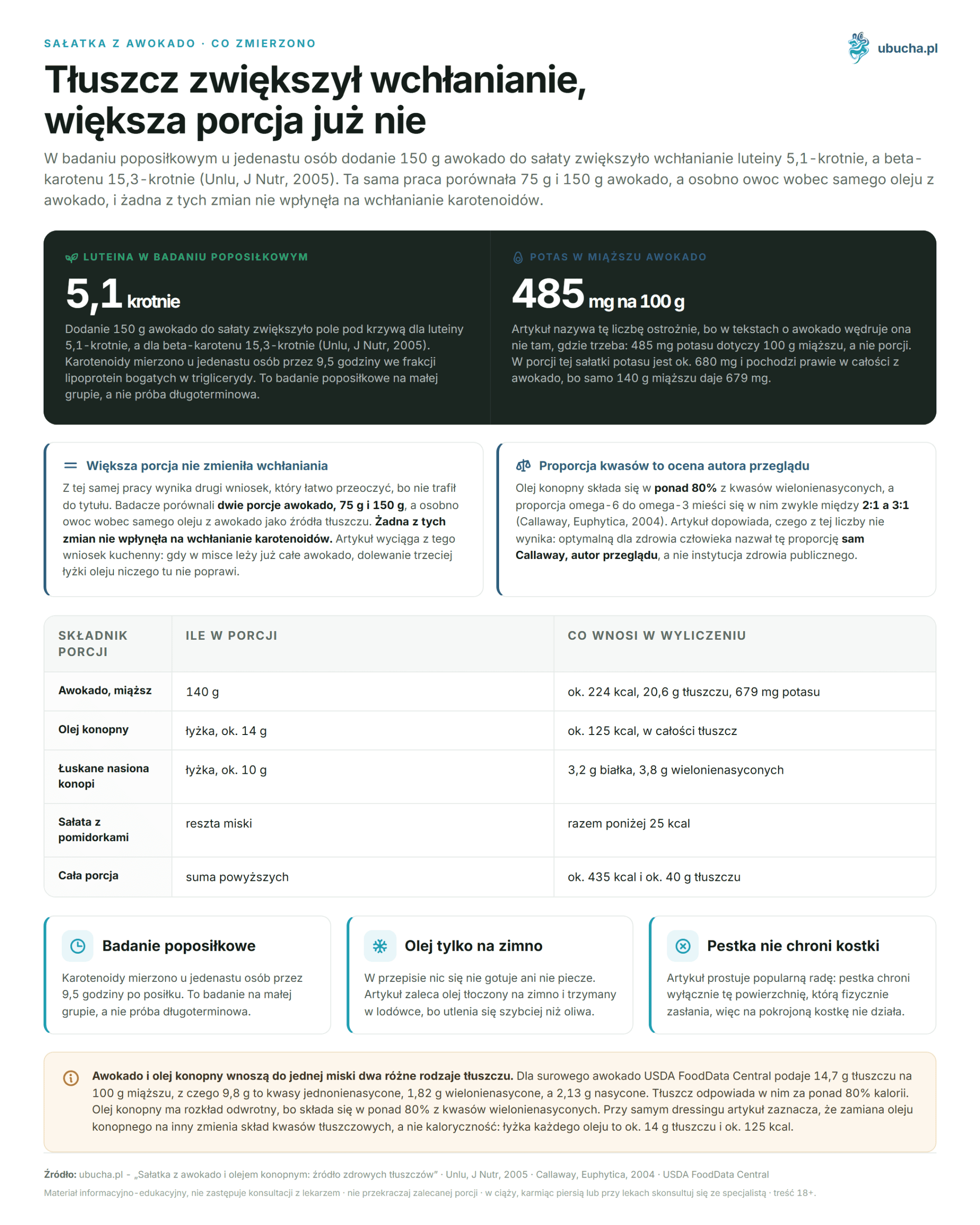
• Adding 150 g of avocado to salad increased lutein absorption 5.1-fold in eleven people (Unlu, J Nutr, 2005).
• A serving of this salad is about 435 kcal, about 40 g of fat, and about 680 mg of potassium.
What does the combination of avocado and hemp oil provide?
Two complementary fat profiles and significantly better absorption of carotenoids from vegetables. Avocado contributes monounsaturated fats, hemp oil contributes polyunsaturated fats, and each acts as a carrier for fat-soluble pigments. Without fat in the bowl, lutein and beta-carotene from the lettuce are absorbed to a minimal extent.
For raw avocado, USDA FoodData Central reports 14.7 g of fat per 100 g of flesh, of which 9.8 g is monounsaturated, 1.82 g is polyunsaturated, and 2.13 g is saturated. Fat accounts for over 80% of its calories. Hemp oil has the reverse distribution. Callaway (Euphytica, 2004) describes it as over 80% polyunsaturated oil, with an omega-6 to omega-3 ratio typically between 2:1 and 3:1. Callaway himself calls this ratio optimal for human health, but this is the author’s assessment of the review, not a recommendation from a public health institution.
The scale of benefits from fat in the salad was measured separately. Unlu et al. (Journal of Nutrition, 2005) provided eleven healthy individuals with salad without fat, and then the same salad with 150 g of avocado, and measured carotenoids in the triglyceride-rich lipoprotein fraction for 9.5 hours. The area under the curve increased 5.1-fold for lutein and 15.3-fold for beta-carotene. This postprandial study on a small group is not a long-term trial, but the difference is significant enough to translate into the kitchen: salad dressed only with vinegar yields less than it could.
The same work leads to a second conclusion that is easy to overlook because it did not make it into the title. The researchers compared two portions of avocado, 75 g and 150 g, and separately the fruit versus the oil from avocado as a source of fat. None of these changes affected carotenoid absorption. So if a whole avocado is already in the bowl, adding a third tablespoon of oil will not improve anything here. Dress to taste, not to balance.
How much fat and potassium is in one serving?
A serving consisting of one avocado, a tablespoon of hemp oil, and a tablespoon of hulled hemp seeds contains about 435 kcal, about 40 g of fat, about 7 g of protein, and about 11 g of fiber. It has about 680 mg of potassium, almost entirely from the avocado. This is not an appetizer, but a complete meal.
We calculated these numbers from the ingredients, using the composition provided by USDA FoodData Central. A tablespoon of oil is about 14 g of pure fat, which is about 125 kcal, and in this position, the type of oil does not change the caloric content. It only changes the composition of fatty acids.
The largest item is the avocado: 140 g of flesh provides about 224 kcal, 20.6 g of fat, 9.4 g of fiber, and 679 mg of potassium. A tablespoon of hulled hemp seeds, about 10 g, adds 3.2 g of protein and 3.8 g of polyunsaturated fats. Lettuce with tomatoes contributes together less than 25 kcal.
One number requires caution, as it often gets misrepresented in texts about avocado. The value of 485 mg of potassium refers to 100 g of flesh, not a serving. The whole avocado in this salad has about 680 mg.
What do you need for this salad?
Ten minutes, a sharp knife, and ten ingredients, two of which are optional. Nothing is cooked or baked here, so the quality of the avocado and oil determines the outcome more than technique. The proportions are given for two servings.
- 2 ripe avocados, about 140 g of flesh each
- 2 handfuls of salad mix or arugula, about 80 g
- 150 g of cherry tomatoes
- 2 tablespoons of cold-pressed hemp oil
- 1 tablespoon of lime or lemon juice
- 1 teaspoon of honey or maple syrup
- 2 tablespoons of hulled hemp seeds for sprinkling
- a pinch of salt and pepper
- optional: half a cucumber and thin slices of red onion
- optional: chili flakes or 1/4 teaspoon of cayenne pepper
Ripe avocados yield to gentle pressure from a finger and have skin ranging from dark green to almost black. Hard ones will ripen at room temperature in a day or two, fastest in a paper bag with an apple. Buy cold-pressed hemp oil in a dark bottle, and keep it in the fridge, as it oxidizes faster than olive oil due to its high polyunsaturated fat content.
How to prepare the avocado salad step by step?
Six actions, none of which need to be monitored for longer than a minute. The whole process takes about 10 minutes, and the only moment requiring attention is drizzling the avocado with acid right after cutting. You assemble the dressing in a jar, so you don’t need a blender or whisk.
- Choose and cut the avocado. Slice it lengthwise, twist the halves in opposite directions, and scoop out the pit with a spoon. Score the flesh into cubes inside the skin, then scoop it out with a spoon.
- Drizzle the cut avocado with lime juice immediately after cutting. The acid lowers the pH of the flesh and slows down browning, which begins upon contact with oxygen.
- Rinse and dry the salad mix, and cut the cherry tomatoes in half. If adding red onion, slice it very thinly and soak for five minutes in cold water to mellow the sharpness.
- Pour hemp oil, lime juice, and honey into a jar, add salt and pepper. Close and shake for 20 seconds. The dressing should be distinctly acidic, with a nutty background from the oil.
- On plates, lay down a layer of lettuce, place the avocado and tomatoes on top, and then drizzle everything with the dressing just before serving.
- Sprinkle each serving with a tablespoon of hulled hemp seeds and serve immediately. If taking the salad to go, transport the ingredients separately and combine them just before eating.
What variations of this salad work best?
The base of avocado and hemp dressing can withstand three variations without losing its character: Mexican, fish, and low-carb. Each changes something different, so the choice depends on what the rest of the meal is missing. The dressing remains unchanged in each of them. Below is what you change and what you gain from this change.
| Variant | What you change | What you gain |
|---|---|---|
| Mexican | add corn, black beans, and cilantro, and garlic and jalapeño to the dressing | spicier flavor and more fiber from legumes |
| With fish | layer cold-smoked salmon or gravlax on the avocado | long-chain EPA and DHA from the fish added to plant acids |
| Low-carb | omit honey, add hard-boiled eggs and olives | about 5.5 g of digestible carbohydrates instead of 8.3 g and more protein |
The same pair of ingredients served warm is described in the recipe for avocado and hemp oil toasts. The sweet-salty direction can be found in salad with pear and blue cheese, and the dressing without the fruit works in colorful vegetable salad.
Frequently Asked Questions
What fats does the avocado and hemp oil salad contain?
Avocado mainly contributes monounsaturated fats: 9.8 g per 100 g of flesh compared to 1.82 g of polyunsaturated fats (USDA FoodData Central). Hemp oil reverses these proportions, as it consists of over 80% polyunsaturated fats, with an omega-6 to omega-3 ratio typically between 2:1 and 3:1 (Callaway, Euphytica, 2004).
How many calories are in a serving of this salad?
Approx. 435 kcal, if the serving contains a whole avocado, a tablespoon of hemp oil, a tablespoon of hulled hemp seeds, lettuce, and tomatoes. The avocado alone accounts for about 224 kcal, the oil for about 125 kcal, and the seeds for about 55 kcal. The calculation is based on the composition from USDA FoodData Central.
How to prevent avocado from browning in the salad?
Drizzle the flesh with lime or lemon juice immediately after cutting, and keep the rest in a closed container. The acid lowers the pH and slows down enzymatic browning. The popular tip of keeping the pit in the container only protects the surface physically covered by the pit, so it does not work on the cut cubes.
Is this salad suitable for a ketogenic diet?
In the version without honey, yes: a serving then has about 40 g of fat, about 7 g of protein, and about 5.5 g of digestible carbohydrates after subtracting fiber. The fat accounts for over 80% of the calories. With honey, the digestible carbohydrates are about 8.3 g per serving.
Can another oil be used for the dressing instead of hemp oil?
Yes, but the fatty acid composition changes, not the caloric content. A tablespoon of any oil contains about 14 g of fat and about 125 kcal. Olive oil contributes more monounsaturated fats, while hemp oil contributes more polyunsaturated fats and a significantly better omega-6 to omega-3 ratio (Callaway, Euphytica, 2004).
Hemp teas from our offer are collected in the food category. The store at Bucha does not carry hemp oil or hulled seeds, so for the ingredients for this salad, head to the grocery store.
This article is for informational and educational purposes and does not replace consultation with a doctor. If you are pregnant, breastfeeding, taking medications, or have chronic conditions, consult the use of supplements or herbs with a specialist.
Author: Michał Waluk · Published: 2026-06-15 · Updated: 2026-08-16