
Side Effects of Cannabis Abuse - Who Must Be Aware of Increased Risk of Heart Failure?
What was really measured in studies on cannabis and the heart, who belongs to the risk group, which symptoms require urgent reaction, and how CBD alters drug effects.
Cannabis abuse has ceased to be solely a neurological topic. In 2025, a meta-analysis of 24 epidemiological studies was published in the journal Heart, linking cannabis use with a higher risk of acute coronary syndrome, stroke, and cardiovascular death. At the same time, other large analyses find no such association or find it only in people who also smoke tobacco. This discrepancy is not a data flaw but information about how uncertain the picture remains and how cautiously one must read a single press headline. Below we show exactly what was measured and in which samples, who belongs to the high-risk groups, which symptoms after cannabis require immediate reaction, how cannabinoids alter heart medication levels, and what is currently known about CBD in heart diseases. Every number has been verified in the source study.
KEY INFORMATION
• Meta-analysis of 24 studies links cannabis with a 29% higher risk of acute coronary syndrome (Storck et al., Heart 2025).
• Another meta-analysis from the same year found no significant association for myocardial infarction or stroke alone.
• In the CARDIA study, arterial calcification occurred only in people who also smoked tobacco.
• CBD inhibits liver enzymes CYP450, including CYP3A4 and CYP2C9, thus altering statin and anticoagulant levels.
Does cannabis abuse really burden the heart?
It does, but the scale is moderate and still disputed. The largest pharmacological epidemiological meta-analysis to date included 24 studies and showed a 29% higher risk of acute coronary syndrome, 20% for stroke, and more than double for cardiovascular death (Storck et al., Heart, 2025). This is a signal worth attention, not a catastrophe.
The authors provide exact values: relative risk 1.29 (95% CI 1.05-1.59) for acute coronary syndrome, 1.20 (1.13-1.26) for stroke, and 2.10 (1.29-3.42) for cardiovascular death. The review included studies published from January 2016 to January 2023, mostly cross-sectional rather than cohort studies. Analysis limited to cohorts gave a similar result, 1.32 (1.01-1.73).
In the same year, a second meta-analysis based on 17 cohort studies including 1,902,481 people observed for an average of 8.5 years was published. Its result differs: for myocardial infarction alone, relative risk was 1.25 with a confidence interval including one (0.91-1.71), for stroke alone 1.38 with interval 0.88-2.16. A statistically significant result was only the composite endpoint including all cardiovascular events, 1.48 (1.16-1.90) (Sebastian et al., Disease-a-Month, 2025).
Two meta-analyses from the same year, partially using the same data, thus give different answers regarding myocardial infarction. The reason is methodological: the first allows cross-sectional studies, the second only cohorts. Anyone looking for a simple “yes” or “no” in this text will not find it because the literature does not contain it.
It is worth keeping proportions in mind. A 20 to 30 percent risk increase sounds alarming but relates to baseline risk, which is very low in a healthy thirty-year-old woman. The same relative value in a seventy-year-old post-infarction patient translates into a real number of events. Therefore, below we separate the general population from groups where absolute risk is high and every additional percent matters.
How much has cannabis use and flower potency increased?
Two things changed simultaneously: frequency of use and THC concentration in plant material. Between 1992 and 2022, the percentage of Americans reporting daily or almost daily use increased fifteenfold, and the number of use days per capita rose by 218% between 2008 and 2022 (Caulkins, Addiction, 2024).
This study also provides another number that orders the scale of the phenomenon. In 1992, daily or almost daily alcohol consumers in the USA were ten times more numerous than cannabis consumers, 8.9 million versus 0.9 million. In 2022, for the first time, the ratio reversed: 17.7 million versus 14.7 million in favor of cannabis. People drinking alcohol are still significantly more numerous, but daily drinking occurs less often than daily smoking.
Simultaneously, raw material potency increased. Analysis of samples seized by the US DEA showed an increase in average delta-9-THC content from about 4% in 1995 to about 12% in 2014, with a simultaneous decrease in CBD content from about 0.28% to below 0.15%. The THC to CBD ratio changed from fourteenfold to about eightyfold (ElSohly et al., Biological Psychiatry, 2016). A newer analysis of the same datasets covering 2013-2022 confirms that in most samples delta-9-THC now exceeds 10%, and other cannabinoids fall below 1% (ElSohly et al., 2024).
For a physician, this means one thing. Older cardiology literature describes exposure that practically no longer exists today, so directly transferring its conclusions to contemporary users underestimates risk. More about long-term consequences of regular use can be found in the text on long-term effects of marijuana use.
What exactly did large population studies show?
They showed divergent results, and the divergence forms a clear pattern: the longer the observation and the better the tobacco control, the weaker the association. The summary below gives sample size and actual results for each study, without rounding up.
| Study | Sample and Duration | Result |
|---|---|---|
| Storck 2025, meta-analysis | 24 studies, mainly cross-sectional | ACS 1.29; stroke 1.20; CV death 2.10 |
| Sebastian 2025, meta-analysis | 17 cohorts, 1,902,481 people, 8.5 years | MI and stroke not significant; composite endpoint 1.48 |
| Kalla 2018, National Inpatient Sample | hospitalizations, age 18-55 | heart failure OR 1.10; stroke OR 1.24 |
| Ladha 2021, cross-sectional study | 33,173 adults aged 18-44 | past MI OR 2.07 with recent use |
| Corroon 2023, NHANES | 9,769 people aged 35-59 | monthly use no association with MI |
| Reis 2017, CARDIA | 5,113 people, over 25 years follow-up | no association with cardiovascular events |
| Auer 2018, CARDIA | 3,498 people, CT at year 25 | arterial calcification only in tobacco smokers |
Two rows deserve a separate sentence because they are sometimes reversed in popular reports. The CARDIA study, observing over 5,000 people for a quarter century, found no association between cumulative cannabis use and cardiovascular disease incidence, stroke, or cardiovascular death (Reis et al., Am J Public Health, 2017). A later CT analysis of the same cohort found an association with coronary and abdominal artery calcification only in people who had ever smoked tobacco, and none in never smokers (Auer et al., Addiction, 2018).
Do cannabis products increase stroke risk?
They do, though moderately and with large variability between studies. A systematic review of six observational studies including over 119 million participants showed an odds ratio of 1.14 (95% CI 1.08-1.20) for stroke in cannabis abusers, and after adjusting for tobacco and alcohol use, the risk in young adults rose to 1.21 (1.12-1.29) (Liu et al., Front Neurol, 2024).
The authors note two points often missed in summaries. Heterogeneity between studies was very high, I squared was 89%, meaning studies measured significantly different things or defined exposure differently. Subgroup analysis showed no difference between ischemic and hemorrhagic stroke, so this work does not answer the mechanism question.
The result aligns in magnitude with the Heart meta-analysis, where relative stroke risk was 1.20 (1.13-1.26), and with the National Inpatient Sample analysis, where the odds ratio for cerebrovascular incident in 18-55-year-olds was 1.24 (1.14-1.34) after adjustment for hypertension, diabetes, hyperlipidemia, coronary disease, tobacco, and alcohol (Kalla et al., J Cardiovasc Med, 2018). Three independent datasets thus give the same direction and similar strength.
The practical conclusion is inconvenient for both sides of the debate. A 20% increase is too small to speak of a threat comparable to atrial fibrillation or untreated hypertension, and too large to ignore in a person who has already had a vascular event.
Do these data prove cannabis harms the heart?
They do not prove it, and this is not a formal reservation but a real limitation. Almost all discussed studies are observational, with exposure determined by participant self-report, and the strongest confounder, tobacco smoking, co-occurs with cannabis so often that separating their effects is often impossible.
The CARDIA study illustrates this sharply. Arterial calcification appeared only in the subgroup who had ever smoked tobacco, with tobacco strongly and independently associated with calcification, and 46% of smokers reporting at least ten pack-years, while only 6% of cannabis users reported daily use. Exposures thus have very different intensity but are sometimes treated as equivalent.
Mendelian randomization provides a separate tool, using genetic variants instead of self-report and thus less prone to confounding. An analysis based on 32 loci associated with cannabis use disorder showed a causal link with large artery atherosclerotic stroke, odds ratio 1.169 (95% CI 1.030-1.328), but the association with any stroke and ischemic stroke weakened to nonsignificant in multivariable models (Dong et al., Sci Rep, 2024).
The conclusion is layered. For a narrowly defined endpoint, the causal signal persists; for a broad one, it dissipates among confounders. A text giving a single number without this context says less than it seems.
There is one more problem no statistical method can solve. Exposure in these studies was determined by frequency questions, not dose measurement. Two people reporting daily use may consume tenfold different THC amounts, in various forms and potencies. Until studies measure exposure as cardiology measures pack-years, the answer to “how harmful” will remain out of reach.
Which patient groups are most at risk?
The most vulnerable are patients with limited coronary reserve and those for whom added tachycardia disrupts fragile oxygen balance. This group includes post-infarction patients, heart failure, arrhythmias, and hypertension. The latter emerged clearly and separately in data.
In an analysis of 3,634 NHANES III participants, those who had ever used cannabis had a 43% higher chance of ECG signs of myocardial damage than never-users, odds ratio 1.43 (95% CI 1.14-1.80). In hypertensive individuals, the association was stronger than in non-hypertensives, 1.83 versus 1.17 (Skipina et al., Am J Cardiol, 2021). People with diagnosed heart disease were excluded, so this refers to subclinical damage.
| Group | Why at risk |
|---|---|
| Coronary artery disease, post-infarction | tachycardia increases oxygen demand, smoke reduces supply |
| Heart failure | increased heart workload undesirable with reduced ejection fraction |
| Arrhythmias and cardiomyopathies | sympathetic stimulation favors tachyarrhythmias |
| Hypertension | stronger association with myocardial damage signs |
| People also smoking tobacco | only subgroup with arterial calcification in CARDIA study |
| Cardiovascular polypharmacy | risk arises from metabolic interactions, not cannabis itself |
Note the last row. For a patient taking five medications, the greatest threat is not direct cannabinoid effect on the heart muscle but altered drug levels protecting the heart.
Separately, a group often omitted in risk summaries but growing fastest: people over sixty trying cannabis for the first time, usually for pain or insomnia. They combine two unfavorable features. They usually already have some cardiovascular disease and take medications, yet lack years of exposure, so they react more strongly to dose than long-term users. Added to this is the manyfold higher potency of today’s raw material compared to what was known in the seventies.
What mechanisms underlie THC cardiotoxicity?
Several mechanisms have been described, but not all have equally strong support. A review dedicated to infarctions in young users points to the best-documented tachycardia caused by CB1 receptor stimulation in circulation regulation centers and nerve endings, and increased carboxyhemoglobin in smokers (Weresa et al., Cells, 2022).
The same review states something often omitted in popular discussions. For two classic infarction mechanisms, thrombus formation and coronary artery spasm, evidence for a decisive role is scarce. The authors also emphasize that cannabis use often co-occurs with tobacco smoking, complicating effect separation.
| Mechanism | What Happens | Evidence Strength |
|---|---|---|
| Sympathetic tachycardia | CB1 stimulation raises heart rate and myocardial oxygen consumption | well documented |
| Carboxyhemoglobin | carbon monoxide from smoke displaces oxygen on hemoglobin | measured in humans |
| Impaired mitochondrial respiration | cell uses delivered oxygen less efficiently | probable |
| Thrombus formation | vessel lumen occlusion by clot | little evidence for decisive role |
| Coronary artery spasm | transient vessel narrowing without plaque | little evidence for decisive role |
The second row deserves expansion as the oldest and best-measured point on this list. In an experiment with 15 men who habitually smoked both tobacco and marijuana, smoking one marijuana cigarette raised blood carboxyhemoglobin about five times more than a tobacco cigarette, and the amount of inhaled tar was about three times greater (Wu et al., N Engl J Med, 1988). This was due not to THC content but smoking method: larger puff volume, deeper inhalation, and fourfold longer breath-holding.
How does THC affect heart rate and blood pressure?
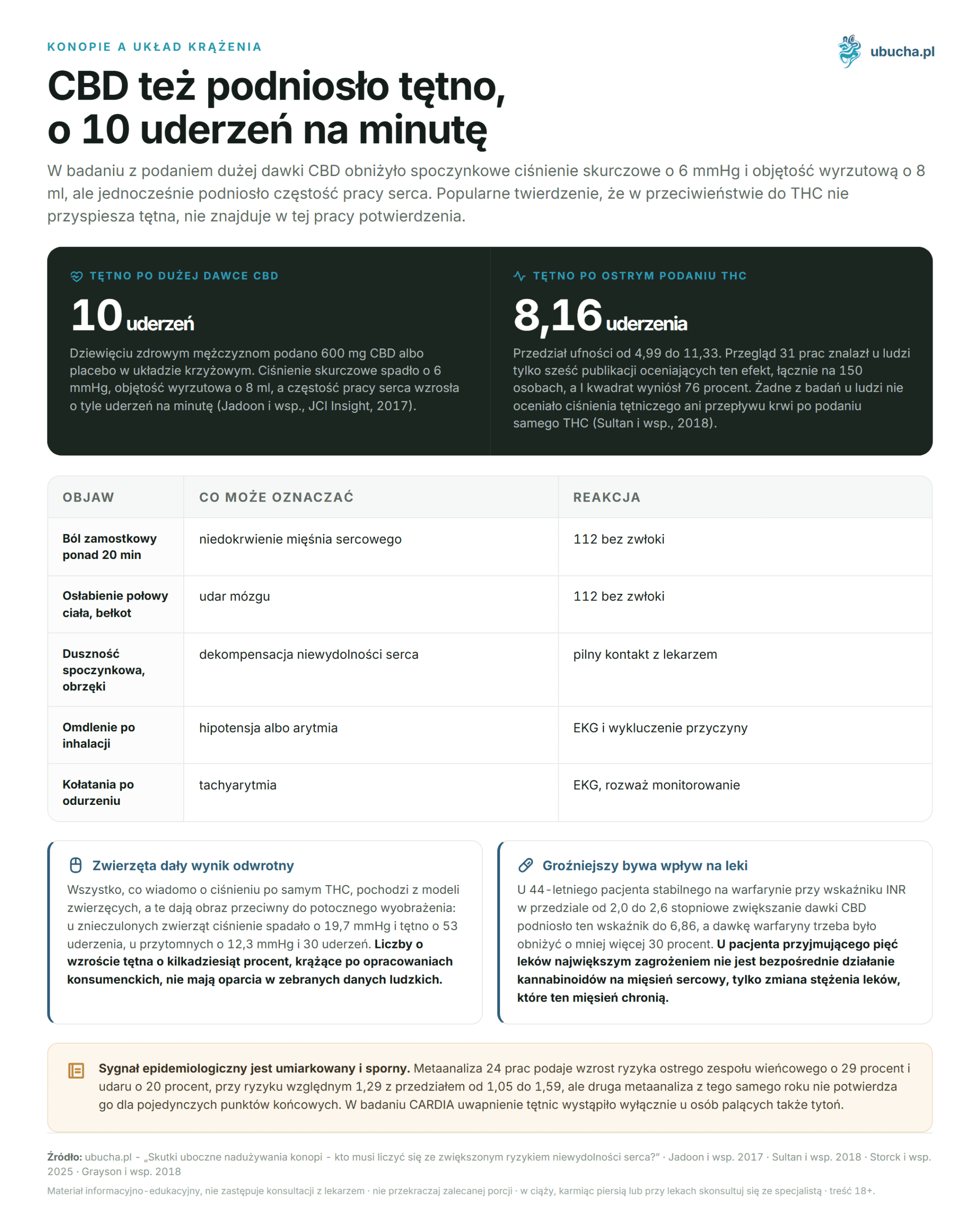
In humans, it raises heart rate, and this is practically the only hemodynamic parameter reliably measured. A systematic review of 31 studies found only six publications assessing this effect in humans, totaling 150 people. Acute THC administration raised heart rate by an average of 8.16 beats per minute (95% CI 4.99-11.33) (Sultan et al., Pharmaceuticals, 2018).
The authors explicitly note that no human studies assessed blood pressure or blood flow after THC alone. All knowledge about blood pressure comes from animal models, which give results opposite to common perception: in animals, THC lowered blood pressure and slowed heart rate, by 19.7 mmHg and 53 bpm in anesthetized, and 12.3 mmHg and 30 bpm in conscious animals.
Species discrepancy has practical consequence. Numbers like “heart rate increase of 20 to 100 percent” circulating in consumer reports lack support in human data. The average measured increase corresponds roughly to ten percent of resting adult heart rate, with large variability between studies, I squared 76%.
For a patient with coronary artery disease, even such an increase can be significant because myocardial oxygen demand rises proportionally to the product of heart rate and blood pressure. The problem is not a dramatic heart rate spike but narrow coronary reserve that tolerates no additional burden.
Which symptoms after cannabis require immediate reaction?
Symptoms of heart and brain ischemia require reaction, the same alarm signals regardless of trigger. Chest pain lasting more than twenty minutes, resting shortness of breath, fainting, and sudden neurological deficit mean calling 112 immediately, not waiting for symptoms to pass.
There are no cardiology society guidelines dedicated solely to cannabis, except the American Heart Association scientific statement from 2020 (Page et al., Circulation, 2020). The list below is thus not a protocol of any organization but a transfer of general acute ischemia management principles to the situation after cannabis exposure.
| Symptom | Possible Meaning | Action |
|---|---|---|
| Chest pain over 20 minutes | myocardial ischemia | call 112 immediately |
| Weakness on one side, drooping mouth corner, slurred speech | stroke | call 112 immediately |
| Resting shortness of breath, edema, orthopnea | heart failure decompensation | urgent doctor contact |
| Fainting after inhalation | orthostatic hypotension or arrhythmia | ECG, exclude cardiac cause |
| Palpitations persisting after intoxication | tachyarrhythmia | ECG, consider Holter monitoring |
One thing is practically more important than the whole table. Hiding cannabis exposure from the emergency team worsens diagnostic pathway because the physician differentiates among a narrower set of causes. This information does not serve patient evaluation but test selection.
It is also worth distinguishing urgent from unpleasant states. Severe anxiety, palpitations, and loss of control feeling after too high THC dose usually pass within hours and are not life-threatening, though frightening. A sign that it is not just an overdose are physical symptoms persisting after intoxication: chest pain that does not subside, resting shortness of breath, or neurological deficit. Then the cause no longer matters.
Do synthetic cannabinoids burden the heart more?
They do, and this is one of the few things measured directly. In an analysis of 3,739 patients admitted to emergency departments for poisoning, 87 had cannabinoid exposure, of whom 17 took synthetic agonists. Arrhythmias were much more frequent in this subgroup, odds ratio 9.2, and psychomotor agitation 3.8 times more frequent than after marijuana (Zaurova et al., J Med Toxicol, 2016).
The confidence interval for arrhythmias ranged from 1.0 to 108, meaning the direction is clear but effect size unknown. Age, basic blood tests, and vital signs at admission did not differ between groups.
The reason synthetics fare worse is pharmacological. Natural THC is a partial CB1 receptor agonist, so its effect has a ceiling. Many synthetic substances are full agonists with much higher affinity, stimulating the same pathway much more strongly without natural limitation. A review of infarctions in young users groups synthetic cannabimimetics with cannabis because the mechanism is the same but intensity differs.
In Polish realities, this directly relates to HHC and related substances sold as “legal substitutes.” HHC is a controlled substance in Poland, and its cardiological profile has not been studied. Treating such a product as a milder version of dried flower has no legal or pharmacological basis.
How do cannabinoids alter heart medication effects?
They do so via the liver. CBD inhibits cytochrome P450 isoenzymes, mainly CYP3A4 and CYP2C19, and interacts with P-glycoprotein responsible for drug excretion, increasing adverse effect risk in polypharmacy patients (Brown and Winterstein, 2019). A separate review lists drugs with described interactions (Balachandran et al., 2021).
The best-documented case concerns warfarin. In a 44-year-old man with Marfan syndrome and mechanical mitral valve, stable on warfarin for six months with INR 2.0-2.6, gradual CBD dose increase raised INR to 6.86. Warfarin dose had to be reduced by about 30%, and no bleeding complications occurred (Grayson et al., 2018). The report concerns one person taking CBD as medication in doses per kilogram body weight.
| Drug Group | Practical Note |
|---|---|
| Warfarin | documented INR increase, requires more frequent monitoring |
| Statins metabolized by CYP3A4 | possible exposure increase, watch for muscle pain |
| Calcium channel blockers | same pathway, risk of excessive blood pressure drop |
| Antiarrhythmics | narrow therapeutic window, decision by cardiologist |
| Renally excreted drugs | lower risk of metabolic interaction |
The same caution applies to herbs because the mechanism is identical. The most common pairs are listed in the text on herb interactions and contraindications. The “natural” label does not change pharmacokinetics: a CYP3A4 inhibitor acts the same regardless of plant extract or tablet origin.
Is medical marijuana safer than recreational?
Not by itself. Cardiovascular burden depends on administration form and dose, not whether the raw material comes from a pharmacy. Smoked pharmacy dried flower delivers carbon monoxide exactly like illegal flower because combustion products do not depend on legal status.
The difference is avoiding fire. In a pilot study with 18 healthy people, a stationary vaporizer was compared to a marijuana cigarette. THC plasma concentrations and area under the curve over 6 hours were similar in both methods, and exhaled carbon monoxide after vaporization was lower. No adverse events were reported (Abrams et al., Clin Pharmacol Ther, 2007).
Devices have also been tested. In a lab test of five vaporizers, total THC recovery ranged from 54.6% to 82.7%, and total CBD recovery from 45.9% to 70.0%, with decarboxylation efficiency above 94% for both cannabinoids. One gas-powered device, however, caused plant material combustion, which vaporization aims to avoid (Lanz et al., PLoS ONE, 2016).
The practical cardiovascular burden hierarchy is thus: lowest are oral and sublingual forms, as they do not introduce carbon monoxide or tar; vaporization is intermediate; smoking is highest, with tobacco admixture being worst due to added nicotine burdening oxygen balance.
In the Polish medical marijuana program, patients receive pharmacy dried flower with specified THC and CBD content and decide on administration method. Here lies a gap. The medical recommendation usually concerns daily dose, not technique, so two people with identical prescriptions may have very different cardiovascular burden depending on whether they vaporize or smoke a joint. If discussing pharmacy flower with a doctor, agree on administration method as carefully as dose, as it determines carbon monoxide exposure.
Does CBD protect the heart?
In experimental models, it looks promising; in humans, this has not been demonstrated. A review on CBD effects on the cardiovascular system states that in healthy volunteers and animals, the substance usually does not significantly change hemodynamic parameters, and hypotensive effects appear mainly under stress (Kicman and Toczek, Int J Mol Sci, 2020).
A single high-dose study explains why no recommendation can be made. Nine healthy men received 600 mg CBD or placebo in a crossover design. CBD lowered resting systolic blood pressure by 6 mmHg and stroke volume by 8 ml but simultaneously raised heart rate by 10 bpm (Jadoon et al., JCI Insight, 2017). The popular claim that CBD, unlike THC, does not increase heart rate is not supported by this study.
A newer 2025 review confirms the same picture. CB2 receptor activation limits infarct size and inflammation in animal models, and early clinical studies suggest endothelial function improvement, but limitations remain: small trials, short observation, and variable bioavailability. Authors state that broader clinical use requires large, rigorous studies (Urlić et al., Int J Mol Sci, 2025).
Preclinical mechanisms are described more broadly in texts on diabetic cardiomyopathy and heart ischemia and CB1 receptor. None changes the practical conclusion: CBD is not a cardiological drug and does not replace therapy.
When to see a cardiologist before using cannabis?
Before any cannabis form if you have diagnosed heart disease or take cardiovascular medications. The reason is simpler than it seems: the cardiologist sees the full medication list and knows which go through CYP3A4. The patient cannot assess this because interaction information is not on cannabis product leaflets.
Diagnoses for which consultation should precede decision include any form of coronary artery disease, post-infarction state, heart failure regardless of ejection fraction, cardiomyopathies, persistent and paroxysmal arrhythmias, poorly controlled hypertension, and after pacemaker or ICD implantation.
- Gather current medication list with doses and recent results, including ECG and echocardiogram.
- Name the reason for considering cannabis, as it determines if a safer alternative exists.
- Ask directly about administration form and if the doctor accepts any.
- Establish what and how long you monitor after starting and when to return.
- Record the decision in documentation so the next doctor does not reconstruct it from patient memory.
Situations usually resulting in refusal are also worth knowing: recent infarction, decompensated heart failure, high-risk active ventricular arrhythmias, severe uncontrolled hypertension, and therapy with many drugs metabolized by CYP3A4 and CYP2C9.
Consultation need not end in prohibition. In a stable coronary disease patient without symptoms on one hypotensive drug, the doctor may consider a trial acceptable, especially oral form and a goal that can be assessed, e.g., sleep quality. Then it is sensible to establish a baseline before starting: blood pressure and heart rate measurement for a week, ECG recording, and symptom severity note. Without such baseline, after two months no one can distinguish drug effect from normal variability.
How much CBD can be taken without risk?
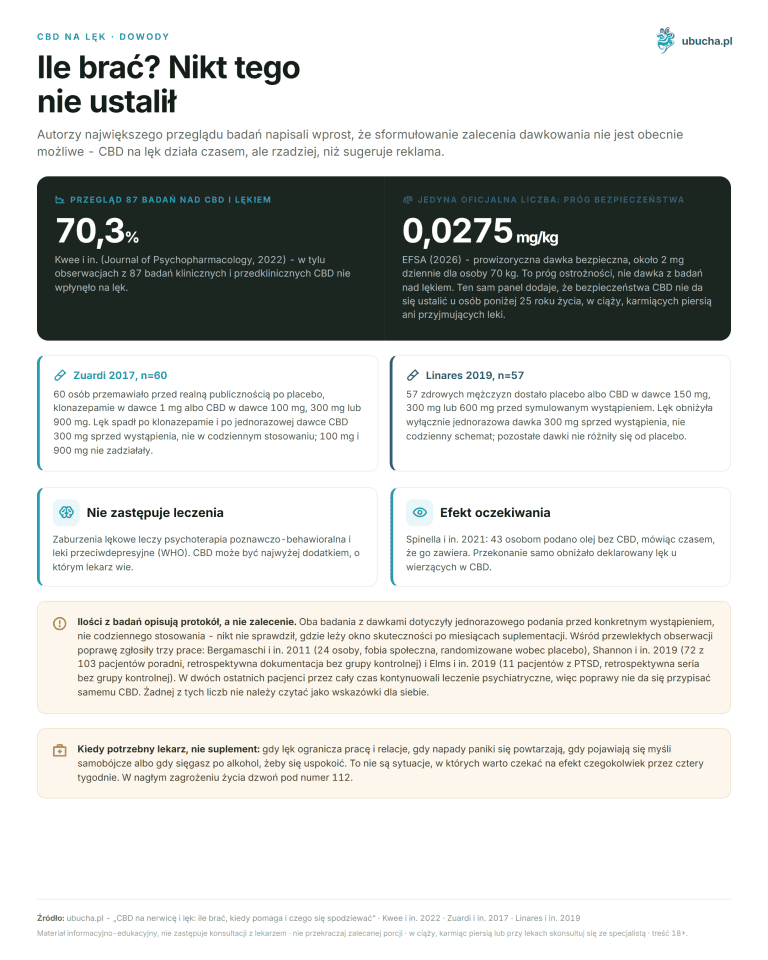
Much less than doses found on the market. The EFSA Nutrition Panel derived in 2026 a temporary safe dose of 0.0275 mg per kilogram body weight per day, about 2 mg daily for a 70 kg adult (EFSA NDA Panel, 2026). The value was obtained by benchmark dose method with uncertainty factor 400.
Reservations are as important as the number. The dose applies only to supplements with at least 98% pure CBD, without nanoparticles, safe production process, and excluded genotoxicity. It does not apply to other forms or full-spectrum extracts.
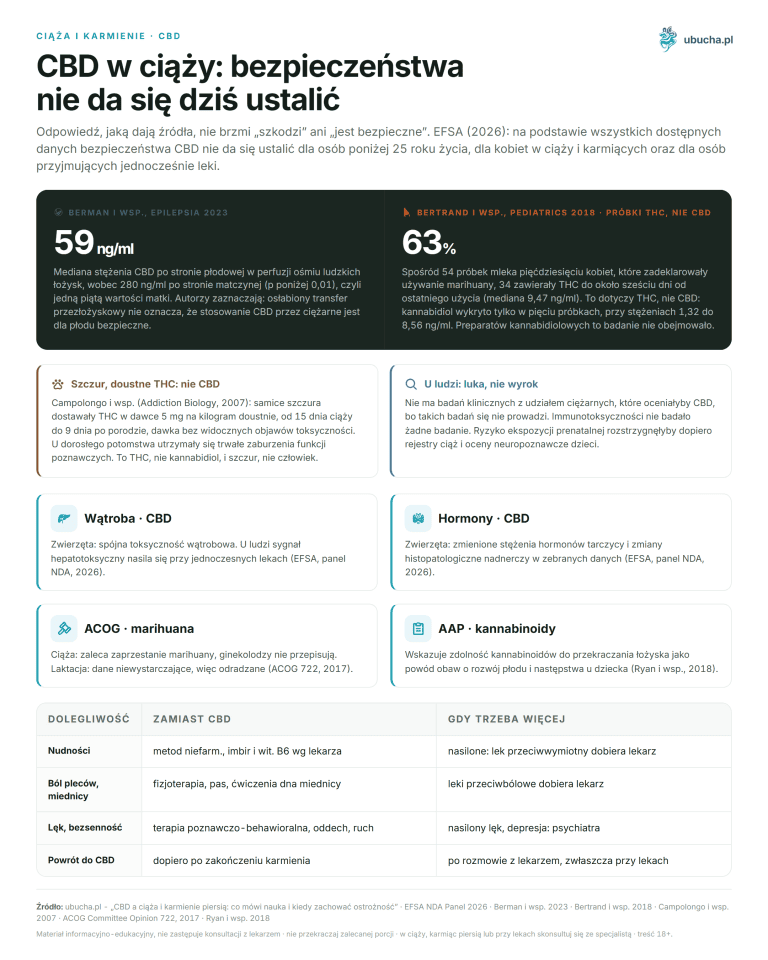
For three groups, the Panel stated safety cannot be established at all: under 25 years old, pregnant and breastfeeding women, and people taking medications simultaneously. The last group includes practically every cardiology patient. Animal studies repeatedly showed liver toxicity signals, and in humans hepatotoxic potential appeared especially with drugs.
If you still use hemp oil, choose products with current lab testing and treat them as active substances, not dietary supplements. The assortment is in the hemp oils category. Decide on starting chronic treatment together with a doctor, not after the fact.
Separately, what this temporary value does not mean. It is neither a ban nor approval of CBD as novel food but a safety assessment with conditions. It also does not say higher doses definitely harm; it says with uncertainty factor 400 they cannot be considered studied. A sanitary notification filed by a producer does not change this as it is not novel food authorization.
Frequently Asked Questions
Does smoking marijuana increase the risk of heart failure?
Data indicate a moderate increase, not a spike. In the National Inpatient Sample analysis of individuals aged 18-55, cannabis use remained an independent predictor of heart failure after adjustment for hypertension, diabetes, tobacco, and alcohol, with an odds ratio of 1.10 (95% CI 1.03-1.18). This is about a 10% increase in risk, not the several dozen percent jump sometimes cited in popular reports.
Is CBD safe for a person with coronary artery disease?
It is unknown because it has not been studied. EFSA in 2026 explicitly stated that CBD safety cannot be established in people simultaneously taking medications, and cardiology patients almost always belong to this group. A separate issue is interactions with statins and anticoagulants.
What symptoms after marijuana use require calling for help?
Chest pain lasting more than 20 minutes, resting shortness of breath, fainting, and focal stroke symptoms: drooping corner of the mouth, weakness on one side of the body, speech disturbances. In such a situation, call 112 and inform the team about cannabis exposure, as it changes differential diagnosis.
Is medical marijuana safer for the heart than recreational?
Not by itself. If pharmacy dried flower is smoked, carbon monoxide exposure remains the same as with illegal marijuana. The difference is made by the administration form, not the legal status of the raw material. In a study using a vaporizer, THC blood concentrations were comparable to smoking, but carbon monoxide levels were lower.
Does CBD affect warfarin?
Yes, and this is documented by a case report. In a 44-year-old patient on warfarin, INR rose from about 2.2 to 6.86 during CBD dose escalation, and the warfarin dose had to be reduced by approximately 30%. No bleeding complications occurred, but frequent INR monitoring was necessary.
Do cannabis products accelerate atherosclerosis?
In the CARDIA study, the association between cannabis use and coronary and abdominal artery calcification occurred only in individuals who had ever smoked tobacco. In never-tobacco smokers, no association was found after adjusting for risk factors. Tobacco itself was strongly and independently associated with calcification.
Which form of cannabis consumption is least burdensome for the heart?
Oral and sublingual forms, because they do not introduce carbon monoxide or tar into the body. Vaporization is intermediate: a pilot study with a stationary device showed comparable THC blood levels with lower carbon monoxide in exhaled air than after smoking a marijuana cigarette.
What daily CBD dose is currently considered safe?
The EFSA panel derived in 2026 a temporary safe dose of 0.0275 mg per kilogram of body weight per day, about 2 mg daily for a 70 kg person. This applies only to supplements with at least 98% pure CBD, without nanoparticles, and is much lower than doses found on the market.
What to remember about cannabis and the heart?
Three things. An epidemiological signal exists and is moderate: the 2025 meta-analysis reports a 29% increased risk of acute coronary syndrome and 20% for stroke, but another meta-analysis from the same year does not confirm it for individual endpoints. The greatest impact is from smoke, not the molecule itself, as it adds carbon monoxide to the already strained oxygen balance of a diseased heart.
Secondly, the most dangerous effect may not be cannabis on the heart but its influence on drugs protecting the heart. The INR increase to 6.86 in a warfarin patient after adding CBD illustrates this best.
Thirdly, CBD is not a cardiological drug and in 2026 there is no data to treat it as such. The EFSA temporary safe dose is about 2 mg daily for a 70 kg adult, and for people taking medications, safety is not established at all. If you seek cannabis help for sleep or pain, start with a conversation with your heart doctor, not purchase.
This article is for informational and educational purposes and does not constitute medical advice. Before starting cannabis or CBD for therapeutic purposes, consult a doctor, especially if you take other medications, are pregnant, or breastfeeding.
Author: Michał Waluk · Published: 2026-05-04 · Updated: 2026-08-10