
Stroke and Hypoxia: Neuroprotective Effects of Cannabis in Ischemia Models
Does CBD protect the brain after a stroke? What have animal models of ischemia really shown, where the limits of preclinical data lie, and what does the clinical trial registry say.
Stroke remains the second leading cause of death worldwide and the third leading cause of lost healthy life years. In 2019, there were 12.2 million new strokes, of which 7.63 million were ischemic strokes (GBD 2019 Stroke Collaborators, Lancet Neurology, 2021). Treatment in the acute phase is time-limited: intravenous thrombolysis has strong evidence of effectiveness only within a 4.5-hour window from the onset of symptoms. Hence, the long-standing search for neuroprotective substances, among which cannabidiol has made the list because it acts both as an antioxidant and anti-inflammatory, precisely where tissue damage increases after a stroke. This article shows what has been specifically demonstrated in animal models of ischemia, where researchers have misinterpreted these studies, and how far we are from application in humans.
KEY INFORMATION
• In a mouse model of middle cerebral artery occlusion, CBD reduced the area of infarction when administered both before and after ischemia (Hayakawa et al., Journal of Neurochemistry, 2007).
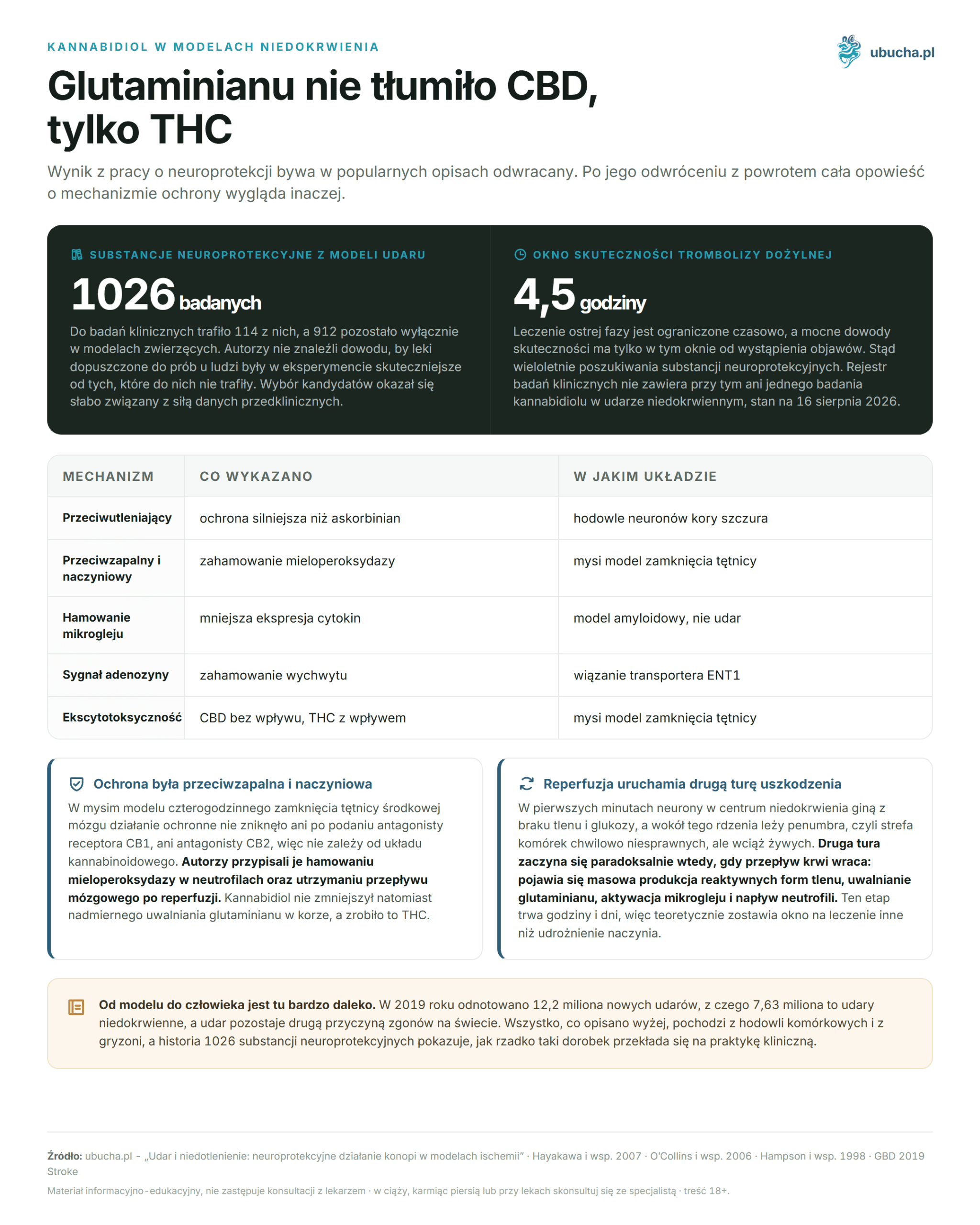
• In the same study, CBD did not affect excessive glutamate release, although THC did. The mechanism was anti-inflammatory, not anti-excitotoxic.
• The protective effect did not disappear after blocking CB1 or CB2 receptors, meaning it does not depend on the cannabinoid system.
• The ClinicalTrials.gov registry contains not a single study of cannabidiol in ischemic stroke (as of August 16, 2026).
• Of the 1026 neuroprotective substances tested in stroke models, virtually none have entered clinical practice.
What happens to the brain during ischemic stroke?
Damage occurs in two waves. In the first minutes, neurons in the center of ischemia die from lack of oxygen and glucose. Surrounding this core is the penumbra, a zone of temporarily dysfunctional but still living cells. This is the target of every acute phase intervention, and its fate determines the final neurological deficit.
The second wave paradoxically begins when blood flow returns. Reperfusion triggers mass production of reactive oxygen species, glutamate release from damaged cells, microglial activation, and influx of neutrophils into the tissue. This stage lasts hours and days, not minutes, so theoretically leaves a window for treatment other than vessel recanalization (Moskowitz et al., Neuron, 2010).
In practice, the situation is worse than this description suggests. A systematic review identified 1026 substances with demonstrated neuroprotective effects in experimental studies; 114 of them entered clinical trials, while 912 remained solely in animal models. The authors found no evidence that drugs approved for human trials were more effective in experiments than those that did not reach them (O’Collins et al., Annals of Neurology, 2006). The selection of candidates turned out to be poorly correlated with the strength of preclinical data, and this is the backdrop against which everything that follows must be read.
How does CBD act on the ischemic cascade?
Through several pathways simultaneously, and outside cannabinoid receptors. In a mouse model of four-hour middle cerebral artery occlusion, the protective effect of cannabidiol did not disappear after administration of a CB1 receptor antagonist or a CB2 antagonist. The authors attributed it to the inhibition of myeloperoxidase in neutrophils and the maintenance of cerebral blood flow after reperfusion (Hayakawa et al., Journal of Neurochemistry, 2007).
It is worth pausing at one result from this work, as it is often reversed in popular descriptions. Cannabidiol did not reduce excessive glutamate release in the cortex after vessel occlusion. THC did that instead. The claim that CBD protects the brain by suppressing excitotoxicity therefore has no basis in this experiment: the protection was anti-inflammatory and vascular.
| Mechanism | What was shown | In what system |
|---|---|---|
| Antioxidant | CBD protected neurons from glutamate toxicity more effectively than ascorbate and alpha-tocopherol; effect independent of receptors | rat cortex neuron cultures (Hampson 1998) |
| Anti-inflammatory, vascular | Inhibition of myeloperoxidase in neutrophils, fewer MPO-positive cells, preserved cerebral blood flow after reperfusion | mouse MCAO model (Hayakawa 2007) |
| Microglial inhibition | Altered calcium response and microglial migration, reduced cytokine expression in the brain | amyloid model, not ischemia (Martin-Moreno 2011) |
| Adenosine signaling enhancement | Binding to the ENT1 nucleoside transporter and inhibition of adenosine uptake; decrease in TNF-alpha reversed by A2A receptor antagonist | mouse microglia and in vivo mice (Carrier 2006) |
Two things in this table require emphasis. Hampson’s work concerns cell cultures, not a living brain with an occluded vessel (Hampson et al., PNAS, 1998). Meanwhile, the frequently cited work on microglial inhibition in stroke was conducted in an Alzheimer’s disease model, in mice given beta-amyloid intracerebroventricularly, and does not measure the area of infarction (Martin-Moreno et al., Molecular Pharmacology, 2011). We discuss it separately in our post about CBD in Alzheimer’s disease. The adenosine mechanism has been documented as a pathway for immunosuppression, not as a means of protecting neurons after a stroke (Carrier et al., PNAS, 2006).
What have animal models shown and where are their limits?
The data comes almost exclusively from the middle cerebral artery occlusion model in rodents. The results in this group are consistent: cannabidiol reduces the area of necrosis and suppresses the influx of inflammatory cells. The authors of a review of this literature note that the effect is long-lasting, independent of the CB1 receptor, and that tolerance does not develop to it (Hayakawa et al., Pharmaceuticals, 2010).
However, the limitations of this model are structural. The rodent brain has different proportions of white to gray matter and a different vascular organization than the human brain. Animals in such experiments are young and healthy, while a stroke patient usually has hypertension, diabetes, or atrial fibrillation. The timing of drug administration in the lab is known to the minute, while in an emergency department it may be uncertain.
We have noticed that in popular discussions of this topic, information about how this field looks from the results perspective is almost never mentioned. The history of clinical neuroprotection is a history of failures counted in hundreds of compounds, from glutamate receptor antagonists to free radical scavengers. Efficacy in rodents is a prerequisite in this field, not a guarantee of success, and the number 1026 substances from O’Collins’ review is the shortest summary of this. A similar discrepancy between model and clinic is described in myocardial ischemia.
Is the therapeutic window for CBD wider than for thrombolysis?
In the animal model, yes, and significantly so, but what is measured in this work is something else. Intravenous thrombolysis with alteplase has strong evidence of effectiveness within a 4.5-hour window from the onset of symptoms (European Stroke Organisation guidelines, European Stroke Journal, 2021). It saves the penumbra by recanalizing the vessel. The same guidelines allow for later treatment in patients who wake up with symptoms and have an appropriate pattern of changes on MRI, but this is an exception requiring imaging, not a shift in the window for everyone.
The study of the therapeutic window for cannabidiol, on the other hand, concerned the delayed phase, that is, the increasing damage after reperfusion. Mice were given CBD multiple times, starting on the first, third, or fifth day after artery occlusion. Groups starting treatment on the first and third days had better functional outcomes and higher survival rates; the group starting on the fifth day did not differ from controls. The effect was linked to a decrease in HMGB1 protein levels (Hayakawa et al., Biological and Pharmaceutical Bulletin, 2009).
Comparing these two windows directly is therefore misleading, though very tempting. Thrombolysis and cannabidiol address different stages of damage: the former restores flow, the latter limits the inflammatory response that follows. A fair conclusion is this: if this mechanism were confirmed in humans, it would concern patients for whom it is already too late to recanalize the vessel. This is a hypothesis worth testing, not a result.
What is the status of clinical trials?
There are none. The American clinical trial registry, queried on August 16, 2026, about cannabidiol in ischemic stroke, returns zero records. A more general query about cannabinoids and stroke returns two studies, but both concern chronic central pain, not neuron protection in the acute phase. Therefore, there is no study in this registry, completed or ongoing, on which a recommendation could be based.
This finding is worth remembering, as discussions about CBD and stroke often include a statement about “ongoing phase I and II trials.” Checked directly in the registry, there are none for this indication at all. The distance between a promising mouse model and a clinical protocol has not been bridged even in the first step in this case.
A fair summary of the state of knowledge can be written in three sentences. The biological mechanism is credible and described in peer-reviewed literature. Preclinical data is consistent, but comes from a model that has failed hundreds of times in this field. There are no clinical data, so for a person after a stroke and their family, the practical conclusion is one: any consideration of cannabidiol requires a conversation with the treating neurologist and never replaces treatment with proven efficacy.
Frequently Asked Questions
Does CBD protect the brain after a stroke?
In rodents, it reduced the area of infarction and improved functional outcomes, administered both before and after ischemia. This has not been tested in humans. Translating results from mice to patients requires exceptional caution in this field, as hundreds of effective substances in animals have failed in clinical trials.
What mechanism does CBD use for neuroprotection?
In the ischemia model, by inhibiting myeloperoxidase in neutrophils and maintaining cerebral blood flow after reperfusion. It also acts as an antioxidant in neuron cultures and enhances adenosine signaling by blocking the ENT1 transporter. The effect in the stroke model did not disappear after blocking CB1 and CB2 receptors.
Does CBD reduce excitotoxicity from glutamate?
In neuron cultures, it protected them from glutamate toxicity, but as an antioxidant, not by blocking receptors. In a living brain after artery occlusion, it did not change excessive glutamate release; THC did. The popular notion of CBD suppressing excitotoxicity in stroke is therefore an oversimplification.
Are there clinical trials for CBD in stroke?
No. The American clinical trial registry queried on August 16, 2026, about cannabidiol in ischemic stroke returns zero records. Two cannabinoid studies related to stroke concern chronic central pain, not neuroprotection. There is no approved protocol for using CBD after a stroke.
Have CBG and THC also been studied for neuroprotection?
Yes, but in different systems. THC reduced the area of infarction only when administered before ischemia, not after. Cannabigerol has been studied in Huntington’s disease models, where it limited reactive microgliosis and protected striatal neurons (Valdeolivas et al., Neurotherapeutics, 2015). This work does not cover the ischemia model. We discuss this compound further in our guide on cannabigerol.
This article is for informational and educational purposes only and does not constitute medical advice. Before starting to use cannabis or CBD for therapeutic purposes, consult with a physician, especially if you are taking other medications, are pregnant, or breastfeeding.
Author: Michał Waluk · Published: 2026-08-09 · Updated: 2026-08-16