
Gynostemma (jiaogulan): what studies say and how to drink it (FAQ)
Jiaogulan and blood sugar levels, lipids, and brewing the infusion. We check what has been measured in humans, how much herb was used in studies, and what the trials did not confirm.
Jiaogulan is sometimes called the herb of immortality, and Polish descriptions of this infusion usually promise everything at once: longevity, lower cholesterol, less stress, and better immunity. Studies involving humans say much less, but they are specific, and in one area, they are surprisingly consistent. This text shows what has been measured in humans, how much dried herb was used in clinical trials, and which of the circulating promises were directly tested and unconfirmed in those same studies. We will start with a disclaimer about the name itself: no study has tested whether drinking jiaogulan extends life, and the nickname comes from tradition, not measurement. For every number, we provide how many participants there were, how long the study lasted, and in what form the raw material was administered, because in the case of this plant, the form is a rare and beneficial one: the infusion that is bought as tea was studied.
KEY INFORMATION
• A meta-analysis from 2026 included 8 clinical studies and 584 patients; fasting blood glucose decreased on average by 0.79 mmol/l (Wang et al., Frontiers in Pharmacology, 2026).
• In a placebo trial, 24 people with type 2 diabetes drank an infusion made from 6 g of herb daily for 12 weeks (Huyen et al., Hormone and Metabolic Research, 2010).
• The same studies checked the lipid profile and did not show a difference compared to placebo. The promise of lowering cholesterol is not supported by them.
• In both trials, no hypoglycemia or adverse effects on liver and kidney parameters were reported.
• The European Medicines Agency did not include gynostemma in its herbal monograph, although it included ginseng root. The status of the list checked on August 16, 2026.
What is gynostemma and which part of the plant is used for the infusion?
Gynostemma pentaphyllum is a climbing plant from the gourd family, which also includes cucumber and melon. It grows in East and Southeast Asia. The infusion uses the herb, which is the above-ground part of the plant with leaves, not the root. This distinction is important when comparing it to ginseng, where the medicinal raw material is the root: we are talking about two different organs of two unrelated plants.
The components attributed with action are triterpenoid saponins called gypenosides. Their structural similarity to ginsenosides from ginseng is the source of the nickname “cheap ginseng.” However, chemical similarity does not equate to identical action, and the numbers circulating in commercial descriptions, claiming one hundred or one hundred seventy different gypenosides, are often given without citing a study that counted them. We do not repeat them here for this reason.
It is also worth clarifying the term “adaptogen,” which appears most frequently in descriptions of jiaogulan. It is not a pharmacological or legal category and has no regulatory definition. It is a descriptive term, so the statement “gynostemma is an adaptogen” does not carry any verifiable claim by itself. Verifiable are only specific endpoints, and that is what the rest of this text is about.
Does gynostemma lower blood sugar?
Here the data is the strongest and comes from two levels. A meta-analysis published in 2026 included 8 clinical studies and 584 patients. Fasting blood glucose decreased on average by 0.79 mmol/l (95 percent confidence interval from 1.08 to 0.51), glycated hemoglobin by 1.01 percentage points (from 1.41 to 0.61), and blood glucose two hours after a meal by 0.90 mmol/l (from 1.95 to 0.15). The authors note that better results were achieved with long-term use and self-administration, without combining with medications.
The level of individual trials looks like this. In the placebo study, 24 people with type 2 diabetes who had not previously taken antidiabetic medications participated. For 12 weeks, they drank an infusion made from 6 g of herb daily or a placebo infusion, and both groups received dietary and activity recommendations. Fasting blood glucose decreased by 3.0 mmol/l compared to 0.6 mmol/l in the control group, and glycated hemoglobin by about 2 percentage points compared to 0.2 points. The HOMA-IR insulin resistance index improved in the jiaogulan drinking group and worsened in the control group.
The second study by the same team had a crossover design: each participant underwent both phases, with a two-week washout period, and insulin sensitivity was assessed by an infusion test (Huyen et al., Journal of Nutrition and Metabolism, 2013). Fasting blood glucose was lower in the phase with jiaogulan, and the effect reversed after switching assignments, which is a strong argument for a causal relationship. The improvement occurred without a significant change in insulin concentration, so the authors explain it as an improvement in sensitivity, not increased secretion.
| Study | Who and how many participants | Preparation and duration | Result |
|---|---|---|---|
| Wang et al., 2026 | meta-analysis; 8 studies, 584 patients | various protocols | fasting blood glucose -0.79 mmol/l; glycated hemoglobin -1.01 percentage points |
| Huyen et al., 2010 | 24 people with type 2 diabetes, previously untreated pharmacologically | infusion of 6 g of herb daily for 12 weeks, compared to placebo infusion | fasting blood glucose -3.0 vs -0.6 mmol/l; lipids no difference |
| Huyen et al., 2013 | people with type 2 diabetes, crossover design | infusion of 6 g of herb daily for 4 weeks, 2-week washout | fasting blood glucose -1.9 vs -0.2 mmol/l; lipids unchanged |
Does gynostemma improve the lipid profile?
There is no evidence for this, and the contrary claim is often repeated in Polish descriptions as fact. It is decisive that both clinical trials described above measured the lipid profile and did not show an effect. In the first, the authors list lipids alongside glucagon, cortisol, anthropometric measurements, and blood pressure as parameters that did not differ between groups. In the second, no changes in lipids, body measurements, and blood pressure were noted.
This is a situation where the source does not just fail to confirm the promise but directly refutes it. The studies cited in texts promising a reduction in cholesterol and triglycerides are the same studies that measured these parameters and found no effect. We did not find comparisons of jiaogulan to statins in any study we could access, and attributing the plant with effectiveness comparable to a cholesterol-lowering drug is a claim that requires a study with such a comparison.
A fair summary, therefore, is narrow: jiaogulan has repeatable data concerning carbohydrate metabolism and no data confirming action on lipids. The distinction between these two areas is also discussed in relation to alpha-lipoic acid, where similar discrepancies between promise and endpoint also occur.
How much herb was used in studies and how to brew jiaogulan?
In both described clinical trials, participants prepared an infusion from 6 g of dried herb per day. This is the number from the study protocol, not a portion recommended to the reader: how much and whether to drink at all is determined by the physician, especially in cases of diabetes and when taking medications. It is worth noting that the studies were conducted on an infusion of the herb, which is the same form that is bought as tea. This is a rare situation, as for most plants, the data comes from standardized extracts, and conclusions are then transferred to dried herbs without basis.
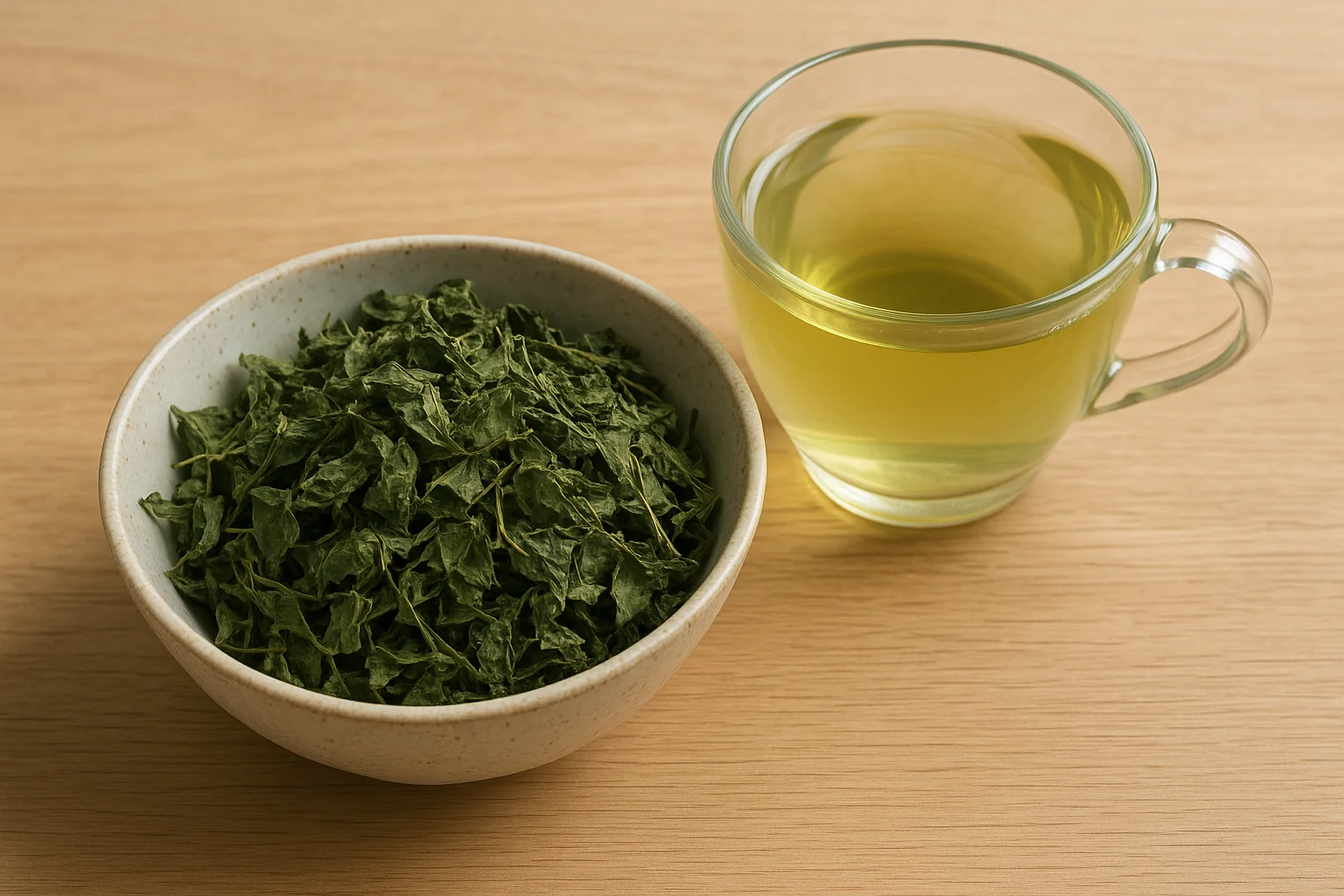
From a culinary perspective, preparing the infusion looks ordinary. Dried herb is poured with hot water, but not boiling, and left covered for a few minutes. Jiaogulan tolerates re-steeping well, so additional infusions can be made from the same portion of herb. The taste is mild, slightly sweet, and grassy, without the bitterness typical of strongly brewed green tea, which is sometimes an argument for drinking it without additives. Other herbal infusions, such as hibiscus, are prepared in the same way.
Separately, it is worth mentioning the safety of what was measured. In both trials, no hypoglycemia or adverse effects on liver, kidney, and gastrointestinal parameters were reported. This finding pertains to the infusion of the herb used for four to twelve weeks in adults, and not to concentrated extracts with unknown gypenoside content, which were not used in these studies.
Does gynostemma have a monograph and how does it compare to ginseng?
No. We checked the list of raw materials evaluated by the Committee for Herbal Medicinal Products on August 16, 2026, and gynostemma is not on it. Ginseng root is listed with a completed evaluation and a therapeutic area defined as fatigue and weakness. The comparison of both plants, so eagerly made in commercial descriptions, has a dimension that these descriptions do not mention: one of them has a completed European evaluation and an assigned indication, while the other has none at all.
The lack of a monograph does not mean that the plant is ineffective or unsafe. It means that there is no document that records the permissible duration of use, the lower age limit, or a record regarding pregnancy and breastfeeding. In the case of jiaogulan, the absence of the latter point has practical significance, as data on safety during pregnancy and breastfeeding are too sparse to make any determinations based on them. The trials described above were conducted in adults with type 2 diabetes and did not include pregnant women, children, or adolescents.
It is worth drawing a more general conclusion than just about jiaogulan. The presence or absence of a raw material on this list does not organize the supplement market, as herbs sold in Europe are foodstuffs regardless of whether the committee has evaluated them. The list does indicate where there is an agreed reference point that a pharmacist can refer to when asked by a patient about the duration of use or about pregnancy. With gynostemma, there is no such point, and this must be stated clearly, instead of replacing it with an assurance of centuries-old tradition.
Frequently Asked Questions
Does gynostemma lower blood sugar?
A meta-analysis of eight studies involving 584 patients showed a reduction in fasting blood glucose by an average of 0.79 mmol/l and glycated hemoglobin by 1.01 percentage points. In the placebo trial, an infusion of 6 g of herb daily for 12 weeks reduced fasting blood glucose by 3.0 mmol/l compared to 0.6 in the control group.
Does jiaogulan lower cholesterol?
There is no evidence for this. Both clinical trials cited for such claims measured the lipid profile and showed no difference compared to the control group. We did not find comparisons of the effectiveness of jiaogulan with statins in any available study.
How much herb was used in clinical studies?
In both trials, participants drank an infusion made from 6 g of dried herb per day for four to twelve weeks. This is the number from the study protocol, not a portion recommended to the reader. In cases of diabetes and when taking medications, the decision is made by the attending physician.
Is gynostemma safe?
In both described trials, no hypoglycemia or adverse effects on liver, kidney, and gastrointestinal parameters were reported. This finding pertains to the infusion of the herb in adults and does not include concentrated extracts, pregnancy, breastfeeding, or children.
Does jiaogulan really extend life?
No study has tested this. The nickname “herb of immortality” comes from tradition and reports of longevity among residents of regions where the plant is popular, not from measurement. Repeated data concern carbohydrate metabolism, not lifespan.
Does gynostemma have a monograph from the European Medicines Agency?
No. The list of raw materials evaluated by the committee for herbal medicinal products checked on August 16, 2026, does not include gynostemma, although it does include ginseng root. Therefore, there is no agreed European usage time or record regarding pregnancy and breastfeeding.
In the store at Bucha, there is no jiaogulan. Herbal and cannabis infusions can be found in the teas category, and extracts and plant dried goods in the herbs category. Stock status as of August 16, 2026.
This article is for informational and educational purposes and does not constitute medical advice. Before starting supplementation, consult your doctor, especially if you are taking medications regularly, are pregnant or breastfeeding, or have chronic illnesses.
Author: Michał Waluk · Published: 2026-08-09 · Updated: 2026-08-16