Vitamin C in gummies: does it work the same as tablets and how much to take daily
A 1000 mg gummy performed the same as a tablet in a study with 30 participants. Check EFSA standards, absorption limits, kidney stone risk, and the sugar trap.
The gummy tastes like candy, so it’s easy to treat it like candy. Meanwhile, it is a supplement, and the question of its effectiveness boils down to two things. Does vitamin C escape from the gelatin matrix? And does the number of milligrams on the label make sense against nutritional standards? The first is answered by a randomized crossover study in which thirty adults took 1000 mg of vitamin C once in a gummy and once in a tablet. The second is answered by EFSA tables and Polish standards, which provide numbers much lower than those suggested by the supplement shelf. Below you will find both, along with what manufacturers do not write on the packaging: what happens to vitamin C during storage, how an acidic gummy affects enamel, and at what dose the risk of kidney stones increases.
KEY INFORMATION
• Gummy 1000 mg and tablet 1000 mg gave the same absorption profile in 30 adults (Evans et al., J Am Coll Nutr, 2020).
• EFSA standards are 110 mg per day for men and 95 mg for women. Polish standards state 90 mg and 75 mg.
• Above 200 mg in one portion, absorption ceases to be complete, and excess goes to urine (Levine et al., PNAS, 1996).
• In studies in the general population, vitamin C did not reduce the number of colds, shortening them by 8 percent in adults (Cochrane, 10,708 people).
• In men, intake above 1000 mg per day was associated with a 43 percent higher risk of kidney stones.
Does vitamin C from gummies absorb the same as from tablets?
Yes. Thirty healthy adults took 1000 mg of vitamin C twice, in random order: once in a gummy and once in a tablet. The area under the plasma concentration curve calculated over 24 hours did not differ between forms, nor did urinary excretion and concentration in leukocytes (Evans et al., J Am Coll Nutr, 2020).
Two differences were statistically significant, both secondary. The tablet produced a higher peak concentration in plasma, although numerically small. The gummy needed more time for the vitamin to reach white blood cells. The total amount that entered the body was not changed by either of these differences, and the authors considered both forms bioequivalent.
A caveat worth knowing: one specific gummy preparation was tested against one specific tablet, in a group of healthy individuals of average body weight. This is the only study we could find in the literature databases directly comparing these two forms in humans. Therefore, there is no basis for attributing an advantage to gummies over tablets or vice versa.
However, we noticed an underrated detail. The release of vitamin depends on how you chew. In an experiment with a chewing robot, the amount of vitamin C released from the gummy increased with the force and number of chews, and decreased with the gelatin content, i.e., with the hardness of the cube: as the gelatin content increased from 3 to 12 percent, hardness increased from 91.7 to 198.8 newtons (Zhou et al., J Food Sci Technol, 2022). Swallowing a whole gummy is not the same as chewing it.
Does vitamin C still absorb above 200 mg?
No, not completely. The intestinal transporter that carries ascorbic acid across the intestinal wall has limited capacity. Seven volunteers spent four to six months in the hospital on a diet providing less than 5 mg of vitamin C, taking doses from 30 to 2500 mg per day. At 200 mg in one portion, absorption was complete. At 500 mg, it began to decline, and the absorbed excess went straight to urine (Levine et al., PNAS, 1996).
Two other numbers from the same study clarify the rest. Neutrophils, monocytes, and lymphocytes were saturated at 100 mg per day and maintained concentrations at least fourteen times higher than plasma. Plasma itself was saturated only at 1000 mg. The authors concluded that the recommended intake should be 200 mg per day and added directly that doses above 400 mg per day do not provide visible benefits.
Polish nutritional standards provide the same relationship in daily terms: with an intake of 30 to 180 mg per day, about 70 to 90 percent of vitamin is absorbed, and with doses exceeding 1000 mg per day, only half (NIZP-PZH, 2020).
For gummies, the conclusion is inconvenient. A gummy with 500 mg does not deliver five times more to the blood than a gummy with 100 mg, because part of the portion flows through the body and ends up in urine. If you are taking a larger portion, splitting it into two moments of the day is physiologically more sensible than eating it all at once.
How much vitamin C do the standards predict daily?
EFSA has established a recommended intake of 110 mg per day for adult men and 95 mg for women. During pregnancy, the standard is 105 mg, while breastfeeding is 155 mg (EFSA, reference value tables). Polish standards are lower: 90 mg for men and 75 mg for women, 85 mg during pregnancy and 120 mg while breastfeeding.
Smokers have a higher requirement. Polish standards recommend about 35 mg more vitamin C per day for them, and in the section on requirements, they add that to achieve comparable plasma concentrations, a smoker needs about 40 percent more than a non-smoker.
The number 2000 mg, which is seen on labels as the “upper safe limit,” remains. EFSA has not established such a limit: in its summary of tolerable upper intake levels for vitamin C, there is a note about insufficient data (EFSA, UL levels). The number 2000 mg comes from American standards, while Polish standards are more cautious and assume that a safe dose does not exceed 1000 mg per day. We have gathered which ingredients have a designated upper limit and where it lies in the guide to upper intake limits.
The market is going in a different direction. An analysis of 106 vitamin C preparations sold in Germany and the USA found an average daily dose of 613.9 mg. More than three-quarters of products exceeded the recommended intake, and nearly 40 percent exceeded the level that the authors considered a possible safety limit (Decke and Seifert, Naunyn Schmiedebergs Arch Pharmacol, 2025).
How much vitamin C really remains in a gummy?
Less than the label states, and the scale of this loss has not been measured on products from the Polish market. Ascorbic acid degrades under the influence of oxygen, moisture, light, and heat, and the gummy is a water matrix that is heated during production. In an accelerated storage test, unprotected vitamin C in a gummy retained 79 percent of its content after ten weeks, while that enclosed in a casein gel retained 92 percent (Yan et al., Food Hydrocolloids, 2021).
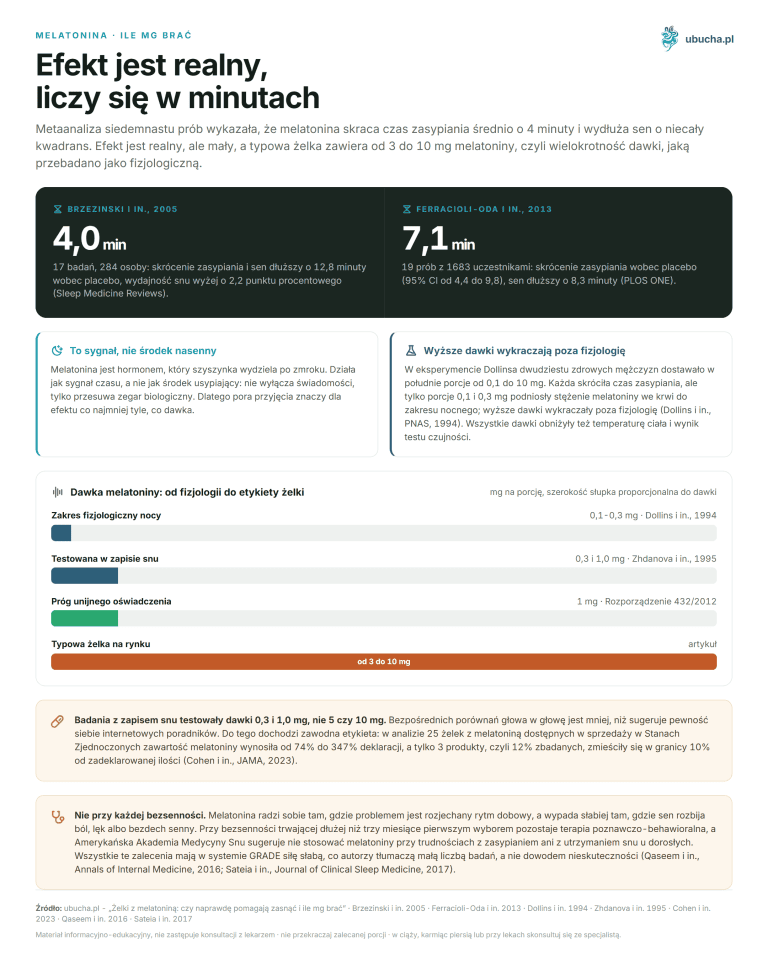
We did not find a published analysis comparing the declared and actual vitamin C content in commercial gummies. The closest evidence pertains to another substance in the same form. Of 25 gummies with melatonin purchased in the USA, 22 had labels inconsistent with their content. Where melatonin was present, it ranged from 74 to 347 percent of the declaration, and one product contained none at all but had 31.3 mg of cannabidiol (Cohen et al., JAMA, 2023). The production format is the same, so caution regarding the number on the package is justified. We described this category separately in the text about melatonin gummies.
Practically, this means that the minimum durability date is not a formality, and gummies stored above the oven or in the car lose their potency faster. Keep the package closed, away from sunlight, and do not buy a year’s supply.
Do sugar and acidity in gummies harm teeth?
With one or two pieces a day, the problem is not calories, but enamel. A gummy usually weighs about three grams, sticks to the surface of the teeth, and most of that mass is a sugar or polyol carrier. Ascorbic acid adds to this low pH, and the sum of these two factors acts longer than a swallowed tablet.
The literature describes a case of a patient with extensive wear and enamel erosion after prolonged overuse of chewable vitamin C tablets. The authors state directly that patients should be informed about the erosive nature of such preparations (Bahal and Djemal, Case Reports in Dentistry, 2014). This is a single case report, not a population study, and pertains to chewable tablets, not gummies. However, the mechanism is the same and well documented in dentistry.
What to do about it without giving up gummies? After eating, rinse your mouth with water and wait about 30 minutes before brushing, just like after an acidic drink, because brushing immediately scrapes softened enamel. On the label, check the line “of which sugars”: between products based on fruit puree and those based on glucose syrup, the difference can be several times. With braces and a tendency to cavities, a swallowable tablet is simply safer.
Does vitamin C protect against colds?
In the general population, no. A Cochrane review gathered 29 comparisons involving a total of 11,306 participants who regularly took at least 200 mg of vitamin C. In studies conducted in the general population, involving 10,708 people, the risk of illness was 0.97 compared to placebo, with a confidence interval from 0.94 to 1.00 (Hemilä and Chalker, Cochrane, 2013). The number of colds did not change.
What changed was the duration of the infection. Thirty-one comparisons covered 9,745 episodes: regular supplementation shortened them by 8 percent in adults, ranging from 3 to 12 percent, and by 14 percent in children, ranging from 7 to 21 percent. In children, a dose of 1 to 2 grams per day shortened a cold by 18 percent. In a seven-day infection in an adult, eight percent gives about half a day. The severity of symptoms also decreased.
There is one exception worth knowing. Five studies included a total of 598 marathon runners, skiers, and soldiers exercising in subarctic conditions. In this group, the risk of catching a cold was 0.48 compared to placebo, with a range from 0.35 to 0.64, meaning it dropped by about half. This concerns extreme physical exertion in the cold, not running twice a week. Polish standards mention the same group alongside the elderly and smokers. They also add individuals with very low plasma vitamin C levels.
Taking vitamin C only after symptoms appear did not yield consistent effects in seven comparisons involving 3,249 episodes. Meanwhile, 80 percent of vitamin C preparations advertise with the slogan of supporting immunity, as shown by the aforementioned market analysis. Gummies are no exception.
Do high doses of vitamin C increase the risk of kidney stones?
In men, yes, although this is an observational study, so it shows a correlation, not causation. It involved 40,536 men and 156,735 women, observed for a median of 11.3 to 11.7 years; during this time, 6,245 cases of kidney stones were recorded. In men, total vitamin C intake above 1000 mg per day was associated with a 43 percent higher risk compared to intake below 90 mg (Ferraro et al., Am J Kidney Dis, 2016).
The signal appeared even lower. An intake of 500 to 999 mg per day indicated a 29 percent higher risk in men, and supplementation from 1000 mg and above indicated a 19 percent higher risk. In women, none of the intake ranges studied were significantly associated with kidney stones. Vitamin C from food showed no association with risk in either sex, but the authors note that few people derive more than 700 mg daily from diet alone, so this observation does not cover the upper range.
The mechanism is known: part of ascorbic acid converts to oxalates, which form deposits with calcium. Polish standards state that this concerns about 1.5 percent of the consumed amount, excreted in urine within a day. In the aforementioned 1996 study, the excretion of oxalates and urates increased at a dose of 1000 mg per day compared to lower doses. The practical conclusion mainly concerns men after a stone episode: a gummy with 1000 mg is a bad idea for them, while bell peppers and currants do not pose a problem.
Does liposomal vitamin C offer an advantage over gummies?
In measurements, yes, but the evidence is thinner than the price suggests. A scope review filtered 321 studies and qualified ten. Nine of them showed higher bioavailability of the liposomal form: peak concentrations higher from 1.2 to 5.4 times and area under the curve higher from 1.3 to 7.2 times (Carr, Basic Clin Pharmacol Toxicol, 2025).
The author immediately cools the enthusiasm. Preparations and doses varied drastically, from 0.15 to 10 grams, and the sampling time ranged from 4 to 24 hours, so the studies cannot be directly compared. None measured excretion, so it is unknown whether higher plasma concentration means more vitamin retained in the body or just more on the way to urine. Cellular uptake was checked in two studies, and biological effects in two as well.
With a dose of around 100 to 200 mg, you are in the range where a regular tablet and a regular gummy absorb almost completely. There is no room for improvement worth paying extra for. The same question about paying extra for the liposomal form is raised in the text about liposomal CBD.
When does a gummy make sense, and when is a tablet better?
A gummy wins where swallowing or maintaining regularity is an obstacle. A tablet wins where price per milligram, lack of sugar, and high dose in one piece matter. The effectiveness of absorption in this choice does not decide, as both forms performed the same in the study.
| Criterion | Gummy | Tablet or capsule |
|---|---|---|
| Absorption at 1000 mg | same area under the curve | same, higher peak concentration |
| Difficulty swallowing | advantage | barrier |
| Sugar contact with enamel | present, gummy sticks | none when swallowed |
| Dose per piece | usually several dozen mg | up to 1000 mg |
| Cost per milligram | higher | lower |
| Storage durability | worse, water matrix | better |
Before reaching for a package, calculate the daily portion, not the content of one piece. If the manufacturer recommends two gummies of 40 mg, you get 80 mg, which is roughly the Polish standard for women. In addition, there is the diet, and red bell pepper, black currant, and parsley provide more vitamin C than many supplements. We described the comparison of vitamin forms more broadly in the post about vitamin gummies with melatonin, B12, C, and D3.
Frequently asked questions
Do vitamin C gummies work the same as tablets?
Yes. In the only published comparative study, 30 adults took 1000 mg of vitamin C once in a gummy and once in a tablet. The area under the plasma concentration curve over 24 hours and urinary excretion did not differ between forms, and the authors considered the preparations bioequivalent (Evans et al., J Am Coll Nutr, 2020).
How much vitamin C should a gummy contain?
Standards do not refer to a single piece, but to daily intake. EFSA states 110 mg per day for men and 95 mg for women, while Polish standards are 90 mg and 75 mg respectively. The portion of gummies counted together with the diet should fall within this range.
When is the best time to take vitamin C gummies?
Splitting the dose into two smaller ones has a physiological basis: at 200 mg in one portion, absorption is complete, starting to decline at 500 mg, and excess goes into urine (Levine et al., PNAS, 1996). After taking a gummy, rinse your mouth with water and wait about 30 minutes before brushing your teeth.
Does vitamin C from gummies protect against colds?
In the general population, no. In a Cochrane review, the risk of illness in studies conducted in the general population, involving 10,708 people, was 0.97 compared to placebo. The duration of infection was reduced by 8 percent in adults and 14 percent in children. An exception is made for individuals after extreme exertion in the cold (Hemilä and Chalker, 2013).
Can you overdose on vitamin C from gummies?
EFSA has not established a tolerable upper intake level for vitamin C due to insufficient data. The circulating limit of 2000 mg comes from American standards. Polish standards assume that a safe dose does not exceed 1000 mg per day, and higher doses cause gastrointestinal symptoms.
Is sugar in vitamin C gummies a problem?
With one or two pieces a day, the sugar load is small, but the risk concerns enamel, not calories. The gummy sticks to the teeth, and ascorbic acid lowers pH. A case of extensive enamel erosion after overusing chewable vitamin C tablets has been described (Bahal and Djemal, Case Reports in Dentistry, 2014).
Preparations in this form, including vitamin ones, have been gathered in the category of gummies, while other forms can be found among supplements.
This article is for informational and educational purposes and does not constitute medical advice. Before starting supplementation, consult your doctor, especially if you are taking medications regularly, are pregnant or breastfeeding, or have chronic illnesses.
Author: Michał Waluk · Published: 2026-06-08 · Updated: 2026-08-15