
Glucomannan for Satiety and Weight: What Has Been Approved in the EU and What Studies Say
The EU claim about glucomannan exists and has strict conditions. However, a meta-analysis of eight randomized studies did not confirm significant weight loss.
Glucomannan is one of the few ingredients in supplements for which there is an approved health claim regarding its impact on body weight in the EU. This is true and can be verified in a few minutes. It is also true that there is something that advertisements do not mention: the approval of the claim is a decision about the allowed wording on the label, not a statement about the strength of the effect. When we move from regulation to randomized studies, the picture becomes much more restrained, and the latest meta-analysis involving only overweight and obese individuals ends with a confidence interval that includes zero. Below, we separate these two layers: what exactly has been approved, under what conditions, and with what mandatory warning, and separately what has actually been measured in people and with what precision.
KEY INFORMATION
• The glucomannan and weight loss claim was approved by the European Commission under Regulation (EU) No 432/2012, based on the EFSA opinion from 2010; it states, \”As part of a low-calorie diet, glucomannan helps with weight loss\”.
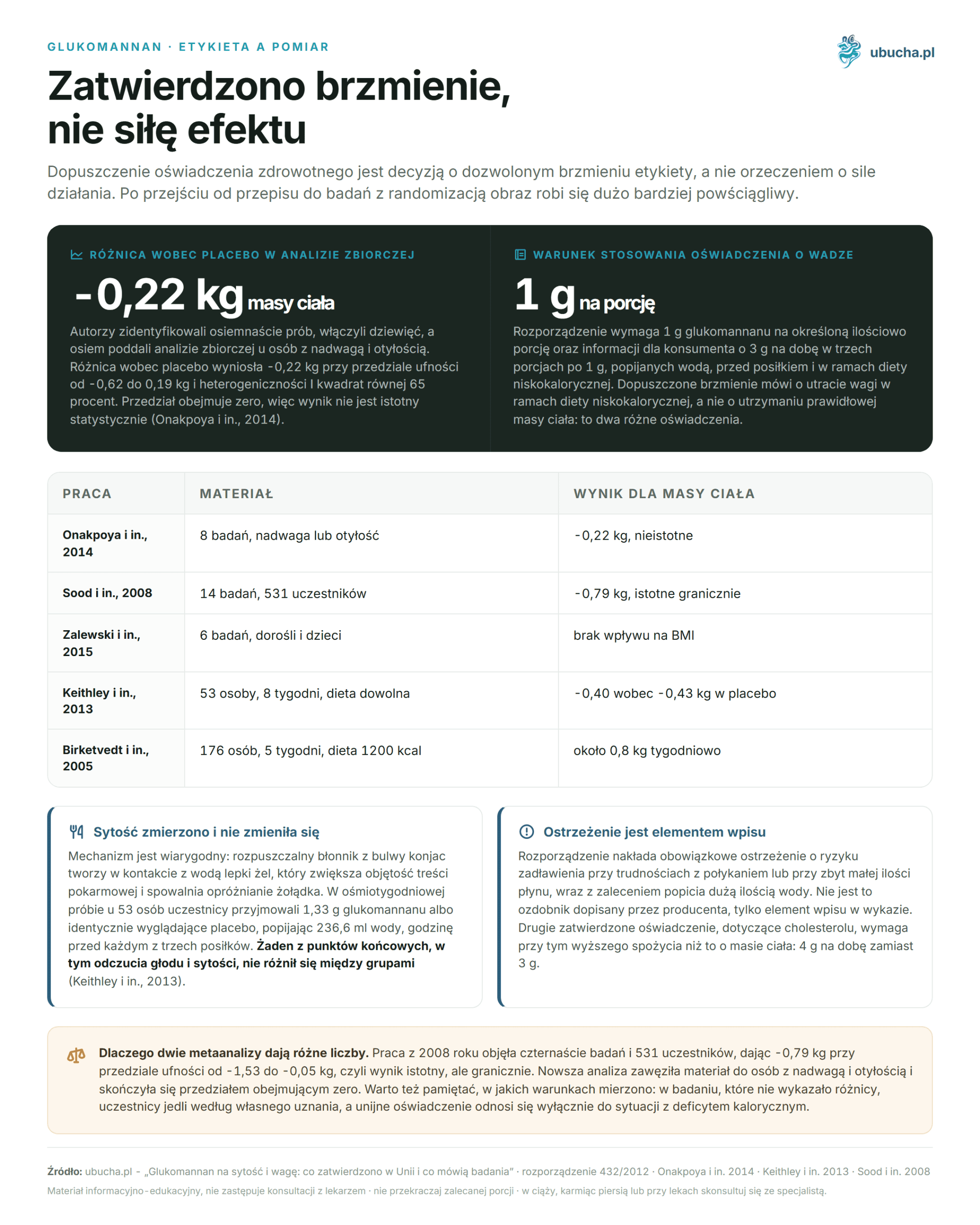
• The condition for using this claim is 1 g of glucomannan per portion and information for the consumer about 3 g per day in three portions of 1 g, with 1 or 2 glasses of water, before meals, and as part of a low-calorie diet.
• The regulation imposes a mandatory warning about the risk of choking in cases of swallowing difficulties or insufficient fluid intake.
• A meta-analysis of eight randomized studies in overweight and obese individuals showed a difference of -0.22 kg compared to placebo, with a confidence interval from -0.62 to 0.19 kg, which includes zero (Onakpoya et al., 2014).
• The second approved claim concerns cholesterol and requires higher intake: 4 g per day.
What Exactly Has Been Approved in the EU and Who Did It?
The list of approved health claims other than those related to disease risk reduction is established by Commission Regulation (EU) No 432/2012. It is the European Commission that approves the claim for marketing; EFSA issues a scientific opinion beforehand, which forms the basis for this decision, but does not itself grant the approval. For glucomannan, this opinion is EFSA Journal 2010;8(10):1798, concerning konjac mannan and weight loss.
In the annex to the regulation, glucomannan appears twice. We checked both entries in the consolidated text of the regulation, in the Polish version from May 17, 2021, available in the EUR-Lex database. Below is the wording and conditions of both.
| Entry Element | Weight Loss Claim | Cholesterol Claim |
|---|---|---|
| Approved Wording | “As part of a low-calorie diet, glucomannan helps with weight loss” | “Glucomannan helps maintain normal blood cholesterol levels” |
| Food Condition | 1 g of glucomannan per specified portion | food providing 4 g per day |
| Mandatory Consumer Information | 3 g per day in three portions of 1 g, with 1 or 2 glasses of water, before meals, as part of a low-calorie diet | beneficial effect occurs with 4 g per day |
| Mandatory Warning | risk of choking in cases of swallowing difficulties or insufficient fluid; recommendation to drink plenty of water | identical |
| Scientific Basis Indicated in the List | EFSA Journal 2010;8(10):1798 | EFSA Journal 2009;7(9):1258 and 2010;8(10):1798 |
Three things are worth remembering from this table. First, the approved wording refers to weight loss as part of a low-calorie diet, not to maintaining normal body weight; these are two different claims, and confusing them is a mistake. Second, the cholesterol claim requires higher intake than the weight loss claim. Third, the choking warning is not an embellishment but a required element of the entry in the regulation.
How Does Glucomannan Work and What Has Been Measured?
Glucomannan is a soluble fiber from the konjac tuber, directly referred to in the EU list as “glucomannan (konjac mannan)”. In contact with water, it forms a viscous gel that increases the volume of food content and slows gastric emptying. This is the same principle that underlies other soluble fibers; we describe it in more detail in the text about psyllium for intestines and cholesterol.
The mechanism is credible, but it does not exempt us from the question of whether the feeling of satiety actually changes. This has been measured. In an eight-week randomized trial involving 53 individuals with a BMI from 25 to 35, participants took 1.33 g of glucomannan or an identical-looking placebo, drinking 236.6 ml of water one hour before each of the three meals. Besides body weight, body composition and feelings of hunger and satiety were assessed. None of these endpoints differed between groups (Keithley et al., Journal of Obesity, 2013). The study was registered under NCT00613600, and participants ate at their discretion, without a prescribed diet. This last point is important when reading the result, as the EU claim refers only to situations with a caloric deficit.
What Have Randomized Studies Shown About Body Weight?
The closest to the question in the title is a meta-analysis involving only overweight and obese individuals. The authors identified eighteen trials, included nine, and analyzed eight in a pooled analysis. The difference compared to placebo was -0.22 kg with a 95 percent confidence interval from -0.62 to 0.19 kg and a heterogeneity I square of 65 percent. The interval includes zero, so the result is not statistically significant (Onakpoya et al., JACN, 2014).
| Study | Material | Result for Body Weight |
|---|---|---|
| Onakpoya et al., 2014 | 8 randomized studies; overweight or obese | -0.22 kg (95% CI from -0.62 to 0.19); not significant |
| Sood et al., 2008 | 14 studies, a total of 531 participants | -0.79 kg (95% CI from -1.53 to -0.05); significant, but borderline |
| Zalewski et al., 2015 | 6 randomized studies; in adults and children | decrease at individual time points; no effect on BMI |
| Keithley et al., 2013 | 53 individuals, 8 weeks, free diet | -0.40 kg vs -0.43 kg in placebo; no difference |
| Birketvedt et al., 2005 | 176 individuals, 5 weeks, 1200 kcal diet | about 0.8 kg per week, more than the diet alone with placebo |
The discrepancy between the first and second rows is not accidental. Sood and colleagues analyzed fourteen studies in a population broader than just overweight, and their confidence interval reaches -0.05 kg, which almost touches zero. Zalewski et al. found a weight loss only at selected measurement points, with a benefit reported in more than one point by one trial, and no effect on BMI was shown by any. The highest values come from the study by Birketvedt et al., where all participants were on a 1200 kcal diet, and three fiber preparations were compared; there were no differences among them.
Does Glucomannan Change Cholesterol and Glycemia?
Here, the data are stronger than for body weight, and this is precisely the area that has a separate claim in the EU list. A meta-analysis of fourteen randomized studies involving 531 participants showed a reduction in total cholesterol by 19.28 mg/dl with a confidence interval from -24.30 to -14.26 and LDL cholesterol by 15.99 mg/dl with a confidence interval from -21.31 to -10.67 (Sood et al., AJCN, 2008).
The other two endpoints performed weaker, though still on the side of benefits: triglycerides by 11.08 mg/dl with a confidence interval from -22.07 to -0.09 and fasting glucose by 7.44 mg/dl with a confidence interval from -14.16 to -0.72. Both intervals almost touch zero, so the result is significant but delicate. Glucomannan had no effect on HDL cholesterol or blood pressure.
The authors noted an important caveat regarding subgroups. Children, individuals simultaneously modifying their diet, and those with carbohydrate metabolism disorders did not benefit to the same extent as the rest of the subjects. The note about dietary modification is particularly interesting, as the EU claim about body weight works exactly the opposite: without a low-calorie diet, it cannot be used at all.
What Risks Does a Swelling Substance Carry?
The most serious risk is choking and esophageal obstruction. This is not our precautionary note but a mandatory element of the entry in the regulation: for both claims, a warning about the risk of choking for individuals with swallowing difficulties or when consumed with insufficient fluid must be included, along with a recommendation to drink plenty of water so that the substance reaches the stomach. If the packaging does not have this warning, the product does not meet the conditions of the claim it uses.
Adverse effects recorded in studies are milder and concern the gastrointestinal tract. The review by Onakpoya et al. lists abdominal discomfort, diarrhea, and constipation. In the eight-week trial by Keithley, liver enzymes and serum creatinine were additionally assessed, and no differences were found compared to placebo, and the preparation was described as well tolerated.
A separate issue is oral medications. A substance that increases the viscosity of intestinal content may slow the absorption of what you take with it, so chronically treated individuals should discuss the timing with a doctor or pharmacist, rather than determining it independently. Similar questions arise with most preparations of this type; we have gathered them in the text about fat burners under the microscope of research.
Frequently Asked Questions
Does glucomannan really have an approved health claim?
Yes, and it has two. The annex to Commission Regulation (EU) No 432/2012 allows the wording \”As part of a low-calorie diet, glucomannan helps with weight loss\” and \”Glucomannan helps maintain normal blood cholesterol levels\”. The scientific basis is the EFSA opinion from 2010, but the approval was made by the European Commission, not EFSA.
What conditions does the EU weight loss claim impose?
The food must contain 1 g of glucomannan per specified portion, and the consumer must be informed that the beneficial effect occurs with 3 g per day in three portions of 1 g, with 1 or 2 glasses of water, before meals, and as part of a low-calorie diet. All these conditions must be met together.
Does the approval of the claim prove its effectiveness?
No. The approval of the claim establishes what wording can be used on the label and under what conditions. The scale of the effect is indicated by studies, and these show modest results: a meta-analysis of eight randomized trials in overweight and obese individuals showed -0.22 kg compared to placebo, with a confidence interval including zero (Onakpoya et al., 2014).
How much weight is lost according to randomized studies?
Depending on which study you read. A meta-analysis of fourteen studies involving 531 participants reports -0.79 kg with a confidence interval from -1.53 to -0.05 kg (Sood et al., 2008), while a later meta-analysis of eight trials in an overweight and obese population showed -0.22 kg with a confidence interval from -0.62 to 0.19 kg (Onakpoya et al., 2014). The latter does not achieve significance.
What warning must be on the packaging?
A warning about the risk of choking for individuals with swallowing difficulties and in case of consumption with insufficient fluid, along with a recommendation to drink plenty of water so that the substance reaches the stomach. The regulation requires this for both glucomannan claims, regardless of the form of the product.
Who should exercise caution?
Individuals with swallowing disorders and esophageal diseases, due to the risks explicitly stated in the regulation. Caution is also required for those taking oral medications, as the viscous gel may slow absorption. The interval between the supplement and medications should be established with a doctor or pharmacist, not independently.
Supplements available in our store have been gathered in the supplements category.
This article is for informational and educational purposes only and does not constitute medical advice. Before starting supplementation, consult with a doctor, especially if you are taking medications regularly, are pregnant or breastfeeding, or have a chronic illness.
Author: Michał Waluk · Published: 2026-08-09 · Updated: 2026-08-16