
Supplements for Insulin Resistance: What Works According to Research (Ranking)
Berberine, inositol, magnesium, chromium, and alpha-lipoic acid for insulin resistance: what meta-analyses show, what doses were studied, and how much a day of treatment costs.
Insulin resistance rarely occurs alone. In a representative sample of 19,751 adult Poles, metabolic syndrome was found in 32.8% of women and 39% of men, with carbohydrate metabolism disorders contributing the most to the increase in this percentage over the decade (Rajca et al., 2021). The shelf of products “for sugar” is growing faster than the evidence that would justify it. This review organizes the topic differently than a typical ranking: instead of promising an effect, it shows what exactly was measured, in whom, and for how many weeks. Here you will find an assessment of the strength of evidence for seven substances, warnings about interactions with medications, and the calculated daily cost of treatment for products that the store actually has in stock.
KEY INFORMATION
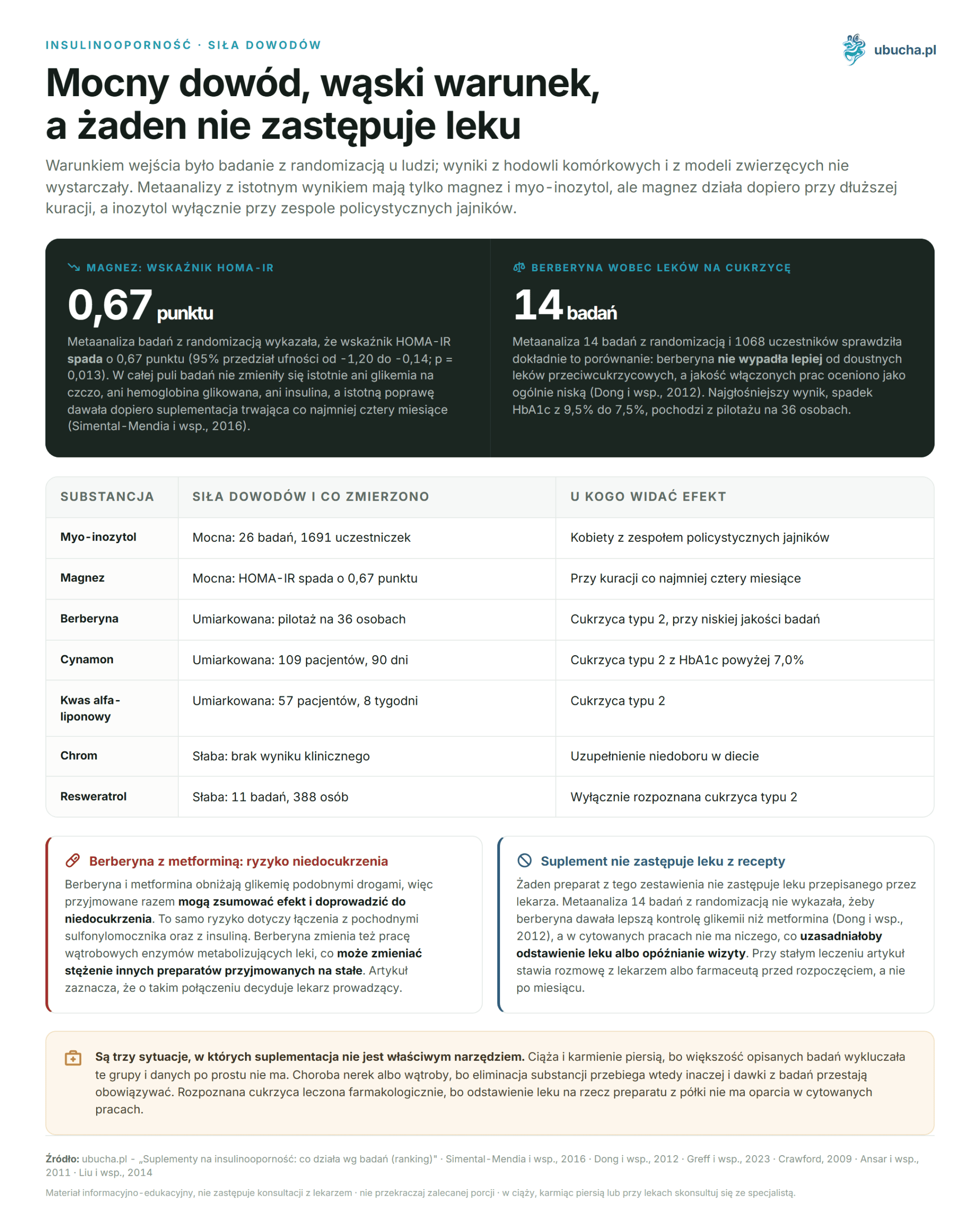
• Magnesium reduced the HOMA-IR index by 0.67 points, but only after four months (Simental-Mendia et al., 2016).
• Berberine performed similarly to metformin in a pilot study of 36 people; a meta-analysis of 14 studies did not confirm an advantage over medications.
• Myo-inositol has strong data only for polycystic ovary syndrome.
• Resveratrol works in people with diabetes, but does not change anything in others.
• None of the products on this list replaces a medication prescribed by a doctor.
How was this ranking created and what does the strength of evidence mean?
The entry condition was one: at least one randomized study with a control group in which glycemia, fasting insulin, or the HOMA-IR index was measured in humans. Results from cell cultures and animal models were not sufficient, even if the mechanism sounded convincing.
We describe the strength of evidence in three degrees. Strong means a meta-analysis of randomized studies with a statistically significant result. Moderate means single randomized studies that have not yet been collected in a meta-analysis or whose results diverge. Weak means that the effect is only visible in a narrow subgroup of patients or that instead of a clinical result, we have only an approved nutritional claim.
There are also three things that this review does not do. It does not evaluate brands or formulations, as the value of a preparation is determined by the standardization of the extract and the actual content of the substance, not the name on the label. It does not place supplements alongside prescription medications as an equivalent therapeutic option, as publications that have made such comparisons were based on small trials. Finally, it does not replace diagnostics: insulin resistance is diagnosed from blood test results, not from a list of symptoms read on the internet.
Which supplements for insulin resistance have the strongest evidence?
The best-documented are magnesium and myo-inositol, as both have meta-analyses of randomized studies with statistically significant results. Berberine has the loudest numbers, but they come from small studies of low methodological quality. Cinnamon, chromium, alpha-lipoic acid, and resveratrol perform worse: they work under narrow conditions or only in people with diagnosed diabetes.
| Substance | Strength of Evidence | What was measured | In whom is the effect visible |
|---|---|---|---|
| Myo-inositol | Strong | 26 randomized studies, 1691 participants: chance of a regular cycle 1.79 times higher than with placebo | Women with polycystic ovary syndrome |
| Magnesium | Strong | Meta-analysis of randomized studies: HOMA-IR lower by 0.67 points | Only with use for at least four months |
| Berberine | Moderate | Pilot study of 36 people: HbA1c from 9.5% to 7.5%; meta-analysis of 14 studies without advantage over medications | Type 2 diabetes, with low-quality studies |
| Cinnamon | Moderate | 109 patients, 1 g daily for 90 days: HbA1c lower by 0.83% compared to 0.37% in the control group | Type 2 diabetes with HbA1c above 7.0% |
| Alpha-lipoic acid | Moderate | 57 patients, 300 mg daily for 8 weeks: lower fasting blood sugar and lower HOMA-IR | Type 2 diabetes |
| Chromium | Weak | No clinical result; in the EU, an approved claim about maintaining normal glucose levels | Supplementing dietary deficiency |
| Resveratrol | Weak | 11 studies, 388 people: improvement in people with diabetes, no effect in people without diabetes | Only diagnosed type 2 diabetes |
What do studies on berberine really show?
Berberine is an alkaloid from the root of barberry, and the most frequently cited work on it is a pilot study from 2008. Thirty-six people with newly diagnosed type 2 diabetes were randomly assigned to berberine 0.5 g three times daily or to metformin at the same dose. After three months, hemoglobin A1c dropped from 9.5% to 7.5%, and fasting blood sugar from 10.6 to 6.9 mmol/l; the authors described the effect as similar to metformin (Yin et al., 2008). In the second part of the same study, in 48 people with poorly controlled diabetes, fasting insulin decreased by 28.1%, and the HOMA-IR index by 44.7%.
However, three caveats must be made. First, the authors themselves call their work a pilot study, and thirty-six people is too few to draw any conclusions. Second, a meta-analysis including 14 randomized studies and 1068 participants examined exactly this comparison, and berberine did not perform better than oral antidiabetic medications, and the methodological quality of the included studies was rated as generally low (Dong et al., 2012). Third, 34.5% of pilot participants experienced transient gastrointestinal discomfort.
The practical conclusion is one and cannot be softened. Berberine is not a substitute for metformin, and there is nothing in the cited works that would justify discontinuing a doctor-prescribed medication or delaying a visit. A complete comparison of both substances, along with what metformin has in evidence that berberine does not, can be found in the text berberine vs metformin.
Does myo-inositol help with PCOS and insulin resistance?
Yes, but the evidence pertains to one specific group. A systematic review from 2023 included 26 randomized studies and 1691 participants, of which 806 took inositol, 311 placebo, and 509 metformin. The chance of a regular menstrual cycle was 1.79 times higher with inositol than with placebo, and compared to metformin, inositol proved to be no worse (Greff et al., 2023). It also lowered blood sugar, the area under the insulin curve, and testosterone levels compared to placebo.
Why specifically polycystic ovary syndrome? Myo-inositol acts as a secondary insulin signaling messenger within the cell, and in PCOS, a disturbance in its conversion to D-chiro-inositol has been described. Supplementation compensates for the missing link in the pathway, so the effect appears where there is actually something to supplement. The forms of inositol and the ratio of myo to D-chiro are discussed in a separate text on inositol for PCOS.
What do these data not say? They do not say anything about men or women with insulin resistance without PCOS, as such participants were simply not included in the review. Transferring conclusions to other groups is an overinterpretation, although it often occurs in product descriptions. The store at Bucha does not have a product with myo-inositol as the main ingredient in its catalog, so if you are looking for it, read the label before buying anything described with the term “for insulin resistance”.
How much do magnesium, cinnamon, and chromium really provide?
Magnesium has the most data here. A meta-analysis of randomized studies showed a reduction in the HOMA-IR index by 0.67 points (95% confidence interval from -1.20 to -0.14; p = 0.013), while in the entire pool of studies, neither fasting blood sugar, hemoglobin A1c, nor insulin changed significantly (Simental-Mendia et al., 2016). The division into shorter and longer treatments shows where this variability comes from: significant improvement in HOMA-IR and fasting blood sugar was only provided by supplementation lasting at least four months.
Cinnamon was studied in the context of ordinary medical practice, making its result easier to translate into everyday life. In a randomized study of 109 patients with type 2 diabetes and hemoglobin A1c above 7.0%, capsules containing 1 g of cinnamon daily for 90 days reduced HbA1c by 0.83%, compared to 0.37% in patients receiving only standard care (Crawford, 2009). The effect is real, but small. Additionally, with the cassia variety, there is the issue of coumarin, of which Ceylon cinnamon has negligible amounts.
Chromium performs the weakest of the three. In the European Union, a claim has been approved for it stating that it helps maintain normal blood glucose levels (Regulation 432/2012), but such a claim describes the role of the element in the body, not its effectiveness in treating insulin resistance. The reference intake value is 40 µg per day, and a typical preparation provides exactly that. What this means for appetite and blood sugar is checked in the text about chromium.
Is it worth adding resveratrol and alpha-lipoic acid?
The answer depends on whether you already have diagnosed diabetes. A meta-analysis of 11 randomized studies involving 388 people showed that resveratrol improves glycemic control and insulin sensitivity in people with diabetes, while in people without diabetes, it does not change any of the measured parameters (Liu et al., 2014). Subgroup analyses did not show any impact of dose, duration of treatment, or body mass index. For a person with only insulin resistance, still without diabetes, this is rather discouraging news.
Alpha-lipoic acid has more modest but consistent data. In a randomized study of 57 patients with type 2 diabetes, a dose of 300 mg daily for 8 weeks reduced fasting blood sugar, postprandial blood sugar, and the HOMA-IR index compared to placebo (Ansar et al., 2011). Pay attention to the size of this dose, as labels often suggest two or four times more, citing studies that did not test such amounts.
Neither of these two substances is available as a single-ingredient preparation at the store at Bucha. If you are considering them, you are buying them outside this catalog, and it is even more worthwhile to check the label for how much substance is in the daily serving, not per capsule.
How much does a day of supplementation cost and what is available in the store?
The price alone says little, as a 15 ml bottle and a package of 180 capsules are completely different supplies. Therefore, in the last column is the cost of one daily serving, calculated from the manufacturer’s declaration of serving size. Prices come from the store’s API, as of August 8, 2026.
| Product | What stands out | Price | Cost per daily serving |
|---|---|---|---|
| Aura Care Adaptogens Sugar in Norm 15 ml | Macera from barberry 300 mg, gurmar 200 mg, chaga 190 mg, white mulberry 150 mg, and cinnamon 100 mg per serving | 99.00 PLN | approx. 3.70 PLN (400 drops, up to 15 drops daily) |
| Aura Care Bioactive Chromium 15 ml | Chromium picolinate, 40 µg per serving, which is 100% of the reference intake value | 79.00 PLN | approx. 1.98 PLN (400 drops, 10 drops daily) |
| Aura Care Magnesium 50 ml | Magnesium chloride hexahydrate with vitamin B6, 48 mg of magnesium as an element per serving | 79.00 PLN | approx. 2.37 PLN (33 servings of 1.5 ml) |
| Navigator Magnesium 400 mg, 180 capsules | 400 mg of magnesium in one capsule, one capsule per day | 59.90 PLN | approx. 0.33 PLN (180 servings) |
It is also worth knowing what is not included in this ranking. The catalog does not contain a preparation with berberine or with myo-inositol as the leading ingredient; barberry appears only as one of the macerates in herbal blends. The store does carry an extract of white mulberry, but the manufacturer does not provide the size of the daily serving, so the cost of a day’s treatment cannot be fairly calculated for it and therefore it did not make it to the table.
When can a supplement do more harm than good?
The most common mistake is combining a supplement with a medication that has the same mechanism. Berberine and metformin lower blood sugar through similar pathways, so taken together, they can sum the effect and lead to hypoglycemia. The same risk applies to combining with sulfonylurea derivatives and insulin. Such a combination is decided by the attending physician based on your results, not an article on the internet.
Berberine also affects liver enzymes that metabolize drugs, which can change the concentration of other preparations taken regularly. If you take anything chronically, discussing it with your doctor or pharmacist is advisable before the first capsule, not after a month.
There are three situations in which supplementation is not the right tool. Pregnancy and breastfeeding, as most of the studies described here excluded these groups, and there is simply no data. Kidney or liver disease, as the elimination of substances occurs differently then, and the doses from the studies cease to apply. Diagnosed diabetes treated pharmacologically, as discontinuing medication in favor of an over-the-counter preparation is not supported by any of the works cited in this article.
The foundation remains unchanged. Weight reduction, regular exercise, and a good night’s sleep affect tissue sensitivity to insulin more than any substance on this list. A supplement added to a well-managed diet can be helpful; a supplement instead of a diet works uphill.
Frequently Asked Questions
Can a supplement replace metformin or another prescription drug?
No. A meta-analysis of 14 randomized studies did not show that berberine provided better glycemic control than metformin, and the quality of the included studies was generally rated as low (Dong et al., 2012). Discontinuing a doctor-prescribed medication in favor of a supplement is not supported by this data.
How long does it take to see the effects of supplementation?
It depends on the substance. For magnesium, a significant improvement in the HOMA-IR index was only achieved after a treatment lasting at least four months (Simental-Mendia et al., 2016). Cinnamon was studied for 90 days, and berberine for three months. An assessment after two weeks does not provide any conclusions, as measurements were taken much later.
Can berberine be combined with metformin?
Both substances lower blood sugar through similar pathways, so their combination may sum the effect and increase the risk of hypoglycemia. In a pilot study from 2008, berberine acted similarly to metformin administered at the same daily dose (Yin et al., 2008). Such a combination is decided by the attending physician, not the patient.
What dose of chromium makes sense for insulin resistance?
The reference intake value for chromium is 40 µg per day, which is provided by a typical preparation. In the European Union, a claim has been approved stating that chromium helps maintain normal blood glucose levels (Regulation 432/2012). However, this is not evidence for treating insulin resistance with higher doses.
Does magnesium improve insulin sensitivity?
A meta-analysis of randomized studies showed a reduction in the HOMA-IR index by 0.67 points (Simental-Mendia et al., 2016). However, in the entire pool of studies, fasting blood sugar and hemoglobin A1c did not change significantly. Improvement in HOMA-IR appeared with treatments longer than four months.
Does kitchen cinnamon work like a capsule?
In Crawford’s study, capsules containing 1 g of cinnamon were used daily for 90 days, resulting in a decrease in hemoglobin A1c by 0.83% (Crawford, 2009). Sprinkling the spice by eye does not provide a repeatable dose, and the cassia variety contains coumarin, of which Ceylon cinnamon has negligible amounts.
The composition and current prices of the preparations discussed in this ranking can be checked in the supplements category, and herbal extracts in the plant extracts category.
This article is for informational and educational purposes and does not constitute medical advice. Before starting supplementation, consult your doctor, especially if you are taking medications regularly, are pregnant or breastfeeding, or have a chronic illness.
Author: Michał Waluk · Published: 2026-06-29 · Updated: 2026-08-08