
Indica vs sativa: why the label doesn’t indicate the effect
Indica, sativa or hybrid? Genomics does not confirm the division. What really determines the effect: the ratio of THC to CBD and the terpene profile. Plus a table of differences.
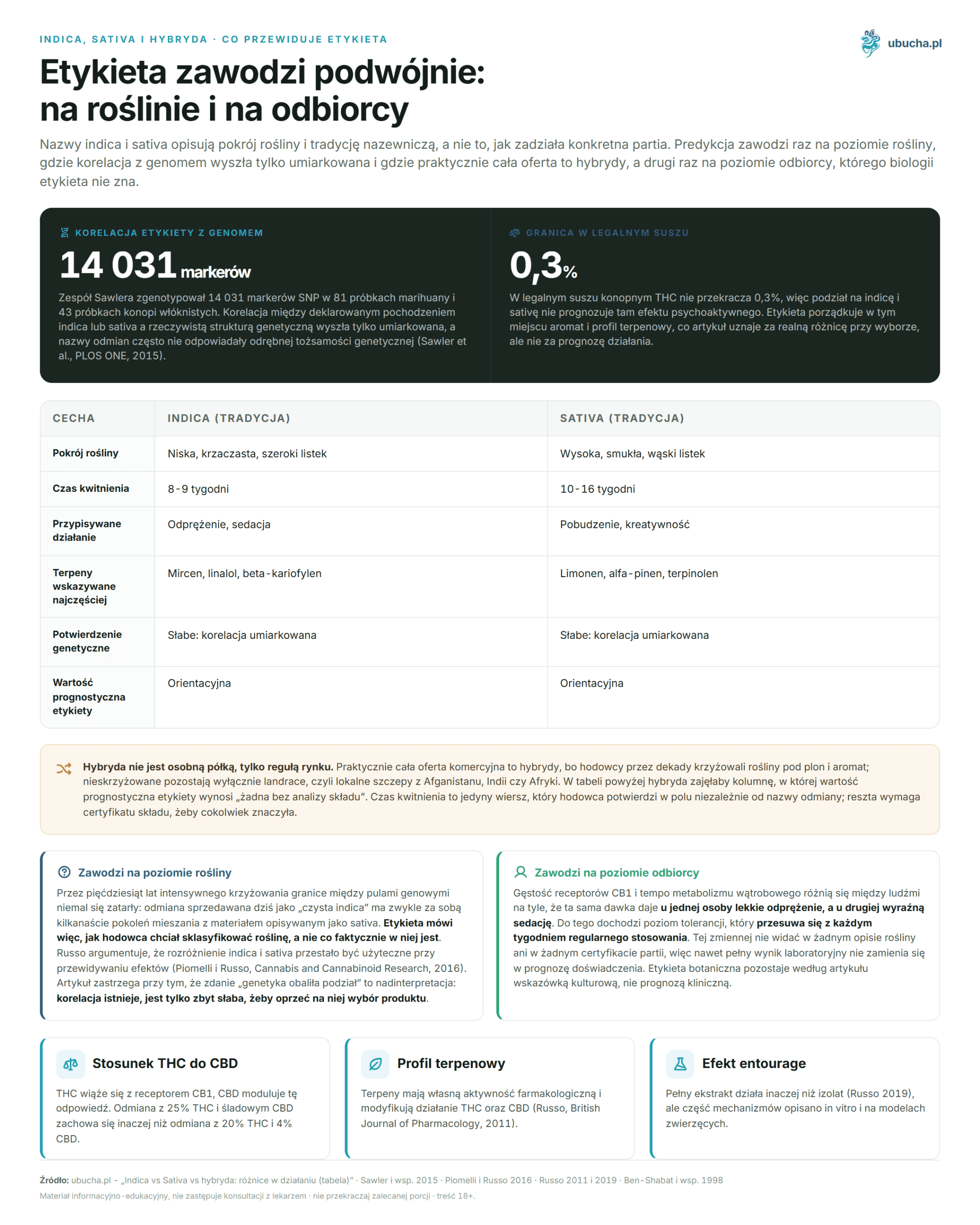
The indica or sativa label describes the plant’s morphology and naming tradition, not its effect. What determines how a strain will act is the ratio of THC to CBD and the terpene profile, neither of which can be read from the name alone. If you’ve heard that indica puts you to sleep and sativa stimulates, you’ve encountered a mental shortcut that breeders and shops have repeated since the 1970s. Genomics tells a different story. In the analysis of 14,031 SNP markers in 81 cannabis strains and 43 fiber cannabis strains, the correlation between declared indica or sativa origin and actual genetic structure was only moderate, and strain names often did not correspond to a distinct genetic identity (Sawler et al., PLOS ONE, 2015). This does not mean that the division is useless. It means that it describes the appearance of the plant and the naming tradition, not how a specific batch of product will act. In this article, you will find a table of morphological features and traditionally attributed effects, an explanation of what really drives the action of a strain, and a comparison of the cannabis flower currently available with a price per gram conversion.
KEY INFORMATION
• In 81 cannabis strains, the correlation of the indica or sativa label with the genome was only moderate (Sawler et al., PLOS ONE, 2015).
• Practically the entire offer consists of hybrids; only landrace strains remain unhybridized.
• The effects are determined by the ratio of THC to CBD and the terpene profile, not the label.
• In legal flower, THC does not exceed 0.3%, so the label mainly describes the aroma.
Where did the division into indica and sativa come from?
The division has its roots in 18th-century botany, not pharmacology. Cannabis sativa was described by Carl Linnaeus in 1753, referring to fiber hemp cultivated in Europe. Cannabis indica was described by Jean-Baptiste Lamarck in 1785 based on plants imported from India: shorter, more robust, with broader leaves. Neither studied the psychoactive effects or chemical composition.
The meaning of these names shifted only in the second half of the 20th century when they were adopted by the breeding culture. At that time, indica began to mean physical relaxation and drowsiness, while sativa meant mental stimulation and euphoria. This association was reinforced by seed catalogs and dispensary menus, as it provided a simple sales language where laboratory analysis was unavailable or illegal.
The problem is that after fifty years of intensive crossing, the boundaries between these gene pools have nearly blurred. A strain sold today as a “pure indica” usually has several generations of mixing with material described as sativa. The label on the package thus indicates how the breeder wanted to classify the plant, not what is actually in it. Russo argues directly that the distinction between indica and sativa has ceased to be useful in predicting effects and should give way to a chemical description (Piomelli and Russo, Cannabis and Cannabinoid Research, 2016).
Does genetics confirm the division of indica and sativa?
Only partially, and not where you would expect. Sawler’s team genotyped 14,031 SNP markers in 81 cannabis samples and 43 fiber cannabis samples. The result showed clear, genome-wide differentiation between psychoactive and fiber cannabis, so the difference between these two populations is not limited to genes responsible for THC synthesis (Sawler et al., PLOS ONE, 2015).
Within cannabis itself, the picture is much more blurred. The correlation between the breeder-declared origin of indica or sativa and the actual genetic structure was moderate, and the authors stated directly that strain names often do not correspond to a distinct genetic identity. Two batches sold under the same name can differ genetically more than two batches with different names.
We have noticed that this conclusion is often sharpened in Polish texts to the statement “genetics has debunked the division into indica and sativa.” This is an overinterpretation. The correlation exists; it is simply too weak to base product selection on it. An interesting fact from the same study usually goes unnoticed: fiber cannabis, which is the raw material for legal flower in Poland, turned out to be genetically closer to indica-type strains than to sativa-type strains. Thus, labels on legal flower describe the naming tradition even more, rather than the genetic line.
What are the practical differences between indica, sativa, and hybrid?
Despite genetic reservations, the traditional division describes real differences in plant morphology and established expectations regarding effects. The table below compares the two, indicating where agricultural observation ends and marketing begins.
| Feature | Indica (tradition) | Sativa (tradition) | Hybrid |
|---|---|---|---|
| Plant morphology | Short, bushy, broad leaf | Tall, slender, narrow leaf | Intermediate or variable |
| Flowering time | 8-9 weeks | 10-16 weeks | Varies by strain |
| Attributed effect | Relaxation, sedation | Stimulation, creativity | Declared as intermediate |
| Most commonly indicated terpenes | Myrcene, linalool, beta-caryophyllene | Limonene, alpha-pinene, terpinolene | Varies by crossing |
| Genetic confirmation | Weak: moderate correlation | Weak: moderate correlation | Dominates the market |
| Names used in trade | Afghan Kush, Hindu Kush | Durban Poison, Amnesia Haze | OG Kush, Gorilla Glue |
| Predictive value of the label | Indicative | Indicative | None without composition analysis |
The row about flowering time is the only item that the breeder can confirm in the field regardless of the strain name. The rest requires a composition certificate to mean anything. Pay attention to the last row, as it explains why to read further: without laboratory analysis, the strain label predicts nothing that could be verified before purchase.
How to read these two things from the strain description is shown in our strain profile guide, and the very question of stimulation and calming is broken down in the text about chemovars instead of the indica and sativa division.
What really determines the action of a strain?
Three variables, none of which are visible on the botanical label: the cannabinoid ratio, the terpene profile, and the biology of the person reaching for the product. Only together do they explain why the same batch gives different experiences to different people.
The ratio of THC to CBD sets the entire rest. THC binds directly to the CB1 receptor and is responsible for the psychoactive effect, and at higher concentrations, also for anxiety in individuals without tolerance. CBD acts differently: it modulates the response to THC and alleviates some unwanted reactions. A strain with 25% THC and trace CBD will behave differently than a strain with 20% THC and 4% CBD, even if both carry the same hybrid name.
The terpene profile accounts for the character of the experience at similar cannabinoid content. Russo gathered data indicating that cannabis terpenes have their own pharmacological activity and modify the effects of THC and CBD (Russo, British Journal of Pharmacology, 2011). This is why two strains with identical laboratory results for THC can act completely differently.
The last variable is the hardest to predict. The density of CB1 receptors and the rate of liver metabolism differ among individuals enough that the same dose can give one person slight relaxation and another clear sedation. Additionally, the level of tolerance shifts with each week of regular use. Therefore, prediction from the label fails doubly: once at the plant level, and again at the recipient level.
Which terpenes change the character of the effect?
Cannabis contains over a hundred cannabinoids and a comparable number of terpenes, but most aromatic differences are due to a few dominant compounds. The following list organizes those that appear most frequently in analysis certificates.
| Terpene | Aroma | Described effect |
|---|---|---|
| Myrcene | Earthy, musky | Sedative; most commonly dominates in strains called indica |
| Limonene | Citrusy | Mood elevating, studied for anxiolytic properties |
| Alpha-pinene | Pine | Inhibits acetylcholinesterase; may alleviate memory impairment from THC |
| Linalool | Lavender | Calming, described as anxiolytic |
| Beta-caryophyllene | Peppery | Binds to the CB2 receptor, anti-inflammatory action |
Beta-caryophyllene stands out from this list because it is not solely an aromatic compound. A study published in PNAS showed that it selectively binds to the CB2 receptor, making it a dietary component with cannabinoid activity (Gertsch et al., PNAS, 2008). You can also find it in black pepper and cloves.
The claim repeated in product descriptions that myrcene opens the blood-brain barrier and thus enhances THC has no confirmation in human studies. We removed it from this article during the update. The sedative properties of myrcene are described, but the mechanism with the blood-brain barrier remains a hypothesis repeated among shops.
What is the entourage effect?
The term describes a situation where inactive or weakly active compounds enhance the action of the main compound. It was introduced by Ben-Shabat and Mechoulam’s team in 1998, describing glycerol esters of fatty acids that enhance the activity of 2-arachidonoylglycerol (Ben-Shabat et al., European Journal of Pharmacology, 1998). Only later was the concept transferred to the entire cannabis plant.
Russo developed this concept and compiled evidence that a full extract acts differently than isolated THC or CBD. His conclusion for the market is direct: since the effect is determined by the full chemical profile of the batch, selling an experience under the strain name has no basis, as the same name denotes different plants from different breeders (Russo, Frontiers in Plant Science, 2019).
In the context of the dispute over indica and sativa, the entourage effect explains a phenomenon that is difficult to explain by THC content alone. Two batches with similar laboratory results for cannabinoids can provide different experiences if one is dominated by myrcene and the other by limonene. Therefore, when purchasing, a more sensible question is “what is the terpene profile of this batch” rather than “is this indica.” However, it should be noted that the strength of the evidence is uneven: some mechanisms have been described in in vitro studies and animal models, and studies involving humans comparing full extract with isolate are few.
Which cannabis flower to choose and for how much?
In legal cannabis flower, THC does not exceed 0.3%, so the division into indica and sativa does not predict psychoactive effect. However, it still organizes aroma and terpene profile, which is a real difference when choosing. A practical parameter worth comparing between products is the price per gram. Below is a comparison of the current offer in the category cannabis flower at Bucha, sorted from the cheapest gram.
| No. | Product | What distinguishes it | Weight | Price | Cost per 1 g |
|---|---|---|---|---|---|
| 1 | SZAŁ MIAŁ CBD 10G Babcia Marysia MIX Trym | Trim, i.e., small fractions; the cheapest gram in the offer | 10 g | 75.00 PLN | 7.50 PLN |
| 2 | SZAŁ MIAŁ CBD + CBG 10G Babcia Marysia MIX Trym | A mix of two profiles in one package | 10 g | 75.00 PLN | 7.50 PLN |
| 3 | Specjały Babci Marysi Susz Konopny Midwest 10G | Whole flowers in a large backup format | 10 g | 140.00 PLN | 14.00 PLN |
| 4 | Specjały Babci Marysi Susz Konopny Northwest 5G | Medium format, a compromise between price and freshness | 5 g | 75.00 PLN | 15.00 PLN |
| 5 | Specjały Babci Marysi Susz Konopny Santhica CBG 5G | Santhica strain with a CBG profile instead of CBD | 5 g | 75.00 PLN | 15.00 PLN |
| 6 | Susz Rollmops Specjał Mopsa (CBD Heaven) 5g | Selection from the CBD Heaven brand | 5 g | 99.00 PLN | 19.80 PLN |
| 7 | Cannabis Spot Susz CBD Amnesia Haze 5G | Name from the sativa tradition; citrus-herbal aroma | 5 g | 100.00 PLN | 20.00 PLN |
| 8 | Cannabis Spot Susz CBD Gorilla Glue 5G | Name from the hybrid tradition; resinous aroma | 5 g | 100.00 PLN | 20.00 PLN |
| 9 | CBD Mango Gelato 2G | Small format for testing aroma | 2 g | 45.00 PLN | 22.50 PLN |
| 10 | Babcia Marysia CBD Northwest 1G | Smallest package, lowest entry threshold | 1 g | 35.00 PLN | 35.00 PLN |
Prices come from the store API and describe the state as of 2026-08-08. The range of cost per gram reaches nearly fivefold, and names from the indica, sativa, and hybrid traditions appear in every price range. This is a good illustration of the thesis of the entire article: the strain label says nothing about the price or composition.
Frequently Asked Questions
What is the difference between indica and sativa in effect?
Breeders traditionally attribute indica to relaxation and drowsiness, while sativa to stimulation and creativity. Genomics does not confirm this: in the analysis of 81 cannabis strains, the correlation between declared origin and genetic structure was only moderate, and strain names often did not correspond to a distinct genetic identity (Sawler et al., PLOS ONE, 2015).
Are indica and sativa separate species?
The taxonomy of cannabis remains disputed. Some botanists describe Cannabis sativa and Cannabis indica as separate species or subspecies, while others treat the genus as one polymorphic species. Genotyping of 14,031 SNP markers showed a clear difference between fiber and psychoactive cannabis, but not between commercial indica and sativa strains.
What is a cannabis hybrid?
A hybrid is a strain resulting from the crossing of plants with indica and sativa traits or earlier hybrids. Practically the entire commercial offer today consists of hybrids, as breeders have crossed plants for yield and aroma for decades. Only landrace strains, which are local varieties from Afghanistan, India, or Africa, remain unhybridized.
What determines the effects of a cannabis strain?
The ratio of THC to CBD, the terpene profile, and the individual biology of the user. Terpenes modify the effects of cannabinoids: myrcene promotes sedation, limonene elevates mood, and alpha-pinene inhibits acetylcholinesterase and may alleviate memory impairment from THC (Russo, British Journal of Pharmacology, 2011). The botanical label remains a cultural guideline, not a clinical prediction.
Do terpenes really affect the effects of cannabis?
Yes. Beta-caryophyllene binds directly to the CB2 receptor, as shown in a study published in PNAS (Gertsch et al., 2008). Russo gathered evidence that terpenes modify the effects of THC and CBD, although there are still few studies involving humans.
Which cannabis flower should I choose to start?
To start, a small format, 1 g or 2 g, is reasonable to check the aroma without a large expense. A gram in a 1 g package costs 35.00 PLN, and in a 10 g package from 7.50 PLN (as of 2026-08-08). Move to a larger package only after selecting the aroma profile.
The full, updated offer along with the composition of individual batches can be found in the category cannabis flower.
This article is for informational and educational purposes. It contains internal links to product categories available in the Bucha store. Prices and specifications may change: check the current data on the product page before purchasing.
Author: Michał Waluk · Published: 2026-07-31 · Updated: 2026-08-24