
Cannabis in Religion: From Rastafari to Ancient Rituals (Guide)
From Pamir 2500 years ago to Jamaican Rastafari. What archaeology really confirms, where the evidence ends, and how the law treats the religious use of cannabis.
Cannabis is one of the oldest plants cultivated by humans and one of the few that has accompanied people not only in economy but also in ritual. However, this topic has its own trap: stories about the sacred plant circulate much more widely than the evidence that supports them. The authors of the most important archaeological work in this field themselves write that the evidence for the ritual use of cannabis is limited and disputed. This guide therefore separates three things that are usually conflated in popular studies: what has been confirmed by chemical analysis, what ancient authors recorded, and what is a contemporary interpretation of religious texts. In the end, we show how today’s law deals with this heritage.
KEY INFORMATION
• The earliest directly dated and chemically confirmed evidence of ritual cannabis smoking comes from the Jirzankal cemetery in eastern Pamir, dating back about 2500 years (Ren et al., Science Advances, 2019).
• In the Atharvaveda, cannabis is described as a sacred grass, and the tradition of bhang has been rooted in the Indian subcontinent for at least two thousand years (Balhara et al., Indian Journal of Psychological Medicine, 2022).
• The Jamaican amendment to the Dangerous Drugs Act of 2015 allowed sacramental use of ganja by Rastafari followers in registered places of worship.
• The hypothesis that the Hebrew “kaneh bosem” means cannabis has minimal support among lexicographers and botanists.
What is the oldest confirmed evidence of ritual cannabis use?
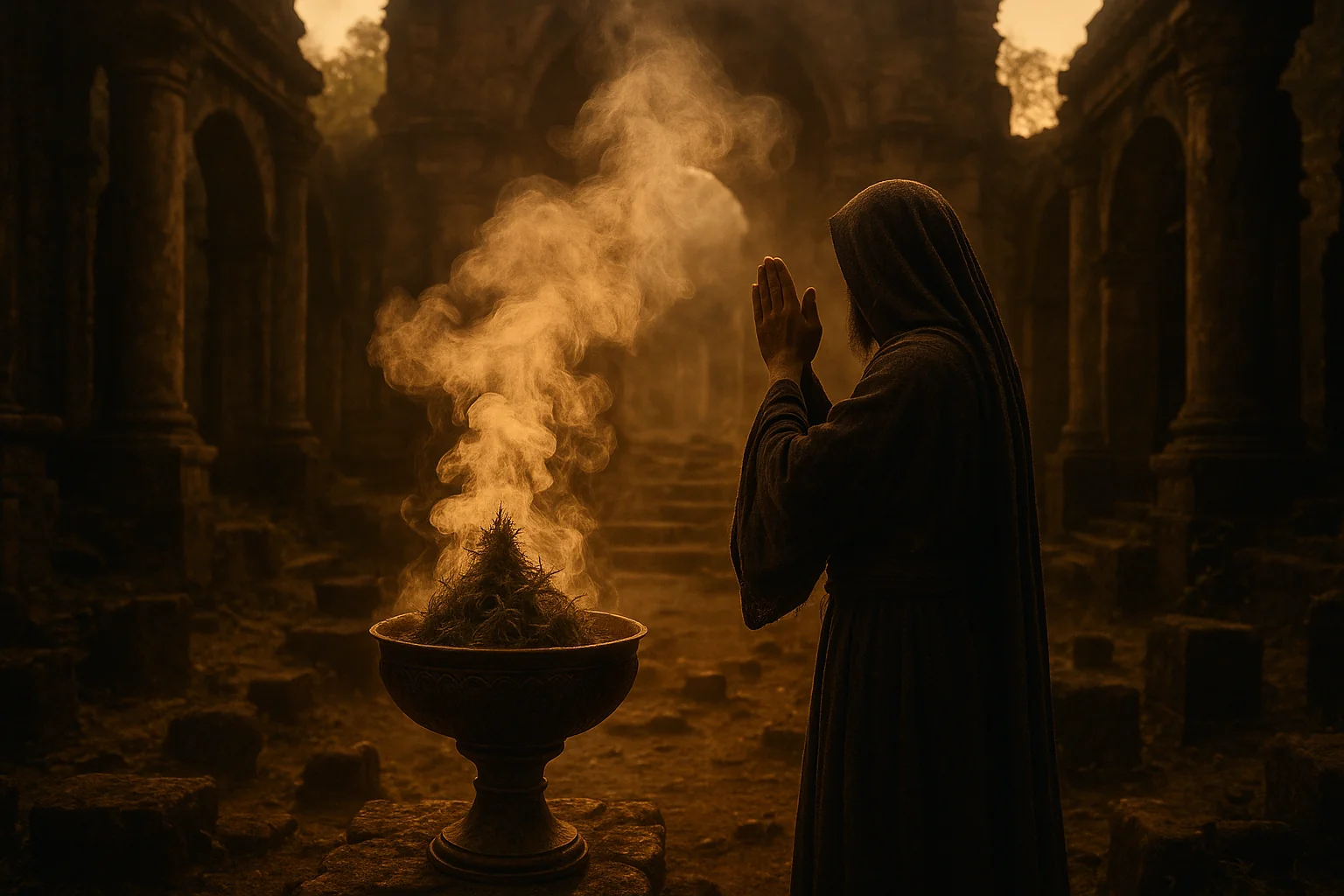
The earliest directly dated and scientifically verified evidence of ritual cannabis smoking is the find from the Jirzankal cemetery in eastern Pamir. Chemical analysis revealed that around 500 BC, cannabis was burned in wooden censers during funeral ceremonies, and the plants produced high concentrations of psychoactive compounds.
The authors’ conclusion is more cautious than is often quoted. They write that cannabis was smoked as part of ritual or religious activities in western China at least two and a half thousand years ago, and in the same paragraph, they note that the archaeological evidence for ritualized consumption of cannabis remains limited and disputed. This statement is worth remembering, as it invalidates most categorical claims circulating on this topic.
The find has another significance, extending beyond religious studies. It shows when cultivated plants began to produce elevated amounts of psychoactive compounds, that is, when a feature that we now consider obvious first appeared. A review of the plant’s history describes cannabis as a species cultivated for fiber and seed alongside recreational, medicinal, and ritual uses (Russo, Chemistry and Biodiversity, 2007). A broader context can be found in the study of the history of cannabis from prehistory to modernity.
What did Herodotus write about the Scythians and does archaeology confirm it?
Herodotus in the fourth book of Histories, written in the 5th century BC, described the custom of the Scythians, nomads from the steppes north of the Black Sea. After a funeral, they would erect small tents, place heated stones inside, and throw cannabis seeds on them, inhaling the resulting vapors. The Greek historian noted that participants made sounds of satisfaction and compared the whole activity to bathing.
For centuries, this fragment was treated as a colorful anecdote of a traveler. Today, the situation looks different, but precision is needed in describing what exactly has changed it. Analysis from Jirzankal confirms not Herodotus’ description itself, but the existence of a similar practice: smoking cannabis with high levels of psychoactive compounds during funeral rites, in the same era, in the steppe cultures of Eurasia. However, the cemetery is located in eastern Pamir, not in the areas described by Herodotus.
This distinction does not weaken the significance of the find; it only organizes it. We have independent written evidence and independent chemical evidence that speak of a similar custom in a similar time, but from different places. Such a set of evidence is stronger in archaeology than a single confirmation, and at the same time does not authorize the statement that the excavations confirmed Herodotus’ account in terms of the word.
What role does cannabis play in Indian tradition?
In the Indian subcontinent, the cultivation and use of cannabis have been rooted for at least two thousand years, with the first mentions dating back to the second millennium BC. In the Atharvaveda, the plant is described as a sacred grass. Bhang, or a preparation from cannabis leaves, appears in religious texts and in practices aimed at warding off evil forces.
Its use also had an ascetic dimension. Wandering monks would use bhang to endure several days without food and drink, linking the plant not with feasting but with renunciation. This context distinguishes the Indian tradition from most descriptions, where the psychoactive substance accompanies celebration.
Contemporary Indian law has inherited from this tradition an exception that is difficult to explain without referring to history. The Narcotic Drugs and Psychotropic Substances Act of 1985 banned cannabis but did not include bhang, or preparations from leaves. In several states, including Rajasthan, Uttar Pradesh, Punjab, and Odisha, licensed bhang shops operate, and licenses are issued by state excise offices. At the same time, cannabis remains illegal in India, and scientific research on its use is rare and methodologically weak (Karki and Rangaswamy, Indian Journal of Psychological Medicine, 2023).
Why do Rastafari treat ganja as a sacrament?
The Rastafari movement emerged in Jamaica in the 1930s, crystallizing around the coronation of Haile Selassie I as Emperor of Ethiopia in 1930. Ganja serves as a sacrament: it is a means of prayer and meditation, not a drug, and this intention distinguishes religious use in doctrine from recreational use.
The justification is derived from the Bible. The most frequently cited verse is from Genesis, in which God gives man every herb yielding seed, and a fragment from Revelation speaking of the leaves of the tree of life for the healing of the nations. Ganja is often smoked during all-night sessions called reasoning, combining theological debate with prayer and meditation aimed at discerning the will of Jah.
The plant itself arrived in Jamaica relatively late and through a route that closes the Indian thread from the previous section. It was brought by Indian contract workers in the 19th century, and only later was it adopted and transformed into an element of religious practice by the emerging movement. It is worth noting, as popular studies present the connection between Rastafari and cannabis as ancient, while it is less than two centuries old. We discuss how this image was later solidified by music in the text about cannabis in pop culture, film, and music.
Does contemporary law recognize the religious use of cannabis?
Only in a narrow scope and only in a few countries. Jamaica has gone the furthest: the amendment to the Dangerous Drugs Act of 2015, effective from April 15 of that year, allowed sacramental use of ganja by Rastafari followers. However, the exception is not tied to the person but to the place.
The law allows sacramental use in registered Rastafarian places of worship, and adult followers and Rastafarian organizations can apply for permission to cultivate for ritual purposes. Outside registered places, restrictions on smoking in public spaces still apply. This is a technical solution, not a declaration: the state does not so much recognize the religion as a basis for entitlement, but creates a separate and controlled path for it.
A contrasting example was provided by the United States. Bill Levin, the founder of the First Church of Cannabis, filed a lawsuit on July 8, 2015, citing the state law on restoring religious freedom in Indiana as the basis for an exception for sacramental use of cannabis. In July 2018, the Marion County court dismissed this lawsuit, deeming the state’s interest in maintaining the ban to be paramount. In Poland, there is no such debate at all: the regulations do not provide for religious exceptions for controlled substances, and an organized movement referring to cannabis in worship does not exist. Where the names used in these disputes come from is explained in the text about the history of the word marijuana.
| Evidence | Dating | What was specifically demonstrated |
|---|---|---|
| Jirzankal Cemetery, eastern Pamir | Circa 500 BC | Chemical analysis: burning of cannabis in wooden censers during funeral ceremonies |
| Herodotus, Histories, Book IV | 5th century BC | Written evidence, non-material: description of a Scythian rite with vapors from cannabis seeds |
| Atharvaveda and bhang tradition | At least 2000 years | The plant described as sacred grass; bhang in religious and ascetic practices |
| Rastafari, Jamaica | Since the 1930s | Ganja as a sacrament; since 2015, legal exception in registered places of worship |
| Hypothesis of “kaneh bosem” | Proposed in 1936 | Linguistic interpretation without support in standard lexicons of biblical Hebrew |
Frequently Asked Questions
What is the oldest confirmed evidence of ritual cannabis smoking?
The Jirzankal cemetery in eastern Pamir, dated to around 500 BC. Chemical analysis revealed the burning of cannabis in wooden censers during funeral ceremonies, with the plants producing high concentrations of psychoactive compounds. The authors of the study also note that the overall evidence for the ritual use of cannabis remains limited and disputed.
Did the ancient Scythians use cannabis ritually?
Herodotus described in the fourth book of Histories a Scythian funeral rite involving inhaling vapors from cannabis seeds thrown on heated stones. Analysis from Jirzankal confirms the existence of a similar practice in the same era in the steppe cultures of Eurasia, but it comes from a different region, so it is not a direct confirmation of Herodotus’ account.
What role does cannabis play in Indian tradition?
The cultivation and use of cannabis have been rooted in the subcontinent for at least two thousand years. In the Atharvaveda, the plant is described as a sacred grass, and bhang, a preparation from the leaves, appears in religious texts and in ascetic practices. The Indian law of 1985 banned cannabis but excluded bhang from this prohibition.
Why do Rastafari treat ganja as a sacrament?
The movement emerged in Jamaica in the 1930s around the coronation of Haile Selassie I. Ganja serves as a means of prayer and meditation, and the justification is derived from the Bible, most often from the verse in Genesis about the herb yielding seed. Smoking occurs during all-night sessions called reasoning, combining theological debate with prayer.
Are there mentions of cannabis in the Bible?
This is a disputed and poorly substantiated thesis. Polish anthropologist Sula Benet proposed in 1936 that the Hebrew “kaneh bosem” was incorrectly translated in the Septuagint as calamus and that it means cannabis. The hypothesis has minimal support among lexicographers and botanists, and the standard lexicon of biblical Hebrew associates this term with a balsamic plant.
This article is for informational and educational purposes only and does not constitute legal advice. The legal status described in the article is valid as of the date of publication: regulations regarding cannabis may change. Consult a lawyer or current legal acts before making decisions.
Author: Michał Waluk · Published: 2026-08-09 · Updated: 2026-08-11