
Does marijuana kill brain cells: what science says (FAQ)
Marijuana does not kill neurons, but the effect of THC on the brain depends on age. Check what imaging studies, memory tests, and data on the risk of psychosis show.
Marijuana kills brain cells. This statement has been repeated in anti-drug campaigns for three decades, usually with an animation of a fried brain in the background. The source was one study: Heath and colleagues exposed 21 rhesus monkeys to marijuana smoke or intravenous THC and described changes at the synaptic level. When human brains were measured with MRI twenty years later, no atrophy was found. The modern answer is less convenient than the myth, as it sounds different for adults and differently for teenagers. It is resolved by three questions: do neurons die, do changes reverse, and does the age of first contact matter. Below we break it down into what imaging studies, cognitive tests, and data on the risk of psychosis show, and what these studies do not say.
KEY INFORMATION
• MRI in frequent users showed no brain atrophy or tissue volume changes (Block et al., 2000).
• The density of CB1 receptors in the cortex decreases with daily smoking and returns to normal after about four weeks of abstinence (Hirvonen et al., 2012).
• Memory deficits in adults disappear by the 28th day of abstinence: by day 28, there were no significant differences (Pope et al., 2001).
• The exception is initiation before eighteen: an average IQ drop of 8 points, which did not recover after cessation (Meier et al., 2012).
Where did the myth about killing brain cells come from?
From one experiment on monkeys and from a campaign that turned it into an image. Heath and colleagues studied 21 rhesus monkeys exposed to marijuana smoke or intravenous THC and described lasting changes in recordings from deep brain structures and damage visible at the synaptic level (Heath et al., 1980).
However, the design of this work does not transfer to humans. Some animals had electrodes implanted in their brains, exposure was conducted in apparatus delivering smoke for many months, and individual groups consisted of a few individuals. The authors wrote about doses comparable to human ones, but the comparison was based on THC concentration in plasma, not on the method of smoking.
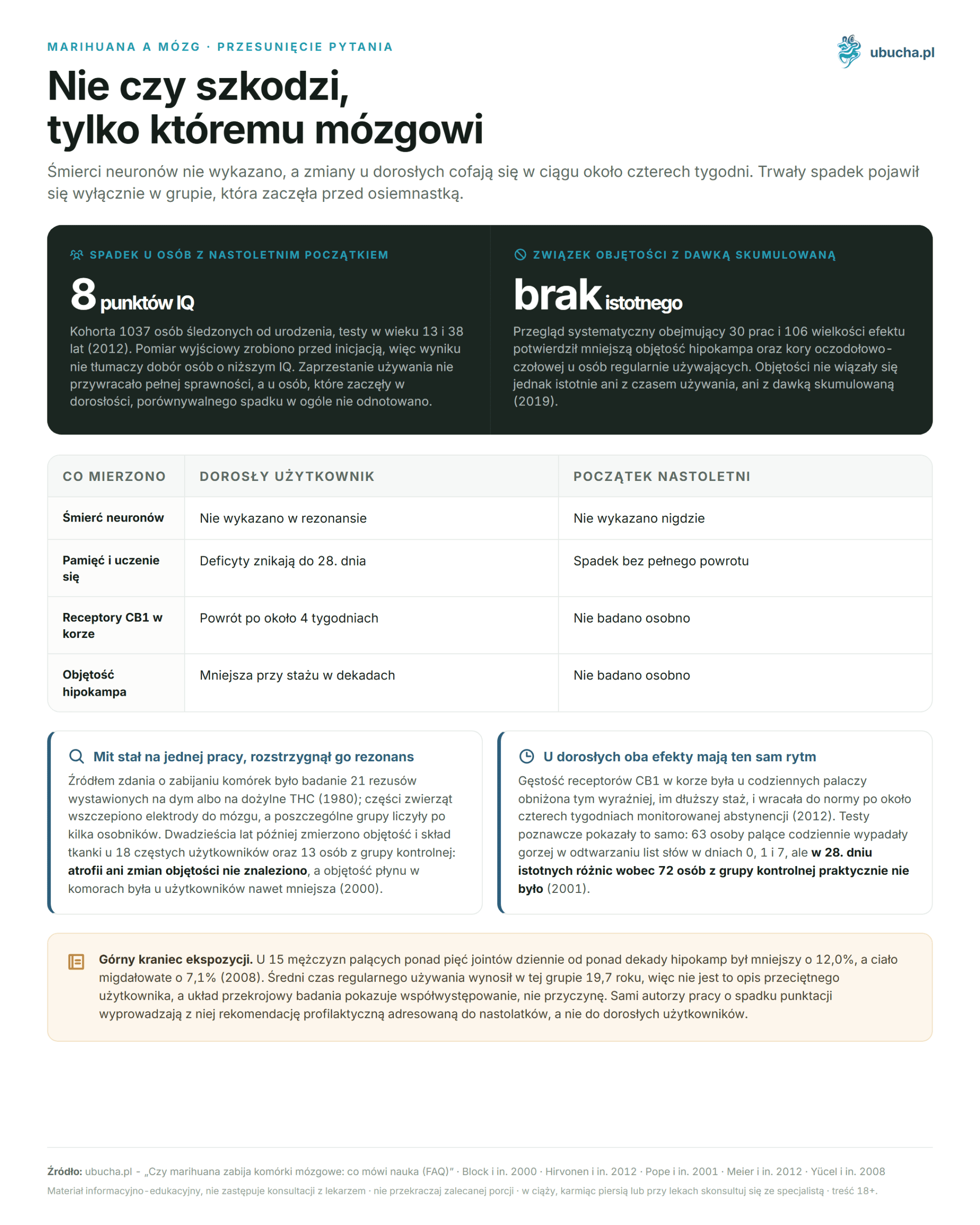
The resolution came from imaging. Block and colleagues measured the volume and composition of brain tissue in 18 frequent marijuana users and 13 individuals from the control group using MRI. They found no atrophy or volume changes, global or regional, and the volume of fluid in the ventricles was even smaller in users than in non-users (Block et al., 2000).
The myth persisted because the image of a fried brain sticks in memory better than a table of volumes. However, the absence of neuron death does not mean the absence of impact, and that is the proper subject of the rest of the text.
What does THC actually do to an adult brain?
It changes receptor density and temporarily impairs memory, after which both effects reverse. Positron emission tomography showed reduced density of CB1 receptors in the cortex among daily smokers, more pronounced the longer the smoking duration. After about four weeks of monitored abstinence, density returned to normal (Hirvonen et al., 2012).
This same rhythm is visible in cognitive tests. Pope and colleagues studied 63 daily smokers, 45 former heavy users, and 72 individuals from the control group, and then conducted a 28-day cessation controlled by urine testing. On days 0, 1, and 7, smokers performed worse in recalling word lists, and the result correlated with the concentration of THC metabolite in urine at entry. By day 28, there were practically no significant differences between groups (Pope et al., 2001).
The authors’ conclusion is more cautious than the headlines made from it: deficits are detectable even a week after the last session, but they are associated with recent exposure, not with cumulative lifetime dose. A break does more than any supplement, and we wrote about what happens in the brain during the first two days in the text about a two-day break from THC.
Why does the age of first contact change the outcome?
Because the permanent drop appeared only in the group that started before eighteen. In the Dunedin cohort, which included 1037 individuals tracked from birth, cognitive tests were performed at ages 13 and 38. Among the most persistent users who started in their teens, the average IQ drop was 8 points (Meier et al., 2012).
Three things from this work weigh more than the number itself. The baseline measurement was made before initiation, so the result cannot be explained by the fact that people with lower IQ reach for marijuana. The drop increased with the number of waves of the study in which the participant met the criteria for addiction. Cessation did not restore full capacity in the group with teenage onset, although among those who started in adulthood, no comparable drop was recorded at all.
People from the participants’ surroundings reported cognitive problems regardless of the tests, which the authors treated as a separate indicator. For practice, this means one shift in emphasis. The question is not whether marijuana harms the brain, but which brain and at what point in development. The authors themselves derive a preventive recommendation addressed to teenagers, not to adult users, and that is the most practical thing that can be taken from this work.
What is seen in the brains of long-term users?
Small but measurable volume differences, and that at the upper end of exposure. Yücel and colleagues compared 15 men smoking more than five joints a day for over a decade with 16 individuals from the control group. The hippocampus was 12.0% smaller, the amygdala 7.1% smaller (Yücel et al., 2008).
The average duration of regular use in this group was 19.7 years, so this is not a description of the average user. The volume of the left hippocampus was associated with the severity of subthreshold psychotic symptoms, and the study had a cross-sectional design, meaning it shows comorbidity, not causation. A systematic review with a meta-analysis, including 30 studies and 106 effect sizes, confirmed smaller volumes of the hippocampus and orbitofrontal cortex in regular users. The surprising second part of this result: volumes were not significantly associated with duration of use or cumulative dose (Lorenzetti et al., 2019). The dose-response relationship, which intuition suggests, did not appear in the aggregate data.
| What was measured | Adult user | Onset in adolescence |
|---|---|---|
| Neuron death | Not shown in MRI (Block, 2000) | Not shown in any of the cited works |
| Memory and learning | Deficits disappear by the 28th day of abstinence (Pope, 2001) | IQ drop of 8 points, with no full recovery (Meier, 2012) |
| CB1 receptors in the cortex | Reduced density, return after about 4 weeks (Hirvonen, 2012) | Not studied separately in the cited works |
| Hippocampal volume | Smaller with duration counted in decades (Yücel, 2008) | Not studied separately in the cited works |
A broader overview of what changes with long-term use beyond the volume of structures has been gathered in the text about long-term effects of marijuana use.
Does CBD protect the brain from THC effects?
In acute experiments, yes, but this has not been checked in population data. Bhattacharyya and colleagues administered THC, CBD, or placebo to 15 healthy men and observed opposing activation patterns, including in the amygdala when viewing faces expressing fear. In the second part of the study, administering CBD before intravenous THC prevented acute psychotic symptoms (Bhattacharyya et al., 2010).
The scale of the threat that CBD would protect against is shown by the European study EU-GEI. Di Forti’s team gathered 901 patients with their first episode of psychosis and 1237 individuals from control groups in eleven centers in Europe and Brazil. Daily marijuana use was associated with an odds ratio of 3.2, and daily use of strains with THC content of 10% or more had an odds ratio of 4.8 (Di Forti et al., 2019). If strong strains disappeared from the market, the authors estimate that 12.2% of cases in the entire studied population could be prevented, 30.3% in London, and 50.3% in Amsterdam.
What this study does not say: it did not compare strains in terms of CBD content, so the popular claim about balanced strains as a buffer has no basis in it. Neuroprotective effects of CBD have been described in animal models and acute human studies, but not in data on long-term use. The mechanisms of action of CBD in the nervous system have been broken down in the text about the effects of CBD on the brain.
Frequently asked questions
Does marijuana kill brain cells?
No. MRI in 18 frequent users showed no brain atrophy or tissue volume changes compared to the control group (Block et al., 2000). The myth comes from a study on rhesus monkeys, whose setup, with implanted electrodes and months of exposure to smoke, cannot be transferred to humans.
How long do memory deficits last after cessation?
In adults, about a month. In a study with 28 days of monitored cessation, heavy users performed worse in recalling word lists on days 0, 1, and 7, and by day 28 there were practically no significant differences compared to the control group (Pope et al., 2001).
Does THC lower IQ?
For those who started before eighteen, yes. In a cohort of 1037 individuals tested at ages 13 and 38, the most persistent users who started in their teens lost an average of 8 IQ points, and cessation did not restore their full capacity (Meier et al., 2012).
Can marijuana induce psychosis?
It increases the risk, especially with strong strains. In a study of 901 individuals with their first episode of psychosis, daily use was associated with an odds ratio of 3.2, and daily use of strains with THC content of 10% or more had an odds ratio of 4.8 (Di Forti et al., 2019).
Do changes in the brain reverse?
Partially and in measurable time. The density of CB1 receptors in the cortex returned to normal after about four weeks of monitored abstinence (Hirvonen et al., 2012). Volume differences in structures among long-term heavy users were described as comorbidity, with no data on their full reversal.
Does CBD mitigate the effects of THC on the brain?
In a study involving healthy volunteers, administering CBD before intravenous THC prevented acute psychotic symptoms, and both compounds showed opposing patterns of brain activation (Bhattacharyya et al., 2010). There is no data on protection with long-term use.
This article is for informational and educational purposes and does not constitute medical advice. Before starting to use cannabis or CBD for therapeutic purposes, consult a doctor, especially if you are taking other medications, are pregnant, or are breastfeeding.
Author: Michał Waluk · Published: 2026-08-09 · Updated: 2026-08-10