
CBD for acne: does hemp oil help and how to use it on the skin
CBD inhibits sebum production in human sebocyte culture, but studies on acne patients have still not been published. Check what this means.
Acne does not end with graduation: it persists into the twenties in about 64 percent of people (Bhate and Williams, British Journal of Dermatology, 2013), and in the group of women aged 20-29, 50.9 percent report changes (Collier et al., JAAD, 2008). It is no wonder that every new ingredient promising calm skin attracts attention. CBD entered cosmetics after a famous study in 2014, which showed that cannabidiol calms sebum production. The thing is, it was done on cells in a petri dish, not on patients, and for a decade no one has repeated this in a clinical study. Below we break down what CBD can actually do for the skin, how it differs from hemp seed oil, and when to give up on experiments.
KEY INFORMATION
• Cannabidiol inhibited lipogenesis and the proliferation of sebocytes in cell culture and in organ culture of human skin (Oláh et al., J Clin Invest, 2014).
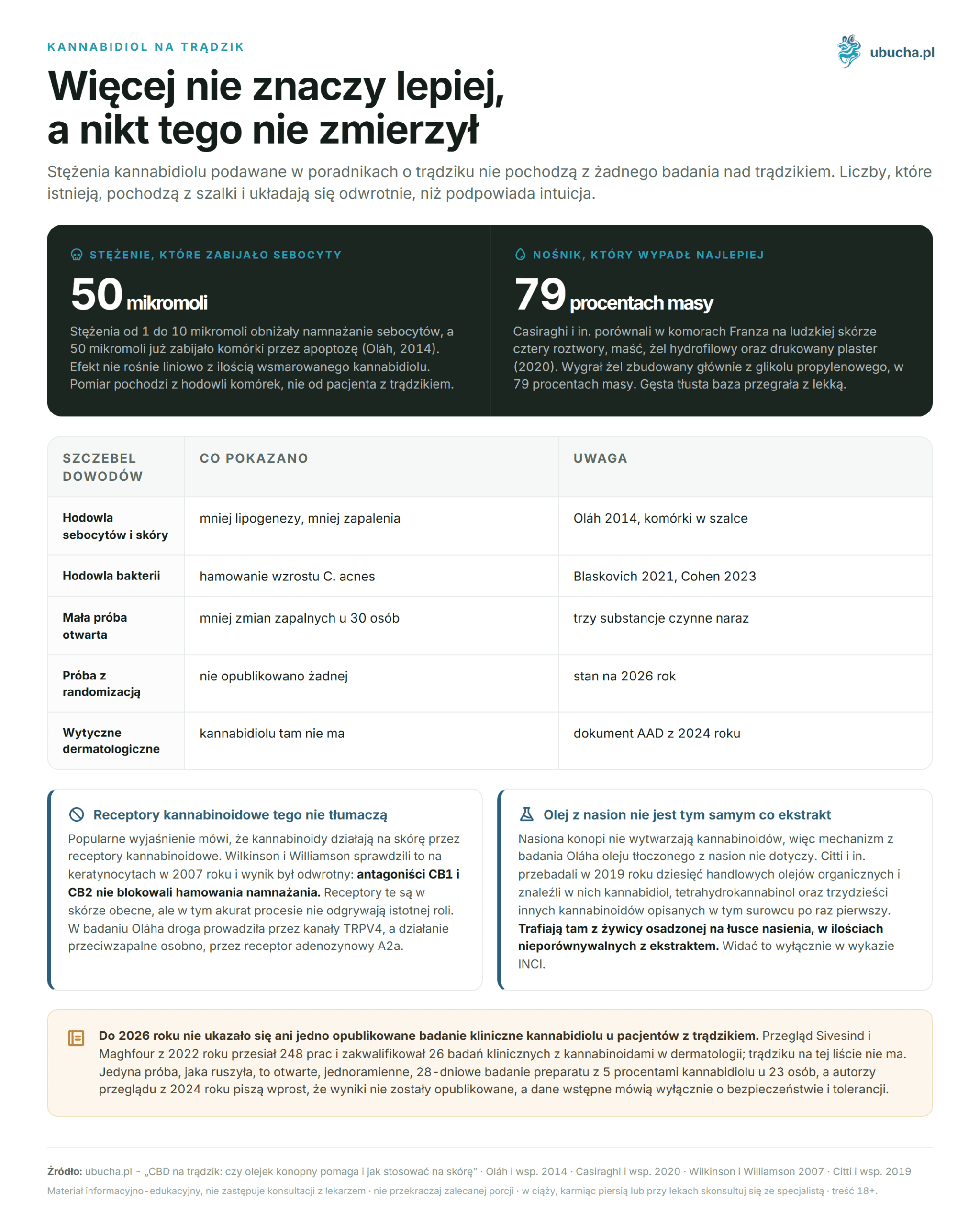
• As of 2026, no clinical study of CBD in acne patients has been published.
• Hemp seed oil (Cannabis Sativa Seed Oil) is not a source of cannabinoids but carries trace amounts of them (Citti et al., Front Plant Sci, 2019).
• Benzoyl peroxide, topical retinoids, and isotretinoin have strong recommendations in the AAD guidelines from 2024.
Does CBD help with acne?
Cannabidiol does exactly what is expected from an acne treatment in cell culture: it reduces sebum production and suppresses inflammation. Whether this translates to the patient’s face is unknown, as no published clinical study of CBD in acne has appeared as of 2026.
This is not a cautious rhetorical figure, but the state of the literature. A systematic review Sivesind, Maghfour et al. (JID Innovations, 2022) sifted through 248 works and qualified 26 clinical studies involving cannabinoids in dermatology. Among them were scleroderma, dermatomyositis, trichotillomania, and bullous pemphigoid. Acne is not on this list.
The review Kuzumi et al. (American Journal of Clinical Dermatology, 2024) describes the only trial that actually started: an open-label, single-arm 28-day study of a product with 5 percent CBD in 23 people with moderate to severe acne. The authors state directly that the results have not been published, and the preliminary data only speak to safety and tolerance, not efficacy.
The latest synthesis (Komane and Kaye, Molecules, 2026) summarizes this bluntly: clinical signals exist, but they come from small, mostly non-randomized trials, on various formulations, usually with several active substances at once. Evidence for lasting benefit remains limited.
What exactly did the Oláh study from 2014 show?
The study Oláh et al. (Journal of Clinical Investigation, 2014) was conducted on cultured human sebocytes and human skin in organ culture. None of its results come from an acne patient. This is an important distinction because in guides this work is sometimes cited as if it were a clinical trial.
The mechanism was described in detail. Cannabidiol inhibited lipogenesis induced by arachidonic acid and a mixture of linoleic acid with testosterone and limited the proliferation of sebocytes by opening TRPV4 channels. Activation of TRPV4 interrupted the pro-lipogenic ERK1/2 MAPK pathway and reduced NRIP1 protein, which regulates lipid metabolism. The anti-inflammatory action followed a separate pathway: through the adenosine A2a receptor, increased TRIB3, and inhibition of NF-kappaB.
It is worth remembering two numbers from this work, cited in the review by Kuzumi et al. Concentrations from 1 to 10 micromoles reduced sebocyte proliferation, and 50 micromoles already killed cells through apoptosis. The effect does not increase linearly with the amount of cannabidiol applied, so the logic of “more means better” has no support here.
The popular explanation that cannabinoids act on the skin through cannabinoid receptors does not correspond to the data. Wilkinson and Williamson (Journal of Dermatological Science, 2007) checked this on keratinocytes: CB1 and CB2 antagonists did not block the inhibition of proliferation. These receptors are present in the skin, but they do not play a significant role in this particular process.
Is hemp oil the same as CBD?
No. Hemp seed oil, listed on the INCI label as Cannabis Sativa Seed Oil, is pressed from seeds, and seeds do not produce cannabinoids. However, this does not mean that the oil is completely devoid of them. Citti et al. (Frontiers in Plant Science, 2019) examined ten commercial organic oils and found cannabidiol, tetrahydrocannabinol, and thirty other cannabinoids described in this raw material for the first time. They come from the resin deposited on the seed coat, in amounts incomparable to the extract, so the mechanism from the Oláh study does not apply to seed oil. Cannabidiol in cosmetics comes from the extract of leaves and flowers.
This distinction has practical implications on the store shelf. Many products described as hemp-based are built on seed oil, not on extracts with cannabinoids, and this is visible only in the INCI list. The brand name or leaf on the packaging does not determine anything: body milk, cooling gel, or massage oil can be pure emollients from seeds, even though they stand next to products with extracts. Read the ingredient list, not the front of the box.
The raw material from seeds is not useless, although extracts have been studied more than the pressed oil itself. In the study Ali and Akhtar (Pakistan Journal of Pharmaceutical Sciences, 2015), a cream with 3 percent hemp seed extract used twice daily for 12 weeks reduced sebum content and erythema on the cheeks more than the base alone. The trial was small and single-blind, and it was conducted on healthy men, not on acne patients. Treat this as a signal, not proof of efficacy.
The review by Komane and Kaye from 2026 went further and excluded seed products from the analysis of efficacy unless the authors confirmed the presence of cannabinoids in them. This is a good measure of how seriously this difference is treated today.
Does CBD from cream reach the sebaceous glands?
No one has demonstrated this in humans with acne, and the path is difficult. Cannabidiol is highly lipophilic, so it gets trapped in the stratum corneum instead of traveling deeper. The amount applied to the skin and the amount that reaches the sebaceous gland are two completely different values.
The most interesting data comes from the work Casiraghi et al. (Pharmaceuticals, 2020). The authors compared four solutions, ointment, hydrogel, and printed patch in Franz chambers on human skin. The hydrogel, mainly composed of propylene glycol, won, making up 79 percent of the mass. The propylene glycol solution also provided significantly greater retention of cannabidiol in the epidermis than the other carriers.
This reverses the intuition that most guides repeat. A thick, greasy base is not the best carrier for CBD, even though it seems a natural choice for a fat-soluble substance. A light gel with propylene glycol worked better.
A separate issue is the labels. The INCI list provides ingredients in descending order of proportion, not in milligrams, so you rarely read how much cannabidiol is actually in the cream from the packaging. Concentrations like “0.8-1.2 percent” or “250-350 mg per 30 ml,” which circulate in Polish acne guides, do not come from any study on acne, as no such study has been published.
Does CBD fight Cutibacterium acnes bacteria?
In vitro, partially yes, in humans it is unknown. Cutibacterium acnes is a Gram-positive bacterium, and it is precisely on this group that cannabidiol performs best in the laboratory. However, from limited data, it is difficult to draw conclusions about its action on the skin of a patient.
The work Blaskovich et al. (Communications Biology, 2021) tested cannabidiol on a wide panel of pathogens. It showed activity against Gram-positive bacteria, including resistant strains of Staphylococcus aureus, Streptococcus pneumoniae, and Clostridioides difficile, good efficacy against biofilms, and low propensity to induce resistance. The mechanism is the disruption of the bacterial membrane, not blocking a single enzyme.
Directly on Cutibacterium acnes, Cohen et al. (eCAM, 2023) looked. Concentrations of 5 and 10 micrograms per milliliter inhibited the growth of this bacterium, and an extract from Centella asiatica enhanced this effect. The team built a preparation from this and tested it on 30 people: the number of inflammatory lesions and the level of porphyrins decreased significantly. The catch is that the formulation contained three active substances at once, so the benefits cannot be attributed solely to cannabidiol.
What acne treatments have proven efficacy?
Acne is one of those skin diseases where it is well known what works. The 2024 guidelines from the American Academy of Dermatology strongly recommend benzoyl peroxide, topical retinoids, topical antibiotics, and oral doxycycline. Isotretinoin has a strong recommendation in severe forms.
Conditional recommendations include clascoterone, salicylic acid, and azelaic acid, and among oral medications, minocycline, sarecycline, a combination oral contraceptive pill, and spironolactone. A good practice is to combine topical preparations with different mechanisms and limit systemic antibiotics.
| Method | Status in AAD 2024 guidelines | Practical note |
|---|---|---|
| Benzoyl peroxide | Strong recommendation | Limits bacterial resistance, can be irritating |
| Topical retinoids | Strong recommendation | Foundation for comedonal therapy, requires SPF filter |
| Topical antibiotics | Strong recommendation | Combine with benzoyl peroxide, do not use solo |
| Oral doxycycline | Strong recommendation | Short courses, with topical therapy |
| Isotretinoin | Strong recommendation in severe forms | Also for scarring and significant psychological burden |
| Azelaic acid, salicylic acid, clascoterone | Conditional recommendation | Options for intolerance to first-line treatment |
| Topical cannabidiol | Not present in guidelines | No published clinical study in acne |
How to sensibly use a CBD product for acne?
Treat it as skincare alongside treatment, not instead of it. With this assumption, a cannabidiol product will not harm, and for skin irritated by a retinoid, it can be a pleasant complement. There are a few things worth checking before purchasing and during use.
- Read the INCI, not the slogan on the front of the package. Cannabidiol or Cannabis Sativa Leaf Extract is an extract with cannabinoids. Cannabis Sativa Seed Oil is seed oil, which is an emollient supporting the skin barrier.
- Do not count on a declaration of content. Cosmetic manufacturers rarely provide it, and concentrations from online guides are fabricated.
- Choose light formulas. The work by Casiraghi et al. indicates a hydrogel, not a thick greasy balm.
- Do not apply concentrated sublingual oil to your face. This is a product for a different purpose and has a different viscosity.
- Forget comedogenicity tables. The numbers attributed to oils come from tests on rabbit ears and describe the raw material, not the formulation.
- Introduce one product at a time and give it 8-12 weeks. Acne has natural fluctuations, so shorter observation does not resolve anything.
The last point has solid backing. Draelos and DiNardo (JAAD, 2006) tested ready-made cosmetics using the Mills and Kligman method on volunteers and concluded that a product containing an ingredient considered comedogenic does not have to clog pores. Check a specific cream on yourself, not its ingredients in an online table. More about what hemp cosmetics can actually do can be found in the post hemp cosmetics: CBD cream, serum, and balm.
When to go to a dermatologist instead of experimenting?
There are situations where delaying costs the skin for years. Nodular and cystic changes, the first scars from acne, and post-inflammatory hyperpigmentation require treatment, not another serum. The AAD guidelines explicitly mention scarring and psychological burden as indications for isotretinoin.
Also, go to the office if you do not see improvement after about 12 weeks of consistent skincare, if acne suddenly appears in an adult woman along with irregular menstruation or excessive hair growth, or if the changes start to govern your mood and avoidance of people. None of these scenarios is a task for a cosmetic. A dermatologist also has tools that you cannot buy at a drugstore: steroid injection into a single large nodule, spironolactone, or a combination pill in hormonal acne, and the decision about isotretinoin. All three are mentioned in the AAD document from 2024.
Support from within should also be based on what has been studied. Oral zinc has some research backing in acne, which we discuss in the text zinc for immunity and acne. Oral cannabidiol has not been studied for this indication at all, so the doses given in guides are made up.
Frequently asked questions
Does CBD help with acne?
In the culture of human sebocytes, cannabidiol reduced sebum production and suppressed inflammation (Oláh et al., J Clin Invest, 2014). This is a laboratory result, not from a clinic. As of 2026, no clinical study of CBD in acne patients has been published, so its effectiveness in humans remains undetermined.
Does hemp seed oil clog pores?
The comedogenic numbers attributed to oils come from tests on rabbit ears and pertain to the raw material, not the finished cosmetic. Draelos and DiNardo (JAAD, 2006) showed that a product with an ingredient considered comedogenic does not have to be comedogenic. Instead of a table, check a specific cream on a small patch of skin for two weeks.
How much CBD should an acne product contain?
It is impossible to provide a sensible number because there is no study that would establish an effective dose for the skin. Manufacturers rarely declare the cannabidiol content because the INCI list provides the order of ingredients, not their quantity. Concentrations circulating in guides have no source.
Can a CBD product be combined with a retinoid or benzoyl peroxide?
There is no data on interactions, but also no reason to abandon treatment with proven effectiveness. The AAD guidelines from 2024 strongly recommend benzoyl peroxide and topical retinoids. Treat the CBD product as skincare alongside therapy, not instead of it, and introduce it separately.
How long does it take to see the effect of a CBD product?
It is unknown because there is no published study that has measured this. In dermatology, it is accepted that assessing acne treatment requires about 12 weeks. If there is no improvement after this time, it is a signal to consult a dermatologist, not to buy a stronger cosmetic.
If you are looking for a hemp product for daily care, the current assortment can be found in the hemp cosmetics category. Check the label to see if you are dealing with an extract or seed oil.
This article is for informational and educational purposes and does not constitute medical advice. Before starting to use cannabis or CBD for therapeutic purposes, consult a doctor, especially if you are taking other medications, are pregnant, or breastfeeding.
Author: Michał Waluk · Published: 2026-05-20 · Updated: 2026-08-14