
The Impact of Marijuana on Music Perception: Neurobiology, Time Dilation, and Cultural Context
THC changes memory, emotions, and sense of time, not hearing itself. We examine what controlled studies show about cannabis, music, and CBD, and what the law says.
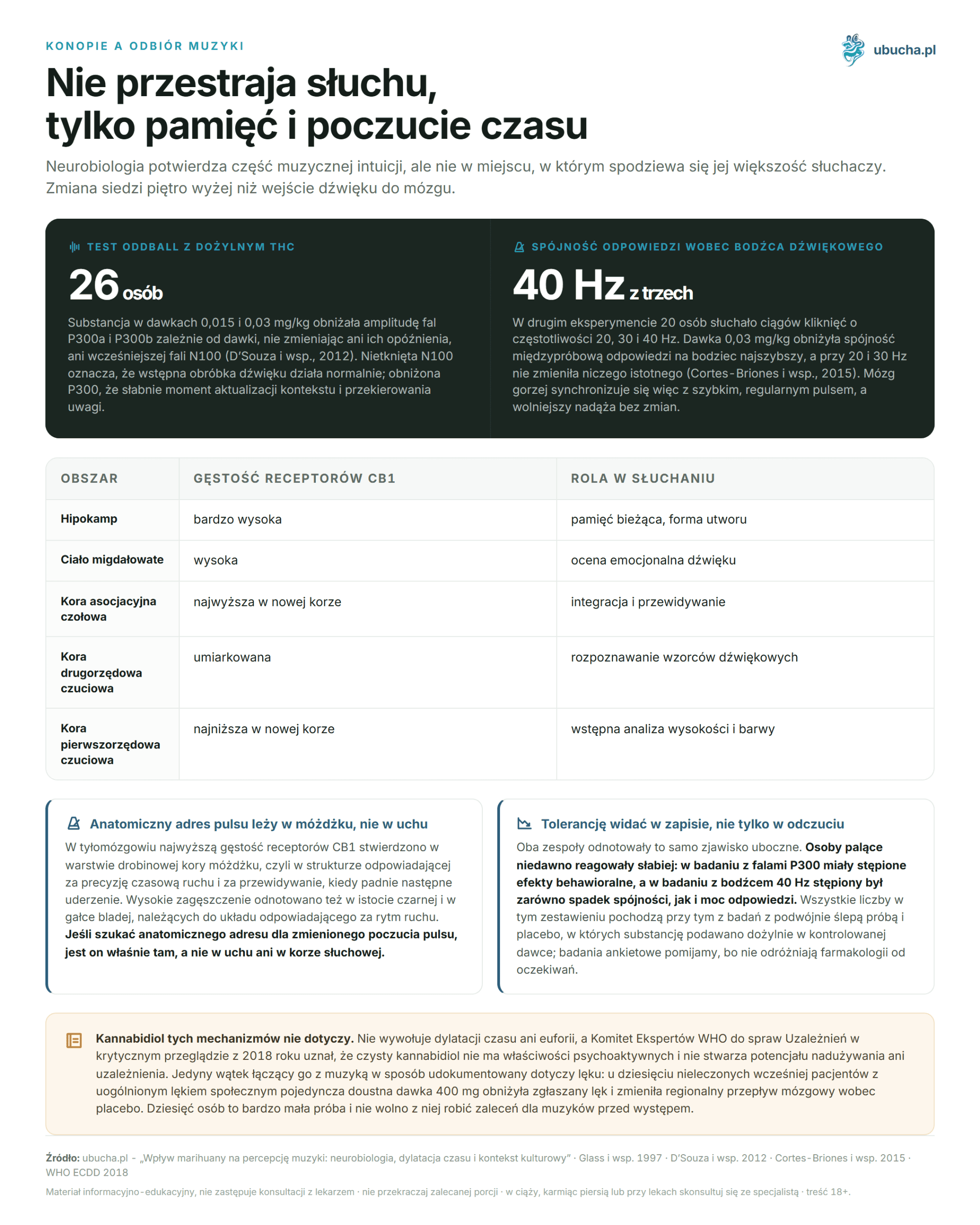
Musicians have been saying for a hundred years that the same record sounds different under the influence of cannabis. Neurobiology confirms part of this intuition, just not in the place where most listeners expect it. Autoradiography of the human brain shows that CB1 receptors are densest in the hippocampus and amygdala, and rarest in the primary sensory cortex, which includes the primary auditory cortex. THC does not retune hearing. It retunes what the brain does with sound afterwards: memory, emotion, and sense of time. Below we show what can be said based on controlled studies with intravenous THC, where the evidence ends and the cultural narrative begins, as well as what the legal situation in Poland looks like in August 2026.
KEY INFORMATION
• CB1 receptors are densest in the hippocampus and rarest in the primary sensory cortex (Glass et al., 1997).
• Intravenous THC reduces the amplitude of P300 waves in the auditory oddball test without changing their latency (D’Souza et al., 2012).
• At every studied dose of THC, participants overestimated the passage of time (Sewell et al., 2013).
• Recreational marijuana remains illegal in Poland.
How does marijuana change music perception?
THC changes three things at once: it stretches the subjective sense of time, weakens current memory, and lowers the accuracy with which the brain tracks rapid sound events. The threshold of hearing and initial sound analysis remain intact. The listener thus gains in the intensity of experience but loses in the precision of analysis.
This distinction has practical significance. The same piece becomes subjectively longer, emotionally stronger, and less structurally readable at the same time. For a pop song with a clear chorus, the difference can be subtle. For a jazz or ambient piece, where texture and space matter more than the main melody, the change is pronounced.
It is important to separate pharmacology from expectations. Music is a stimulus in which the effect of suggestion works particularly strongly: a listener who expects a deeper experience usually reports it. Therefore, all the numbers in this text come from double-blind studies with placebo, in which THC was administered intravenously at a controlled dose. We omit studies based on surveys among users because they do not distinguish one from the other.
Where in the brain are CB1 receptors and what does it mean for listening?
Quantitative autoradiography of eight adult human brains showed that cannabinoid receptors are distributed very unevenly. The highest concentrations are in the hippocampus, high in the entorhinal cortex and amygdala, and the lowest in the new cortex are found in the primary sensory and motor fields (Glass et al., 1997).
The conclusion is less spectacular than the common narrative about heightened hearing, but it better explains the data. Cannabis acts most strongly where the brain assigns meaning to sound and weakest where it simply analyzes it.
| Area | Density of CB1 receptors | Role in listening |
|---|---|---|
| Hippocampus (dentate gyrus, Ammon’s horn, support) | very high | current memory, tracking the form of the piece |
| Amygdala, entorhinal cortex | high | emotional evaluation of sound |
| Association cortex of the frontal and limbic lobes | highest in the new cortex | integration, prediction, self-control |
| Secondary sensory and motor cortex | moderate | pattern recognition of sounds |
| Primary sensory and motor cortex | lowest in the new cortex | initial analysis of pitch and timbre |
It is worth comparing this with the anatomy of hearing itself. Belin and colleagues showed that areas specialized in processing the human voice are located in the upper part of the temporal lobe, outside the primary cortex (Belin et al., 2000). It is these processing layers, not the first entry of sound, that neighbor regions rich in CB1.
One place on this map eludes all stories about “heightened hearing,” and for music, it matters more than the cortex. In the hindbrain, the highest density of CB1 receptors was found in the molecular layer of the cerebellar cortex, which is responsible for the temporal precision of movement and for predicting when the next beat will occur. High density was also noted in the substantia nigra and globus pallidus, which belong to the system responsible for the rhythm of movement. If you are looking for an anatomical address for the altered sense of pulse, it is right there, not in the ear or the auditory cortex.
What do EEG measurements say about listening under the influence of THC?
The closest to music are two experiments with intravenous THC and auditory stimuli. In the first, 26 healthy individuals performed a three-stimulus oddball test while EEG was recorded. THC at doses of 0.015 and 0.03 mg/kg reduced the amplitude of P300a and P300b waves depending on the dose, without changing their latency or the earlier N100 wave (D’Souza et al., 2012).
This result is surprisingly precise. The untouched N100 wave means that the initial processing of sound works normally. The reduced P300 means that the moment when the brain updates context and redirects attention to something new weakens. The authors also noted that the decrease in P3b amplitude was accompanied by an increase in reported perceptual changes.
The second experiment involved 20 individuals listening to sequences of clicks at frequencies of 20, 30, and 40 Hz. THC at a dose of 0.03 mg/kg reduced inter-trial coherence of responses to the 40 Hz stimulus, while at 20 and 30 Hz, it did not change anything significant (Cortes-Briones et al., 2015). The brain under the influence of THC synchronizes worse with a fast, regular pulse, while slower ones keep up unchanged. We noted that this is the only hard evidence supporting the common observation that dense and fast rhythms are tiring, while slow ones are engaging.
Both teams also noted the same side effect, which is rarely discussed. Recently smoking individuals reacted more weakly: in the study with P300 waves, they had blunted behavioral effects, and in the study with the 40 Hz stimulus, both the decrease in coherence and the strength of responses were blunted. Tolerance is therefore not just a matter of subjective dose feeling. It is visible in the raw electrical recording from the surface of the head. For the listener, this means that the experience described by an occasional smoker and that by a daily smoker are two different physiological phenomena, not two opinions about the same thing.
Why does music stretch in time under the influence of THC?
Because the internal clock runs faster, not slower. In a study where 44 individuals received intravenous THC at doses from 0.015 to 0.05 mg/kg, each dose caused overestimation of time intervals and their too brief replay. The effect did not depend on the dose, and in frequent smokers, it was diminished (Sewell et al., 2013).
The direction is opposite to the popular explanation. If the clock ticks faster, then in the same objective second, there are more ticks, so the interval seems longer. Hence the impression that a pause weighs heavily, a string’s reverberation does not end, and a three-minute piece lasts like a six-minute one. The authors also noted that chronic smoking itself did not change the baseline sense of time; it only changed the reaction to the dose.
Music does part of this work itself, without any substance. A review of studies on the impact of music on the representation of space and time lists dozens of such observations, but its authors conclude that the evidence remains inconsistent and does not yet fit into a single model (Schäfer, Fachner, and Smukalla, 2013). Separating what the piece does from what THC does has not yet been conducted in a single experiment.
There is one more observation from the time study that contradicts common thinking about dosage. The effect did not increase with the amount of THC administered: overestimation appeared even at the lowest dose and did not deepen at the highest. The sense of time behaves like a switch, not a knob. This distinguishes it from changes in brain waves, which increased proportionally in the same dose ranges. Two effects of the same substance, measured in the same laboratory, have completely different characteristics, and there is no reason to describe them in one sentence about “potency of the high.”
Does marijuana really increase the pleasure of listening to music?
There is no direct measurement, but there are two strong pieces of the puzzle. The first concerns the music itself: a study using positron emission tomography showed the release of endogenous dopamine in the striatum at the moment of peak musical emotion, with the caudate nucleus active in the anticipation phase and the nucleus accumbens at the climax (Salimpoor et al., 2011).
Music itself thus reaches for the same reward system that psychoactive substances act on. The second piece is the observation that intravenous THC induces euphoria and perceptual changes in healthy volunteers (D’Souza et al., 2004). Combining both provides a credible hypothesis, not proof: no one has yet measured dopamine release while listening to music under the influence of THC.
The decisive factor here is the individual. In a study of 22,252 individuals, reactions to unknown musical fragments predicted personality traits, most strongly openness to experience and extraversion, beyond what demographic data provided (Nave et al., 2018). Since the reaction to music is so strongly individualized even when sober, expecting one common effect of THC has no basis.
The authors repeated this result in a second sample of 21,929 individuals, this time based on likes of artists on a social media platform instead of reactions to recordings. The consistency of both measurements is significant for our question, as it shows that we are talking about a lasting disposition, not a mood from the day of the study. A person who soberly seeks complexity in music and a person who seeks solace in it enter two different experiences under the influence of THC, despite the same dose and the same playlist.
How does weakened memory change tracking the form of a piece?
In a study involving 22 healthy individuals, intravenous THC at doses of 2.5 and 5 mg disrupted both immediate and delayed word recall while preserving recognition and worsened working memory, verbal fluency, and resistance to distraction (D’Souza et al., 2004). Orientation remained intact.
This pattern translates directly to music. Preserved recognition means that the theme sounds familiar when it returns. Disrupted recall means that it cannot be summoned on its own when it is not playing. The musical form lives in this second ability: to hear that a fugue intertwines the theme with the counter-theme, one must hold the first in mind when the second enters.
Therefore, under the influence of THC, music with a structure stretched in time loses the most. A sonata, fugue, long progressive suite, or elaborate solo require working memory, which is currently weakened. Music built on repetition and texture, like dub, drone, or minimal, does not impose such a requirement at all. This does not mean that one is better than the other, only that the former costs more under the influence than it gives.
Why does music become unpleasant for some people under the influence?
Because the same mechanism that deepens the experience begins to produce anxiety at higher doses. In a study with intravenous THC in 22 healthy volunteers, both euphoria and increased anxiety, perceptual changes, and transient symptoms resembling psychosis were recorded, along with an increase in cortisol levels in plasma (D’Souza et al., 2004). These were not two different groups of subjects, but the same individuals after the same substance.
The electrical recording of the brain shows this relationship even more clearly. In a study with a 40 Hz stimulus, the more THC disrupted the coherence of responses to the fast pulse, the higher the scores on the PANSS positive and negative symptom scales (Cortes-Briones et al., 2015). The same measure that describes losing the rhythm also describes the unpleasant perception of the entire situation.
The practical conclusion is uncomfortable for both sides of the cannabis debate. There is no separate “good” musical effect and a separate “bad” anxiety effect that could be separated by strain selection or playlist. There is one mechanism disrupting stimulus processing, which reads as depth at low intensity and as overstimulation at high intensity. The transition point depends on the dose, experience, and baseline state, not on what is currently playing through the speakers. The anxious side of THC’s action, along with data on psychosis, is discussed separately in our entry on the impact of marijuana on mental health.
Where did the connection between popular music and cannabis come from?
From discography, not from the laboratory. References to marijuana have appeared in popular recordings since the 1930s and return in various genres with a regularity that cannot be explained by coincidence. However, this fact does not prove that cannabis shaped the sound of these genres, as no study has been conducted that separates the influence of the substance from the influence of the environment in which it was created.
| Year | Recording | Genre |
|---|---|---|
| 1932 | Cab Calloway, “Reefer Man” | jazz |
| 1978 | Bob Marley and The Wailers, “Kaya” | reggae |
| 1992 | Dr. Dre, “The Chronic” | hip-hop |
| 1993 | Snoop Doggy Dogg, “Doggystyle” | hip-hop |
| 2009 | Kid Cudi, “Man on the Moon: The End of Day” | hip-hop |
Historically, the legal context is more important than the songs themselves. Marijuana has been a cheaper and less persecuted substance in these environments than alcohol, and later became a symbol of identity for entire scenes, from Jamaican to Western American. This is enough to explain the presence of the motif in lyrics without assuming that it changed the harmonic structure of the genre.
Caution is warranted here, as many certainties circulate in this same narrative that no one has verified. Statements like “this album was made for the listener under the influence” usually describe the reception of the record, not the intentions of its creators, and in that form, they are worth reading. The same problem with unverified certainties is evident with the code 420, whose history and debunked myths we discuss in a separate text.
Which genre of music works best with cannabis?
The answer can be derived from three measured effects of THC, rather than from surveys. Since synchronization with a 40 Hz pulse worsens, working memory weakens, and time is overestimated, the least is lost in pieces with a slow tempo, repetitive structure, and long reverberations. The most is lost in those that require holding a theme from two minutes ago in mind.
| Feature of the piece | What happens to it under the influence of THC | Example genres |
|---|---|---|
| Slow tempo, long reverberations | gains: stretched time gives more room for detail | dub, ambient, drone |
| Repetitive, modular structure | gains: does not require working memory | minimal, krautrock, reggae |
| Strong emotional charge | gains: limbic areas are rich in CB1 | ballad, soul, modal jazz |
| Dense, fast rhythm | loses: worse synchronization with a fast pulse | bebop, drum and bass |
| Elaborate form with a recurring theme | loses: weakened recall from memory | fugue, sonata, progressive rock |
This table is a conclusion from the data, not a result of a study. There is no experiment that has given people THC and measured their genre preferences under controlled conditions. Treat it as a hypothesis to test on your own equipment, not as a recommendation.
Does CBD also affect music perception?
CBD does not cause time dilation or euphoria, so the mechanisms described above do not apply to it. The WHO Expert Committee on Addiction in a critical review in 2018 concluded that pure cannabidiol has no psychoactive properties and does not create potential for abuse or dependence, and recommended not including it in international control (WHO ECDD, 2018).
The only thread that connects CBD with music in a documented way concerns anxiety. In a study involving ten previously untreated patients with generalized social anxiety, a single oral dose of 400 mg of CBD reduced reported anxiety and changed regional brain flow in limbic and perilimic structures compared to placebo (Crippa et al., 2011).
Ten individuals is a very small sample and should not be made into recommendations for musicians before performances. The signal is, however, consistent with what performers themselves describe: stage fright is a barrier to technical freedom, not a flaw in technique. If CBD were to reduce it without a psychoactive effect, it would be an action exactly opposite to the profile of THC, which increases freedom at the cost of precision.
Does creating music under the influence work better or worse?
It depends on the stage. Data from studies on THC indicate a decrease in self-control and altered perception while simultaneously worsening working memory and verbal fluency (D’Souza et al., 2004). The first may help in finding ideas, the latter hinders everywhere where it is necessary to compare two versions and remember both.
The mixing and mastering stage is the purest case of this. Assessing whether the bass is one and a half decibels too loud requires comparing the state from a moment ago with the current state, which is exactly the ability that THC weakens. Additionally, worse synchronization with a fast pulse makes it difficult to assess rhythmic tightness.
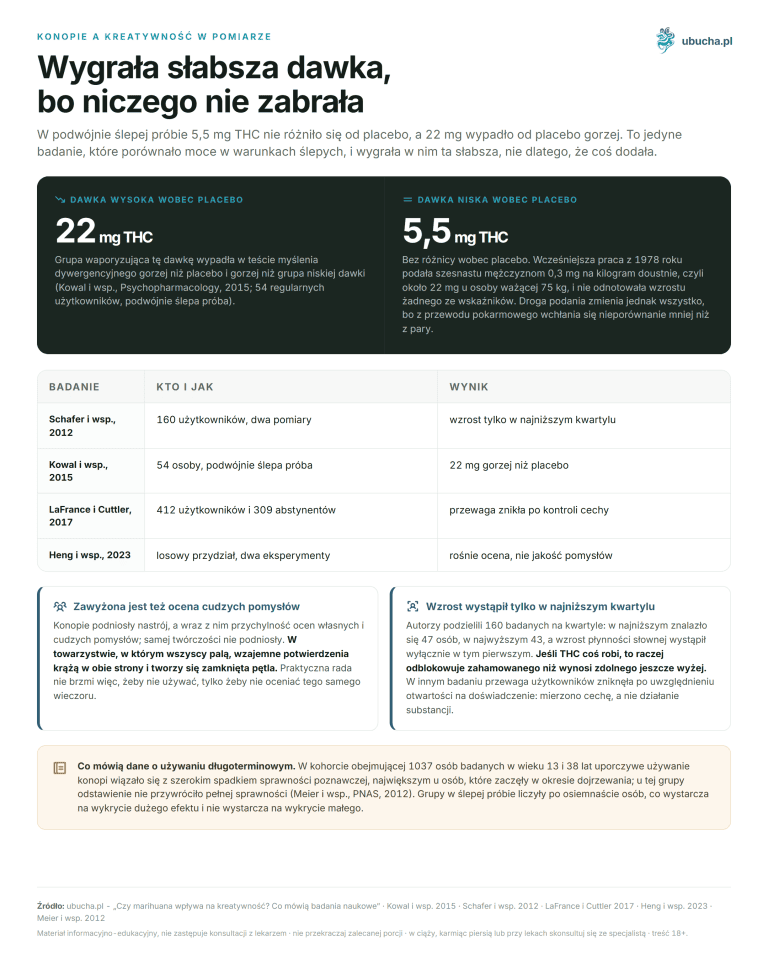
At the sketching stage, the account looks different because there is nothing to compare yet. An idea that sober self-control would reject after two bars gets a chance to play out to the end. How much of this remains after returning to sobriety is a separate question, and studies on creativity alone answer it ambiguously. We break them down into factors in a separate text on whether marijuana affects creativity.
The practical conclusion is banal and therefore easy to overlook: separate stages in time, not in intention. Sketching sessions and decision-making sessions require different states of attention, so combining them into one sitting costs regardless of whether any substance is involved.
What is the legal status in Poland?
Recreational marijuana remains illegal in Poland, and possession of narcotic substances is a crime under Article 62 of the Act on Counteracting Drug Addiction. Legal products from industrial hemp and medical marijuana prescribed remain legal. This article is informational and does not encourage breaking the law.
The boundary between the two is defined by the definition in Article 4 point 5 of the Act of July 29, 2005 on Counteracting Drug Addiction (Journal of Laws 2023 item 1939), as amended by the Act of March 24, 2022 (Journal of Laws 2022 item 763). Industrial hemp refers to plants in which the sum of delta-9-THC and tetrahydrocannabinolic acid in flowering tops or fruit does not exceed 0.3% of dry mass, rounded to one decimal place.
Two details of this definition are often misrepresented. First, the threshold concerns the sum of delta-9-THC and THCA, not just delta-9-THC, which changes the result of laboratory testing. Second, the Polish threshold does not arise from EU law: it is a separate regulation with the same numerical value as the threshold from Regulation (EU) 2021/2115, applicable from January 1, 2023. The previous EU threshold was 0.2%. Cannabidiol does not appear in any lists of controlled substances, while HHC is a controlled substance in Poland. The amendment effective from August 27, 2026 does not change either the threshold, the classification of substances, or the rules of retail sale.
Summary
The impact of cannabis on music perception is real and measurable, but it proceeds differently than the common narrative suggests. Hearing remains intact: the N100 wave did not budge in any of the controlled studies. What changes is what happens next, namely context updating, synchronization with a fast pulse, current memory, and sense of time.
From these four changes, the rest follows. Slow, repetitive, and emotional pieces gain, while elaborate forms with a recurring theme lose, and sound production loses the most at the stage where comparisons must be made. CBD stands outside this picture, as it does not act psychoactively. In Poland, THC remains illegal, while products from industrial hemp up to 0.3% of the sum of THC and THCA are available for sale.
It is also worth noting what is not in this picture. There is no study that has given people THC and measured their musical preferences. There is no measurement of dopamine during music listening under the influence. There are no data comparing headphones with speakers. Everything that can be said today about genres and equipment is a conclusion drawn from studies that did not concern music. This difference between measurement and conclusion disappears in most texts about cannabis and music, and it is the only thing that allows distinguishing description from advertising.
Frequently Asked Questions
Does marijuana really change music perception, or is it just suggestion?
It changes it in reality. In double-blind studies, intravenous THC reduced the amplitude of P300 waves in the auditory oddball test and worsened synchronization with the 40 Hz stimulus. Suggestion adds to it, so only measurements with placebo are reliable, not surveys among users.
Why does time seem to flow differently under the influence of cannabis?
Because the internal clock speeds up. At doses from 0.015 to 0.05 mg/kg of intravenous THC, participants overestimated time intervals and replayed them too briefly. More ticks in the same second give the impression that the piece lasts longer. The effect did not increase with the dose.
Does CBD change music perception?
Not in a psychoactive sense. The WHO recognized in 2018 that pure cannabidiol has no psychoactive properties. However, its impact on anxiety is documented: 400 mg orally reduced anxiety and changed brain flow in ten patients with social anxiety, which is a very small sample.
Which genre of music works best with cannabis?
No study has verified this. Measurements indicate that least is lost in slow, repetitive pieces with long reverberations, such as dub, ambient, and reggae, while most is lost in complex forms with a recurring theme, like fugue or progressive rock. This is a conclusion from the data, not an experimental result.
Does marijuana help in composing and mixing?
THC lowers self-control, which can be helpful in finding ideas, but it weakens working memory and verbal fluency. Mixing and mastering rely on comparing two versions from memory, so they suffer the most. Studies on creativity alone do not provide a clear answer.
Do headphones or speakers perform better under the influence of cannabis?
There is no data from studies on this. From the described mechanisms, it only follows that both mediums remain untouched at the level of hearing itself, as early sound processing does not change. The difference you hear concerns attention and emotions, not hearing sharpness.
Is listening to music under the influence of marijuana legal in Poland?
No, because possession itself is illegal. Article 62 of the Act on Counteracting Drug Addiction is responsible for this. Medical marijuana on prescription and products from industrial hemp, where the sum of delta-9-THC and THCA does not exceed 0.3% of dry mass, remain legal.
Legal products from industrial hemp in Poland, including oils, can be found in the hemp oil category.
This article is informational and educational and does not constitute medical advice. Before starting to use cannabis or CBD for therapeutic purposes, consult a doctor, especially if you are taking other medications, are pregnant, or breastfeeding.
Author: Michał Waluk · Published: 2026-05-10 · Updated: 2026-08-10