
How to Choose a CBD Dose - Drops, mg, Effects - Guide 2026
How to convert CBD oil drops to milligrams, how much substance reaches the blood, what doses were used in studies, and what daily amount EFSA considers safe.
The most common question about CBD oil is: how many drops to take. This question has no good answer because a drop is not a dose unit. The same drop from a 5% bottle and a 30% bottle differs sixfold in content, and manufacturers list milligrams on the label. There is also a second unknown: how much of the taken portion actually reaches the bloodstream. A systematic review of cannabidiol pharmacokinetics in humans showed this value was measured only for one administration route (Millar, Frontiers in Pharmacology, 2018). This guide shows how to convert bottle content to milligrams, what doses were actually used in clinical studies, and what daily amount EFSA currently considers safe.
KEY INFORMATION
• In 2026, EFSA derived a provisional safe dose of 0.0275 mg per kilogram of body weight per day, about 2 mg for a 70 kg person (EFSA, 2026).
• Cannabidiol safety cannot be established for individuals under 25 years old, pregnant or breastfeeding women, or those taking medications.
• A drop is a volume, not a dose. Milligrams are calculated from concentration and bottle volume.
• In humans, bioavailability was measured only after smoking and was 31%; no measurement exists for drops or capsules.
Why is there no single CBD dose for everyone?
Because a dose effective in one study may not work in another, not due to human differences but due to the substance itself. In a randomized study with 57 healthy men, single oral doses of 150 mg, 300 mg, and 600 mg were compared to placebo. Only the middle dose reduced public speaking anxiety (Linares, Revista Brasileira de Psiquiatria, 2019).
This result cannot be translated into a simple rule “more means stronger.” The authors described it as an inverted U-shaped curve and emphasized that optimal doses must be determined separately for each use before applying study results in practice.
The second reason is pharmacokinetic. Cannabidiol is metabolized in the liver, and its blood concentration depends on the preparation form, food presence, and other medications. A review of cannabinoid pharmacokinetics and pharmacodynamics describes this variability as the main reason doctors lack data for simple dose conversions between patients (Lucas, British Journal of Clinical Pharmacology, 2018).
The third reason is the most mundane. Most people do not know how many milligrams they take because they count drops. As long as the unit remains a drop, no self-observation is repeatable because it changes with the bottle, pipette, and oil temperature. Therefore, this guide starts with arithmetic, not a recommendation table.
How many milligrams of CBD are in one drop of oil?
It depends solely on concentration and bottle volume, calculated in two steps. The percentage concentration means the mass of cannabidiol in 100 ml of preparation, so 5% oil contains 5 g in 100 ml, i.e., 500 mg in a 10 ml bottle. Dividing by volume gives milligrams per milliliter. Dividing by the number of drops per milliliter gives milligrams per drop.
The table below is an arithmetic conversion, not a dosage recommendation. It assumes 30 drops per milliliter, a typical pipette value. The actual number of drops depends on oil viscosity, temperature, and bottle angle, so treat the result as an approximation, not a measured portion.
| Concentration | CBD in 10 ml bottle | CBD in 1 ml | CBD per drop (30 drops/ml) |
|---|---|---|---|
| 5% | 500 mg | 50 mg | approx. 1.67 mg |
| 10% | 1000 mg | 100 mg | approx. 3.33 mg |
| 15% | 1500 mg | 150 mg | 5 mg |
| 20% | 2000 mg | 200 mg | approx. 6.67 mg |
| 30% | 3000 mg | 300 mg | 10 mg |
This shows why the instruction “ten drops in the morning” means nothing without concentration. Ten drops of 5% oil is about 17 mg, and ten drops of 30% oil is about 100 mg. The difference is sixfold and covers the entire range distinguished in clinical studies. To compare two products, compare milligrams per milliliter, not the number of drops on the label.
How to convert any bottle to milligrams?
You need two numbers from the label: total cannabidiol content and preparation volume. Content divided by volume gives milligrams per milliliter, and that number divided by 30 gives approximate milligrams per drop. A 30 ml bottle with 1500 mg contains 50 mg per milliliter and about 1.67 mg per drop, exactly the same as 5% oil in a smaller package.
This example is worth remembering because it shows that bottle volume and concentration are two independent pieces of information. A manufacturer may sell the same preparation in 10 ml and 30 ml packages, describing the first as 5% and the second only by total mass. Without conversion, these look like two different products.
A more accurate method than counting drops is a pipette with a scale. Measuring 0.25 ml or 0.5 ml gives a repeatable result, independent of viscosity and temperature. For 10% oil, half a milliliter is 50 mg regardless of how many drops come out. For comparing your own observations day to day, this matters more than conversion precision.
Also check if the declared content is supported by a batch analysis certificate. The label is the manufacturer’s declaration, and the certificate is a measurement result. If you base dose selection on label arithmetic, its reliability limits the accuracy of everything else. More about choosing concentration is in the text Which CBD Concentration to Choose.
How do you know the bottle contains what the label declares?
You don’t know from the label alone because it is the manufacturer’s declaration, not a measurement result. All arithmetic in the previous section relies on two numbers from the package, so its accuracy cannot exceed the accuracy of those numbers. A verifiable confirmation is a certificate of analysis issued for a specific production batch.
The certificate is issued by an external laboratory and lists measured contents of individual cannabinoids and usually contamination test results. The batch number on the document must match the number embossed on the bottle. A certificate for another batch says nothing about the product in your hand, though it looks equally credible.
Purity is not a trivial formality. The provisional safe dose set by EFSA applies only to dietary supplements with cannabidiol purity of at least 98%, without nanoparticles, produced by a process recognized as safe and excluding genotoxicity. Outside this scope, the panel does not express any value, so relating your portion to this number requires knowledge of product purity.
A cannabidiol safety review highlights the other side of the same problem. Authors point out that cannabidiol’s impact on liver enzymes and drug transporters is still insufficiently studied, and most clinical data come from epilepsy and psychotic disorder studies (Iffland, Cannabis and Cannabinoid Research, 2017). A product with unknown composition adds an unknown variable that cannot be compensated by dosing precision.
How much THC can legal CBD oil contain in Poland?
The threshold is 0.3%, calculated as the sum of delta-9-THC and tetrahydrocannabinolic acid (THCA), converted to dry mass and rounded to one decimal place. The basis is Article 4 point 5 of the Act of July 29, 2005 on counteracting drug addiction (consolidated text Journal of Laws 2023 item 1939), as amended by the Act of March 24, 2022 (Journal of Laws 2022 item 763).
The calculation method matters practically because it changes the lab test result. Plant material mainly contains THCA, which converts to delta-9-THC only under heat. Measuring delta-9-THC alone would give a seemingly lower result, but the regulation explicitly refers to the sum of both compounds.
The national threshold corresponds to the EU threshold but does not derive from it. Since January 1, 2023, hemp varieties eligible for support under the Common Agricultural Policy may contain up to 0.3% THC based on Article 4 paragraph 4 of Regulation (EU) 2021/2115. Previously, the EU threshold was 0.2% from Regulation 1307/2013, repealed on January 1, 2023. These are two separate regulations with the same numeric value.
For someone counting milligrams, the conclusion is that a full-spectrum product contains THC in an amount limited by law but not zero. If you work in a profession subject to psychoactive substance testing, this matters regardless of the chosen cannabidiol portion. A separate regulation expressed in milligrams per kilogram applies to food from hemp seeds and does not concern oils.
Is full spectrum counted differently than isolate?
Arithmetically, no; regarding official values, yes. Milligrams of cannabidiol are calculated from the label the same way in every preparation. The difference appears only when comparing your portion to EFSA’s provisional safe dose, which has a composition condition.
The panel specified that the derived number applies only to dietary supplements with cannabidiol purity of at least 98%, without nanoparticles, produced by a process recognized as safe and excluding genotoxicity. A full-spectrum product by definition contains other cannabinoids and terpenes, so it does not fit this description. This does not mean it is more dangerous, only that EFSA’s position simply does not cover it and no reference value exists.
The same applies to pharmacokinetic data. The food effect study was conducted on capsules containing 99% pure cannabidiol, and the tolerance study on an oral solution of purified cannabidiol. Both describe the behavior of a single substance, not a mixture. Applying them directly to multi-ingredient preparations is an assumption neither study verified.
The practical conclusion is not “choose isolate.” It is: if you use a full-spectrum product, know you are outside the range for which the cited numbers exist, and your reference points become the certificate of analysis and a conversation with a doctor, not a guide table.
Does higher oil concentration work stronger?
No. Fifty milligrams of cannabidiol from 5% oil and from 30% oil is the same mass of the same substance. Concentration changes the volume you must take, not the effect strength. From 5% oil, it will be about one milliliter; from 30% oil, about one-sixth of a milliliter. The difference concerns convenience and dosing precision.
The practical consequence is opposite to sales intuition. Low concentration gives greater precision for small portions because one drop is a smaller increment. For 30% oil, one drop is about 10 mg, so the smallest change possible by a drop is six times larger than with 5% oil. This matters when gradually adjusting the portion.
Higher concentrations have a volume advantage. Those taking large portions would have to drink several milliliters daily with 5% oil, which is impractical and costly per milligram. Switching to a stronger preparation is rational then, but not because it acts differently.
The preparation’s fat matrix can be more important than concentration. MCT-based oils deliver cannabidiol with fat, and fat presence changes absorption as described below. When comparing two products with the same concentration, check the carrier as well as the percentage on the label.
How much CBD from a drop or capsule reaches the blood?
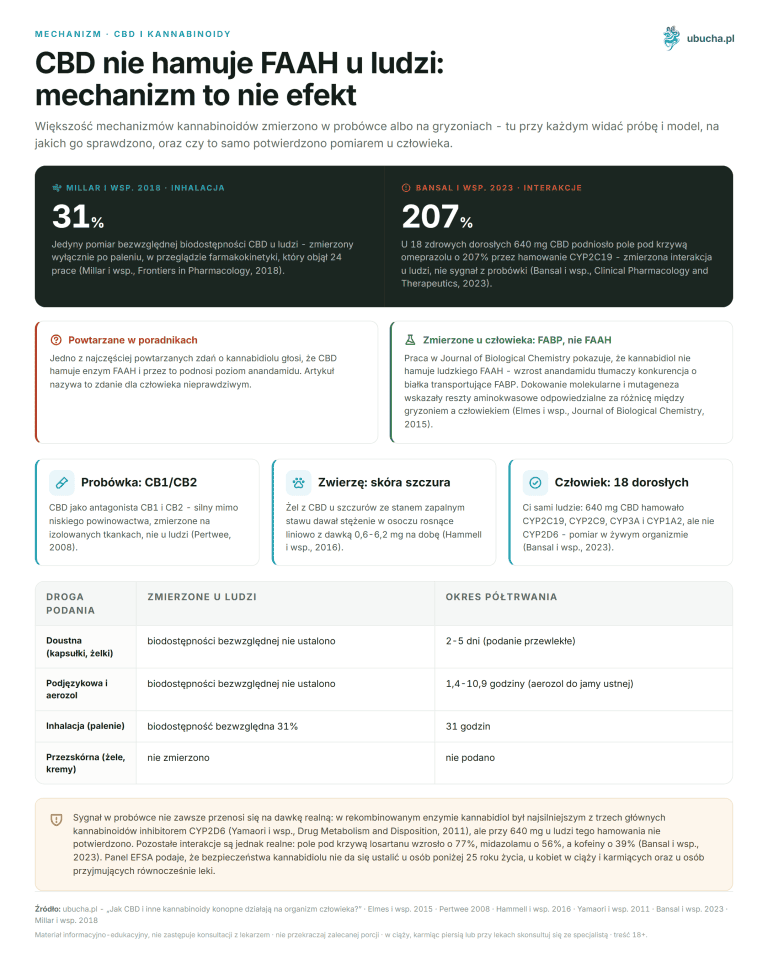
The honest answer is: no one has measured it. A systematic review covering 24 human pharmacokinetic studies established absolute bioavailability only after smoking, where it was 31%. For other administration routes, despite availability of intravenous preparations, no study attempted such measurement (Millar, Frontiers in Pharmacology, 2018).
This is important because numbers repeated in product descriptions, usually “6% orally” and “13-19% sublingually,” do not come from human measurements. Millar’s review explicitly states the lack of such data and lists it as a gap needing filling. Any bioavailability table presenting these values as established is ahead of the literature.
The review established half-life and time to maximum concentration. After oral mucosa aerosol, half-life ranged from 1.4 to 10.9 hours; after chronic oral administration, 2 to 5 days; after intravenous administration, 24 hours; and after smoking, 31 hours. Maximum concentration occurred between zero and four hours post-dose.
Area under the curve and maximum concentration increase with dose, and maximum concentration is higher after a meal and with lipid preparations. This means administration form really changes body exposure, but the scale of change is not expressed by a single percentage. The swallowing loss mechanism is described in a separate text on first-pass effect.
Does food change CBD absorption?
Yes, and this is one of the best-documented effects in the field. In a phase 1 study with healthy volunteers, a single 1500 mg dose taken after a high-fat meal gave a maximum concentration 4.85 times higher and area under the curve 4.2 times higher than fasting. Time to maximum concentration and half-life remained unchanged (Taylor, CNS Drugs, 2018).
A second study tested the same in patients, not volunteers. Eight adults with refractory epilepsy took a single dose of 99% pure cannabidiol capsules once fasting and once after a meal of 840-860 kilocalories with high fat content. Maximum concentration was on average fourteen times higher after the meal, and area under the curve four times higher (Birnbaum, Epilepsia, 2019).
The authors concluded that fat content in the meal explains part of the exposure variability observed in the same patient between days. In other words, the same portion taken fasting and after dinner are two different situations from the body’s perspective.
The practical conclusion for daily use is simple and requires no portion change. Take the preparation under consistent conditions, fasting or with food, but consistently. If you change this condition during observation, you cannot tell if the change in effects comes from the portion or the meal.
What is the start low, go slow principle?
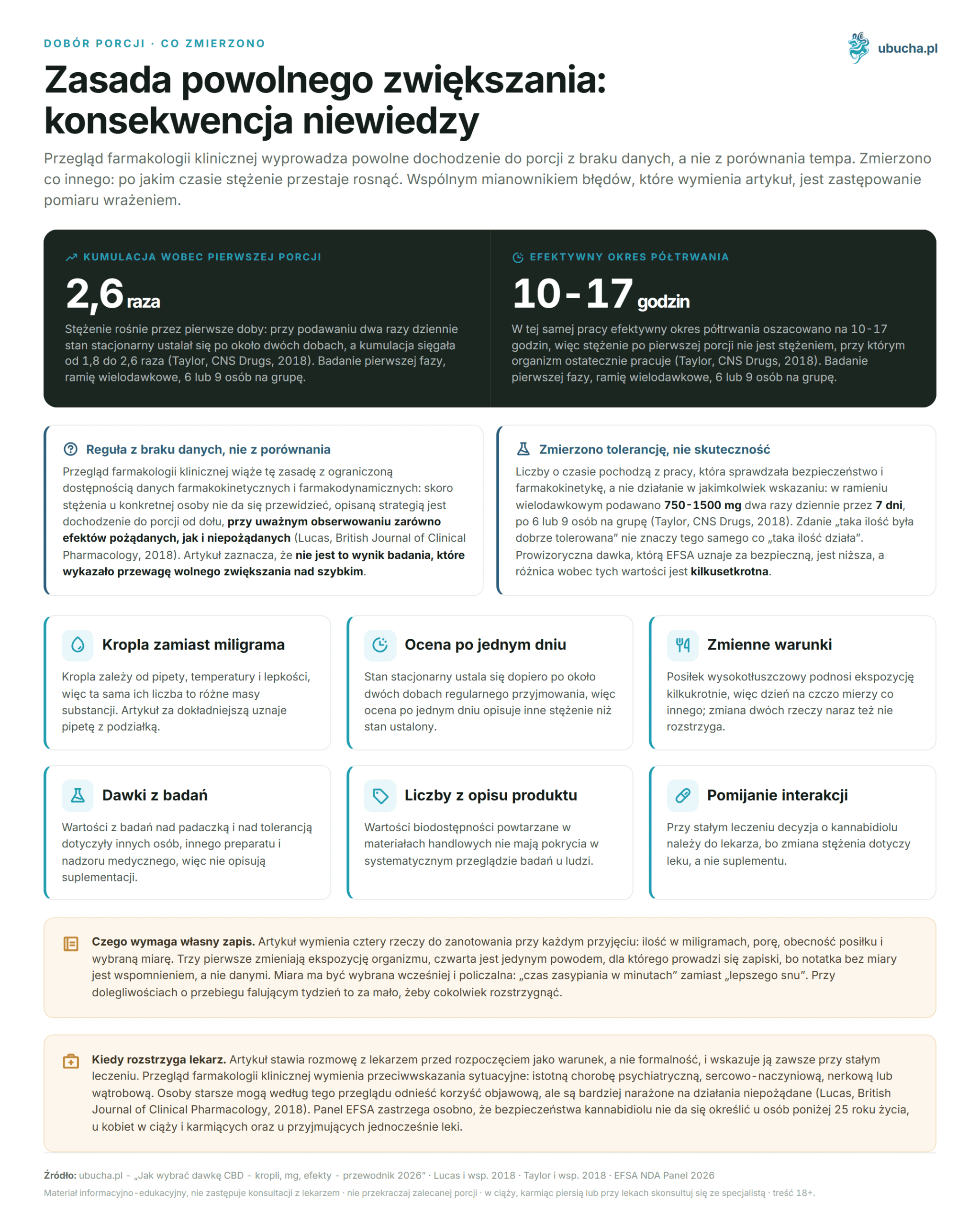
This recommendation comes from a clinical cannabinoid pharmacology review, formulated directly as a response to lack of data. Authors write that limited availability of pharmacokinetic and pharmacodynamic information requires starting with a low portion and increasing it slowly, carefully observing both desired and adverse effects in the patient (Lucas, British Journal of Clinical Pharmacology, 2018).
It is worth noting where this principle comes from. It is not the result of a study showing the advantage of slow increase over fast. It is a consequence of ignorance: since it is impossible to predict the concentration a given portion will produce in a specific person, the only safe strategy is to approach from below.
Pharmacokinetics also explains why assessment after one day makes no sense. In a phase 1 study, steady state with twice-daily dosing was reached after about two days, with accumulation from 1.8 to 2.6 times. The effective half-life was estimated at 10-17 hours, and the terminal half-life about 60 hours. Concentration after the first portion is therefore not the concentration at which the body ultimately operates.
Practically, this means one thing: between changes, take a break long enough to assess steady state, not a single episode. A step-by-step titration scheme is described in a separate text on increasing CBD dose. Consulting a doctor before starting is a condition, not a formality.
What doses were used in clinical studies?
The range is much wider than guides suggest, and studies rarely involve healthy people taking supplements. The table below lists only what was actually used: who participated, how many, what portion, and for how long. None of these values is a recommendation for the reader and none should be applied without a doctor.
| Study | Participants | Administered Amount | Duration | Result |
|---|---|---|---|---|
| Linares 2019 | 57 healthy men | 150, 300, or 600 mg orally | single dose | only 300 mg reduced anxiety |
| Shannon 2019 | 72 adults with anxiety or insomnia | amounts not specified in abstract | monthly and longer observation | anxiety reduced in 79.2%, sleep improved in 66.7%, with fluctuations over time |
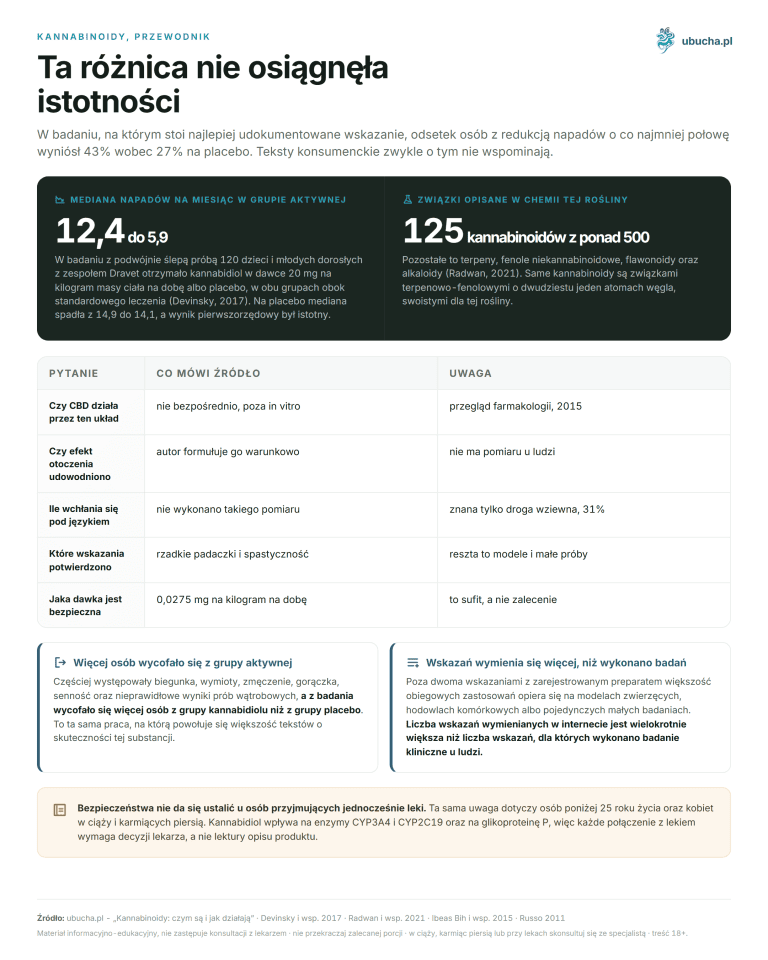
| Devinsky 2017 | 120 children and young adults with Dravet syndrome | 20 mg per kilogram per day | 14 weeks | median seizures dropped from 12.4 to 5.9 per month |
| Taylor 2018 | healthy volunteers, 6 or 9 per group | 1500-6000 mg single dose or 750-1500 mg twice daily | 7 days in multi-dose arm | good tolerance, mild or moderate adverse effects |
| Birnbaum 2019 | 8 adults with refractory epilepsy | single dose of 99% pure cannabidiol capsule | measurement up to 72 hours | meal increased exposure several times |
Note the distance between these numbers and supplementation. Devinsky’s study involved severe childhood epilepsy and a registered drug, not an over-the-counter product. Taylor’s study tested tolerance, not efficacy for any indication. Applying these values to your own plan is misuse, even if a guide table does it.
Why are epilepsy study doses not a model for supplements?
Because they concern a different preparation, different people, and different supervision. In the 2017 study, 120 children and young adults with Dravet syndrome were randomized to oral cannabidiol solution at 20 mg per kilogram per day or placebo, both as add-on to existing antiepileptic treatment. Median seizures dropped from 12.4 to 5.9 per month versus 14.9 to 14.1 in placebo (Devinsky, New England Journal of Medicine, 2017).
Three elements of this description are lost when the number reaches a guide. First is the baseline treatment, which cannabidiol did not replace but supplemented. Second is Dravet syndrome, a severe childhood epilepsy with high mortality. Third is the blinded, controlled study measuring difference versus placebo, not subjective well-being before the month.
The cost of this efficacy is also not lost. Diarrhea, vomiting, fatigue, fever, drowsiness, and abnormal liver tests occurred more often in the cannabidiol group than placebo. More participants withdrew from the cannabidiol group. These data come from the same study that produced the 20 mg per kilogram number.
Separately, efficacy studies should be distinguished from tolerance studies. The study where healthy volunteers took 1500 to 6000 mg single doses tested safety and pharmacokinetics, not efficacy for any indication. The statement “such amount was well tolerated” is not the same as “such amount works,” yet product descriptions often conflate these meanings.
Why does a higher dose not mean a stronger effect?
Because in the only study directly testing this in humans, the largest dose acted like placebo. Fifty-seven healthy men were randomized to one of four groups and subjected to simulated public speaking. Only the middle dose significantly reduced anxiety. The smallest and largest dose groups did not differ from placebo (Linares, Revista Brasileira de Psiquiatria, 2019).
The authors interpreted this as an inverted U-shaped curve, consistent with earlier animal observations. They also noted a limitation that guides omit: the study included only healthy men, one indication, and one administration. It is unknown if the curve shape and peak position are the same for women, patients, or chronic use.
The authors’ conclusion is: optimal therapeutic cannabidiol doses must be rigorously determined to translate study results into clinical practice. This 2019 statement has not been replaced by any subsequent study.
For the reader, this changes the question. Instead of “how much to take for a stronger effect,” a more sensible question is “how to check if increasing dose changes anything at all.” This is the topic of the text on dose tuning instead of endless increasing.
What daily dose does EFSA consider safe?
The EFSA panel on nutrition and novel foods derived in 2026 a provisional safe dose of 0.0275 mg per kilogram of body weight per day, about 2 mg daily for a 70 kg person. The value was obtained by benchmark dose method from subchronic studies compliant with good laboratory practice, applying an uncertainty factor of 400 (EFSA, 2026).
This number applies under narrowly defined conditions. It concerns only dietary supplements with cannabidiol purity of at least 98%, without nanoparticles, produced by a process recognized as safe and excluding genotoxicity. Outside this scope, the panel does not express any value.
The panel also states what cannot be determined. Cannabidiol safety cannot be established for individuals under 25 years old, pregnant or breastfeeding women, or those concurrently taking medications. This is not a precautionary formula but a conclusion from a review where animal studies showed consistent liver toxicity and human studies indicated liver risk especially when combined with drugs.
It is worth comparing this value with numbers circulating in product descriptions. The statement about safety up to 1500 mg daily is not supported by the referenced document. Doses of that magnitude appeared in a tolerance study with healthy volunteers over seven days under supervision, not as a consumer recommendation. The difference from EFSA’s position is several hundredfold and is not a matter of interpretation.
When does CBD dosing require a doctor’s consultation?
Always when taking any medications chronically. Cannabidiol is metabolized in the liver and may inhibit enzymes and transporters responsible for metabolizing other substances, changing their blood concentration. A documented example is inhibition of clobazam metabolism (Lucas, British Journal of Clinical Pharmacology, 2018).
The same review lists situational contraindications: significant psychiatric, cardiovascular, kidney, or liver disease. It also notes that older people may benefit symptomatically but are more prone to adverse effects. This group is where self-dosing is most risky.
A cannabidiol safety and adverse effects review lists fatigue and diarrhea as most common, along with appetite and weight changes. Authors also note that cannabidiol’s impact on liver enzymes and drug transporters remains insufficiently studied, as does its possible effect on hormonal balance (Iffland, Cannabis and Cannabinoid Research, 2017).
In a registration study in children with Dravet syndrome, diarrhea, vomiting, fatigue, fever, drowsiness, and abnormal liver tests occurred more often than in placebo. The last item is why EFSA’s position on inability to establish safety in medicated individuals should be read literally, not as a precautionary formula.
How to keep your own notes when adjusting dose?
Start with one goal and one measure. “Better sleep” is not measurable, but “time to fall asleep in minutes” and “number of awakenings at night” are. Without a chosen measure, any change in feelings can be explained in several ways, and after a month you cannot distinguish the preparation’s effect from weather or workload changes.
Record four things at each intake: amount in milligrams, time, food presence, and chosen measure. The first three change body exposure, as shown by studies on food effect and steady state. The fourth is the only reason you keep notes. A note without a measure is a memory, not data.
Keep notes long enough to cover natural symptom variability. For fluctuating conditions, a week is too short to decide anything because improvement could occur without intervention. Comparing several weeks before and during use gives a result you can discuss with a doctor.
Do not change two things at once. Increasing amount and switching from capsule to drops simultaneously gives an uninterpretable result because both changes affect exposure. This is the most common reason someone cannot say after two months what worked and what did not. One change at a time, assessment after steady state, note with measure.
What mistakes most often spoil dose selection?
The first and most costly is counting drops instead of milligrams. A drop depends on pipette, temperature, and viscosity, so the same number of drops means different substance masses in practice. The result is an observation that cannot be repeated or compared to anything, including your own note from a week ago.
- Assessment after one day. Steady state is reached only after about two days of regular intake, with accumulation close to two and a half times the first exposure (Taylor, 2018).
- Changing intake conditions during observation. A high-fat meal increases exposure several times, so comparing a fasting day with a post-meal day does not measure the portion.
- Treating study doses as recommendations. Values from epilepsy and tolerance studies concerned different people, preparations, and medical supervision.
- Taking product description numbers as data. Bioavailability values repeated in marketing materials are not supported by systematic human studies.
- Ignoring drug interactions. With chronic treatment, the decision about cannabidiol belongs to the doctor because concentration changes affect the drug, not the supplement.
The common denominator of these mistakes is replacing measurement with impression. A preparation whose content you did not convert, taken under variable conditions and assessed after one day, gives no information usable for the next decision.
Frequently Asked Questions
How many milligrams of CBD are in one drop of 5%, 10%, and 20% oil?
Assuming 30 drops per milliliter, 5% oil provides about 1.67 mg per drop, 10% oil about 3.33 mg, and 20% oil about 6.67 mg. This is an arithmetic conversion from concentration and bottle volume, not a dosage recommendation. The actual drop volume depends on the pipette, temperature, and viscosity of the preparation.
What daily CBD dose does EFSA consider safe?
In 2026, the EFSA panel derived a provisional safe dose of 0.0275 mg per kilogram of body weight per day, approximately 2 mg for a 70 kg person, with an uncertainty factor of 400. This value applies only to supplements with cannabidiol purity of at least 98% and without nanoparticles.
Is there a safe CBD dose during pregnancy or when taking medications?
No established value exists. EFSA states that cannabidiol safety cannot be determined for individuals under 25 years old, pregnant or breastfeeding women, or those concurrently taking medications. In these cases, the decision to use CBD is made by the attending physician, not a guide.
How much CBD from oil reaches the bloodstream?
A systematic review of human pharmacokinetics established absolute bioavailability only for smoking, which was 31%. No study has measured it for sublingual or oral administration. Values often cited in product descriptions, such as 6% orally, are not supported by this review.
Does food affect CBD absorption?
Yes, significantly. In healthy volunteers, a high-fat meal increased maximum concentration 4.85 times and area under the curve 4.2 times (Taylor, 2018). In eight adults with refractory epilepsy, maximum concentration was on average fourteen times higher after a meal than fasting (Birnbaum, 2019).
Does a higher CBD dose have a stronger effect?
Not across all ranges. In a randomized study with 57 healthy men, only the 300 mg dose reduced public speaking anxiety. The 150 mg and 600 mg doses did not differ from placebo. The authors described this pattern as an inverted U-shaped curve.
How long does it take for CBD to reach steady blood concentration?
In a phase 1 study, steady state with twice-daily dosing was reached after about two days, with accumulation from 1.8 to 2.6 times. The effective half-life was estimated at 10-17 hours. Thus, effect assessment after a single dose measures something different than steady state.
When should dose selection be discussed with a doctor?
With any chronic treatment, liver, heart, kidney diseases, and psychiatric disorders. Cannabidiol inhibits metabolism of some drugs, with clobazam as a documented example. In a registration study in children with Dravet syndrome, abnormal liver function tests were also observed.
Summary: what is known and unknown about CBD dosing
It is known how to convert bottle content to milligrams because it is arithmetic. It is known that a high-fat meal increases exposure several times and that steady state is reached after about two days. Finally, it is known that in the only study comparing three doses in humans, the middle dose worked, not the highest.
What is unknown, and what guides most eagerly provide, is not measured. Bioavailability after sublingual or oral administration is not measured. No study has established an effective range for supplementation in healthy people. No data allow predicting what blood concentration a given amount will produce in a specific person.
In this situation, the only official value is EFSA’s provisional safe dose: 0.0275 mg per kilogram of body weight per day, about 2 mg for a 70 kg person, and only for supplements with purity of at least 98%. Safety cannot be established for individuals under 25 years old, pregnant or breastfeeding women, or those taking medications.
The practical conclusion is not “take this much,” but “count in milligrams, change one thing at a time, record a measure, and talk to a doctor if you take anything chronically.” The conversion in this text is enough to compare any two products in the oils category on the same scale.
This article is informational and educational and does not constitute medical advice. Before starting cannabis or CBD for therapeutic purposes, consult a doctor, especially if you take other medications, are pregnant, or breastfeeding.
Author: Michał Waluk · Published: 2026-05-11 · Updated: 2026-08-10