
CBD for Back and Spine Pain: Do Oils or Gummies Help
The only randomized study on CBD for back pain performed equally to placebo. Check what WHO guidelines recommend and what symptoms require urgent attention.
Lower back pain is the leading cause of disability worldwide, and few ailments have received as many unfulfilled promises (Hartvigsen et al., The Lancet, 2018). The number of years lived with disability due to it increased by 54 percent between 1990 and 2015, mainly due to population growth and aging. CBD is one of those promises. We checked in the European PMC database how many clinical studies actually support the claim “CBD oil for back pain.” The result is clear: one randomized study with a placebo group, conducted in an emergency department, where CBD performed equally to placebo. Therefore, you will not find a dosage schedule here. You will find what truly changes the course of lower back pain and a list of symptoms that require a visit to the doctor, not the store.
KEY INFORMATION
• CBD was tested in back pain in one randomized study. The difference from placebo after two hours was 0.3 points on a scale of 0-10 against CBD (Bebee et al., Medical Journal of Australia, 2021).
• WHO guidelines from 2023 did not formulate recommendations for cannabis products in chronic primary back pain.
• An acute episode of back pain usually significantly decreases within the first six weeks (Wallwork et al., CMAJ, 2024).
• Disturbances in urination or defecation, numbness in the perineal area, and progressive weakness in the leg indicate the need for urgent diagnostics.
Does CBD really work for back and spine pain?
There is no evidence for this. The only randomized study that tested CBD for back pain yielded a negative result. It is called CANBACK and involved one hundred patients in an emergency department in Melbourne with acute, non-traumatic lower back pain.
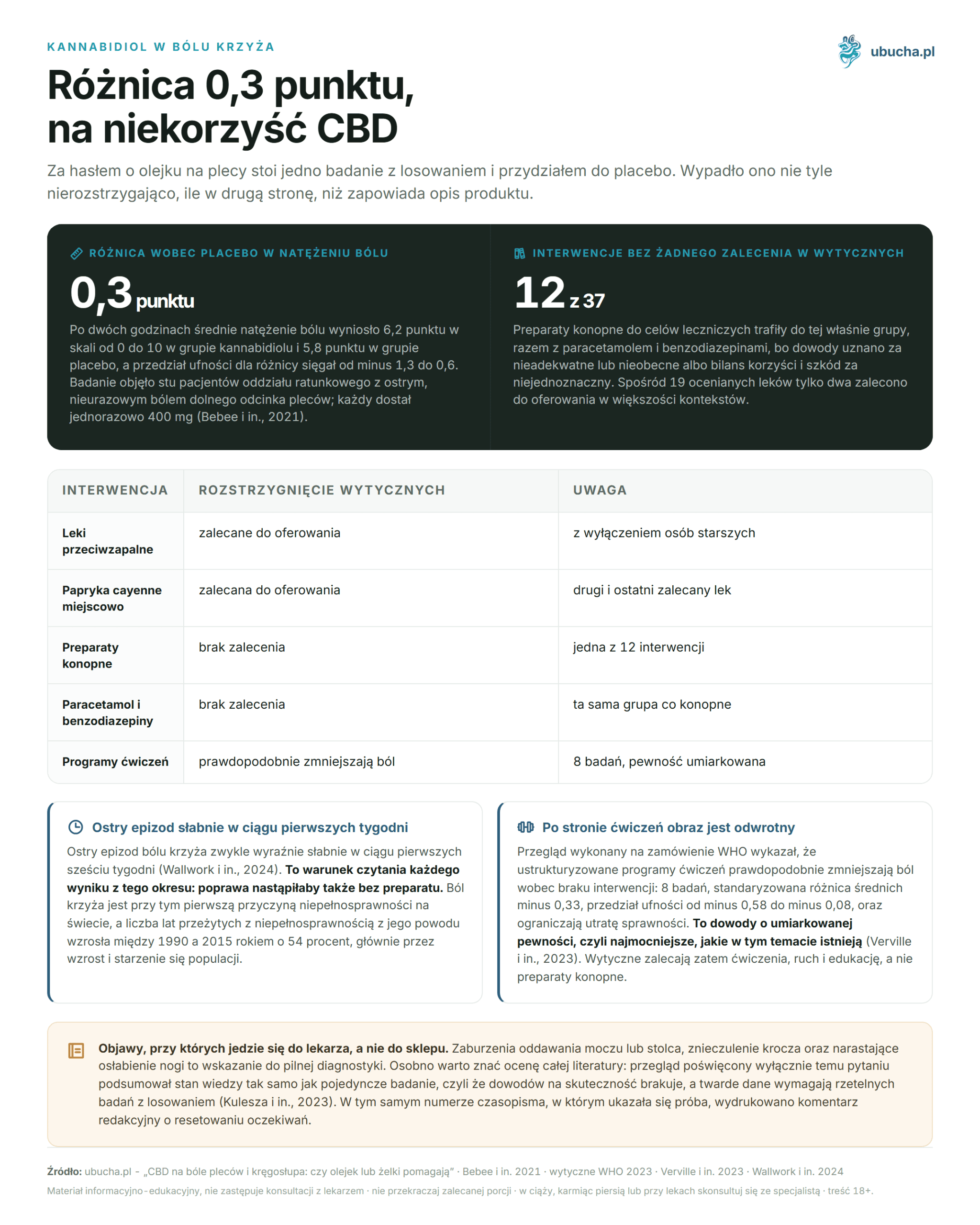
The study was randomized and double-blind, with a median age of participants being 47 years. Each received a single dose of 400 mg of cannabidiol or placebo, as an adjunct to standard pain medications used in the department. After two hours, the average pain intensity was 6.2 points on a scale from 0 to 10 in the CBD group (95% confidence interval 5.5 to 6.9) and 5.8 points in the placebo group (5.1 to 6.6). The absolute difference is 0.3 points against CBD, with a confidence interval from minus 1.3 to 0.6. The length of stay in the department and the use of oxycodone in the four hours before and after administration were similar in both groups. The authors’ conclusion is straightforward: CBD was not better than placebo (Bebee et al., Medical Journal of Australia, 2021).
A commentary in the same issue of the journal titled “Lack of Efficacy of Cannabidiol in Alleviating Back Pain: Time to Reset Expectations” (Hayes and Martin, 2021) was published. Two years later, a literature review dedicated solely to this question summarized the state of knowledge similarly: there is a lack of evidence for the efficacy of CBD in acute back pain, there is one clinical study, and it did not show an advantage over placebo, and hard data require rigorous randomized studies (Kulesza et al., Annals of Agricultural and Environmental Medicine, 2023).
What do current guidelines recommend for back pain?
Exercise, movement, and education, not cannabis products. In 2023, WHO issued the first guidelines for non-surgical management of chronic primary back pain in adults. They evaluated 37 non-surgical interventions possible to apply in primary healthcare, based on 367 randomized studies, and formulated 24 recommendations and one good practice statement.
Among the 19 evaluated medications, including cannabinoids and herbal preparations, only two were recommended for offering in most contexts: non-steroidal anti-inflammatory drugs and topically applied cayenne pepper. The recommendation for anti-inflammatory drugs does not include older adults. Cannabis products for therapeutic purposes were placed in a group of 12 interventions for which no recommendation was formulated, as the evidence was deemed inadequate or absent, or the balance of benefits and harms was ambiguous. Paracetamol and benzodiazepines were also in this same group (Briggs et al., Global Health Research and Policy, 2025, discussion of the guidelines WHO).
| Group of medications evaluated in WHO 2023 guidelines | Resolution |
|---|---|
| Non-steroidal anti-inflammatory drugs | Recommended for offering, excluding older adults |
| Topically applied cayenne pepper | Recommended for offering |
| Cannabis products for therapeutic purposes | No recommendation, one of 12 interventions without resolution |
| Paracetamol, benzodiazepines | No recommendation, same group of 12 |
| Others among the 19 evaluated medications | Not included among those recommended for offering |
On the side of non-pharmacological interventions, the picture is reversed. A review commissioned by WHO found that structured exercise programs likely reduce pain compared to no intervention (8 studies, standardized mean difference minus 0.33, confidence interval from minus 0.58 to minus 0.08) and functional limitations (Verville et al., Journal of Occupational Rehabilitation, 2023). This is evidence of moderate certainty, the strongest that exists on this topic.
What symptoms with back pain require urgent consultation?
Disturbances in urination or defecation, numbness in the perineal area, and progressive weakness in the leg are signals of compression on the cauda equina roots. In this situation, time matters, not the product: urgent imaging and neurosurgical consultation are needed. This is the most important part of this article.
Symptoms for which you do not wait and do not experiment with supplementation:
- disturbances in urination or defecation, including urinary retention and fecal incontinence
- numbness or tingling in the perineal area, buttocks, and inner thighs
- progressive weakness in the leg, foot drop, difficulty climbing stairs
- pain that occurred after an injury or fall, especially in a person over sixty or treated with glucocorticoids
- fever, chills, recent infection or procedure in the spine area
- unintended weight loss and a history of cancer
- night pain that does not subside at rest and wakes you from sleep
Cauda equina syndrome occurs rarely but carries a high risk of permanent disability, and the therapeutic window is narrow. Early diagnosis, rapid imaging, and urgent decompression determine the return of neurological functions (Aduri et al., Cureus, 2026). Two caveats. First, in almost all people with back pain, it is not possible to identify a specific nociceptive cause, and a well-understood pathology, such as a vertebral fracture, cancer, or infection, is present in a small percentage of patients (Hartvigsen et al., 2018). Second, the accuracy of individual alarm symptoms is limited. A Cochrane review involving 14 studies examined them for vertebral fracture and found that most of them used alone do not perform well as a screening tool. A few proved useful, primarily older age, history of trauma, and use of glucocorticoids, and their combinations worked better than single symptoms (Han et al., Cochrane Database of Systematic Reviews, 2023). Treat this list as a reason to contact a doctor, not as a tool for self-diagnosis.
How long does a typical episode of back pain last?
Most episodes significantly decrease within the first six weeks. In a meta-analysis of 47 cohorts, the average pain intensity in the acute group dropped from 56 points out of 100 at the start to 26 after six weeks, 22 after twenty-six weeks, and 21 after fifty-two weeks (Wallwork et al., CMAJ, 2024).
In the subacute group, improvement stops earlier: from 63 points at the start to 29 after six weeks and 31 after a year. In the group with chronic pain, the change is minimal, from 56 to 40 points after a year, with very low certainty of evidence. The course of disability is somewhat more favorable than the course of pain itself.
This has direct consequences for the assessment of supplements. If you start taking anything during the acute phase, improvement in the following weeks is what most people experience without any intervention. That is why observational studies on CBD in back pain, conducted without a control group and without blinding, do not answer the question of efficacy. They show the passage of time, not the effect of the product.
Why do studies on cannabis in neuropathic pain say nothing about back pain?
Because it is a different type of pain and most often a different substance. The material that circulates under the slogan “cannabis for pain” mostly comes from studies on THC-containing products conducted in neuropathic pain, which arises from damage to the nerve itself. Ordinary back pain has a different mechanism.
When transferring these results to the back, three substitutions are made at once. The first concerns the substance: results obtained for THC extracts are attributed to CBD itself, although these are two different compounds with different action profiles. The second concerns the diagnosis: data from neuropathic pain is transferred to overload pain in the lower back, where in almost all patients, it is not possible to identify a specific nociceptive cause. The third concerns the model: the anti-inflammatory action described in rodents is presented as an argument that humans will stop having back pain. None of these transfers is justified, and combined they create the impression of evidence that does not exist.
The difference between nociceptive and neuropathic pain is described in more detail in the post nociceptive vs neuropathic pain. It is worth knowing before reaching for any product advertised with the slogan “for pain.” The authors of a review dedicated to CBD in back pain formulate the same caution: most of the ten included studies concern chronic pain, and while the results suggest a benefit, there is a lack of hard evidence, and rigorous randomized studies are needed (Kulesza et al., 2023). This cautious suggestion pertains to cannabinoids as a group, not to cannabidiol itself.
Oil or gummies for back pain, does the format change anything?
Since the substance itself has not shown an advantage over placebo in back pain, the question of format is secondary. The choice between oil and gummies changes the speed and predictability of absorption. It does not change whether CBD alleviates back pain.
It is also worth challenging the numbers that almost every guide repeats, including an earlier version of this text. A systematic review of CBD pharmacokinetics in humans included 24 studies and found that the only route of administration for which anyone measured absolute bioavailability is smoking: 31 percent. For sublingual and oral administration, no study provided such a value. The half-life ranged from 1.4 to 10.9 hours after aerosol on the mucosa and from 2 to 5 days with chronic oral administration, and maximum concentration increased after meals and in fatty formulations (Millar et al., Frontiers in Pharmacology, 2018). Popular comparisons like “sublingually 20 to 35 percent, gummies 6 to 15 percent” have no basis in this data and have been removed from the article.
Real differences between formats are simpler. A gummy has a fixed content per piece, while oil allows for measuring less or more. A meal changes absorption. More about this in the texts CBD bioavailability and gummies vs oil.
Why is there no dosage scheme in this article?
Because there is no study from which it could be derived. An earlier version of this text provided a weekly schedule with specific milligrams and number of drops. We removed it entirely because such numbers suggest precision that has not been measured in spine pain.
The only dose tested in this diagnosis under randomized conditions is a single 400 mg in the CANBACK study, and it did not outperform placebo. The ranges cited in guides come from studies on epilepsy, anxiety, or neuropathic pain, and are then manually rescaled to back pain. A protocol written this way looks like a medical recommendation, but it is not.
There is also a second reason. CBD does not pass by other medications neutrally, as it inhibits the enzymes responsible for their metabolism. In an open crossover study on thirteen healthy volunteers, a single dose of 30 mg of CBD increased exposure to amitriptyline, a drug used in chronic pain, by about 13 percent in the area under the curve and 17 percent in maximum concentration. It did not significantly affect tramadol given in the same scheme, and the authors caution that with longer use and in patients, the interaction may be stronger (Gorbenko et al., British Journal of Clinical Pharmacology, 2026). Therefore, the discussion about combining CBD with medications belongs to the doctor or pharmacist and should concern your list of medications, not a table in an article.
Frequently Asked Questions
Does CBD help with back pain?
This has not been demonstrated. In the CANBACK study, one hundred patients with acute lower back pain received either CBD or a placebo as an adjunct to standard treatment. After two hours, the average pain intensity was 6.2 points in the CBD group and 5.8 in the placebo group. The authors concluded that CBD was not better than placebo.
Does CBD help with sciatica?
There is no randomized study specifically testing CBD for sciatica. Data on cannabinoids in neuropathic pain pertains to products containing THC and other diagnoses. If sciatica lasts more than six weeks or if there is progressive weakness in the leg, a medical consultation is needed, not a supplement.
How much CBD should I take for spine pain?
This cannot be responsibly stated. There is no study on back pain that has shown an effective dose of CBD, so any dosage in milligrams is transferred from studies on other conditions. If you are taking medications regularly, talk to your doctor or pharmacist about your list of medications.
Will a CBD ointment or cream work for the back?
Topical preparations have no randomized studies in spine pain. A substance applied to the skin of the back does not reach the nerve roots or the intervertebral disc. The relief felt may come from the act of rubbing itself and from the aromatic substances present in the formulation. More in the post ointment vs transdermal patch.
Is it better to lie down or move with back pain?
Move. Guidelines consistently recommend education supporting self-management and a return to normal activity and exercise, and identify excessive lying down, imaging, and opioids as problems (Foster et al., The Lancet, 2018). Lying in bed is not recommended treatment.
When does back pain require urgent medical attention?
When there are disturbances in urination or defecation, numbness in the perineal area, progressive weakness in the limb, pain after injury, fever, unintended weight loss, or night pain that does not subside at rest. These symptoms require urgent diagnostics, not trying another product.
If you still want to try, treat it as a product supporting well-being, not as a treatment for the spine. In the store at Bucha, you will find both cannabis gummies and cannabis oils.
This article is for informational and educational purposes and does not constitute medical advice. Before starting to use cannabis or CBD for therapeutic purposes, consult your doctor, especially if you are taking other medications, are pregnant, or breastfeeding.
Author: Michał Waluk · Published: 2026-05-22 · Updated: 2026-08-15