
CBD for Pain: Does it Work for Back and Joint Pain? Research 2026
Does CBD relieve back and joint pain? In 15 out of 16 randomized trials, it did not perform better than placebo. We discuss Cochrane 2026, CANBACK, and the Vela trial 2022.
Low back pain is the most common single cause of years lived with disability worldwide. In 2020, it affected 619 million people, and projections suggest 843 million by 2050 (GBD 2021 Low Back Pain Collaborators, Lancet Rheumatology, 2023). It is no wonder that CBD oil is marketed as a natural answer to back and joint pain. The problem is that when studies with a control group are summed up, the picture becomes surprisingly poor. A review of sixteen randomized trials with pure CBD showed no advantage over placebo in fifteen of them, and the 2026 update of the Cochrane review found no clear evidence for relief in neuropathic pain. Below, we show what exactly was measured, how inflammatory pain differs from neuropathic and mechanical pain, and why strong results in rodents did not translate to humans.
KEY INFORMATION
• Fifteen out of sixteen randomized trials with pure CBD showed no advantage over placebo (Moore et al., Journal of Pain, 2024).
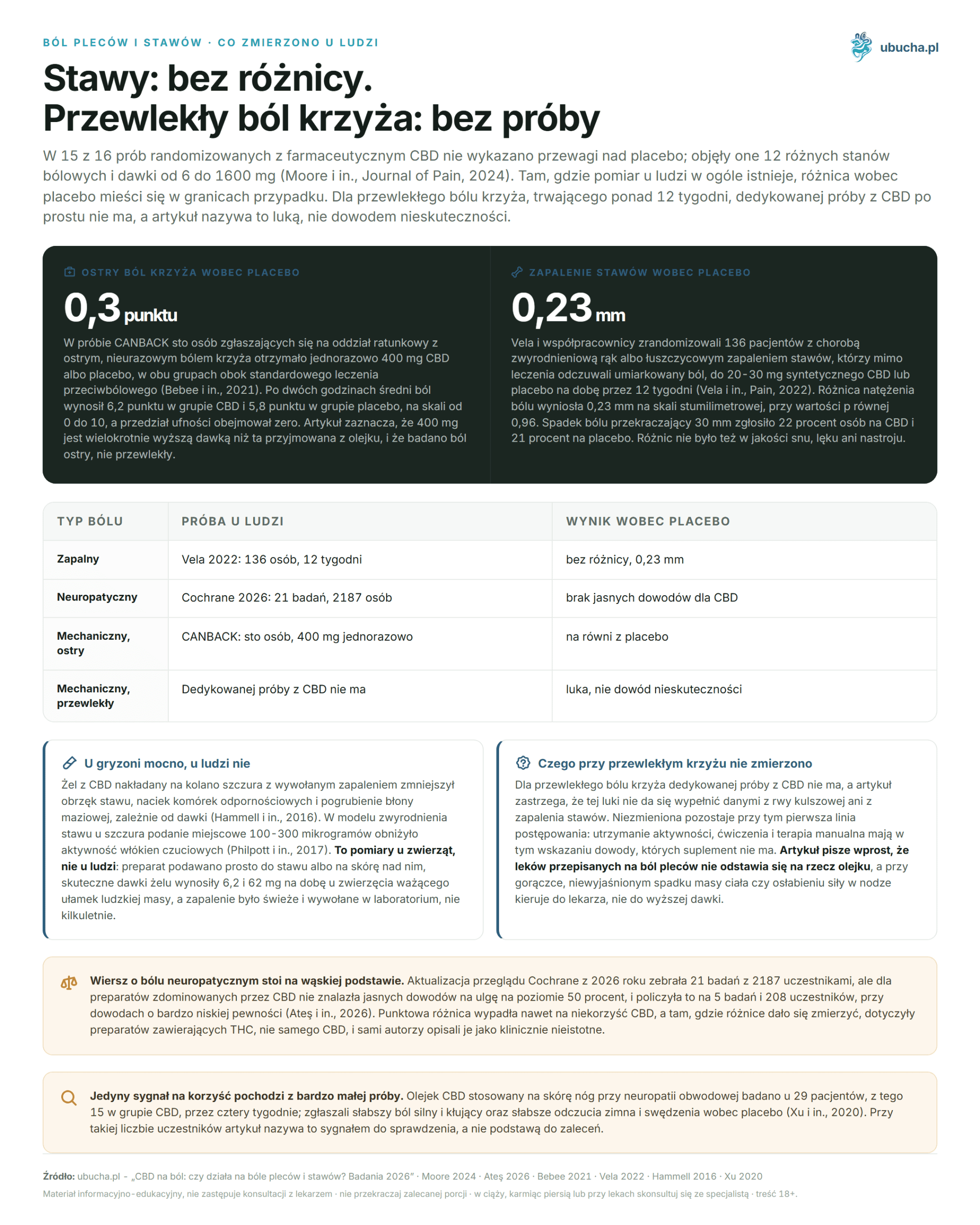
• The CANBACK trial: 400 mg of CBD for acute low back pain resulted in a difference of 0.3 points compared to placebo.
• RCT for hand osteoarthritis and psoriatic arthritis: difference of 0.23 mm on a hundred-millimeter scale.
• Rodent data is strong, but it has not been confirmed in humans.
Does CBD really work for back and joint pain?
Not as advertised. A review of sixteen randomized trials with pharmaceutical CBD, published in the Journal of Pain in 2024, showed no advantage over placebo in fifteen of them (Moore et al., 2024). The studies covered 12 different pain conditions and doses ranging from 6 to 1600 mg.
The 2026 update of the Cochrane review goes in the same direction. The authors gathered 21 studies with 2187 participants and found no clear evidence for pain relief at the 50 percent level for CBD-dominant products (5 studies, 208 participants, evidence of very low certainty; Ateş et al., Cochrane Database of Systematic Reviews, 2026). Where differences could be measured at all, they concerned products containing THC, not CBD alone, and the authors themselves described them as clinically insignificant.
So where do all the positive reports come from? The placebo effect in pain studies is exceptionally strong. In the arthritis trial, 21 percent of those taking an inactive capsule reported significant relief. We have noticed the same in conversations with customers: relief is most often described by those who simultaneously started moving, improved their sleep, or stopped sitting at their desks in the evening. These are real effects, but their source is different from what is assumed.
How would CBD work for pain?
Through several pathways at once, not through one receptor. The influence of CBD on TRPV1 channels responsible for pain stimulus reception and on adenosine signaling and serotonin receptors 5-HT1A has been described (Mlost et al., International Journal of Molecular Sciences, 2020). Additionally, there is indirect interaction with the immune system’s CB2 receptors.
CB2 receptors are mainly located on immune cells, and their activation reduces the production of cytokines and chemokines that drive inflammation (Nagarkatti et al., Future Medicinal Chemistry, 2009). On paper, this looks like a ready-made drug for arthritis, and it has also shown positive results in rodents. A CBD gel applied to a rat’s knee with induced inflammation reduced joint swelling, immune cell infiltration, and synovial membrane thickening, depending on the dose (Hammell et al., European Journal of Pain, 2016). In a rat model of joint degeneration, local administration of 100-300 micrograms reduced sensory fiber activity and provided preventive protection against joint nerve damage (Philpott, O’Brien, and McDougall, Pain, 2017).
The gap between these results and practice arises from three things: the preparation was administered directly to the joint or on the skin above it, effective doses of the gel were 6.2 and 62 mg per day in an animal weighing a fraction of human mass, and the inflammation was fresh and induced in the laboratory, not chronic. A review of cannabinoid mechanisms of action in pain directly mentions limitations in human studies: short treatment, small groups, heterogeneous populations, different cannabinoids and doses, and modest observed effects (Vučković et al., Frontiers in Pharmacology, 2018). This review concerns cannabinoids as a group, mostly THC-dominant products, not CBD alone.
What is the difference between inflammatory, neuropathic, and mechanical pain?
By the mechanism of occurrence, and thus susceptibility to treatment. This difference determines the outcome of the study: a trial that lumps sciatica and an overloaded lumbar segment together will measure the average of two unrelated phenomena. Therefore, when reading reports about CBD, start by asking what type of pain was studied.
| Type of Pain | Typical Examples | What CBD Studies Show |
|---|---|---|
| Inflammatory | RA, psoriatic arthritis, gout, swelling after injury | Strong data in rodents. In humans, the 2022 RCT showed no difference compared to placebo after 12 weeks. |
| Neuropathic | Sciatica, diabetic neuropathy, post-herpetic pain | Best studied area. Cochrane 2026: no clear evidence for CBD-dominant products. |
| Mechanical | Overload back pain, muscle pain after exertion, knee degeneration | Least data. The only trial for acute back pain was on par with placebo. |
This division is also useful when assessing your own case. Burning and shooting pain, with numbness or tingling, suggests a neuropathic component. Dull pain that worsens with movement and eases at rest indicates a mechanical mechanism. Diagnosis belongs to the doctor, but simply being aware of the difference protects against transferring the results of one study to a completely different problem.
What do studies say about CBD for back pain?
There is one solid trial, and it came out negative. In the CANBACK study, one hundred people presenting to the emergency department with acute, non-traumatic back pain received a single dose of 400 mg of CBD or a placebo, in both groups alongside standard pain treatment (Bebee et al., Medical Journal of Australia, 2021).
After two hours, the average pain was 6.2 points in the CBD group and 5.8 points in the placebo group, with a difference of 0.3 points on a scale from 0 to 10 and a confidence interval including zero. There were also no differences in length of stay in the department or oxycodone consumption in the four-hour window before and after administration. The 400 mg dose is also many times higher than what is realistically taken from oil.
For chronic back pain, lasting more than 12 weeks, there is simply no dedicated trial with CBD. This is a gap, not evidence of ineffectiveness, but it cannot be filled with data from sciatica or arthritis. Meanwhile, the first line of action remains unchanged: maintaining activity, exercise, and manual therapy have evidence in this indication that supplements do not. If you are taking medications prescribed for back pain, do not stop them in favor of oil.
Does CBD help with arthritis?
The best trial in this indication showed no difference. Vela and colleagues randomized 136 patients with hand osteoarthritis or psoriatic arthritis who, despite treatment, experienced moderate pain, to receive 20-30 mg of synthetic CBD or a placebo daily for 12 weeks (Vela et al., Pain, 2022).
The difference in pain intensity after 12 weeks was 0.23 mm on a hundred-millimeter scale with a p-value of 0.96. A reduction in pain exceeding 30 mm was reported by 22 percent of those on CBD and 21 percent on placebo. A total of 129 of these patients were included in the main analysis. The researchers also checked sleep quality, anxiety, mood, and pain catastrophizing, and found no differences in any of these dimensions.
It is worth comparing this result with the enthusiasm for animal data from the previous section. The same substance, the same group of diseases, two opposite conclusions. The difference is that in rats, swelling of the joint and nerve activity are measured in a controlled model of acute inflammation, while in humans, subjective pain intensity is measured in a disease lasting for years. A review comparing preclinical and clinical data raises the same caveat: using CBD does not always eliminate pain, and products purchased outside of control carry the risk of contamination (Argueta et al., Frontiers in Pharmacology, 2020).
Does CBD work for neuropathic pain?
This is the best-studied area and therefore the most instructive. The Cochrane review from 2018 included 16 studies with 1750 participants. Relief of at least 50 percent was reported by 21 percent of those on cannabinoid products compared to 17 percent on placebo, resulting in an NNT of 20 with low-quality evidence (Mücke et al., 2018).
For the overall assessment of improvement by the patient, the number needed to treat was 11, with very low certainty evidence. It should be noted what these studies concerned: in ten out of sixteen, an aerosol with THC and CBD was used, in two, inhaled cannabis flowers, in two, nabilone, and in two, dronabinol. Pure CBD was not studied in this set at all.
The 2026 update added six new studies and reached 21 trials with 2187 participants. For CBD-dominant products, there is no clear evidence for relief at the 50 percent level, and the point difference even came out against CBD. The exception remains a small trial of CBD oil applied to the skin of the legs in peripheral neuropathy: 29 patients, of which 15 were in the CBD group, four weeks, with weaker severe and stabbing pain and reduced sensations of cold and itching compared to placebo (Xu et al., Current Pharmaceutical Biotechnology, 2020). With such a number of participants, this is a signal for further investigation, not a basis for recommendations.
What doses of CBD were used in pain studies?
The range was enormous and did not change the outcome. In the sixteen trials collected by Moore’s team, doses ranged from 6 to 1600 mg per day, administered orally, sublingually, and topically, for periods from a single dose to 12 weeks. Fifteen of them showed no advantage over placebo.
A review of CBD dosing in clinical populations points out another thing: in small trials involving chronic pain, low doses were used, averaging 2.4 mg per kilogram of body weight per day, and in none of these indications was there a signal of effectiveness (Millar et al., British Journal of Clinical Pharmacology, 2019). In epilepsy, where CBD has a registered drug, doses averaged 15 mg per kilogram, meaning over a thousand milligrams daily for an adult.
There is also a limit from the other side. The EFSA panel established a temporary safe dose in 2026 of 0.0275 mg per kilogram of body weight per day, or about 2 mg daily for a person weighing 70 kg, and noted that this applies only to supplements with at least 98% CBD purity. The safety of CBD cannot be established today for individuals under 25 years of age, for pregnant and breastfeeding women, and for those taking medications (EFSA panel, EFSA Journal, 2026).
Pharmacokinetics also do not favor simple protocols. The half-life ranges from 1.4 to 10.9 hours after sublingual aerosol and from 2 to 5 days after prolonged oral administration, with maximum concentration occurring within four hours, and a fatty meal raising it (Millar et al., Frontiers in Pharmacology, 2018). Since analgesic efficacy has not been demonstrated, we do not provide a dosing protocol “for pain” here. General dosing guidelines are described in the text Dosing CBD, how many drops of oil to take, and concentration selection in the guide What concentration of CBD to choose.
When does pain require a doctor, not a supplement?
Whenever a warning signal appears. Chronic back pain can be the first symptom of cancer or bone infection, so certain symptoms require diagnostics, not increasing the dose of oil. See a doctor immediately if you notice any of the following.
- Pain lasting longer than four to six weeks or waking you at night.
- Fever or unexplained weight loss.
- Weakness in the leg, numbness in the groin, urinary or bowel dysfunction.
- Pain after minor injury in a person with osteoporosis or after long-term steroid treatment.
The safety profile of CBD is decent. The WHO report from 2018 deemed this substance well-tolerated, with no addictive potential and no intoxicating effects (WHO, Critical Review Report, 2018). Adverse effects mentioned in this report from studies on epilepsy, conducted at doses many times higher than from oil, include drowsiness, decreased appetite, diarrhea, and elevated liver enzymes.
Newer studies add two caveats. There is an increasing number of reports of elevated liver enzymes, and analyses of commercially available products in North America and Europe showed CBD content ranging from zero to many times higher than declared, sometimes with harmful contaminants (Moore et al., 2024). Additionally, there is the metabolic pathway: CBD is primarily metabolized by CYP3A4 and CYP2C19, the same enzymes that handle many medications. A review of registration data assesses the risk of interactions as high and lists warfarin, antiepileptic drugs, and proton pump inhibitors among the at-risk substrates (Brown and Winterstein, Journal of Clinical Medicine, 2019). The WHO report itself cautions that inhibition of these enzymes by CBD has been observed in vitro, and it is unknown whether it occurs at concentrations achieved in treatment. From our experience, the most common mistake is not taking the wrong dose, but stopping prescribed treatment in the hope that oil will replace it. It will not.
Frequently Asked Questions
Does CBD help with back pain?
Controlled data do not confirm this. In the Australian CANBACK trial, one hundred people with acute low back pain received 400 mg of CBD or a placebo as an adjunct to standard treatment in the emergency department. After two hours, the difference in pain intensity was 0.3 points on a scale from 0 to 10, which falls within the range of chance.
Does CBD work for arthritis?
In a randomized trial Vela et al. (Pain, 2022), 136 patients with hand osteoarthritis or psoriatic arthritis received 20-30 mg of synthetic CBD or a placebo for 12 weeks. The difference in pain intensity was 0.23 mm on a hundred-millimeter scale. No impact on sleep, anxiety, or mood was noted either.
What doses of CBD were used in pain studies?
From 6 to 1600 mg per day, in oral, sublingual, and topical forms, for periods ranging from a single dose to 12 weeks (Moore et al., Journal of Pain, 2024). This range did not translate into results: fifteen out of sixteen trials showed no advantage of CBD over placebo.
How long does CBD stay in the body?
A review of pharmacokinetic data reports a half-life of 1.4 to 10.9 hours after sublingual aerosol and 2 to 5 days after prolonged oral administration (Millar et al., Frontiers in Pharmacology, 2018). Maximum concentration occurs within the first 4 hours, and a fatty meal significantly raises it.
Can CBD be combined with pain medications?
Not without consultation. CBD is metabolized by CYP3A4 and CYP2C19, the same enzymes as many medications, which is why Brown and Winterstein (2019) assess the risk of interactions as high and list warfarin and antiepileptic drugs among the at-risk substrates. The decision to combine should be left to a doctor or pharmacist.
Is CBD safe for long-term use?
The report WHO from 2018 deemed CBD well-tolerated and devoid of addictive potential. Newer reviews add two caveats: an increasing number of reports of elevated liver enzymes and discrepancies between declared and actual CBD content in retail products (Moore et al., 2024).
If you still want to try CBD for yourself, start with a product that has laboratory testing of the batch. Our compilation can be found in the hemp oil category.
This article is for informational and educational purposes and does not constitute medical advice. Before starting to use cannabis or CBD for therapeutic purposes, consult a doctor, especially if you are taking other medications, are pregnant, or breastfeeding.
Author: Michał Waluk · Published: 2026-06-22 · Updated: 2026-08-14