
Cordyceps: what it is, what it helps with, and how to dose the mushroom for energy and endurance
Cordyceps for energy and endurance: what the studies by Hirsch 2017 and Chen 2010 really showed, how militaris differs from sinensis, and where evidence ends.
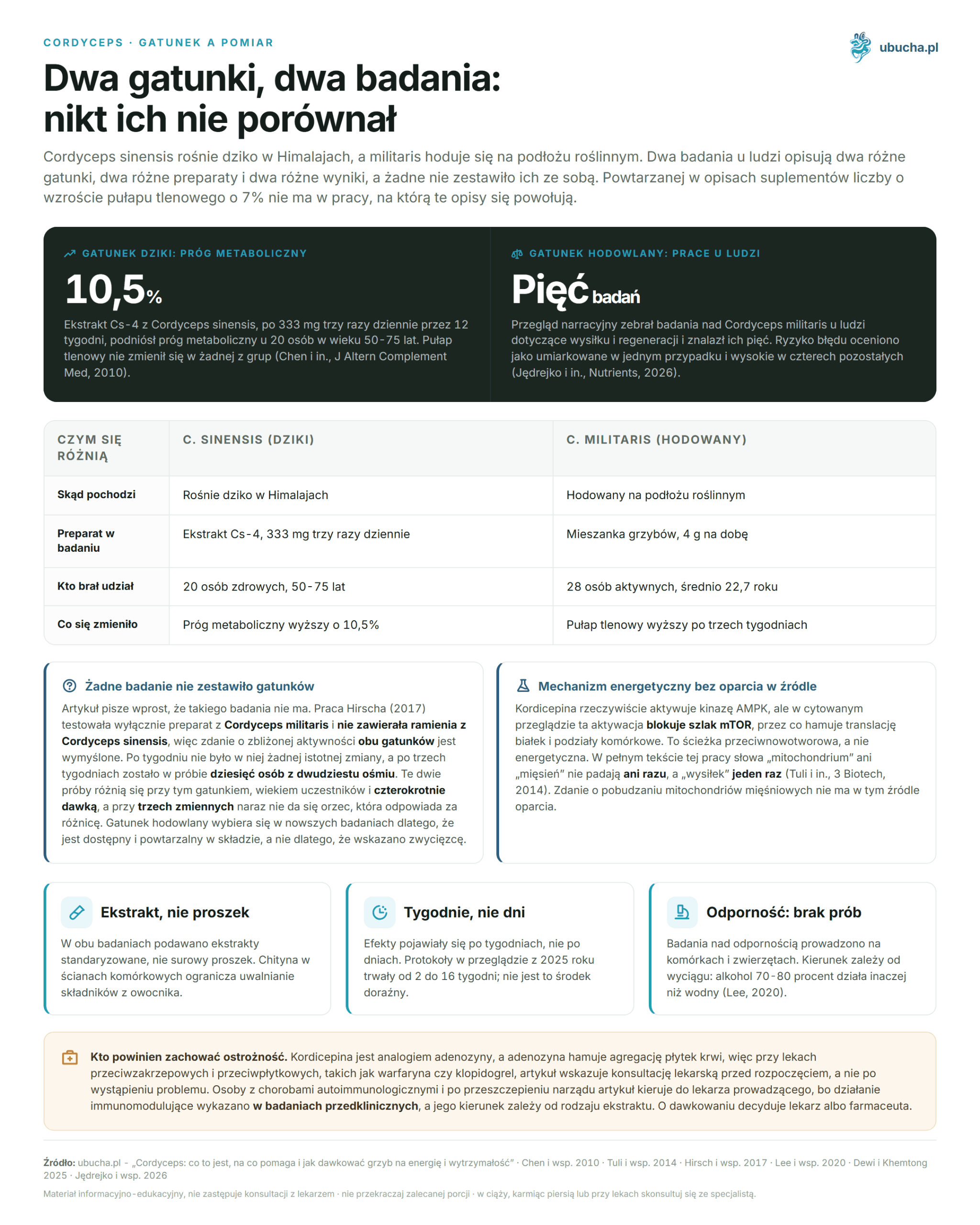
Cordyceps is sold today as the “energy mushroom,” and the most frequently repeated number in supplement descriptions is the increase in oxygen threshold after three weeks. We referred to the study that these descriptions cite, and it turned out to say something narrower: a mixture of mushrooms was studied, not cordyceps alone, at a dose higher than that advertised, and after three weeks, only ten out of twenty-eight individuals remained in the trial. A second study, which supplement descriptions no longer cite, found an improvement in metabolic threshold without any change in oxygen threshold. This article shows what has actually been measured in this field in humans, how the two species marketed differ, and where evidence ends and advertising begins.
KEY INFORMATION
• In the only frequently cited study, one week of supplementation showed no significant change, and an improvement in oxygen threshold was recorded only after three weeks in ten individuals who continued (Hirsch et al., J Diet Suppl, 2017).
• The preparation in this study is a mixture of mushrooms, in which cordyceps is the main ingredient, administered at a dose of 4 g per day.
• In 20 individuals aged 50-75, 12 weeks of Cs-4 extract raised the metabolic threshold by 10.5%, but the oxygen threshold did not change in any group (Chen et al., J Altern Complement Med, 2010).
• Reviews from 2025 and 2026 agree on five studies in humans, with a risk of bias ranging from moderate to high and inconsistent effects on aerobic performance.
What is cordyceps and where does it come from?
Cordyceps is a genus of insecticidal fungi, known primarily from two species. The first is Cordyceps sinensis, now classified as Ophiocordyceps sinensis, which naturally develops in the bodies of butterfly larvae on the Tibetan Plateau and in the Himalayas. The second is Cordyceps militaris, cultivated in laboratory conditions on a plant substrate.
The Himalayan species is one of the most expensive natural resources in the world, and this is not a marketing gimmick, but a consequence of biology. It grows only at high altitudes, is harvested by hand, and its wild population is rapidly declining under the pressure of climate change and overharvesting. The authors of an analysis from Science of the Total Environment directly warn that maintaining this collection is now threatened both ecologically and economically (Wei et al., 2021).
That is why the cultivation of C. militaris was a breakthrough for availability. The mushroom grows in controlled conditions, without the risk of contamination from high-altitude soil, and its supply does not depend on the dwindling wild resource. It is also the species around which newer literature on physical effort has focused: the review from 2026, which we discuss below, includes only studies on C. militaris in humans. In Tibetan and Chinese medicine, cordyceps has been used for centuries under the name yartsa gunbu, meaning “winter worm, summer grass,” mainly as a vitality and lung function enhancer.
Does cordyceps really raise the oxygen threshold?
The answer is: perhaps, but not in the way the labels claim. The study referenced by almost the entire market was conducted by a team from the University of North Carolina. Twenty-eight recreationally active individuals with an average age of 22.7 years received in a double-blind and placebo-controlled setup 4 g per day of a mushroom mixture, in which cordyceps militaris is the main ingredient, or maltodextrin.
After one week, there was no significant difference: neither in oxygen threshold, nor in time to exhaustion, nor in ventilatory threshold, nor in power. Only after three weeks did the oxygen threshold significantly increase in the study group, by 4.8 ml per kilogram of body weight per minute compared to 0.9 in the placebo group. However, this second phase included only ten volunteers who agreed to continue (Hirsch et al., J Diet Suppl, 2017).
The second study goes in the opposite direction and is omitted in supplement descriptions. Twenty healthy participants aged 50-75 took Cs-4 extract from C. sinensis for 12 weeks, at 333 mg three times a day, or placebo. The metabolic threshold increased by 10.5%, and the ventilatory threshold by 8.5%, but the oxygen threshold did not change in any group (Chen et al., 2010). Thus, the economy of effort improved, not the ceiling of endurance. More about the measurement itself and why these two results are not contradictory can be found in our article on cordyceps and oxygen threshold in RCT studies.
What do reviews of studies on humans say?
Two independent reviews from the last two years say the same thing: there is little evidence, and it is uncertain. A narrative review from Nutrients gathered all studies on C. militaris in humans regarding effort and recovery and found five. The authors assessed the risk of bias in each of them separately: Hirsch’s work performed the best, with an overall rating of “moderate,” while the other four received a “high” rating (Jędrejko et al., Nutrients, 2026).
Their conclusion is cautious and worth quoting in full, as it differs from what is written on packaging: supplementation of C. militaris may bring ergogenic and recovery benefits to physically active individuals, including improvements in oxygen threshold, time to exhaustion, and power. The word “may” is not a courtesy here. With five studies, four of which have a high risk of bias, a stronger formulation simply cannot be defended.
The second review, in Current Nutrition Reports, examined the entire genus Cordyceps more broadly and separated two things that are easily confused. Long-term supplementation, from 2 to 16 weeks, improved exercise performance measured by time to exhaustion, depending on the dose. The effect on aerobic capacity remains inconsistent. The authors also note that most participants were young, active individuals, so little is known about the effects in seniors and sedentary individuals (Dewi and Khemtong, 2025).
How would cordyceps work for energy?
The main active compound is cordycepin, or 3′-deoxyadenosine, a structural analog of adenosine. A review from 3 Biotech describes it as a molecule with strong anti-cancer and anti-inflammatory effects, studied in the context of immunity and liver and kidney function (Tuli et al., 2014).
At this point, however, it is necessary to clarify the mechanism that circulates in supplement descriptions. Cordycepin does indeed activate AMPK kinase, but in the cited review, this activation leads to the blockage of the mTOR pathway, and thus to the inhibition of protein translation and cell division. This is an anti-cancer pathway, not an energy one. We searched the full text of this work: the words “mitochondrion” or “muscle” do not appear in it even once, and “effort” appears once. The statement that cordycepin stimulates muscle mitochondria to increase ATP production has no support in this source.
So what remains? The adenosine contained in the mushroom dilates blood vessels, which theoretically improves the supply of oxygen to the muscles, and Chen’s results, in which the metabolic threshold increased without a change in oxygen threshold, fit well with the improvement in muscle work economy. However, this is still a hypothesis fitted to the result, not a mechanism measured in humans. It is fair to say that we know more about what changes than about why.
Militaris or sinensis: which species to choose?
For most practical applications, the answer is C. militaris, but for a different reason than stores state. Not because any study has compared both species and indicated a winner, as there is no such study. Hirsch’s work tested only the preparation from C. militaris and did not include an arm with C. sinensis, so the statement “the study confirmed similar activity of both species” is fabricated.
The reasons are straightforward. The cultivated species is available, consistent in composition, and free from contaminants that threaten the raw material collected from high-altitude soil. Wild sinensis, on the other hand, is rare and increasingly difficult to obtain, and its population is declining. Newer studies on effort are conducted on the cultivated species simply because it can be purchased in a standardized form.
When purchasing, sensible criteria include the specified species, declared beta-glucan content, extract instead of ground fruiting body, and a purity certificate from an independent laboratory. Note that in both studies described above, standardized extracts were administered, not raw powder. With powder from the whole fruiting body, chitin in the cell walls limits the release of components, so results from those trials cannot be transferred to it.
Does cordyceps boost immunity?
Data in this area are preclinical but consistent. A review from Frontiers in Pharmacology organized studies on the immunomodulating effects of C. militaris and did something that had not been done before: it separated the effects according to the type of extract. Water extracts and those obtained with 50% alcohol shifted the response towards type 1 immunity, while extracts with 70-80% alcohol and cordycepin itself shifted towards type 2 (Lee et al., Front Pharmacol, 2020).
The practical conclusion is inconvenient for marketing. Since the direction of action depends on what the producer used to extract the raw material, two preparations from the same mushroom may affect the immune system differently. Labels rarely provide the solvent, and even when they do, the translation of results from cell cultures to humans remains unknown.
It is also worth remembering that these are studies on cells and animals. There are no clinical trials showing that cordyceps reduces the number of infections in humans. Individuals with autoimmune diseases or on immunosuppressive medications should approach it cautiously for the same reason, as we discuss below. A broader comparison of functional mushrooms has been gathered in our article on adaptogenic mushrooms.
What doses and how long were administered in studies?
In none of the described studies was a recommended dose established for the healthy reader, and the numbers below describe only the protocols. The following summary shows how much they differ from each other, which in itself explains part of the discrepancies in results.
| Study | Who and how many | Preparation and dose | Time and result |
|---|---|---|---|
| Hirsch 2017 | 28 active individuals, average age 22.7; 10 remained after 3 weeks | Mushroom mixture with C. militaris, 4 g per day | 1 week with no changes; after 3 weeks, oxygen threshold higher by 4.8 ml/kg/min |
| Chen 2010 | 20 healthy individuals, aged 50-75 | Cs-4 extract from C. sinensis, 333 mg three times a day | 12 weeks; metabolic threshold higher by 10.5%, oxygen threshold unchanged |
| Review Dewi 2025 | Studies mainly on young active individuals | Diverse protocols | 2-16 weeks; time to exhaustion increased depending on dose, aerobic performance inconsistent |
The table shows two things. First, effects appeared after weeks, not days, so cordyceps does not work like a stimulant taken acutely. Second, the two studies with different results differ in species, age of participants, and dose by four times, and with three variables at once, it is impossible to determine which one is responsible for the difference. Dosing is determined by a doctor or pharmacist who knows your medications and health status.
Who should exercise caution?
Cordycepin is an adenosine analog, and adenosine inhibits platelet aggregation. For this reason, with anticoagulant and antiplatelet medications, such as warfarin or clopidogrel, cordyceps requires medical consultation before starting, not after a problem arises. This is not a precautionary statement: the mechanism is the same as that of the drug.
The second group is individuals with autoimmune diseases and those who have undergone organ transplants. The immunomodulating effects demonstrated in preclinical studies may interfere with immunosuppressive therapy, and the direction of this influence, as shown by the 2020 review, depends on the type of extract. This is an argument not for caution, but for refraining without the consent of the attending physician.
The third group is individuals with mushroom allergies, who may experience hypersensitivity reactions. Exceeding doses used in studies has reported gastrointestinal complaints, which resolved after reducing the portion. Since the observation period in existing studies does not exceed several weeks, nothing is known about the safety of use for a year or longer, and a lack of data is not the same as proof of safety.
Frequently asked questions
Does cordyceps increase the oxygen threshold by 7%?
Such a number is not present in the study referenced by the supplement descriptions. Hirsch and colleagues reported an increase of 4.8 ml per kilogram of body weight per minute after three weeks, in ten individuals who continued participation, and with a mushroom mixture at a dose of 4 g per day. After one week, there was no significant change.
What is the difference between Cordyceps militaris and sinensis?
Militaris is cultivated in a laboratory on a plant substrate, while sinensis grows wild in the Himalayas and is rare and expensive. Newer clinical studies are conducted on the cultivated species because it is available in a standardized form. No study has directly compared both species, so it is unknown which one works stronger.
How long does it take to see the effects of cordyceps?
In studies, effects appeared after weeks. In Hirsch’s study, one week of supplementation showed no significant change, and the improvement in oxygen threshold came after three weeks. In Chen’s study, the metabolic threshold increased after 12 weeks. A review from 2025 included protocols ranging from 2 to 16 weeks.
Does cordyceps work like caffeine?
No. Cordyceps does not contain caffeine, and its immediate stimulating effect was not measured in studies. The effects reported in clinical trials relate to exercise parameters after several weeks of regular intake, not a noticeable energy boost from a single dose.
Is cordyceps safe with medications?
Not in every case. Cordycepin is an adenosine analog, which inhibits platelet aggregation, so a medical consultation is necessary with anticoagulant and antiplatelet medications. Caution is also required for individuals with autoimmune diseases and those taking immunosuppressive drugs, due to the immunomodulating properties of the mushroom.
How many studies on humans have been conducted?
Not many. A narrative review from 2026, covering studies on exercise and recovery in humans, found five papers. The risk of bias was assessed as moderate in one case and high in the other four. This is too little to speak of established ergogenic effects.
Does cordyceps boost immunity?
Studies on immunomodulation have been conducted on cells and animals, not in clinical trials. A review from 2020 also showed that the direction of influence depends on the type of extract: water extracts and polysaccharides act differently than alcohol extracts and cordycepin itself. There is no evidence that cordyceps reduces the number of infections in humans.
Reishi, lion’s mane, and other functional mushrooms mentioned above have been gathered in the adaptogens category; our offer does not include cordyceps itself.
This article is for informational and educational purposes and does not constitute medical advice. Before starting supplementation, consult your doctor, especially if you are taking medications regularly, are pregnant or breastfeeding, or have chronic illnesses.
Author: Michał Waluk · Published: 2026-06-22 · Updated: 2026-08-16