
CBD and Pregnancy and Breastfeeding: What Science Says and When to Exercise Caution
Is CBD safe during pregnancy and breastfeeding? EFSA position 2026, human placenta perfusion, measurements in breast milk, and ACOG recommendations.
Nausea, back pain, insomnia, and anxiety are ailments for which CBD is often recommended online, and at the same time, ailments that most women experience during pregnancy. The question about hemp oil is therefore being asked by more and more pregnant and breastfeeding women. The answer we found in the sources does not sound like “it harms” or “it is safe,” but rather something third and less convenient: the safety of CBD for this group simply cannot be established today, and this is the position of the European food safety authority. Below, we describe what exactly was measured in human placentas and in breast milk, what studies have not measured at all, and what procedures obstetric societies propose. Separately, we answer the question about hemp seeds, which are food, not a cannabinoid product, and are subject to completely different regulations.
KEY INFORMATION
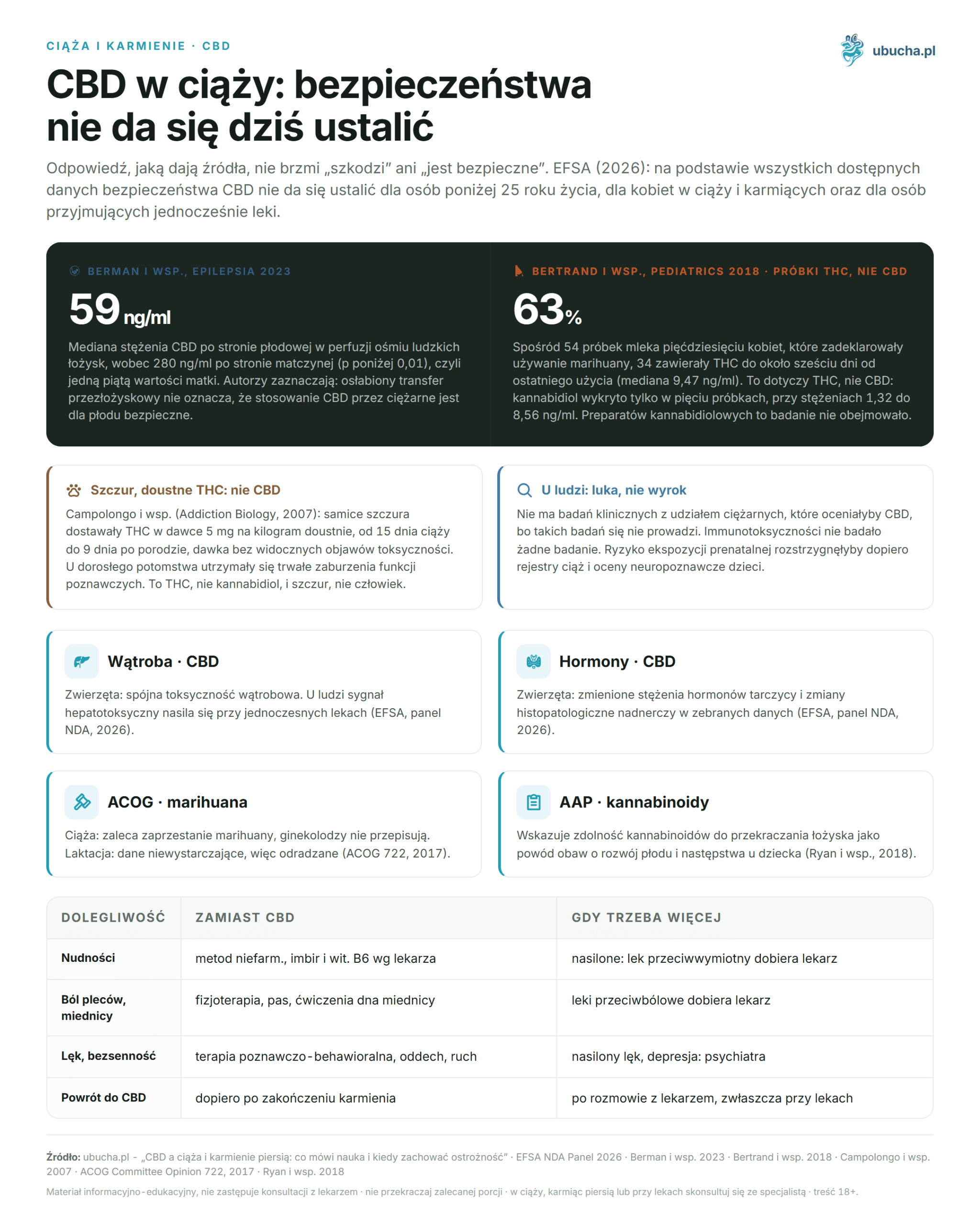
• EFSA 2026: the safety of CBD cannot be established for pregnant and breastfeeding women, for individuals under 25 years of age, and for those taking medications.
• The provisional safe dose for adults is 0.0275 mg/kg body weight per day, which is about 2 mg for a person weighing 70 kg.
• In the perfusion of the human placenta, the concentration of CBD on the fetal side was one-fifth of the maternal side (Berman et al., Epilepsia 2023).
• ACOG advises against cannabis and its derivatives during pregnancy and lactation (Committee Opinion No. 722, 2017).
Why does CBD during pregnancy raise concerns?
The reason is not proven harm, but the size of the data gap. There are no clinical studies involving pregnant women that have evaluated CBD, as such studies are not conducted, and the collected animal and mechanistic data are sufficient to not consider the matter closed.
The update of the position of the European Food Safety Authority (EFSA, NDA panel, 2026) outlines what is still unknown. The gaps indicated in 2022 have not been closed, as new works have methodological limitations: non-standardized protocols, short observation times, and simultaneous treatment with other agents. Animal studies show consistent liver toxicity, and in humans, the hepatotoxic potential primarily manifests when CBD is combined with medications. The panel also notes hormonal disturbances, namely altered thyroid hormone levels and histopathological changes in the adrenal glands.
Two sentences from this document directly concern pregnancy. The ability of CBD to cross the placenta and accumulate in the body raises additional safety concerns. After prenatal exposure, neurodevelopmental effects have been observed, long-lasting and sex-dependent. Separately, the panel notes that immunotoxicity has not been studied in any research.
The conclusion of EFSA is stated directly: based on all available data, the safety of CBD cannot be established for individuals under 25 years of age, for pregnant and breastfeeding women, and for individuals simultaneously taking medications. The provisional safe dose, which the panel derived using the benchmark dose method with an uncertainty factor of 400, is 0.0275 mg per kilogram of body weight per day, which is about 2 mg daily for a person weighing 70 kg, and applies only to supplements with a purity of CBD of at least 98%.
Does CBD pass through the placenta?
Yes, and this has been measured in human tissue. The placenta is not an impermeable wall, but a selective barrier, and CBD is a small and highly lipophilic molecule, which is exactly the type that passes through it.
The study Berman et al. (Epilepsia, 2023) used perfusion of placentas taken from healthy women after cesarean sections. Eight samples were perfused for 180 minutes with a solution containing CBD at a concentration corresponding to a low therapeutic level. The result: CBD accumulated in placental tissue in amounts very varied between samples, and the concentration on the fetal side was one-fifth of the concentration on the maternal side (median 59 vs. 280 ng/ml, p below 0.01). The expression of placental genes did not change significantly.
The authors describe this phenomenon vividly: the placenta behaves like a warehouse that slows the passage of CBD to the fetus, which in a living organism may result in lower fetal concentrations, but lasting longer. And they add a sentence that no seller will quote: weakened transplacental transfer does not mean that the use of CBD by pregnant women is safe for the fetus. The risk of prenatal exposure would only be resolved by pregnancy registries and neurocognitive assessments of children.
The previous version of this article attributed the described perfusion of the human placenta to the work “Bertrand et al. 2018,” and the identifier provided led to an article on organic chemistry. Bertrand et al. do indeed exist, but they studied something else, as described below.
What do EFSA, ACOG, and AAP say about CBD during pregnancy?
Three documents answer three different questions, and it is worth not confusing them, as they concern different substances. EFSA evaluates cannabidiol itself as a food ingredient. Obstetric and pediatric societies comment on cannabis as a recreational substance, including products containing THC.
The position of the American College of Obstetricians and Gynecologists (ACOG, Committee Opinion No. 722, Obstetrics and Gynecology 2017) formulates three recommendations. Pregnant women or those planning pregnancy should be encouraged to stop using marijuana. Gynecologists should not prescribe or suggest the use of marijuana for medical purposes before conception, during pregnancy, and during lactation. For the breastfeeding period, the data are insufficient, and in the absence of data, use is discouraged.
The clinical report of the American Academy of Pediatrics (Ryan et al., Pediatrics 2018) follows the same path, pointing to the ability of cannabinoids to cross the placenta as a reason for concerns about fetal development and distant consequences for the child. The authors note that social media promotes cannabis for severe pregnancy-related nausea.
From this summary, we removed two claims that were previously here. The first stated that WHO recognized CBD as safe for adults at typical doses: the WHO report is not a safety assessment of a supplement and has been replaced in this role by the EFSA position from 2026. The second attributed a specific recommendation about cannabinoids to the Polish gynecological society, which could not be confirmed in any available document.
Does CBD transfer to breast milk?
Measurement exists, but it says less than is often repeated online. Milk from women using marijuana was studied, not from women taking cannabidiol products, so the result refers to a different situation than daily use of oil.
In the work Bertrand et al. (Pediatrics, 2018), fifty breastfeeding women who reported using marijuana provided 54 milk samples. THC was detected in 34 samples, or 63%, up to about six days after the last reported use, with a median concentration of 9.47 ng/ml. Cannabidiol or 11-hydroxy-THC was detected in only five samples, with CBD concentrations ranging from 1.32 to 8.56 ng/ml. Cannabinol was not found in any sample.
This difference is significant for reading headlines. The statement “CBD was detected in milk for at least six days” is a misrepresentation: six days refers to THC, while CBD appeared in less than one-tenth of the samples. However, this is not evidence of safety, but rather a lack of measurement in the scenario of interest. EFSA includes breastfeeding women in the same sentence as pregnant women: safety for this group cannot be established. Separately, we discuss the postpartum period in the text CBD and postpartum depression and baby blues.
What do animal studies teach about cannabinoids during pregnancy?
They teach what cannot be studied in humans, and they must be read with the caution appropriate for animal models. The most frequently cited study concerns THC, not cannabidiol, which is often lost along the way.
Campolongo et al. (Addiction Biology, 2007) administered THC to female rats at a dose of 5 mg per kilogram orally, from the 15th day of pregnancy to the 9th day postpartum, at a dose without visible signs of toxicity. Reproductive parameters did not change. However, in adult offspring, changes in gene expression in the cerebral cortex related to the glutamatergic and noradrenergic systems persisted, with reduced extracellular concentrations of both neurotransmitters and lasting cognitive function disturbances.
The previous version of this article attributed changes in CB1 receptor density in the hippocampus and disruption of the endocannabinoid system maturation to this work, citing the Journal of Neuroscience as the source. The work appeared in Addiction Biology and does not contain such results. We corrected both the description and the identifier.
For CBD itself, the animal signal summarizes the EFSA position: reproductive toxicity studies reinforce concerns in this regard, and after prenatal exposure, long-lasting and sex-dependent neurodevelopmental effects have been observed. Doses in animal models can be higher than typical supplemental doses in humans, so direct translation of the result is not justified. However, in the absence of clinical studies, this is the only available signal.
What to use instead of CBD for pregnancy-related ailments?
For each of the ailments for which the question about CBD arises, there is a procedure with a better-described safety profile during pregnancy. The choice and dosage belong to the attending physician, as pregnancy changes pharmacokinetics, and some over-the-counter medications are contraindicated during it.
For pregnancy-related nausea and vomiting, the procedure usually starts with non-pharmacological methods, and with severe symptoms, the doctor selects an antiemetic with an established safety profile. Ginger and vitamin B6 are sometimes recommended as supplements, but their validity and dosage are determined by the person managing the pregnancy, not the article. More about the antiemetic mechanism of cannabinoids is written in the text Does CBD help with nausea, with the caveat that this pathway is excluded during pregnancy.
For back and pelvic pain, the first line is perinatal physiotherapy, supplemented with a support belt and pelvic floor exercises. Pain medications are selected by the doctor, as the acceptability of individual substances changes with each trimester.
For anxiety and insomnia, cognitive-behavioral therapy is effective and free from effects on the fetus, supported by breathing techniques and movement adapted to pregnancy. In cases of severe anxiety or prenatal depression, the appropriate address is a psychiatrist who will select treatment with a documented safety profile. A summary of general reservations regarding cannabidiol itself can be found in the text Is CBD safe.
Are hemp seeds safe during pregnancy?
Hemp seeds are food, not a cannabinoid product, and in this regard, they stand completely apart from CBD oil. However, they are not, contrary to frequent assurances, completely free of cannabinoids, and the previous version of this text claimed otherwise.
This is determined by food law. Annex I section 2.6 of Commission Regulation (EU) 2023/915, applicable from May 25, 2023, establishes the maximum allowable levels of THC in food from hemp seeds: 3.0 mg/kg for seeds and for ground seeds and other products processed from them, as well as 7.5 mg/kg for hemp seed oil. The level refers to the sum of delta-9-THC and delta-9-THCA expressed as delta-9-THC, with a factor of 0.877 for THCA. Such limits are not set for a component that is not present in the product.
The practical conclusion is calm but requires precision. Seeds legally introduced into circulation must meet these limits and remain a valuable food, rich in protein and alpha-linolenic acid. The assurance of “zero cannabinoids” is a marketing slogan, not a product description, and should not be relied upon for a sense of safety. Any significant dietary changes during pregnancy should be discussed with the person managing the pregnancy.
When can one return to CBD after pregnancy?
After breastfeeding is completed and after a conversation with a doctor. The end of lactation removes the only route of exposure for the child, but it does not eliminate questions about the mother herself, especially if she is taking medications after childbirth.
The reason is specific and stems from the EFSA position: the hepatotoxic potential of CBD in humans primarily manifests when used simultaneously with other medications, and one of the three excluded from the safety assessment are individuals taking medications. After childbirth, this applies to many women, from antidepressant treatment to thyroid preparations. A conversation with a doctor is not a formality here, but a way to avoid interactions.
The form of the preparation also matters. The provisional safe dose of EFSA applies only to supplements with a purity of cannabidiol of at least 98%, without nanoparticles and with a safe production process. For full-spectrum products, cosmetics, and foods with added hemp, this assessment does not apply, as the panel did not conduct it. Therefore, a label stating “full spectrum” does not fall within the number provided by the authority.
We do not provide the time after which CBD “disappears” from the body or a waiting scheme before returning to breastfeeding. The numbers that were previously here had no source, and the interval measured from an article concerning infants is exactly what we want to avoid. If you are looking for a broader hormonal context, you can find it in the text The endocannabinoid system in the menstrual cycle.
Frequently Asked Questions
Is CBD safe during pregnancy?
This cannot be determined today, and this is the conclusion of EFSA from 2026, which includes pregnant women, breastfeeding women, individuals under 25 years of age, and those taking medications. There are no clinical studies involving pregnant women. ACOG advises against cannabis and its derivatives during pregnancy and lactation.
Does CBD pass through the placenta?
Yes. In the perfusion of eight human placentas, cannabidiol accumulated in placental tissue, and its concentration on the fetal side was one-fifth of the maternal side (Berman et al., Epilepsia 2023). The authors emphasize that weakened transfer does not mean safety for the fetus.
Does CBD transfer to breast milk?
In a study of milk from fifty women using marijuana, cannabidiol was detected in five of 54 samples, with concentrations ranging from 1.32 to 8.56 ng/ml (Bertrand et al., Pediatrics 2018). The six-day persistence referred to THC, not CBD. Cannabidiol products were not included in this study.
Is CBD for nausea during pregnancy safe?
There is no data to confirm this, and for pregnancy-related nausea, there is a procedure with a better-described safety profile. It starts with non-pharmacological methods, and with severe symptoms, the doctor selects an antiemetic. EFSA cannot determine the safety of CBD for pregnant women.
Do hemp seeds contain cannabinoids?
Yes, in trace amounts, and that is why EU law sets limits for them: 3.0 mg/kg for seeds and products processed from them and 7.5 mg/kg for hemp seed oil, as the sum of delta-9-THC and THCA. The basis is Regulation (EU) 2023/915.
When can one return to CBD after pregnancy and breastfeeding?
After breastfeeding is completed and after a medical consultation, especially when taking medications simultaneously. EFSA indicates that the hepatotoxic potential of cannabidiol in humans primarily manifests in combination with medications, and the safety assessment does not include individuals taking medications.
This article is for informational and educational purposes only and does not constitute medical advice. Before starting to use cannabis or CBD for therapeutic purposes, consult a doctor, especially if you are taking other medications, are pregnant, or breastfeeding.
Author: Michał Waluk · Published: 2026-06-15 · Updated: 2026-08-15