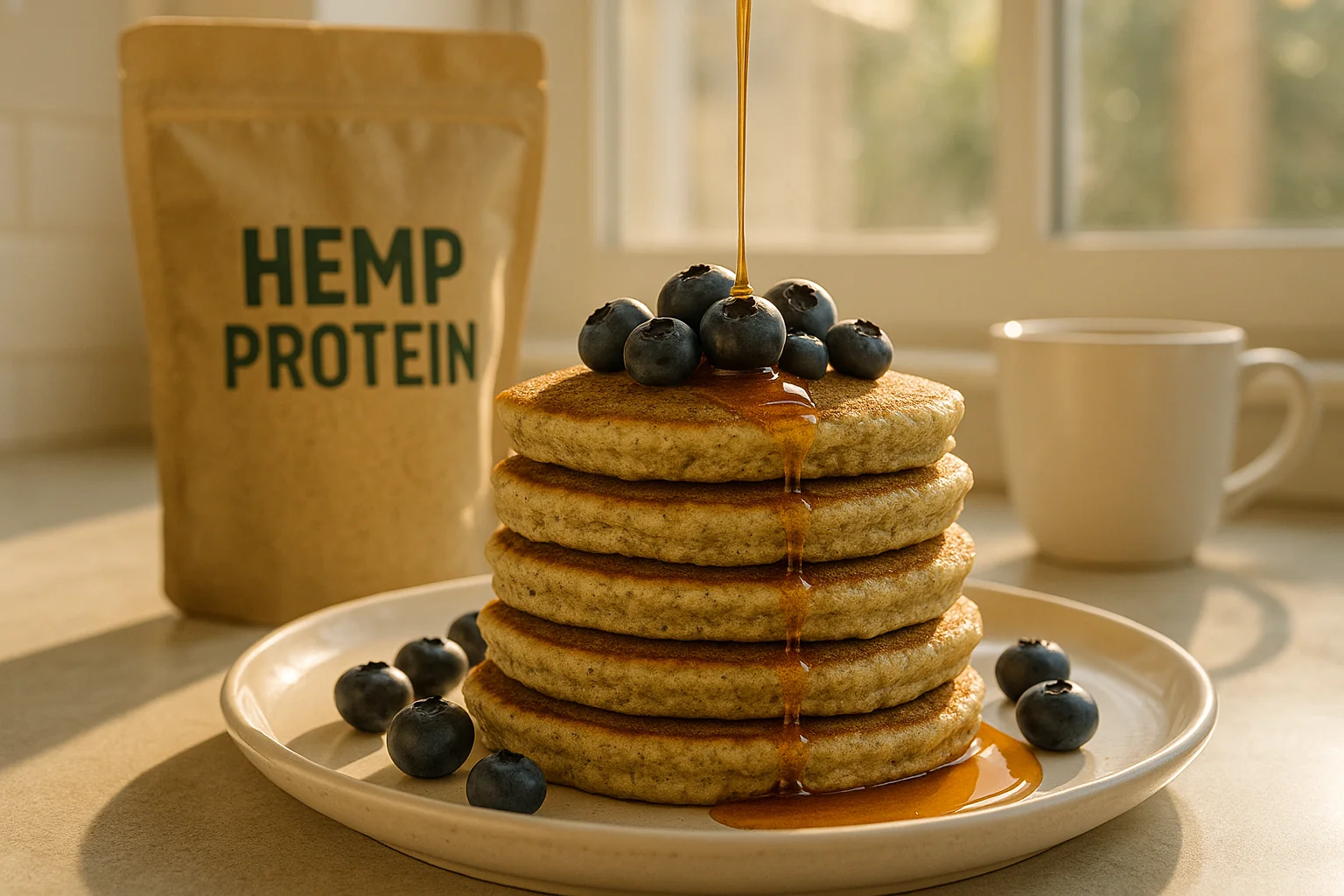

Protein Pancakes with Hemp Protein: Post-Workout
Protein pancakes with hemp protein step by step. How much protein do they really provide, what do the digestibility measurements of hemp protein say, and how to fry them so they do not fall apart.
Pancakes with hemp powder have two reputations at once. Some say they are the best plant-based breakfast after a workout, while others claim the pancakes turn out crumbly, earthy, and fall apart in the pan. Both sides are somewhat right, but for different reasons. Hemp protein does digest well, but its amino acid quality is lower than suggested by the descriptions on the packaging. And the batter is indeed more delicate because the powder absorbs liquid differently than wheat flour and does not build a gluten network. Below you will find a recipe for six to eight pancakes, data from measurements of thirty commercial hemp samples, and adjustments that keep the pancakes intact when flipping. I will also write how much protein can be counted in this recipe and how much needs to be read from the package.
KEY INFORMATION
• The hemp cake after oil extraction, which is the raw material for protein powders, has 40.7% protein and PDCAAS 46-51% (House, Journal of Agricultural and Food Chemistry, 2010).
• Lysine is the first limiting amino acid in all studied hemp products, so hemp is not a complete protein in terms of amino acid scoring.
• Hemp isolate digested in vitro at 88-91% compared to 71% for soy isolate (Wang, Food Chemistry, 2008).
• Shelled hemp seeds have 31.6 g of protein and 48.8 g of fat per 100 g (USDA FoodData Central, record 170148).
What is really known about hemp protein?
That it digests very well, and its amino acid scoring is average, and these two things are not contradictory. The broadest measurement was made by House’s team (Journal of Agricultural and Food Chemistry, 2010) on thirty commercial samples from Western Canada: whole seeds, cold-pressed cake, shelled seeds, and hulls. Quality was assessed using the PDCAAS index, in a digestibility test on rats, against the FAO and WHO requirements for children aged 2-5 years.
The results vary between forms of the raw material. Whole seeds had 24.0% protein and 30.4% fat, shelled seeds 35.9% and 46.7%, and the cake after pressing had 40.7% protein with 10.2% fat. The digestibility of the protein itself was high everywhere, and in the cake, it was the highest, at 90.8-97.5%. However, the PDCAAS was lower: 49-53% for whole seeds, 46-51% for cake, and 63-66% for shelled seeds. The reason is provided by the same work: lysine is the first limiting amino acid in all studied hemp products. Removing the hull improves both digestibility and the final score.
The second measurement concerns the isolate. Wang and colleagues (Food Chemistry, 2008) compared hemp isolate with soy isolate in an in vitro digestion model. After the action of pepsin and trypsin, the digestibility of hemp isolates was 88-91% compared to 71% for soy isolate. The same authors state directly that apart from lysine and sulfur amino acids, the hemp profile meets the FAO and WHO recommendations for small children. In other words: it is a good plant protein with a clear amino acid gap, not a whey equivalent. The main storage proteins in the seeds are edestin and albumin, both easily digestible, as noted by Callaway (Euphytica, 2004).
How much protein do these pancakes have?
As much as is indicated on your powder label plus about 22 g from the eggs and oats. Two large eggs weigh about 115 g without shells, which is close to 14.5 g of protein (USDA FoodData Central, record 171287). Sixty grams of dry oats add 7.9 g of protein and 6.1 g of fiber (record 173904). This is the part that can be counted from measurements, not from the description on the package.
The rest depends on the powder, and here you need to read the label. The powder sold as hemp protein is made from the cake after oil extraction, additionally sifted and defatted, so the declared protein content can be higher than the 40.7% measured by House for the cake itself. There is no single record in the food composition database for all such powders, as they differ in processing, so the nutritional table on the package is the authoritative source.
A separate issue is the satiety that is most often attributed to these pancakes. Leidy and colleagues (Obesity, 2011) observed 27 overweight or obese men on a 750 kcal deficit diet for twelve weeks. The group consuming 25% of energy from protein reported greater satiety throughout the day than the group consuming 14%, and in the evening, they thought about food less often. Note the scope of this result: this is a weight loss study in overweight men, not a post-workout recovery study. This work does not mention the anabolic window at all.
From our experience, hemp powders from different manufacturers behave quite differently in batter. Finely ground, light brown gives a smooth batter and milder taste. Coarser, darker absorbs more liquid and leaves an earthy aftertaste. If the batter comes out like thick pudding, it is not a recipe error, but a different granulation.
What do you need for six pancakes?
The proportions are for two servings of three to four pancakes each. Grind the oats yourself, as freshly ground oats absorb liquid more slowly than ready-made flour, making it easier to achieve the right batter consistency.
- 40 g of hemp protein powder, about three heaping tablespoons
- 60 g of finely ground oats or oat flour
- 1 teaspoon of baking powder
- a pinch of salt
- 2 large eggs
- 200 ml of plant-based milk, oat or almond
- 1 tablespoon of unrefined coconut oil
- 1 teaspoon of honey or maple syrup, optional
- for frying: coconut oil or clarified butter
- for serving: fresh fruits, yogurt, a tablespoon of maple syrup
Hemp powder has a natural greenish hue and nutty aroma. Both are normal, and after frying, the pancakes simply turn out darker than usual. If you want to lighten them, reduce the powder to 30 g and add 10 g of oats. Choose unsweetened plant-based milk, as sugary versions burn on the pan faster than the center of the pancake can set. You can replace coconut oil with clarified butter, but not regular butter: the residue from it sticks to the pan and darkens subsequent pancakes.
How to fry pancakes with hemp protein?
The whole process takes about twenty minutes, with eight minutes for preparing the batter. The only moment when it is easy to spoil the effect is flipping: the hemp batter needs more time in the pan than regular batter before it binds enough to withstand the spatula’s movement.
- Grind the oats in a blender or grinder for 30 seconds into a fine powder. You can also use ready-made oat flour.
- In a large bowl, combine oat flour with hemp powder, baking powder, and salt. Break up clumps of powder with a whisk, as it has a strong tendency to clump together.
- In a separate bowl, whisk the eggs with plant-based milk, coconut oil, and optionally honey. Pour into the dry ingredients and mix. A few clumps are fine.
- Let the batter sit for 5 minutes for the powder to absorb the liquid. If after this time it is too thick, add 2-3 tablespoons of plant-based milk.
- Heat a non-stick pan over medium heat for 2 minutes and lightly grease it with coconut oil. A drop of batter should gently sizzle, not pop.
- Pour 3-4 tablespoons of batter and cook for 2.5-3 minutes until bubbles appear across the surface and the edges stop shining. Flip with a wide spatula in one motion and cook for another 1.5-2 minutes. Do not press the pancakes with the spatula.
- Serve immediately with fruits and yogurt. Cold hemp pancakes harden more than wheat ones, so reheat them briefly in a dry pan, not in the microwave.
What to change if the batter falls apart?
The most common cause is flipping too early, and the second is too little binding agent in the batter. Hemp powder has no gluten and will not build a network that holds the pancake together, so the role is played by eggs and starch from the oats. If the pancakes still break despite waiting, reduce the powder to 30 g and add one yolk. A smaller size also helps: a pancake with a diameter of eight centimeters flips without breaking, while a fifteen-centimeter one breaks in half under its own weight.
The egg-free version works with flaxseed: two tablespoons of ground flaxseed soaked in six tablespoons of water for five minutes replace two eggs. The pancakes come out less fluffy but hold their shape and taste the same. In the chocolate version, add two teaspoons of cocoa and a teaspoon of cinnamon, and reduce the hemp powder by 5 g, as cocoa also absorbs liquid. The same powder can be used unchanged in protein omelet, protein shake, and homemade protein bars.
Frequently Asked Questions
How much protein do pancakes with hemp protein have?
Two eggs and 60 g of oats provide about 22 g of protein for the entire batch, based on records 171287 and 173904 from the USDA FoodData Central. How much the hemp powder adds depends on its processing, so read this number from the nutritional table on the package.
Is hemp protein complete?
Not in terms of amino acid scoring. House and colleagues (2010) found that lysine is the first limiting amino acid in all studied hemp products, and Wang (2008) adds sulfur amino acids to this list. All essential amino acids are present, but two positions fall below the reference requirement.
Is hemp protein digested worse than soy protein?
On the contrary. In an in vitro digestion model after pepsin and trypsin, hemp isolates achieved digestibility of 88-91% compared to 71% for soy isolate (Wang, Food Chemistry, 2008). The lower PDCAAS of hemp is due not to digestibility, but to amino acid composition, mainly due to lysine deficiency.
What is the difference between hemp powder and hemp seeds?
By origin and fat content. The powder is made from the press cake left after oil extraction, which has 40.7% protein and 10.2% fat (House, 2010). Shelled seeds are a different product: 31.6 g of protein and 48.8 g of fat per 100 g according to record 170148 from the USDA FoodData Central.
Can these pancakes be made without eggs?
Yes. Two tablespoons of ground flaxseed soaked in six tablespoons of water for five minutes replace two eggs. The batter will be looser, so reduce the hemp powder to 30 g and fry smaller pancakes. They come out less fluffy but do not break when flipping.
When to eat protein pancakes after a workout?
Whenever it suits you. The popular anabolic window lasting half an hour is not confirmed in the studies referenced in this text: Leidy’s 2011 study concerned satiety on a weight loss diet, not post-exercise recovery. Rather, the total daily protein intake matters more than the clock after the last set.
There is no hemp protein or hemp seeds in our store. Among hemp food products, you will find in the food category hemp teas and sweet snacks.
This article is for informational and educational purposes and does not replace consultation with a doctor. If you are pregnant, breastfeeding, taking medications, or have chronic conditions, consult the use of supplements or herbs with a specialist.
Author: Michał Waluk · Published: 2026-06-15 · Updated: 2026-08-16