
Does CBD show up on drug tests? What you need to know before working and driving
Does CBD show up on drug tests? What did the urine study after pure CBD show, what does the police saliva test look for, and what regulations really apply.
This is one of those questions where the answer “it depends” is not a cop-out. Cannabidiol itself does not show up on a standard test because the test does not look for it. But full-spectrum oil is not just cannabidiol, and that is where the risk begins. If you work in a profession with regular testing or drive professionally, you need specifics: what exactly does the test measure, how much THC would have to be in you, and on what legal basis the control is conducted. Below you will find one study that measured this directly, as well as regulations read from the source, not from repeated simplifications found online. You will also see why two numbers repeated in almost every guide about CBD behind the wheel do not mean what they are attributed to.
KEY INFORMATION
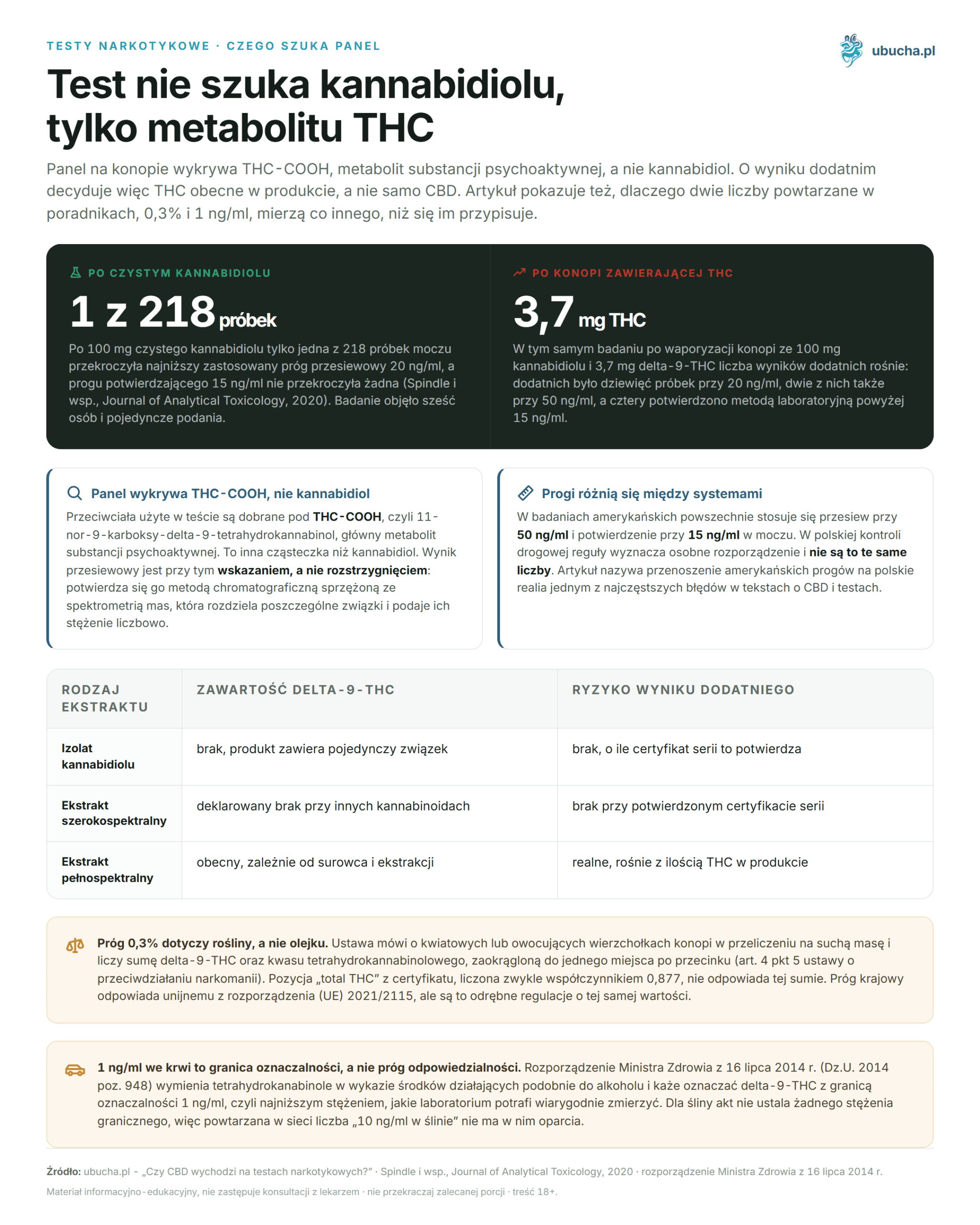
• After administering pure CBD, only 1 out of 218 urine samples exceeded the lowest screening threshold, and none exceeded the confirmatory threshold (Spindle et al., Journal of Analytical Toxicology, 2020).
• After vaporizing cannabis containing 100 mg of CBD and 3.7 mg of THC, nine samples tested positive in the screening, and four were confirmed by laboratory method.
• The threshold of 0.3% applies to the plant, not the oil, and counts as the sum of delta-9-THC and THCA; it results from Article 4 point 5 of the Act on Counteracting Drug Addiction, not from EU regulation.
• The value of 1 ng/ml of delta-9-THC in blood is the limit of method detectability, not a statutory threshold for liability.
What do drug tests really look for?
A standard test does not look for cannabidiol. The cannabis panel detects THC-COOH, or 11-nor-9-carboxy-delta-9-tetrahydrocannabinol, the main metabolite of the psychoactive substance. This is a completely different molecule than cannabidiol, and the antibodies used in the test are tailored to it.
Screening tests work immunologically: the sample reacts with the antibody, and the device or strip shows a result above or below a set threshold. Such a result is an indication, not a determination. It is confirmed by a chromatographic method coupled with mass spectrometry, which separates individual compounds and provides their concentration numerically.
Screening and confirmation thresholds differ between countries and systems. In American studies, a screening threshold of 50 ng/ml and a confirmation threshold of 15 ng/ml in urine are commonly used. In Polish roadside checks, the rules are set by a separate regulation, which we discuss below, and these are not the same numbers. Transferring American thresholds to Polish realities is one of the most common mistakes in texts about CBD and tests. If you are interested in pharmacokinetics itself, we have gathered it in a text about how much CBD is detectable in blood and urine.
Can cannabidiol itself give a positive result?
This was measured directly. Spindle and colleagues published a study in Journal of Analytical Toxicology in 2020, in which six healthy adults in a crossover design received 100 mg of cannabidiol orally, 100 mg via vaporization, vaporized cannabis rich in cannabidiol, and a placebo. Urine was collected before administration and for five consecutive days.
The result for pure cannabidiol is unequivocal. Out of 218 urine samples, only one exceeded the lowest applied screening threshold of 20 ng/ml, and none exceeded the confirmatory threshold of 15 ng/ml. The authors state directly that a single administration of pure cannabidiol does not yield a positive result at their employee testing thresholds.
This changed immediately when THC came into play. The vaporized cannabis contained 100 mg of cannabidiol and 3.7 mg of delta-9-THC. After it, nine samples tested positive in the screening at 20 ng/ml, two of them also at 50 ng/ml, and four were confirmed in laboratory testing above 15 ng/ml. This is the whole answer to the titular question: the problem is not cannabidiol, but the THC that accompanies it.
The study involved six people and single doses, so it says nothing about the result after months of daily use. The authors conclude with a call for reliable labeling of THC content in cannabis products, as it determines the result.
How much THC is allowed in cannabis and what does this threshold apply to?
The threshold of 0.3% is described incorrectly in Polish texts about CBD in three ways at once, so it is worth breaking it down. It results from Article 4 point 5 of the Act of July 29, 2005 on Counteracting Drug Addiction, as amended by the Act of March 24, 2022, and effective from May 7, 2022.
First, the threshold applies to the plant, not the final product. The law refers to flowering or fruiting tops of cannabis from which resin has not been removed, calculated on dry mass. Oil is not a plant, and the law does not set such a limit for it.
Second, it is not just delta-9-THC that counts, but the sum of delta-9-THC and tetrahydrocannabinolic acid, rounded to one decimal place. This has practical consequences when reading the certificate of analysis: the “total THC” position, usually calculated with a factor of 0.877, does not correspond to the sum from the law.
Third, the national threshold does not result from EU regulation. The EU establishes its own limit of 0.3% for varieties covered by subsidies in Article 4 paragraph 4 of Regulation (EU) 2021/2115, effective from January 1, 2023. These are two separate regulations with the same numerical value, and the correct statement is: the national threshold corresponds to the EU threshold.
What are the consequences for a driver after using full-spectrum oil?
Cannabidiol is not a substance acting similarly to alcohol and is not in itself a basis for either detention or charges. The risk concerns only the THC present in full-spectrum products. Article 45 paragraph 1 point 1 of the Road Traffic Law (t.j. Dz.U. 2024 poz. 1251) prohibits driving a vehicle after using a substance acting similarly to alcohol, and testing for its presence is conducted based on Article 129j of this law.
The list of these substances and the method of testing is specified in the regulation of the Minister of Health from July 16, 2014 (Dz.U. 2014 poz. 948). It explicitly lists tetrahydrocannabinols in the list of substances subject to testing. The screening test involves a non-invasive saliva sample collection and its analysis using an immunological method in a device designed for this purpose. The regulation does not provide any threshold concentration for saliva, so the repeated number “10 ng/ml in saliva” has no basis in it.
In blood testing, the regulation requires measuring delta-9-THC with a detectability limit of 1 ng/ml. This is the most commonly confused value: the limit of detectability indicates how reliably the laboratory can measure, not from what point liability begins. The legislator has not established an equivalent of per mille for THC.
There are two levels of consequences. Driving under the influence of a narcotic is a crime under Article 178a paragraph 1 of the Penal Code, punishable by imprisonment of up to 3 years, and the court also imposes a monetary penalty of at least 5000 PLN. A milder state after using such a substance is an offense under Article 87 paragraph 1 of the Offenses Code, with a fine of no less than 2500 PLN. We elaborate on this in the text about whether you can drive after taking oil.
Can an employer test you for the presence of THC?
Yes, if they meet the conditions specified in the Labor Code. The regulations on sobriety checks and testing for the presence of substances acting similarly to alcohol were introduced into the Labor Code by the Act of December 1, 2022, amending the Labor Code and certain other acts (Dz.U. 2023 poz. 240). Previous texts about CBD at work usually refer to the Act on Raising in Sobriety, which is a reference to the wrong act.
The control is not a free entitlement. The employer introduces it when it is necessary to ensure the protection of life and health of employees or other persons or the protection of property, and the groups of employees subject to control and the method of conducting it must be established in company regulations and communicated to employees in advance.
The testing covers the same substances as in roadside checks: opioids, amphetamines and their analogs, cocaine, tetrahydrocannabinols, and benzodiazepines. Cannabidiol is not on this list, so an employee using isolate or THC-free product has nothing to fear from an analytical perspective. The risk is solely from full-spectrum products, especially with prolonged use of higher doses.
Which type of oil should I choose for regular tests?
The rule is simple: if you are subject to testing or drive professionally, choose a THC-free product and have documentation for it. The table below compares three types of extracts based on this one criterion, not overall effectiveness.
| Type of extract | Delta-9-THC content | Risk of positive result |
|---|---|---|
| Cannabidiol isolate | none, product contains a single compound | none, as long as the batch analysis certificate confirms it |
| Broad-spectrum extract | declared absence, with other cannabinoids and terpenes preserved | none with confirmed certificate, but declaration without testing is not enough |
| Full-spectrum extract | present, in an amount depending on the raw material and extraction method | real, the greater the more THC the product contains and the more you take |
The analysis certificate is more important here than the name on the label. The results of the Spindle study show why: the difference between no positive result and four confirmed samples was made by 3.7 mg of THC, an amount that cannot be read from the label. Request a certificate for a specific batch, as the composition changes between batches. We have described the differences between types of extracts in more detail in the text full spectrum vs broad spectrum.
What to do after a positive test result?
First of all, treat the screening result as an indication, not a determination. You have the right to request a confirmatory test using a chromatographic method that separates cannabidiol from THC and provides a numerical concentration. In roadside checks, this is a blood test conducted under Article 129j of the Road Traffic Law.
Secure evidence before you start explaining anything. Keep the product packaging with the batch number, the analysis certificate for that batch, and proof of purchase. Record when and how often you use the product. Material collected after the fact is much weaker than what you had from the beginning.
It is also worth clarifying the legal status in the background. Possession and use of products with cannabidiol is legal in Poland, and CBD itself in the body is not a basis for any liability. The issue only arises when a test shows the presence of THC in a person driving a vehicle or operating machinery, regardless of whether you felt any effect. In a dispute with an employer or in proceedings after a roadside check, seek legal assistance, as the qualification of the act is determined by the entirety of the expert’s opinion, not a single number from the strip.
Frequently Asked Questions
Does cannabidiol itself show up on a drug test?
No. Tests look for THC-COOH, a metabolite of delta-9-THC, not cannabidiol. In the study by Spindle et al. (Journal of Analytical Toxicology, 2020), after administering pure CBD, only 1 out of 218 urine samples exceeded the lowest screening threshold of 20 ng/ml, and the confirmatory threshold was never exceeded.
Can full-spectrum oil give a positive result?
Yes, because it contains delta-9-THC. In the same study, after vaporizing cannabis with 100 mg of CBD and 3.7 mg of THC, nine samples tested positive in the screening, and four were confirmed by LC-MS-MS method. The risk depends on how much THC the product contains, and with isolate and THC-free extracts, it practically disappears.
What does a police test look for during a roadside check?
The screening test involves a non-invasive saliva sample collection and its analysis using an immunological method. The basis is the regulation of the Minister of Health from July 16, 2014 (Dz.U. 2014 poz. 948), which lists tetrahydrokanabinols in the list of substances acting similarly to alcohol. The act does not establish a threshold concentration for saliva.
Is 1 ng/ml THC in blood a threshold for liability?
No. The value of 1 ng/ml for delta-9-THC from the 2014 regulation is the limit of method detectability, meaning the lowest concentration that the laboratory can reliably measure. It is not a statutory threshold for liability. The qualification of the act is determined by the court based on the entirety of the expert’s opinion.
Which type of oil should I choose for regular tests?
Cannabidiol isolate or broad-spectrum product, in both cases with a certificate of analysis confirming the absence of delta-9-THC. A label declaration is not enough. Ask the seller for a certificate for a specific batch, as the composition varies between batches of the same product.
Oils available in the store at Bucha can be found in the oils category. Before purchasing, check the analysis certificate for a specific batch to see how much delta-9-THC it contains, as only this document answers the question posed in this article.
This article is for informational and educational purposes only and does not constitute legal advice. The legal status described in the article is valid as of the date of publication: regulations regarding cannabis may change. Before making a decision, consult a lawyer or current legal acts.
Author: Michał Waluk · Published: 2026-06-15 · Updated: 2026-08-16