Vaporization - What and How? Complete Buyer’s Guide 2026
How to choose a vaporizer in 2026: convection or conduction, which temperatures, how much to realistically spend, and what research says about inhaling vapor instead of smoke.
Choosing a vaporizer seems simple until you open the first list of models. Conduction or convection, ceramic or steel, pocket or stationary device, plus dozens of names that mean nothing to a first-time buyer. Meanwhile, differences between devices are measurable: in the study by Lanza et al. 2016, total THC recovery in vapor ranged from 54.6 to 82.7 percent among five models using the same material, a one-and-a-half-fold difference. This guide organizes the market by four factors that truly determine satisfaction with the purchase: heating method, temperature range, power source, and operating cost. It separately shows what vaporization measurements do not tell because they simply have not been studied.
KEY INFORMATION
• Total THC recovery in vapor varied between five devices from 54.6% to 82.7% (Lanza et al., PLOS ONE 2016).
• Besides cannabinoids, vapor contained three compounds, while smoke from the same portion had one hundred eleven, including five known PAHs (Gieringer et al., 2004).
• Working range for herb is 157-220°C; above this, thermal decomposition products increase.
• Lung function after switching to vaporizer was measured for up to a month in twelve people.
What is vaporization and how does it differ from smoking?
Vaporization is heating plant material to a temperature at which active compounds evaporate but the material itself does not ignite. For hemp herb, this range is 157-220°C. Smoking occurs at ember temperatures around 600-900°C, where hundreds of decomposition products form alongside active substances.
The difference is measurable. Gieringer et al. (Journal of Cannabis Therapeutics, 2004) passed the contents of a Volcano vaporizer balloon through a gas chromatograph and compared it to smoke from the same 200 mg portion burned in a pipe. In the vapor gas phase, besides cannabinoids, three compounds were preliminarily identified: caryophyllene, a terpene naturally present in cannabis, and two of unknown origin. THC alone accounted for 89 percent of the estimated mass, and together with cannabinol nearly 95 percent.
Smoke from the same portion yielded one hundred eleven preliminarily identified compounds, including five known polycyclic aromatic hydrocarbons, with cannabinoids constituting only 12 percent of the estimated mass. This is the proper measure of the difference, not just “fewer toxins.” THC recovery in repeated tests ranged from 36 to 61 percent, showing how much the result depends on chamber filling technique.
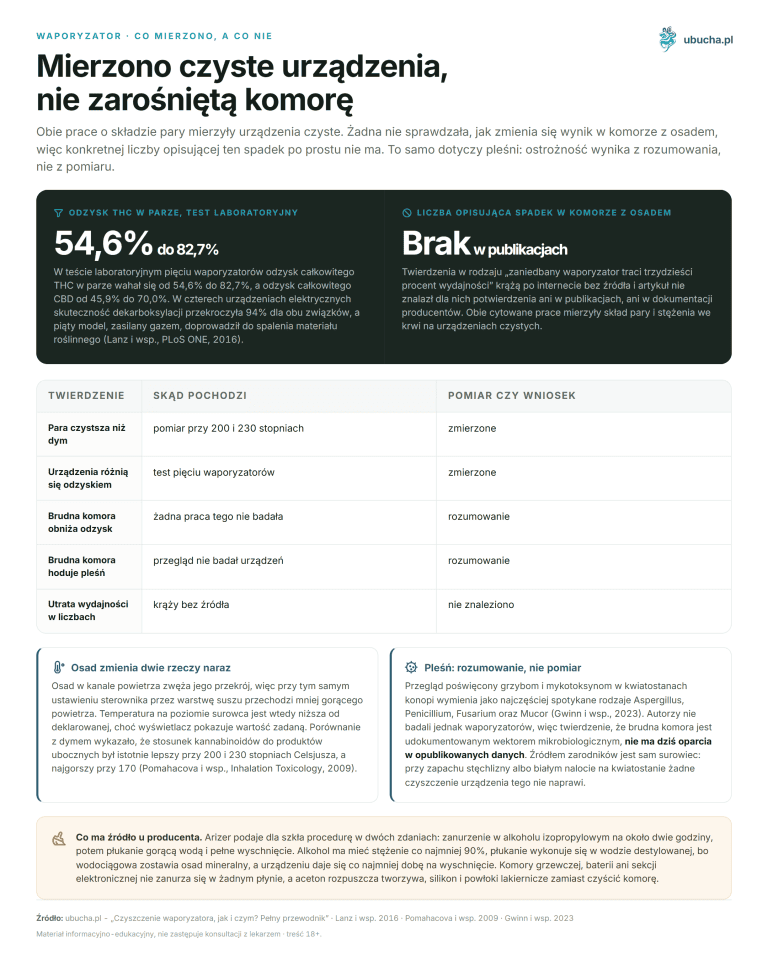
A similar picture emerged from HPLC analysis in Pomahacova et al. (Inhalation Toxicology, 2009). The ratio of cannabinoids to byproducts in vapor obtained at 200°C and 230°C was clearly more favorable than in cigarette smoke. That study also produced a result that challenges popular intuition: the worst ratio was measured not at the highest but at the lowest tested temperature, 170°C. Lower setting does not automatically mean cleaner vapor.
There is also a difference not visible in numbers. Smoking offers one mode of operation because ember temperature is fixed. A vaporizer has as many modes as the setting allows, each evaporating a different set of compounds from the same material. The same herb portion can yield a mild and aromatic session or a dense and intense one, depending on what you set on the display.
In practice, this means one thing. A vaporizer gives control over what evaporates, but this control works only if you use it consciously. Equipment without temperature control deprives you of half the benefits that make it worth buying and reduces the entire difference from smoking to one dimension: absence of open flame.
Is vaporization really healthier than smoking?
It would be safer to say: less harmful than smoking, not healthy. Laboratory measurements consistently show fewer combustion products in vapor than in smoke. None of these studies, however, tells what happens to lungs after ten years of daily inhalation, as such observations simply do not exist.
The most frequently cited evidence for vaporization is the work of Earleywine and Barnwell (Harm Reduction Journal, 2007). In a large online sample, vaporizer use was associated with fewer reported respiratory symptoms, even after adjusting for age, sex, cigarette smoking, and amount of material used. The effect was stronger the more material respondents declared. This is strong evidence but based on a survey and a single time point, so it does not resolve whether vaporization improves lung condition or is chosen by people with fewer symptoms.
One study went beyond surveys. Van Dam and Earleywine (International Journal on Drug Policy, 2010) gave vaporizers for a month to twenty regular cannabis users reporting at least two respiratory symptoms, measuring spirometry before and after. In twelve participants who did not fall ill, symptoms clearly eased, vital lung capacity increased significantly; forced expiratory volume in one second improved but not significantly. There was no control group or randomization, so authors called the result preliminary and called for randomized studies.
This ends the measurement layer. One month is the longest observation measuring lung function after switching to vaporizer. The randomized study called for does not exist yet in literature or clinical trial registries. Vaporization of plant material became widely used only in the 2000s, so observations cover at most a decade and mostly rely on participant reports. Until such data exist, any statement starting with “healthier” is a conclusion from vapor composition and one month of measurements, not from long-term human tracking.
Our assessment after reviewing these sources is moderate. If you already inhale plant material, a vaporizer reduces exposure to combustion products, and this is well documented. If you do not inhale anything, vaporization is no reason to start.
Did the EVALI epidemic concern herb vaporization?
No. Lung injuries described as EVALI were linked to ready-made liquid cartridges, not heating plant material. The review by Amjad et al. (IJERPH, 2025) points to vitamin E acetate, i.e., vitamin E in ester form, as the main responsible substance. It was added as a thickener to illegal THC liquids to dilute oil without changing viscosity.
The scale was not small. By February 2020, US CDC counted 2807 hospitalizations without fatal outcome and 60 deaths. Vitamin E acetate was detected in bronchoalveolar lavage fluid in most patients, and mechanistic studies linked it to surfactant dysfunction, the layer reducing surface tension in lung alveoli. After removing this additive from many products, case numbers dropped significantly, but isolated reports still appear.
For buyers, the conclusion concerns one specific equipment category: that with ready-made cartridges. Vaporizing pure herb and inhaling vapor from a cartridge of unknown composition are two different situations, though marketing often lumps them together. Cartridges bought outside legal channels are the riskiest market segment, as no one but the manufacturer knows their content, and any certificate of analysis, if it exists, refers to a different batch than the one in your hand.
How does convection differ from conduction and hybrids?
The heat delivery method to the material determines evaporation uniformity and device price. Convection passes hot air through the chamber, conduction relies on contact of material with a heated chamber wall, hybrid combines both. Choosing between them is usually a choice between price and session repeatability.
| Heating Method | How It Works | Strength | Weakness |
|---|---|---|---|
| Convection | stream of hot air passes through chamber | even evaporation, distinct terpene profile | higher price, longer heating, higher power consumption |
| Conduction | material contacts hot chamber wall | low price, starts in 15-30 seconds, simple design | uneven heating, burning with longer sessions |
| Hybrid | heated chamber plus hot air flow | fast start with good uniformity | more expensive service, more parts to clean |
It is worth knowing what these labels do not promise. Lanza et al. (PLOS ONE, 2016) tested five devices by gas chromatography at the same 210°C setting and material, reporting recovery separately. The pocket Arizer Solo delivered 82.7 percent total THC and 70.0 percent total CBD, while another pocket model, DaVinci, gave 54.6 and 56.7 percent respectively. The stationary Volcano Medic was in the middle with 58.4 and 51.4 percent; Plenty gave 66.8 and 56.1 percent. The authors did not classify devices as convection or conduction but as stationary vs. pocket and electric vs. gas-powered, so this spread cannot be attributed solely to heating method. It shows that model choice really affects how much material you use.
The same study brought a result lost in the technology debate: all tested electric devices decarboxylated starting compounds with very high efficiency, above 97 percent for THC and above 94 percent for CBD. The gas-powered device performed worse and additionally burned material. The buyer’s conclusion is simpler than marketing suggests: stable, controlled electric temperature matters more than whether the manufacturer calls their solution convection or hybrid.
What types of vaporizers are on the market?
The market divides along two axes: what you heat and where the device gets power. Combining these axes yields six categories differing in temperature range, mobility, and common failure points. The table below lists them in this order.
| Type | Temperature Range | Power Source | Watch Out For |
|---|---|---|---|
| Portable for herb | 160-220°C | built-in battery or replaceable 18650 cell | battery life, chamber cools slowly after off |
| Stationary for herb | 130-230°C | 230 V mains | cost of consumable balloons and hoses, countertop size |
| Portable for concentrates | above 230°C, depending on atomizer | battery | atomizers wear out quickly and are consumables |
| Stationary for concentrates | presets usually around 230-315°C | mains or battery | delicate quartz and glass parts, high entry price |
| Pod-style with cartridge | factory set, usually no control | battery | cartridge composition often undocumented, no temperature control |
| Hybrid for herb and concentrates | 160-230°C for herb, higher for cartridges | battery or mains | extra cost for versatility, two cleaning accessory sets |
Stationary equipment manufacturers usually specify the narrowest tolerance because it is easier to maintain constant temperature from mains than from a cell. Specifications of reference models are on manufacturers’ technical pages, including Storz & Bickel and Arizer. To see how these categories look in specific models, we gathered them in a separate list: vaporizer ranking 2026.
Category boundaries have blurred in recent years. Some portable devices now support concentrate cartridges, and some stationary models can be powered by external batteries. This does not change the basic trade-off: the smaller the device, the harder it is to maintain constant temperature throughout the session because low thermal mass loses heat faster to flowing air. Therefore, pocket devices work best for short sessions, while longer ones benefit from larger chambers or mains power. We broke down the operating principles of individual designs in the article on how a vaporizer works.
What can you vaporize besides herb?
A vaporizer supports five material groups but rarely all at once. Herb chamber and concentrate insert are different constructions, and pod-style cartridges require a completely separate device. Before choosing equipment, determine what you will realistically heat in it.
| Material | Typical Range | Requirements | Notes |
|---|---|---|---|
| Hemp herb | 175-215°C | herb chamber, grinder | legally traded herb from fiber hemp, i.e., plants with total THC and THCA ≤ 0.3% |
| Aromatic herbs | 130-190°C | same chamber as herb | lavender, lemon balm, mint, chamomile; aromatic effect, no psychoactivity |
| Concentrates | above 230°C | insert or separate device | wax, shatter, rosin, hash; easy to overheat and lose flavor |
| Liquid cartridges | factory set | pod-style device | hard to assess inhaled content without analysis |
| Extracts on insert | depends on carrier | dedicated ceramic insert | supported only by some high-end devices |
The last row causes most confusion. Oil intended for sublingual use is not for inhalation because the oil carrier behaves differently when heated than a liquid prepared for vaporization. This distinction matters practically, not just formally: oral and vaporizer products are tested differently and have different approved ingredients. If you seek plant material for the chamber, choose hemp herb or ready herbal blends for vaporization.
How does vaporizing concentrates differ from vaporizing herb?
It differs in temperature, portion size, and error tolerance. Concentrates vaporize above 230°C, outside the range of herb chambers, and a single portion is a fraction of a gram instead of two or three tenths. Herb and extract equipment are practically two different devices, even if sold under one name.
The main difference concerns dosing. In herb chambers, the portion is spread over several draws, and active compound concentration rarely exceeds a few percent. Extracts contain many times more, so the same volume gives a completely different dose. People switching from herb to concentrates often err here, dosing by habit rather than content.
The second difference is maintenance. Atomizers or quartz elements in extract devices are consumables and require replacement much more often than herb chambers. Concentrate residue builds up faster, hardens when cooled, and after a few sessions without cleaning starts to alter the taste of every draw. If you lack a regular maintenance habit, extract equipment will annoy you more than a herb vaporizer.
For most beginners, a herb device is a more reasonable entry point. It offers a gentler learning curve, cheaper mistakes, and material whose composition can be verified by certificate. You can always return to concentrates later by buying an insert or separate device.
Which models are currently available, their prices, and heating types are listed separately in the herb vaporizer ranking.
What do you really pay for in a vaporizer?
For session repeatability, not power. Five design features change usage enough to be noticeable after a month: smooth temperature control instead of three presets, mouthpiece and chamber material, availability of spare parts, battery type, and power source. The rest of the specs are convenience, not quality differences.
| Feature | Benefit | Consequence of Absence |
|---|---|---|
| Smooth temperature control | choice of which fractions evaporate from the same load | device works in one mode, like smoking but without fire |
| Mouthpiece and chamber made of glass, ceramic, or steel | no own taste after hundreds of sessions | plastic imparts odor and cannot withstand alcohol cleaning |
| Spare parts sold separately | replace screen or gasket instead of device | welded screen makes device disposable |
| Replaceable 18650 battery | worn battery costs as much as a new one | soldered cell marks device end of life |
| Mains power supply | stable temperature throughout long session | low thermal mass loses temperature during long draws |
Equipment prices change faster than this text, so we give order of magnitude with date, not a price list. At u Bucha store, the vaporizer category ranged from 374 to 499 PLN on August 15, 2026, while the market reaches much higher for stationary balloon systems. Add operating costs: screens, gaskets, atomizers, and balloons wear out depending on usage intensity, and their prices rarely appear in offers. For lower-tier equipment, this can change the second-year cost more than the purchase price difference.
We noticed the most common disappointment reason is not too small budget but buying a device for a different use than needed. Someone wanting discreet gear for outings buys a stationary balloon model, and someone planning long home sessions picks the smallest portable model and struggles with battery life.
Which components determine equipment durability?
Five parts determine vaporizer lifespan, four of which are consumables. Mouthpiece, heating chamber, screen, battery, and gaskets have their own maintenance intervals, and neglect always shows as reduced vapor density and bitter taste.
| Component | Recommended | Maintenance | Wear Sign |
|---|---|---|---|
| Mouthpiece | glass | wash every few sessions | residue changing taste, microcracks |
| Heating chamber | ceramic or stainless steel | clean every 10-15 sessions | uneven heating, burning near wall |
| Screen | stainless steel, replaceable | clogging every 5-10 sessions | resistance when drawing, thin vapor |
| Battery | replaceable 18650 or built-in USB-C | charge around 80% | shorter sessions, longer heating |
| Gaskets | food-grade silicone | check every few months | leakage, hot plastic smell |
When buying, check one thing easily forgotten in store: whether spare parts are sold separately at all. A device with a welded screen or no parts catalog is disposable over a few years, regardless of price. We detailed maintenance in the article on vaporizer cleaning.
Look separately at the battery, as it most often ends device life. Lithium-ion batteries lose capacity with charge cycles regardless of care. In models with replaceable 18650 cells, replacement costs as much as a battery; in models with soldered cells, it means service or end of use. If you plan daily use for years, this single design feature weighs more than most specs on the box.
Which accessories really improve session quality?
Three accessories affect the session more than all others combined: grinder, cleaning kit, and storage container. The rest are convenience, not conditions for proper device function.
- Grinder ensures even grinding, which affects airflow through the chamber. Two-piece models suffice; four-piece add screen and pollen chamber.
- Cleaning kit includes isopropyl alcohol, swabs, and brush. Without it, residue builds up and after dozens of sessions changes the taste of each next one.
- Airtight container protects material from drying. Overdry herb evaporates unevenly and burns faster.
- Water adapter cools vapor before inhalation and helps at higher settings and with stationary devices.
- Dosing capsules allow preparing several portions ahead, shortening session prep outside home.
Odorless containers and humidity regulators are in the storage section, grinders in the grinders section. The rule is simple: particles should resemble coarsely ground coffee, not dust.
What you don’t need at start? Sets with elaborate cases, replaceable colored shells, or extra mouthpieces in other shapes. These are usually bought after the first month and then lie unused. Instead, invest in spare screens and a second gasket set, as these fail first and their absence can disable the device for a week waiting for shipment.
How to conduct a session step by step?
The correct sequence has six steps and fits within fifteen minutes. Biggest effect differences come from two things: grind size and draw speed. Too fine material blocks airflow; too fast draw doesn’t allow vaporization.
- Check material moisture. It should crumble but not powder under fingers.
- Grind to medium granularity. Particles the size of coarsely ground coffee allow airflow and good heat transfer.
- Fill chamber to about two-thirds and lightly press. Overpacking blocks airflow. Balloon models have their own instructions.
- Heat device. Takes from a few seconds in conduction devices to about two minutes in stationary. Wait for ready signal; do not draw earlier.
- Draw slowly and smoothly for 4-6 seconds, then wait before next draw. Chamber needs time to rebuild temperature.
- After session, empty ABV and brush chamber while warm. Dried residue is harder to remove.
One note on step four. A chamber that reached set temperature continues heating material even when not drawing. In conduction devices, a long break mid-session wastes some load as herb near the wall evaporates without your participation. If you must pause, turn off the device instead of leaving it ready.
The session ends when material browns and vapor thins noticeably. You don’t have to throw away material after session: what to do with it is described in the article on using ABV herb.
What mistakes do beginners most often make?
Most mistakes don’t come from lack of device knowledge but from transferring smoking habits. A smoked joint draw is short and strong; with a vaporizer, it must be long and calm. This one difference accounts for most first-week disappointments.
- Overpacking chamber. Compressed load blocks airflow, heating unevenly and burning locally.
- Grinding to dust. Fine particles pass through screen, clog channels, and settle in mouthpiece.
- Drawing too fast. Air passes through chamber before heating, vapor is thin despite correct setting.
- Starting at highest setting. Session begun at 220°C loses lighter fractions immediately and tastes harsh.
- Judging device after first session. New ceramic chamber needs several fills to stop imparting its own smell.
- Delaying cleaning. Residue builds gradually, so taste worsens imperceptibly session to session, visible only after a month.
Another error happens before first use: buying equipment for material you don’t have. Concentrate device unused by herb-only user lies in drawer; smallest portable model frustrates someone planning long home sessions. Determine material and use scenario, then choose device.
What temperature to set for what purpose?
Temperature decides which fractions evaporate and which remain in chamber. For hemp herb, practical range is 157-220°C. Above this, thermal decomposition products increase; below, sessions may be disappointingly weak, and the ratio of active substances to byproducts is not necessarily better.
| Range | Dominates | Expect | Use When |
|---|---|---|---|
| 157-180°C | terpenes and lighter volatile fractions | almost invisible vapor, distinct flavor, mild effect | daytime sessions, aromatherapy, first tries |
| 180-200°C | balance of active substances and terpenes | visible vapor, full flavor profile | default daily setting |
| 200-220°C | heavier cannabinoid fractions | dense vapor, less flavor, noticeable throat scratch | session closure, medical use |
| above 220°C | increasing decomposition products | burnt taste, dark chamber residue | not recommended for herb |
Many users raise the setting gradually during one session: starting low for flavor and ending higher to extract the rest from the same load. This requires smooth control; devices with three presets cannot provide such control.
Remember, the number on the display shows heater or chamber wall temperature, not the actual material temperature. Airflow during inhalation lowers it by several to a dozen degrees, and pauses allow it to rise again. Thus, the same setting on two devices yields different effects, and comparing settings between models has limited sense. Calibrate on your own device: note the setting where vapor tastes best and treat it as a reference point.
How to tell if a session is going well?
Four signals suffice to assess a session without looking at the display: vapor color, taste, throat sensation, and material appearance after finishing. After a dozen sessions with the same device, you will recognize the right setting by these alone.
| Signal | Correct | Too High Temperature | Too Low Temperature |
|---|---|---|---|
| Vapor color | whitish, barely visible at low settings | grayish or yellowish | no visible vapor despite full chamber |
| Taste | herbal, distinctly terpene | bitter, burnt | grassy and bland |
| Throat sensation | light warmth | scratchiness and cough reflex | practically no sensation |
| Material after session | light or medium brown, even | dark brown or black, localized charring | still green, unused load |
Uneven material coloring after session is the most common conduction sign: parts touching the wall are darker. If the difference is very clear, stir the load mid-session or fill chamber more loosely. Flavor assessment reference is material quality, judged before session, not during.
Sometimes all four signals look correct, yet the session disappoints. Then the problem is usually material, not device. Herb stored too long in warmth and light loses volatile fractions, so vapor is technically correct but poor. Check material smell before filling chamber. If noticeably weaker than on purchase day, no setting will fix it.
What to watch for when buying a vaporizer in Poland?
Vaporizers themselves are legal electrical devices in Poland and can be freely bought and possessed. Regulations concern material, not equipment. The same rules apply as for any electronics: documented warranty, available service, and return possibility.
Before buying, determine four things. First, whether the seller is authorized by the manufacturer, as only then the manufacturer’s warranty truly applies. Second, whether the device has CE marking and declaration of conformity, required for electrical equipment in the EU. Third, whether consumables are sold separately. Fourth, what the real return period is, as only a few sessions show if the heating type suits you.
Material is governed by the Anti-Narcotics Act (consolidated text Dz.U. 2023 item 1939). Fiber hemp is defined in Article 4 point 5, as amended by the March 24, 2022 act (Dz.U. 2022 item 763), effective May 7, 2022: plants whose sum of delta-9-THC and tetrahydrocannabinolic acid (THCA) in flowering or fruiting tops, from which resin has not been removed, does not exceed 0.3 percent dry weight, rounded to one decimal place.
Two things to remember, as both circulate distorted. The threshold concerns the plant, not the finished product, and counts the sum of two compounds, not just delta-9-THC. Herb from plants exceeding this threshold is available only by prescription as raw material for magistral medicines. Separately: the WHO Expert Committee on Drug Dependence in its 2018 review (WHO ECDD) stated cannabidiol shows no signs of abuse or dependence potential in humans, but this assessment concerns the compound itself, not the administration route.
You can find material for the chamber in our hemp herb section.
Summary: how to match a vaporizer to yourself?
Start with when and how long you will use it, then look at price. Portable devices with temperature control suit short sessions outside home; stationary devices suit long sessions in one place. The opposite match ends with buying a second vaporizer within a year.
When comparing models, look at four parameters from the tables above: heating method, temperature setting precision, power type, and spare parts availability. Mouthpiece and chamber material add a fifth point, as taste after hundreds of sessions depends on it. The rest of specs, including phone control, are convenience, not quality differences.
If you remember one thing from this guide, let it be decision order. First material, then use scenario, then heating method, and price last as a filter, not a starting point. Reversing this order leads to buying a device that does something well but not necessarily what you expect. Equipment matched to actual use serves for years, even if it doesn’t top rankings.
One last thing manufacturers don’t say loudly. Vaporization reduces exposure to combustion products compared to smoking but still involves inhaling hot vapor into lungs. The longest lung function measurement after switching to vaporizer lasted a month and included twelve people, so treat it as risk reduction, not elimination.
Frequently Asked Questions
Is vaporization healthier than smoking?
Measurement studies show fewer combustion products in vapor than in smoke: in Gieringer et al. (2004) vapor from Volcano consisted of about 95 percent cannabinoids, while smoke from the same portion contained one hundred eleven compounds. This does not mean that inhaling vapor is neutral for the lungs. Lung function after switching to a vaporizer was measured for up to a month in twelve people.
How much does a vaporizer cost for a beginner?
At u Bucha store, vaporizers cost from 374 to 499 PLN as of August 15, 2026, while the market reaches much higher prices for stationary equipment. Instead of aiming for a price, check three things: whether the device has smooth temperature control, what the mouthpiece and chamber are made of, and whether spare parts are sold separately.
How many inhalations does one chamber fill provide?
A typical portable vaporizer chamber holds 0.15-0.30 g of herb and suffices for 5-10 draws spread over 10-15 minutes. The number depends on temperature and how slowly you draw. You recognize the session’s end by browning of the material and a clear drop in vapor density, not by a preset time limit.
Can you take a vaporizer on a plane?
Devices with lithium batteries are transported only in carry-on luggage, never in checked baggage. Cells up to 100 Wh do not require carrier approval; above this threshold, approval must be obtained. Plant material is a separate matter: its legality is determined by the destination country’s law, not the carrier’s regulations.
Can you vaporize regular herbs?
Yes. Lavender, lemon balm, mint, chamomile, or sage release essential oils already at 130-190°C, below the typical range for hemp herb. They have no psychoactive effect, and the effect is mainly aromatic. Do not vaporize herbs dusted with pesticides or blends with oil additives, as they are not intended for inhalation.
How often should you clean a vaporizer?
Wipe the mouthpiece and screen after every few sessions; do a full cleaning with isopropyl alcohol every 10-15 fills. Neglected screens narrow airflow, causing uneven heating of some material and a bitter taste. Manufacturers provide their own intervals in service manuals.
What to do with ABV, i.e., vaporized herb?
ABV is material from which most active compounds have been evaporated, but not all. Some users use it for fat extractions or infusions. How much remains depends on temperature and session length, so the strength of such an extract cannot be predicted. Treat it as an additive, not a second dose.
You can see the equipment in the vaporizers section, and material for the chamber and session accessories in herb, herbs for vaporization, and storage sections.
This article is informational and educational. It contains internal links to product categories available at u Bucha store. Prices and specifications may change: check current product page data before purchase.
Author: Michał Waluk · Published: 2026-05-11 · Updated: 2026-08-24