
CBD for Chronic Pain - Mechanisms, Clinical Studies, and Dosage 2026
Cochrane, IASP, and meta-analyses on cannabinoids in chronic pain: what has been proven, what hasn’t, and why benefits may not outweigh harms.
Moderate to severe pain lasting at least six months affects 19% of adult Europeans, and among them, two out of five rate their treatment as insufficient. It is this gap, not a trend, that drives people to cannabis oil. This text examines what Cochrane reviews, a JAMA meta-analysis, and the task force of the international pain research society say about cannabinoids in chronic pain. The answer is less spectacular than advertising: the effect can be real but small, mainly concerns preparations with tetrahydrocannabinol, and comes with a cost of side effects. You will also see which popular claims about cannabis in pain lack support from the cited studies. You will not find doses here because chronic pain is a medical indication, not a matter for self-selection.
KEY INFORMATION
• A Cochrane review covering 16 studies and 1750 people concludes that benefits of cannabis-based medicines may be outweighed by harms (Mücke et al., Cochrane Database of Systematic Reviews, 2018).
• More than half pain relief was achieved by 21% of participants versus 17% on placebo, and nervous system adverse events occurred in 61% versus 29%.
• In an inhalation study with twenty people with fibromyalgia, no cannabis strain, including cannabidiol-only, outperformed placebo on spontaneous pain (van de Donk et al., Pain, 2019).
• Randomized trials do not confirm opioid-sparing effects seen in observational studies (Nielsen et al., Neuropsychopharmacology, 2022).
• The EFSA panel states that cannabidiol safety cannot be established in people taking medications (EFSA Panel on Nutrition, 2026).
What is chronic pain and how does medicine classify it?
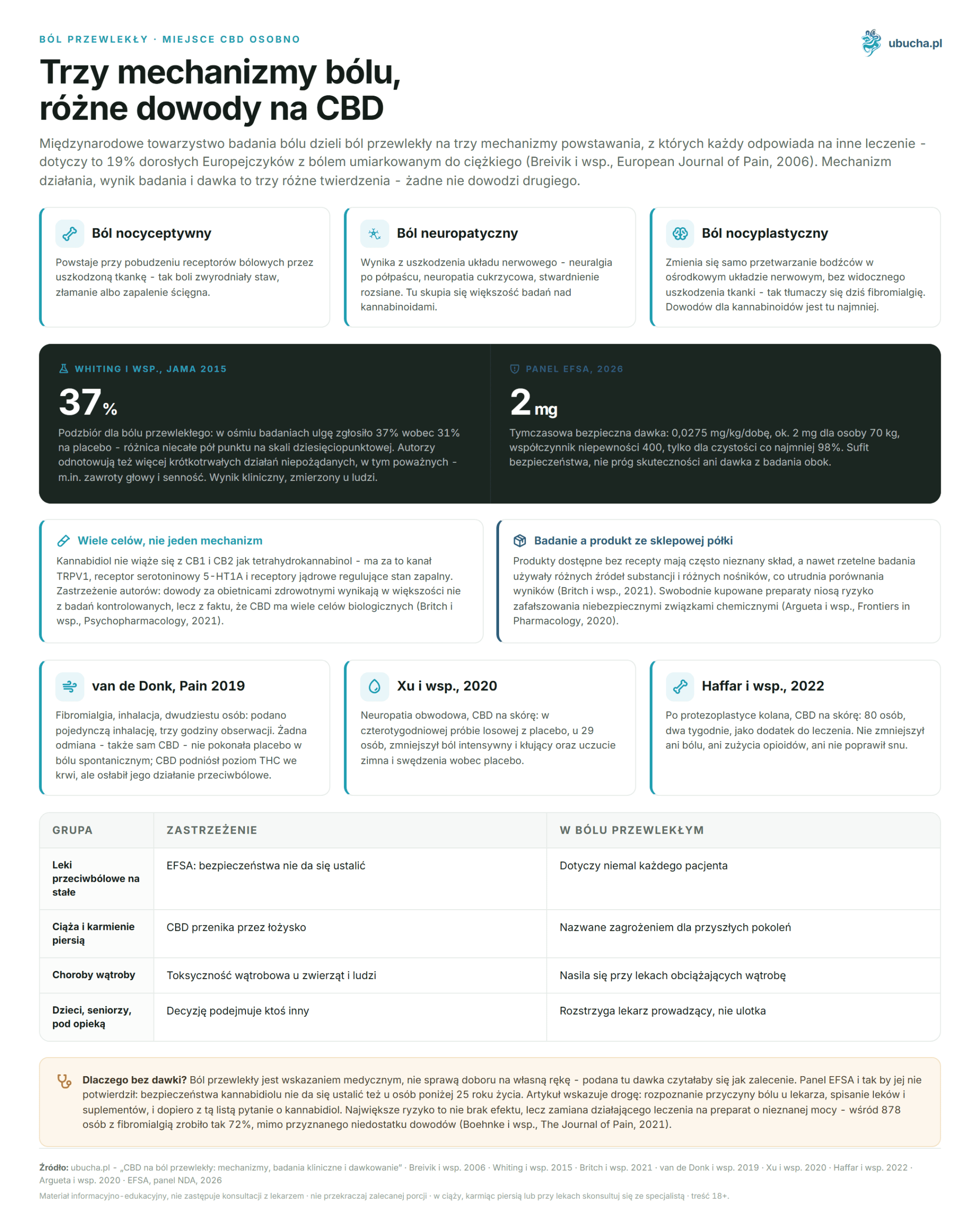
Chronic pain is a condition lasting longer than three months, now described as a separate health problem rather than a symptom accompanying another disease. The International Association for the Study of Pain distinguishes three mechanisms of its origin, each responding to different treatments. This classification is the starting point for any sensible discussion about cannabinoids.
Nociceptive pain arises from stimulation of pain receptors by damaged tissue. This is the pain of osteoarthritis, fractures, or tendon inflammation. Neuropathic pain results from damage to the nervous system itself and accompanies diabetic neuropathy, postherpetic neuralgia, and multiple sclerosis. Classic analgesics are much less effective for it.
The third category, nociplastic pain, describes a situation where the processing of stimuli in the central nervous system changes, but tissue damage is not visible. This explains fibromyalgia and some chronic headaches today. Differences between these mechanisms are described in more detail in our article on nociceptive vs neuropathic pain.
This classification directly affects how studies are interpreted. Most cannabis and pain research concerns neuropathic pain, some cancer pain, and very little nociplastic pain. Transferring results from one category to another is the same error as generalizing results from one drug to the entire class.
How big is the problem in Europe?
A large telephone survey conducted in fifteen European countries and Israel remains a reference point. Moderate to severe pain lasting at least six months was reported by 19% of adults among over forty-six thousand participants (Breivik et al., European Journal of Pain, 2006). This number is the basis for most subsequent analyses.
In-depth interviews with nearly five thousand people with chronic pain showed their daily reality. Two-thirds rated pain as moderate, one-third as severe. Depression due to pain was diagnosed in 21%, 61% were less able or unable to work, and 19% lost employment.
The most uncomfortable number concerns treatment. Forty percent of participants rated their pain treatment as insufficient, one-third were untreated, and only 2% were under specialist pain medicine care. This gap, not cannabis trends, explains the scale of self-directed solution seeking.
It is worth noting what this study does not include. It does not provide social costs, does not concern only Poland, and does not measure any product’s efficacy. Numbers circulating online under the same name, such as billions of euros lost annually, come from other sources or nowhere.
How is CBD supposed to work on pain?
Cannabidiol does not bind directly to cannabinoid receptors CB1 and CB2 like tetrahydrocannabinol. A pharmacology review lists several other molecular targets through which it may influence pain signal conduction and processing (Britch et al., Psychopharmacology, 2021). It is this multiplicity of targets, not a single mechanism, that underlies expectations for this substance.
Described targets include the TRPV1 channel present in peripheral nerve endings, the serotonin receptor 5-HT1A involved in descending pain inhibition, and nuclear receptors regulating inflammatory response. Interaction with the endocannabinoid system has also been described, though data indicate cannabidiol does not bind directly to its receptors.
However, the authors immediately temper conclusions. They write that scientific evidence behind common health claims mostly comes not from controlled studies but from the fact that cannabidiol has many biological targets. This distinction determines everything that follows in this text.
A mechanism described in the lab is a hypothesis until confirmed by human studies. In chronic pain, the path from receptor to perceived relief passes through absorption, metabolism, patient expectations, and natural disease course. Each stage can diminish the effect seen at the cellular level.
What does the Cochrane review say about cannabinoids in neuropathic pain?
This is the most cited and most misrepresented work on the topic. The review included 16 studies with 1750 people, lasting from two to twenty-six weeks, mostly with oromucosal spray administration (Mücke et al., Cochrane Database of Systematic Reviews, 2018). The quality of evidence was rated very low to moderate.
Results for efficacy are modest. At least half pain relief was achieved by 21% of participants versus 17% on placebo, with a number needed to treat (NNT) of 20. For one-third pain relief, it was 39% versus 33%, with NNT of 11.
The other side of the balance is clearer. Nervous system adverse events occurred in 61% of cannabinoid users versus 29% on placebo, and psychiatric disorders in 17% versus 5%. Ten percent withdrew due to adverse events versus 5% in controls.
Therefore, the authors conclude that potential benefits of cannabis-based medicines in chronic neuropathic pain may be outweighed by potential harms. The review also notes no information on long-term risks in the analyzed studies.
Does the JAMA meta-analysis confirm efficacy?
Not to the extent it is cited. The systematic review included 79 randomized studies with 6462 participants across ten indications, with only four studies rated as low risk of bias (Whiting et al., JAMA, 2015). The size of the dataset alone does not determine the strength of conclusions.
For chronic pain, a summary of eight studies showed 37% of people with pain reduction versus 31% on placebo. The odds ratio was 1.41 with a confidence interval from 0.99 to 2.00, including one. The mean difference on a ten-point scale was less than half a point.
The authors summarize that moderate-quality evidence supports cannabinoids for chronic pain and spasticity, while noting increased risk of short-term adverse events, including serious ones. Common side effects include dizziness, dry mouth, drowsiness, euphoria, and disorientation.
Comparing both reviews gives a consistent picture. The effect exists, is small, mainly concerns preparations containing tetrahydrocannabinol, and comes with side effects. None studied cannabidiol oil sold over the counter separately, so applying these results to such products is overinterpretation.
What did the inhalation study in fibromyalgia show?
This is one of few studies comparing four cannabis strains with known composition in a crossover design in twenty people with fibromyalgia. The main result is clear and rarely cited: no strain outperformed placebo on spontaneous or electrically induced pain (van de Donk et al., Pain, 2019).
Strains containing tetrahydrocannabinol raised pressure pain threshold versus placebo, and the strain combining both cannabinoids had more people reporting a one-third pain reduction, 90% versus 55%. However, the size of this reduction correlated with the strength of perceived intoxication.
The most interesting result concerns cannabidiol itself. Its inhalation increased THC blood levels but weakened its analgesic effect. The authors describe this as pharmacokinetic synergy combined with pharmacodynamic antagonism, the exact opposite of the popular entourage effect version.
Limitations are significant and acknowledged. Only a single inhalation was given, and observation lasted three hours, so the study says nothing about effects after weeks of use. It does say a lot about how adding cannabidiol to THC is not automatically enhancing.
Do cannabinoids allow opioid dose reduction?
The answer depends on which studies you trust, and the discrepancy is huge. An updated systematic review included 92 works, from animal models to clinical trials, and separated results by methodological quality (Nielsen et al., Neuropsychopharmacology, 2022). This division explains most of the dispute.
In animal models, morphine dose needed for effect was more than three times lower with concurrent THC. In observational studies, 39% reported complete opioid discontinuation, and 85% reduction. These numbers drive most headlines about cannabis as a solution to the opioid crisis.
Controlled trials show the opposite. Three randomized trials showed no opioid-sparing effect in acute pain, and a meta-analysis of four cancer pain trials showed no effect on opioid dose or pain intensity. Five studies reported more adverse events with cannabinoids than placebo.
The most cited pain center study is observational. Among 97 people completing eight weeks, over half reduced or stopped opioids, and 94% reported improved quality of life (Capano et al., Postgraduate Medicine, 2020). However, there was no control group, so the effect cannot be separated from expectations.
What do surveys among fibromyalgia patients show?
Surveys describe behavior, not efficacy, and this distinction determines their value. In a cross-sectional study of 2701 people with fibromyalgia, 32.4% currently used cannabidiol, 29.4% previously, and 38.1% never (Boehnke et al., The Journal of Pain, 2021). The most common reason was insufficient relief from previous treatment.
A secondary analysis of 878 current cannabidiol users showed the extent of medication substitution. The product replaced some medication in 72%, most often NSAIDs (59%), opioids (53.3%), gabapentinoids (35%), and benzodiazepines (23.1%) (Boehnke et al., The Journal of Pain, 2021).
The authors conclude patients consciously replace conventional analgesics with cannabidiol products despite lack of evidence for their usefulness in this indication. The greatest improvement was reported by users of preparations containing THC above 0.3% threshold.
Limitations typical of online surveys apply. The group was mostly female, ethnically homogeneous, and self-selected, and the cross-sectional design does not allow causal inference. About half reported usually mild adverse effects.
Does topical CBD work for pain?
Here two human studies gave conflicting results, both worth knowing. In a four-week randomized placebo-controlled trial with 29 people with symptomatic peripheral neuropathy of the lower limbs, topical cannabidiol oil reduced intense and stabbing pain, cold and itching compared to placebo (Xu et al., Current Pharmaceutical Biotechnology, 2020).
A study after knee arthroplasty gave the opposite result. Eighty patients used cannabidiol preparation, essential oil, both, or placebo for two weeks as adjunct to standard analgesics. The cannabidiol preparation did not reduce pain, opioid use, or improve sleep quality (Haffar et al., The Journal of Arthroplasty, 2022).
The mechanistic basis comes from an animal model. Cannabidiol gel applied to the skin of rats with knee joint inflammation reduced swelling, immune cell infiltration, and pain behaviors dose-dependently (Hammell et al., European Journal of Pain, 2016). This is animal work and does not replace human studies.
The conclusion from these three works is cautious. Transdermal route makes sense where pain is superficial and localized, not where the source is a deep joint structure post-surgery. The difference also concerns preparation composition, which cannot be compared to over-the-counter products in these studies.
Do cannabinoids help with cluster headaches?
This topic often recurs in cannabis texts and is based on one study that says something different than usually attributed. Questionnaires were completed by 139 cluster headache patients from two French headache centers (Leroux et al., Cephalalgia, 2013). Cannabis use history was reported by 45.3%.
This number describes prevalence, not efficacy, and most repetitions rely on this mistake. Cannabis was tried for attacks by 27 people (19.4% of the group). Among them, 25.9% reported relief, 51.8% variable or uncertain effect, and 22.3% negative effect.
The authors conclude clearly: cannabis should not be recommended for cluster headache until controlled studies with selective synthetic cannabinoids show clearer benefit. Less than one-third of those who tried described any relief after inhalation.
Migraine data quality is similar but it is a different disorder with a different mechanism. What is known and unknown is described separately in our article on CBD and migraine. The common denominator is the same: lack of randomized studies with adequate participant numbers.
What does the scientific society say about cannabinoids in pain?
The presidential task force of the International Association for the Study of Pain systematically reviewed cannabinoid pharmacology, clinical evidence, long-term harm data, and regulatory issues (IASP Task Force, Pain, 2021). The result is not a recommendation but a list of gaps and a research agenda.
They found deficiencies in study design and reporting rigor along the entire path from animal models to clinical trials. The group formulates recommendations on study quality, transparency, and reproducibility, and separately points out areas where high-quality clinical trials with cannabinoids are needed.
They also highlight gaps in understanding the endocannabinoid system itself, including pharmacokinetics and preparation form. They note that questions about short- and long-term safety remain open, which is not a technical detail in a disease lasting years.
For the reader, this means one thing. When the largest scientific society in the field publishes a research agenda instead of clinical guidelines, it means the state of knowledge does not yet allow guidelines. Commercial materials saying otherwise are several steps ahead of science.
Why do study results differ so much?
The first reason is the preparation itself. The pharmacology review notes that over-the-counter products often have unknown composition, and even rigorous studies used different substance sources and carriers, complicating comparison (Britch et al., Psychopharmacology, 2021). Two cannabidiol studies may thus not test the same thing.
The second reason lies in pharmacokinetics. A systematic review of human data showed absolute bioavailability was measured only for inhalation, where it was 31%, and no study measured it for other administration routes (Millar et al., Frontiers in Pharmacology, 2018). Percentages cited for oral products lack measurement support.
The third reason is product quality. A balanced review on cannabidiol in chronic pain notes that use of this substance does not always relieve pain, and freely purchased products carry risk of adulteration with potentially harmful chemicals (Argueta et al., Frontiers in Pharmacology, 2020).
The fourth reason is methodological. Pain is measured by patient-reported scales, which respond to expectations. In the Cochrane review, one-third of placebo group reported significant relief, showing how large an effect must be to rise above background.
What is and isn’t the entourage effect?
The term comes from a review describing possible cooperation of cannabinoids and terpenes in the plant (Russo, British Journal of Pharmacology, 2011). The author discusses limonene, myrcene, pinene, linalool, and beta-caryophyllene and proposes methods to study their interactions. This is a hypothesis review, not a confirming study.
The author states it conditionally. He writes that cannabinoid-terpenoid synergy, if proven, increases chances of new medicinal products from the plant. The conditional word disappears in most repetitions, and the hypothesis becomes a sales argument.
The inhalation study in fibromyalgia shows the relationship can be opposite to expected. Cannabidiol increased THC blood levels but weakened its analgesic effect (van de Donk et al., Pain, 2019). More ingredients in a preparation thus do not automatically mean a stronger effect.
The practical conclusion is that full spectrum is neither inherently an advantage nor a disadvantage. It is a preparation feature that must be studied separately for each indication. Until such studies, the entourage effect remains a 2011 hypothesis and unresolved.
Can CBD be combined with pain medications?
This is a question about interactions, not efficacy, and has a much better measured answer. In eighteen healthy adults, cannabidiol-predominant extract most strongly inhibited CYP2C19, then CYP2C9, followed by CYP3A and CYP1A2, while CYP2D6 activity was unchanged (Bansal et al., Clinical Pharmacology and Therapeutics, 2023).
For analgesics, this has concrete implications. NSAIDs, including ibuprofen, are CYP2C9 substrates, a moderately inhibited pathway. Tramadol is a CYP2D6 substrate, which cannabidiol did not inhibit, so attributed concentration changes lack confirmation in this measurement.
This does not mean opioid combination is neutral. A cannabidiol interaction review lists opioid analgesics among classes with described mutual influence, alongside antiepileptics and antidepressants (Balachandran et al., Journal of General Internal Medicine, 2021). The risk mainly concerns additive sedation, not metabolism changes.
Neuropathic pain drugs stand apart. Amitriptyline and duloxetine have narrow safety margins and metabolism via multiple pathways. Adding cannabidiol requires physician decision, assessing the entire regimen, not a single substance.
How much cannabidiol is considered safe today?
This guide does not provide self-dosing numbers intentionally. Chronic pain is a medical indication requiring diagnosis of cause. Giving a number in a text read by people taking analgesics would be a recommendation disguised as information.
There is, however, an estimate of a different nature. The EFSA panel gives a temporary safe cannabidiol dose of 0.0275 mg per kilogram body weight per day, about 2 mg for a 70 kg person, derived by benchmark dose method with uncertainty factor 400 (EFSA Panel on Nutrition, 2026).
This is a safety ceiling for supplements, not an efficacy threshold or therapeutic recommendation. The estimate applies only to preparations with at least 98% cannabidiol purity, no nanoparticles, safe manufacturing, and excluded genotoxicity. It does not apply to other forms.
The most important sentence in this article reads differently. The panel states cannabidiol safety cannot be established in people taking medications, under 25 years old, pregnant, or breastfeeding. Readers with chronic pain almost always belong to the first group.
Who should be especially cautious?
The list starts with people on chronic medications, as the EFSA panel explicitly refuses to assess safety for them (EFSA Panel on Nutrition, 2026). In chronic pain, this means practically every patient, as therapy usually involves multiple preparations plus medications for comorbidities.
The second group is pregnant and breastfeeding women. A balanced review on cannabidiol in chronic pain dedicates a section to increasing use by pregnant women and calls it a serious threat to future generations (Argueta et al., Frontiers in Pharmacology, 2020). The EFSA panel notes cannabidiol crosses the placenta.
The third group includes people with liver diseases and those taking hepatotoxic drugs. The EFSA panel describes consistent liver toxicity in animal studies and potential hepatotoxicity in humans, especially with concurrent drug use. This also concerns people chronically using analgesics.
The fourth group includes those subject to others’ decisions: children, seniors, and patients requiring care. The caregiver’s situation, assessing the sense of such supplementation for a loved one, is described in our article on care for a loved one using CBD. The rule remains: the treating physician decides, not the product leaflet.
What does Polish law say about cannabis in pain treatment?
Cannabidiol is not listed among controlled substances, so its sale is not prohibited. The status of the plant itself is different. Industrial hemp plants have a sum of delta-9-tetrahydrocannabinol and tetrahydrocannabinolic acid in flowering or fruiting tops not exceeding 0.3% dry weight.
Two details of this definition are often omitted but affect lab test results. The threshold counts the sum of both compounds, not just delta-9-THC, and results are rounded to one decimal place. The basis is Article 4 point 5 of the Act on Counteracting Drug Addiction, as amended March 24, 2022.
Non-industrial hemp flower is available in Poland as raw material for magistral prescriptions, on prescription. However, this path cannot be done remotely: prescription regulations require personal patient examination for cannabis herb, with narrow exceptions.
It is also worth separating two things that advertising merges. A sanitary notification filed by a supplement manufacturer is not a novel food authorization and does not guarantee ingredient safety. Hexahydrocannabinol, sometimes offered as a cannabis flower substitute, remains a controlled substance in Poland.
Evidence for cannabinoids in pain in one table
The table below organizes discussed works by what they actually studied and their results. The study type column is more important than the result itself, as an online survey and a randomized placebo trial answer very different questions. The table does not include doses, as this article concerns a medical indication.
| Study | Type | Indication | Result |
|---|---|---|---|
| Mücke 2018 (Cochrane) | review of 16 randomized trials, 1750 people | neuropathic pain | relief in 21% vs 17%; harms may outweigh benefits |
| Whiting 2015 (JAMA) | review of 79 randomized trials | chronic pain and others | 37% vs 31%, confidence interval includes one |
| van de Donk 2019 | crossover trial, 20 people | fibromyalgia, inhalation | no strain beat placebo on spontaneous pain |
| Nielsen 2022 | systematic review, 92 works | opioid sparing | effect in observational studies, none in randomized trials |
| Capano 2020 | prospective study without control group | patients on opioids | over half reduced opioids, no comparison |
| Boehnke 2021 | online survey, 878 people | fibromyalgia | 72% replaced medications; authors note lack of evidence |
| Xu 2020 | randomized placebo trial, 29 people | peripheral neuropathy, topical preparation | significant reduction of intense and stabbing pain |
| Haffar 2022 | randomized placebo trial, 80 people | post knee arthroplasty, topical preparation | no effect on pain or opioid use |
| Leroux 2013 | survey, 139 patients | cluster headache | relief reported by 25.9% of 27; authors advise against |
| Hammell 2016 | animal model | rat joint inflammation | reduced swelling and pain behaviors |
What does this mean for the reader?
The picture emerging from these works is less spectacular than promises but consistent with sources. Cannabinoids have a small effect in chronic pain, mainly shown for preparations containing tetrahydrocannabinol, with a clear cost of side effects and based on low to moderate quality evidence.
For cannabidiol alone without THC, data are even more modest. One topical study in peripheral neuropathy was positive, another post-orthopedic surgery was negative, and the inhalation study showed no advantage over placebo. This is not a basis for replacing treatment, though it may be a basis for discussion with a doctor.
The greatest risk is not lack of effect but stopping or replacing effective treatment with a product of unknown potency. Surveys show fibromyalgia patients do this, and the authors state evidence for cannabidiol’s usefulness in this indication is lacking (Boehnke et al., The Journal of Pain, 2021).
The practical path looks different. Start with diagnosis of pain cause by a doctor, list all medications and supplements, and only then ask about cannabidiol. If sleep is a main problem, also see our article on CBD’s effect on sleep quality, as that is a different question with different evidence.
Frequently Asked Questions
Does CBD really help with chronic pain?
The evidence is weak and inconclusive. A Cochrane review covering 16 studies and 1750 participants with neuropathic pain concludes that potential benefits of cannabis-based medicines may be outweighed by potential harms (Mücke et al., Cochrane Database of Systematic Reviews, 2018). The proportion of people with more than half pain relief was 21% versus 17% in the placebo group.
Do cannabinoids allow opioid discontinuation?
Observational studies say yes, controlled trials do not. In an updated systematic review, four randomized trials in cancer pain showed no effect of cannabinoids on opioid dose or pain intensity, while observational studies reported discontinuation in 39% of participants (Nielsen et al., Neuropsychopharmacology, 2022).
Does CBD alone, without THC, relieve pain?
In a crossover study involving twenty people with fibromyalgia, none of the cannabis strains, including the strain with only cannabidiol, performed better than placebo on spontaneous pain (van de Donk et al., Pain, 2019). Inhaled cannabidiol increased THC blood levels but weakened its analgesic effect.
Does topical CBD help with joint pain?
Results are conflicting. In a four-week trial with 29 people with peripheral neuropathy of the lower limbs, topically applied cannabidiol oil reduced intense and stabbing pain compared to placebo (Xu et al., Current Pharmaceutical Biotechnology, 2020). After knee arthroplasty, the same administration route did not reduce pain or opioid consumption (Haffar et al., The Journal of Arthroplasty, 2022).
What CBD dose is effective for chronic pain?
This guide does not provide doses because chronic pain is a medical indication, not a matter for self-dosing. The EFSA panel states that cannabidiol safety cannot be established in people taking medications (EFSA Panel on Nutrition, 2026). The dosage is decided by the treating physician.
Does CBD work for fibromyalgia?
Surveys show widespread use but not efficacy. Among 878 people with fibromyalgia using cannabidiol, 72% replaced medications with it, most often anti-inflammatories and opioids (Boehnke et al., The Journal of Pain, 2021). The authors note that evidence for cannabidiol’s usefulness in fibromyalgia is lacking.
Do cannabinoids help with cluster headaches?
There is no evidence for this. Among 139 patients with cluster headache, 27 tried cannabis for attacks, and 25.9% reported relief, with 22.3% reporting negative effects (Leroux et al., Cephalalgia, 2013). The authors explicitly state that cannabis should not be recommended for this indication.
Can CBD be combined with pain medications?
Cautiously and after consulting a doctor. In healthy volunteers, cannabidiol-predominant extract inhibited CYP2C19, CYP2C9, CYP3A, and CYP1A2, but not CYP2D6 (Bansal et al., Clinical Pharmacology and Therapeutics, 2023). A review of interactions lists opioid analgesics among drug classes with described mutual effects (Balachandran et al., Journal of General Internal Medicine, 2021).
This article is for informational and educational purposes and does not constitute medical advice. Before starting cannabis or CBD for therapeutic purposes, consult a doctor, especially if you take other medications, are pregnant, or breastfeeding.
Author: Michał Waluk · Published: 2026-04-27 · Updated: 2026-08-10