
Gotu kola (Centella asiatica): properties for memory, varicose veins, and wound healing 2026
Gotu kola properties – asiaticoside, extract 60-120 mg, varicose veins (Cataldi 2001), wound healing (Bylka 2014), memory. Dosage and safety. Guide 2026.
Gotu kola is a plant from the Ayurvedic tradition that has caught the attention of Western science for three completely different reasons: varicose veins and venous insufficiency, wound healing and scars, and potential nootropic effects on memory. Each of these applications has a different evidence base - from solid RCTs (varicose veins) to preliminary pilot studies (memory). This article organizes what we know for sure, what is promising, and what still requires confirmation, as well as how to dose gotu kola depending on the purpose.
KEY INFORMATION
• Cataldi et al. (Angiology, 2001) in a 4-week RCT demonstrated that TECA extract 60-120 mg/d significantly reduced leg swelling and CVI symptoms in patients with chronic venous insufficiency - this is the best level of evidence for gotu kola.
• Asiaticoside and madecassoside stimulate fibroblasts to produce collagen via the TGF-β1 pathway - this has been confirmed both in vitro and in clinical studies (Bylka et al., 2014).
• Nootropic effects: preliminary data (Wattanathorn 2008) suggest memory improvement at 750 mg/d - no large RCTs.
• Note: potential hepatotoxicity with long-term use - recommended cycles and liver monitoring.
What is Centella asiatica and how does it differ from other adaptogens?
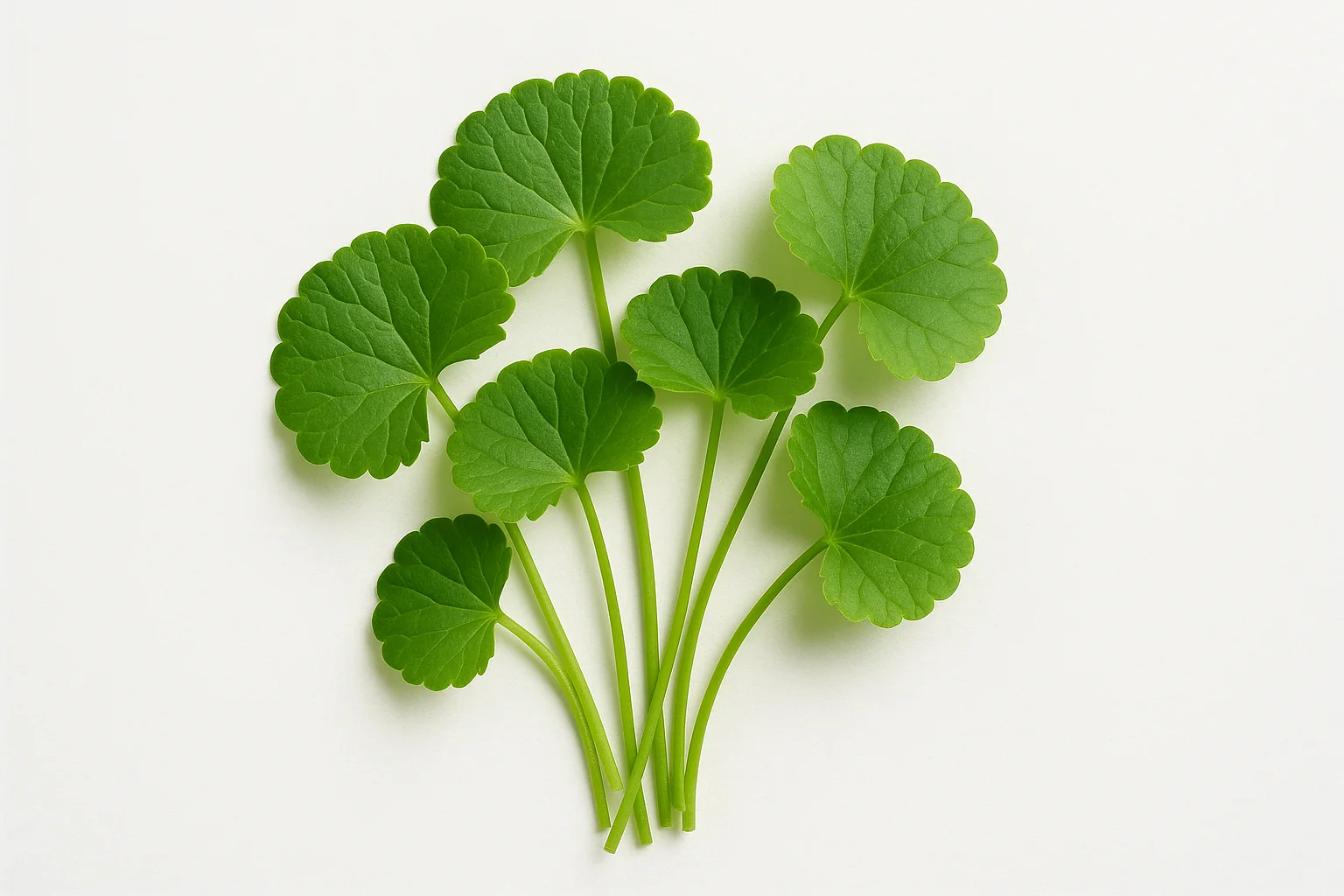
Gotu kola (Centella asiatica, Asian pennywort) is a low herb from the Apiaceae family, growing in moist tropical and subtropical areas of Asia - Indonesia, India, Sri Lanka, and Madagascar. In Ayurvedic medicine, it is known as "brahmi" or "mandukaparni" and is classified among "medhya rasayana" - herbs that enhance intellect and memory. It has been used for over 3000 years.
How does gotu kola differ from other nootropic herbs? Bacopa monnieri (another "brahmi") mainly acts on neurogenesis and neurotransmission. Ginkgo biloba improves cerebral microcirculation. Gotu kola combines both directions, but its unique advantage is its simultaneous action on connective tissue - stimulating collagen in the venous walls and skin. This makes it a "vascular-nootropic" herb - improving microcirculation both in the brain and peripherally, which is significant for varicose veins, diabetic vascular damage, and skin aging.
How does gotu kola work on varicose veins - mechanism and clinical evidence?
Chronic venous insufficiency (CVI) is a condition where the walls of the veins lose elasticity and tone, leading to dilation, blood reflux, swelling, and leg pain. Gotu kola addresses this condition at the molecular level by stimulating the biosynthesis of collagen and elastin in the venous wall and strengthening the connections between endothelial cells, reducing vascular permeability.
Cataldi et al. (Angiology, 2001) conducted a randomized, double-blind study with 94 patients with CVI. TECA extract (Total Triterpenoid Extract of Centella asiatica) at a dose of 60 mg or 120 mg daily for 4 weeks significantly reduced leg swelling (measured by circumferences) and subjective symptoms (heaviness, fatigue, pain) compared to placebo. Higher doses (120 mg/day) were more effective. The study has limitations (short observation time), but the methodology is solid.
Gotu kola for wound healing and scars - what does science say?
Asiaticoside - the main triterpene saponin of gotu kola - has been used for decades in tropical medicine to treat hard-to-heal wounds, leprosy, and burns. The molecular mechanism is explained by Bylka et al. (Phytotherapy Research, 2014): asiaticoside and madecassoside stimulate fibroblasts to produce procollagen I and III by activating the TGF-β1 factor. At the same time, they inhibit matrix metalloproteinases (MMP) responsible for collagen degradation - the net effect is more collagen and better remodeling of connective tissue.
In wound healing, gotu kola accelerates the proliferation phase (increased fibroblasts and neoangiogenesis) and the remodeling phase (normalization of scar structure). The latter has clinical significance in hypertrophic scars and keloids - although gotu kola does not cure keloids, it may reduce their hardness and appearance with topical application.
Practical applications: creams and gels with 1% asiaticoside applied topically twice a day accelerate the healing of minor postoperative wounds, abrasions, and acne scars. Several clinical studies have shown a reduction in the healing time of cesarean scars and a decrease in scar thickness with local application over 12 weeks. Oral gotu kola supplements may complement topical effects through systemic collagen stimulation.
Does gotu kola improve memory? - the state of nootropic research
The nootropic effects of gotu kola are an area of active research, but with a lower level of evidence compared to varicose veins or wound healing. Wattanathorn et al. (Journal of Ethnopharmacology, 2008) conducted a pilot study with 28 volunteers over 65 years old. Supplementation with 250 mg, 500 mg, or 750 mg of Centella asiatica extract for 2 months improved spatial and working memory in computer tests, with the best results at 750 mg/day. The effects were statistically significant vs placebo.
The neuroprotective mechanisms of gotu kola are multifaceted. Asiaticoside crosses the blood-brain barrier and protects hippocampal neurons from oxidative stress (reducing levels of 8-OHdG - a marker of oxidative DNA damage). Madecassoside exhibits anti-inflammatory effects in the CNS by inhibiting NF-κB and IL-6 in microglia. Asiatic acid inhibits beta-amyloid aggregation in vitro - which has raised interest in studying its potential role in Alzheimer's, although clinical data is still preliminary.
Our observations: Gotu kola seems particularly valuable for individuals where "brain fog" and concentration problems coexist with vascular symptoms - cold feet, tendency to swelling, visible veins on the legs. This profile suggests a microcirculatory basis - and it is precisely here that gotu kola addresses two problems simultaneously: circulation and cognitive functions through the same mechanism. For a healthy 25-year-old looking for a "study booster," gotu kola will work less effectively than, for example, bacopa monnieri or L-theanine with caffeine.
Dawkowanie gotu kola - ekstrakt vs proszek, czas kuracji
The dosage of gotu kola depends on the purpose and form of the preparation. The standardized extract TECA/TTFCA (Total Triterpenoid Fraction of Centella Asiatica) contains 40% asiaticoside, 29-30% asiatic acid, and 29-30% madecassoside - this is the reference extract for clinical studies.
For varicose veins and CVI: 60-120 mg TECA daily in 2-3 divided doses for a minimum of 8-12 weeks. Effects appear gradually after 4-6 weeks. For wound healing: orally 30-60 mg 2x/day + topical creams with asiaticoside. For memory support: 750 mg of raw leaf powder or 150-300 mg of standardized extract daily.
Important: use in cycles. It is recommended to use for 8-12 weeks, followed by a 4-week break, then repeat the treatment if necessary. This is due to potential hepatotoxicity with prolonged continuous use - several clinical cases have described transient increases in ALT and AST. With long-term use, it is advisable to check liver enzymes every 3 months.
Check the properties of ginkgo biloba as another support for microcirculation
Gotu kola and anxiety and stress - adaptogenic effects
In addition to vascular and nootropic applications, gotu kola is traditionally used as a "calm mind" herb in Ayurveda. Clinical studies confirm moderate anxiolytic activity. Bradwejn et al. (Journal of Clinical Psychopharmacology, 2000) In a randomized crossover study, they showed that a single dose of Centella asiatica extract (12 g) reduced reactivity to an acoustic startle stimulus - an objective indicator of anxiety and nervous system tension. Although this study involved an acute dose (not chronic use), it suggests anxiolytic effects through modulation of neurotransmission.
The anxiolytic mechanism of gotu kola involves several pathways. Asiatic acid and asiaticoside exhibit GABAergic activity - a similar mechanism to lavender and valerian, although less studied. Gotu kola also reduces cortisol levels during oxidative stress (studies on animal models), suggesting adaptogenic effects through normalization of HPA axis reactivity.
Practical implications: gotu kola may be a suitable complement to the stress-varicose vein protocol, where both conditions often coexist. Stress causes blood vessels in the lower limbs to react with constriction, exacerbating CVI symptoms. Reducing stress reactivity through gotu kola may indirectly benefit venous flow. This is a speculative, but physiologically justified mechanism linking both applications of this plant.
How to use gotu kola in cooking and as tea?
In Asian countries, gotu kola is consumed as a leafy vegetable - especially in Sri Lanka (gotukola salad) and Thailand. Fresh leaves can be eaten raw in salads, sautéed, or used to prepare drinks. The taste is mild, slightly bitter, with an earthy note. In Indonesia, 'jamu' - a traditional herbal drink containing gotu kola - is popular.
Gotu kola tea: 1-2 teaspoons of dried herb per cup of water at 85-90°C, steeped for 5-7 minutes. Drink 1-2 cups daily. The taste is milder than the capsulized extract and can be enhanced with honey or lemon. The content of asiaticoside in tea is lower than in the standardized extract, but regular consumption accumulates effects over time.
Gotu kola leaf powder can be added to smoothies (1/2 teaspoon), vegetable juices, or yogurt. The green color of the powder comes from chlorophyll - this herb has actually been consumed as green food, not just a supplement.
Gotu kola and skin - collagen and aging
In addition to varicose veins and wounds, gotu kola is gaining popularity in cosmetology as an ingredient in anti-aging creams. The mechanism is the same: stimulation of collagen I and III synthesis by skin fibroblasts. With age, skin collagen production decreases by about 1% per year after the age of 25, leading to sagging and the appearance of wrinkles. Asiaticoside applied topically or taken orally may partially compensate for this effect.
Several clinical studies with creams containing TECA or asiaticoside have shown improvement in skin elasticity and reduction in wrinkle depth after 12 weeks of use. The study by Widgerow et al. (2000) using a cream containing TECA showed a 10-15% increase in collagen density in biopsies after 3 months of use. For stretch marks: gotu kola used prophylactically during pregnancy (before their appearance) has shown effectiveness in reducing their formation; for existing stretch marks, the effects are significantly weaker.
Check the properties of hibiscus for microcirculation and blood pressure
Gotu kola - safety, interactions, and who should avoid it?
Gotu kola in standard therapeutic doses is well tolerated by most adults. However, several safety aspects require special attention:
Hepatotoxicity: The main risk. Cases of elevated ALT, AST, and bilirubin have been reported with prolonged daily use of high doses. The mechanism is not fully understood - metabolites of triterpenes may be toxic to hepatocytes under certain CYP polymorphisms. Recommendation: cycles (8-12 weeks, 4 weeks break), with liver enzyme testing every 3 months during long-term use.
Pregnancy: Gotu kola is not recommended during pregnancy. Asiaticoside has shown mutagenic effects in vitro at high concentrations, and some data suggest potential effects on the uterus. During breastfeeding - insufficient safety data; better to avoid.
Drug interactions: Gotu kola may enhance the effects of sedative and calming medications (additive effect on the CNS). With antidiabetic medications, it may potentially lower blood sugar - monitor glucose levels. There are no well-documented interactions with anticoagulants, but caution is advised due to effects on vascular endothelium.
Alergia kontaktowa: Topical creams and gels with gotu kola rarely cause allergic dermatitis. Before applying to a large area, test on a small area for 24 hours.
Frequently Asked Questions
What is gotu kola and what are its active ingredients?
Gotu kola (Centella asiatica, Asian pennywort) is a plant from the Apiaceae family that grows in tropical Asia. Its active ingredients are triterpenes: asiaticoside, madecassoside, asiatic acid, and madecassic acid - responsible for collagen stimulation, improvement of venous microcirculation, and neuroprotective effects. It has been used in Ayurveda for over 3000 years.
How does gotu kola affect varicose veins and venous microcirculation?
Triterpenes from Centella asiatica stimulate collagen synthesis in the venous wall and reduce capillary permeability. Cataldi et al. (Angiology, 2001) showed that TECA extract 60-120 mg/day for 4 weeks significantly reduced leg swelling and CVI symptoms in 94 patients vs placebo in RCT.
Jakie jest dawkowanie gotu kola?
Standardized TECA extract: 60-120 mg/day in 2-3 doses for varicose veins. For memory support: 750 mg of leaf powder or 150-300 mg of extract daily. Use in cycles of 8-12 weeks with a 4-week break due to potential liver effects.
Does gotu kola improve memory and concentration?
Preliminary studies (Wattanathorn et al., Journal of Ethnopharmacology, 2008) showed improvement in spatial and working memory with 750 mg/day for 2 months in older volunteers over 65 years old. The mechanism involves neuroprotection by asiaticoside (protection against oxidative stress in the hippocampus) and improvement of cerebral microcirculation. There are no large RCTs - the data is promising but requires confirmation in studies with larger groups.
Is gotu kola safe and does it have side effects?
In standard doses, well tolerated. Possible: headaches, nausea, drowsiness. Important: potential hepatotoxicity with long-term use - cases of elevated liver enzymes have been reported. Recommended cycles and monitoring of ALT/AST during prolonged supplementation.
Jak gotu kola pomaga przy gojeniu ran i bliznach?
Asiaticoside and madecassoside stimulate fibroblasts to produce collagen types I and III via the TGF-β1 pathway (Bylka et al., Phytotherapy Research, 2014). It accelerates the proliferation phase in the healing process, reduces excessive scarring by normalizing the matrix, and has proangiogenic effects by stimulating the growth of new blood vessels in the wound. Used topically (1% asiaticoside cream twice daily) or orally as a supplement for hard-to-heal wounds and postoperative scars.
This article is for informational and educational purposes and does not replace consultation with a doctor. If you are pregnant, breastfeeding, taking medications, or have chronic conditions, consult the use of supplements or herbs with a specialist.
Author: Michał Waluk · Published: 2026-05-04 · Updated: 2026-05-04