
Ashwagandha KSM-66 vs Sensoril: differences and how to dose
KSM-66 and Sensoril differ in raw material, standardization marker, and dosage. Check what human studies confirm and what is a manufacturer declaration.
KSM-66 and Sensoril are two patented extracts from the same plant, Withania somnifera, sold under different numbers on the label: 5% in one case, 10% in the other. The difference seems simple, but it is not, as both percentages refer to different compounds and do not lie on the same scale. The consequence is practical. Converting milligrams from one product to another has no basis, and the recommended daily doses differ several times. This text compares the specifications of both extracts, separates claims supported by published human studies from manufacturer declarations, and provides the doses actually used in those studies. If you are just starting with this group of plants, a helpful introduction to adaptogens will be useful.
KEY INFORMATION
• KSM-66 comes from the root only and is standardized to at least 5% withanolides measured by HPLC.
• Sensoril combines root and leaf, and its standardization is based on a different marker: at least 10% withanolide glycosides, at least 32% oligosaccharides, and no more than 0.5% free withanolides counted as withaferin A.
• The percentages of both extracts measure different classes of compounds, so they cannot be compared by simple division.
• In human studies, root extracts were most often administered at 300 mg twice daily for 8 weeks, while Sensoril ranged from 125 to 500 mg per day for 60 days.
• A systematic review from 2021 states that the discrepancy between preparations prevents the identification of the optimal extract or optimal dose.
What is KSM-66 extract and what distinguishes it?
KSM-66 is a patented extract of ashwagandha produced by the Indian company Ixoreal Biomed, obtained exclusively from the root and standardized to at least 5% withanolides measured by HPLC. The manufacturer describes the process as water-based extraction, without alcohol and chemical solvents. This is a commercial specification, not a result of independent research.
The most frequently cited study for the root-only extract is the trial by Chandrasekhara and colleagues from 2012. It involved 64 adults with a history of chronic stress, who took a capsule twice daily for 60 days, each containing 300 mg of full-spectrum root extract, or a placebo. The active group achieved significant improvement in all applied stress scales and a reduction in serum cortisol levels, and adverse effects were mild and comparable to placebo (Chandrasekhar et al., Indian J Psychol Med, 2012).
This work stands out for one thing that is rare in supplement research. The publication explicitly names the used preparation: it states that it was the KSM-66 extract supplied by Ixoreal Biomed from Hyderabad, obtained exclusively from the root and standardized to at least 5% withanolides measured by HPLC. Therefore, linking this result to the brand is not based on advertising materials, but on the publication itself, and this is a stronger argument than most claims on labels. The description of the extraction process comes from the manufacturer, and the number of clinical trials cited in advertisements has no independent confirmation, so we do not repeat it in this text.
How does Sensoril differ from KSM-66?
Sensoril is a patented extract from Natreon, made from both root and leaf, with triple standardization: at least 10% withanolide glycosides, at least 32% oligosaccharides, and no more than 0.5% free withanolides counted as withaferin A. This last parameter is an upper limit, not a declared content of the active ingredient, which is often confused in store descriptions.
The second thing worth clarifying concerns the solvent. Sensoril is sometimes described as a purely water extract, while the manufacturer states a water-ethanol process on the biomass of root and leaf. Alcohol is therefore present at the production stage, although not in the final powder. This difference matters for those choosing a supplement based on the extraction method.
The clinical study cited in Sensoril materials is the work by Auddy and colleagues from 2008. The trial included 130 chronically stressed individuals, of which 98 completed it, and the intervention lasted 60 days in three regimens: 125 mg once daily, 125 mg twice daily, and 250 mg twice daily. The authors report a dose-dependent reduction in cortisol levels compared to placebo. The work was published in the JANA journal, which is not indexed by PubMed or Europe PMC, so it cannot be verified in those databases. Specific percentages of cortisol reduction circulating in commercial descriptions have no confirmation in the publicly available abstract, and therefore we do not provide them here.
Why can’t the percentage of withanolides be directly compared?
Because the two numbers on the labels measure different classes of compounds. KSM-66 declares 5% withanolides, Sensoril 10% withanolide glycosides. A glycoside is a withanolide molecule linked to a sugar moiety, with different mass and behavior in the body. The statement “10% is twice as much as 5%” is therefore an arithmetic operation performed on two different scales.
The difference is not formal. In a crossover study from 2025, sixteen healthy volunteers received a single dose of one of four commercial ashwagandha extracts, standardized to 35% or 10% withanolide glycosides or to 5% or 2.5% withanolides, with each preparation delivering the same amount of 185 mg of total withanolides. The extract containing 35% glycosides achieved a significantly higher area under the concentration curve than the other three, and the authors attribute this to the glycoside fraction (Rathi and Kim, Curr Ther Res, 2025).
The study did not test KSM-66 or Sensoril under their commercial names, so it does not resolve the dispute between these two brands. However, it shows that the percentage on the label does not inform how much substance will reach the bloodstream until it is known which marker it refers to. The form of the preparation also affects bioavailability, which is discussed separately in the comparison of liquid and capsule forms of ashwagandha.
Which extract to choose for which purpose?
The honest answer is: published data do not allow for identifying a winner. A systematic review from 2021, covering studies on the effects of Withania somnifera on stress, anxiety, depression, and insomnia, concludes that significant discrepancies between the studied preparations prevent agreeing on the optimal extract or optimal dose (Speers et al., Curr Neuropharmacol, 2021). Therefore, the choice is based on specifications and on which dosing regimen has actually been tested.
Popular comparisons attribute energy and endurance to KSM-66 and sleep and calmness to Sensoril. This division has no basis in a direct comparison of both extracts, as no such study has been published. It stems from the areas in which each manufacturer funded more trials, not from a demonstrated difference in effect. The practical conclusion is simpler than suggested by comparison tables: if you want to replicate the conditions under which anything was measured, choose a product so that one serving delivers the dose used in the study of that extract, not a rounded value from the packaging.
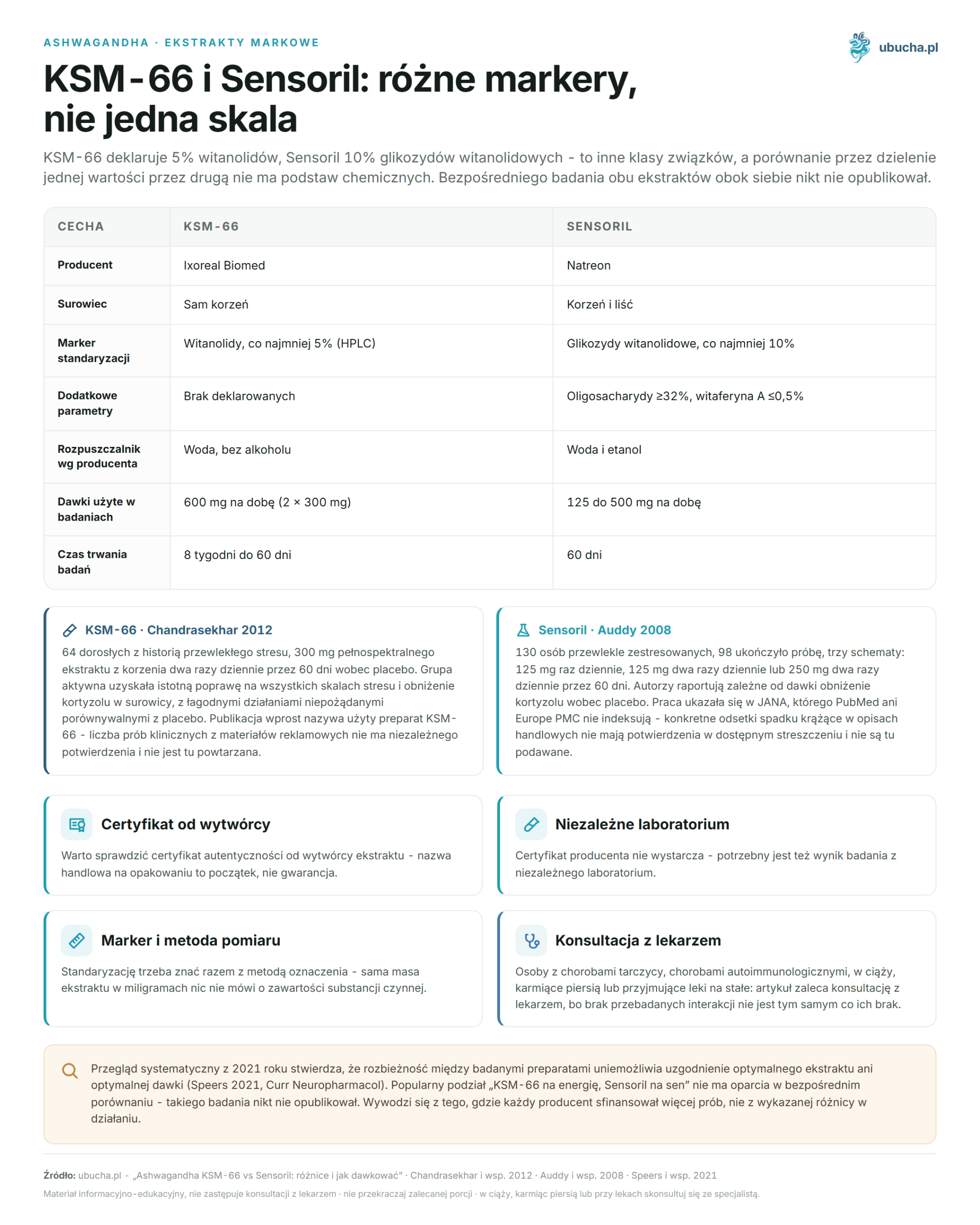
| Feature | KSM-66 | Sensoril |
|---|---|---|
| Manufacturer | Ixoreal Biomed | Natreon |
| Raw material | Root only | Root and leaf |
| Standardization marker | Withanolides, at least 5% (HPLC) | Withanolide glycosides, at least 10% |
| Additional parameters | None declared | Oligosaccharides at least 32%, withaferin A no more than 0.5% |
| Solvent according to the manufacturer | Water, without alcohol | Water and ethanol |
| Doses used in studies | 600 mg per day (2 x 300 mg) | 125 to 500 mg per day |
| Duration of studies | 8 weeks to 60 days | 60 days |
How much ashwagandha daily and for how many weeks?
The reference point should be the doses that have actually been tested, not rounded ranges from the packaging. For the root extract, these are two capsules of 300 mg daily for 8 weeks or 60 days. For Sensoril, the range is from 125 mg once daily to 250 mg twice daily for 60 days.
- Root-only extract: 300 mg twice daily, totaling 600 mg per day.
- Sensoril: from 125 mg once daily to 250 mg twice daily.
- Observation time in studies: from 30 to 112 days, most often 8 weeks.
- Changes in stress scales were usually measured only after 4 and 8 weeks, so assessment after a few days makes no sense.
A systematic review from 2023 gathered nine clinical trials assessing the impact of Withania somnifera on cortisol in stressed individuals. The treatment duration ranged from 30 to 112 days, supplementation reduced cortisol secretion and was not associated with significant adverse effects. However, the authors note that none of these studies evaluated how cortisol reduction affects adrenal function, and they recommend use under medical supervision (Della Porta et al., Nutrients, 2023).
The popular scheme of “6 to 8 weeks of use, then 2 weeks off” does not stem from any of these trials. It is a practical convention, taken from the fact that studies simply ended at that point. The European Medicines Agency has not adopted a European monograph for ashwagandha root: the committee for herbal medicinal products closed the assessment with a public statement, so there is no harmonized recommendation in the EU regarding the duration of use.
What do clinical studies really show?
They show a moderate, repeatable effect on stress scales with great methodological caution from the authors. A systematic review from 2014 identified five trials involving humans that met the inclusion criteria. In one of them, the perceived stress scale score dropped by 44.0% compared to 5.5% in the placebo group, but all studies were burdened with unclear or high risk of systematic error, and the heterogeneity of methods prevented a meta-analysis (Pratte et al., J Altern Complement Med, 2014). This is a review, not a meta-analysis, and it comes from 2014, not 2021.
The second frequently cited trial involved 52 individuals under chronic stress who took 300 mg of root extract twice daily for 8 weeks. The primary endpoint was the perceived stress scale, secondary endpoints included cortisol and body weight, and improvement encompassed both levels. It should be noted that the study was designed as a work on weight control in stressed individuals (Choudhary et al., J Evid Based Complementary Altern Med, 2017).
Outside the area of stress, data are narrower. A Bayesian meta-analysis from 2021 included thirteen trials on physical performance and showed an advantage of ashwagandha over placebo in healthy women and men (Bonilla et al., J Funct Morphol Kinesiol, 2021). In a hormonal study in men aged 40 to 70, supplementation was associated with a 14.7% higher increase in testosterone and an 18% increase in DHEA-S compared to placebo, but without significant differences in fatigue, vitality, or sexual well-being, and the tested preparation was a third extract, neither KSM-66 nor Sensoril (Lopresti et al., Am J Mens Health, 2019). This topic is developed in a separate text about ashwagandha and sperm parameters.
What does the label not say and when to be cautious?
The brand name on the package is just the beginning, not a guarantee. It is worth checking three things: whether the seller has a certificate of authenticity from the extract manufacturer, whether they provide the result of testing from an independent laboratory, and whether they declare the standardization marker along with the measurement method. The mere mass of the extract in milligrams says nothing about the content of the active substance.
A separate trap is multi-ingredient preparations, in which ashwagandha appears alongside several other plants. It is enough to compare the declared mass of the extract in one serving with the doses mentioned above: if the product provides a fraction of what was given in clinical trials, the brand of the extract does not compensate for it. A practical checklist of things to check is gathered in a guide on how to read a dietary supplement label.
On the safety side, the data is moderately reassuring and clearly incomplete. The aforementioned review from 2021 considers ashwagandha generally safe for humans, but indicates the need to study interactions with medications in individuals taking them simultaneously. Data beyond a few weeks of continuous use is limited, and the impact of long-term cortisol reduction on the adrenal glands remains unassessed. Individuals with thyroid diseases, autoimmune diseases, pregnant, breastfeeding, or taking medications regularly should discuss supplementation with their doctor, precisely because the lack of studied interactions does not mean their absence.
Frequently asked questions
What is KSM-66 extract?
It is a patented extract of ashwagandha from Ixoreal Biomed, obtained exclusively from the root and standardized to at least 5% withanolides measured by HPLC. The manufacturer claims extraction based on water, without alcohol and chemical solvents. These are commercial specifications, not parameters confirmed by independent laboratory testing.
How does Sensoril differ from KSM-66?
Sensoril from Natreon is made from both root and leaf, not just the root, and has triple standardization: at least 10% withanolide glycosides, at least 32% oligosaccharides, and no more than 0.5% free withanolides counted as withaferin A. The manufacturer states a water-ethanol extraction. The doses used in studies are lower than for the root-only extract.
Is 10% withanolides in Sensoril twice as much as 5% in KSM-66?
No, because both numbers refer to different classes of compounds. KSM-66 declares withanolides, Sensoril withanolide glycosides, which are molecules linked to a sugar moiety, with different mass. Comparing by dividing one value by the other has no chemical basis, and pharmacokinetic studies show that the percentage alone does not determine bioavailability.
How many milligrams of ashwagandha were used in clinical studies?
For the root-only extract, the most common dosage was 300 mg twice a day, totaling 600 mg per day, for 8 weeks or 60 days. For Sensoril, three regimens were tested: 125 mg once daily, 125 mg twice daily, and 250 mg twice daily, for 60 days. The duration of trials ranged from 30 to 112 days.
Is ashwagandha safe for thyroid and autoimmune diseases?
Reviews consider it generally well tolerated, but interactions with medications taken regularly remain unstudied, and data beyond a few weeks is limited. For thyroid diseases, autoimmune diseases, during pregnancy, and while breastfeeding, the decision to supplement should be discussed with the attending physician.
Standardized plant extracts, including ashwagandha, can be found in the herbs and plant extracts category, where the declared standardization marker is provided for each item.
This article is for informational and educational purposes and does not constitute medical advice. Before starting supplementation, consult your doctor, especially if you are taking medications regularly, are pregnant or breastfeeding, or have chronic illnesses.
Author: Michał Waluk · Published: 2026-08-09 · Updated: 2026-08-10