
Probiotics for the Gut and Immunity: Which Strain to Choose and When to Use
The effectiveness of a probiotic depends on the strain, not the species. We check where the evidence is strong, where it has failed, and who probiotics can harm.
A label stating “Lactobacillus rhamnosus, 50 billion CFU” says almost nothing about whether the product will work. Clinical studies concern individual strains with a deposit number, not entire species. In one randomized study on irritable bowel syndrome, two strains were given in the same dose: Bifidobacterium infantis 35624 reduced symptoms, Lactobacillus salivarius UCC4331 did nothing. Both were alive, both belonged to lactic acid bacteria. This article shows which indications have strong evidence, where it turned out to be weaker than expected, how to read the full strain designation from the packaging, and for whom probiotics are not neutral. You will not find dosage recommendations or brand names of products here: evidence is assigned to strains, not packages.
KEY INFORMATION
• Effectiveness is strain-specific, not species-specific (Hill et al., Nature Reviews Gastroenterology and Hepatology, 2014).
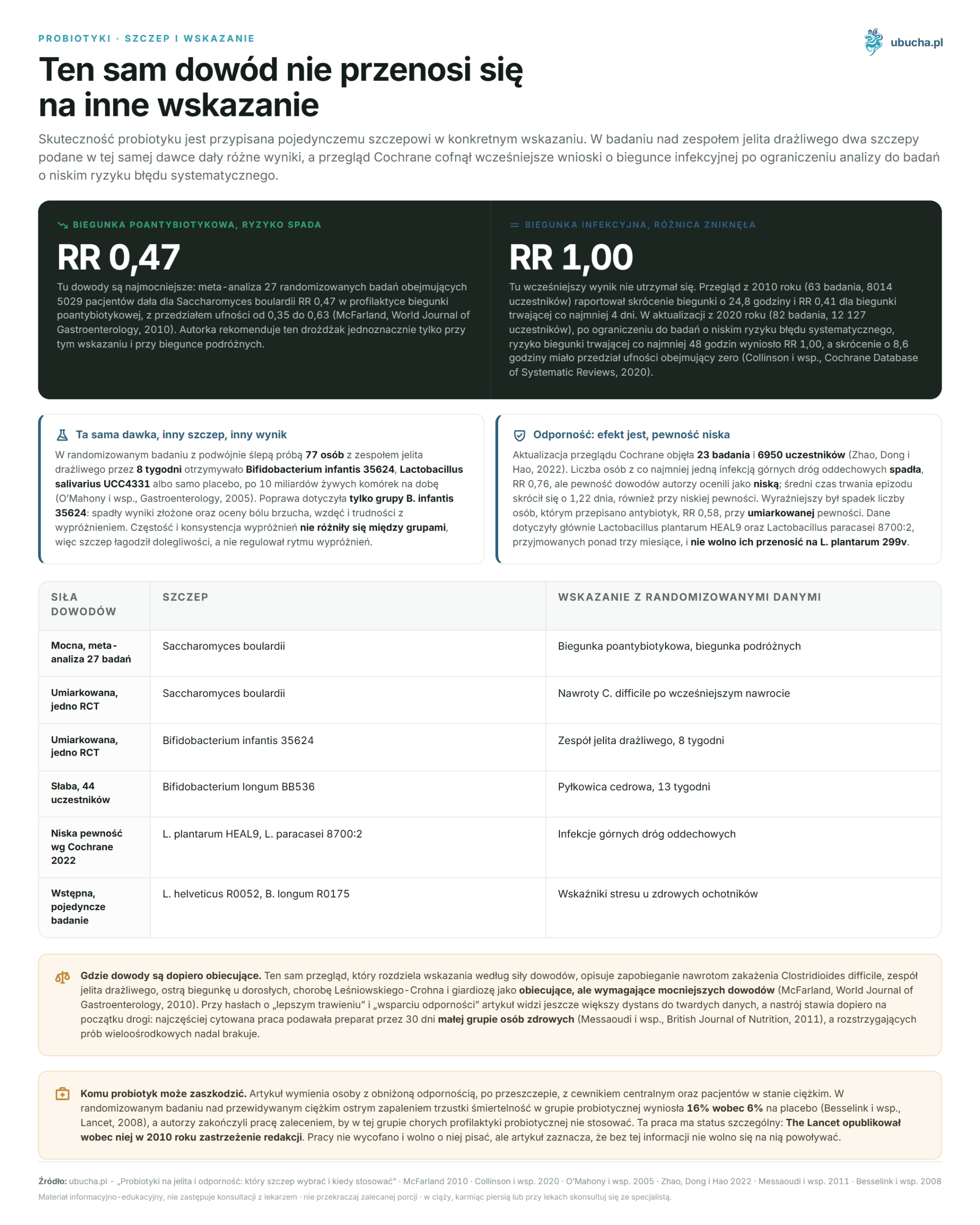
• The strongest data is for the prevention of antibiotic-associated diarrhea: RR 0.47 for S. boulardii (McFarland, 2010).
• Cochrane in 2020 retracted earlier conclusions about infectious diarrhea.
• In seriously ill patients, probiotics can be harmful: mortality 16% vs 6% (Besselink et al., Lancet, 2008, work with editorial note).
Why does the species name on the label mean nothing?
Because clinical evidence is assigned to a single strain, not a species. The ISAPP consensus (Hill et al., Nature Reviews Gastroenterology and Hepatology, 2014) upheld the definition of a probiotic as live microorganisms given in an appropriate amount that provide health benefits to the host and indicated that precise use of this term helps differentiate products on the market.
The full strain designation consists of three parts: genus, species, and strain identifier, for example, Lactobacillus rhamnosus GG or Bifidobacterium longum BB536. The identifier usually refers to a number in a deposit collection, allowing verification of which studies concern that specific microorganism. Without it, the entry “Lactobacillus rhamnosus” describes hundreds of different strains with different properties.
We have noticed that in Polish pharmacies, products described only by the species name occur more frequently than those with full designations. This does not automatically mean that the product is inferior. It means that it cannot be linked to any publication, and thus neither confirmed nor refuted the promises on the packaging. Manufacturers who conduct their own studies provide the strain number because it is their sales argument.
Does more CFU mean better?
No. CFU is the number of live cells capable of forming a colony on a plate, meaning a measure of content, not potency. Systematic reviews show that the dose can be important, but the threshold is low, and above it, the relationship breaks off. The advertised “one hundred billion” has no evidence of superiority behind it.
In a Cochrane review (Guo et al., 2019) that gathered 33 randomized studies and 6352 children taking antibiotics, diarrhea occurred in 8% of children in the probiotic groups compared to 19% in the control groups. Subgroup analysis showed an advantage for doses of 5 billion CFU daily over lower ones. The threshold thus fell significantly below the numbers printed today on packages.
In a Cochrane review on Clostridioides difficile infection (Goldenberg et al., 2017), covering 39 studies and 9955 people, the result was similar in subgroups with lower and higher doses. What made the difference was something else: the baseline risk of illness. With a risk above 5%, the reduction was large; with low risk, there was none at all.
The strongest counterexample to the arithmetic of billions comes from a PLACIDE study (Allen et al., Lancet, 2013). Patients there received 60 billion microorganisms daily for 21 days, a higher dose than in most pharmacy products, and it did not translate into fewer diarrhea cases. The dose is a feature of the strain plus indication, not a parameter that can be cranked up.
What are the differences between prebiotics, synbiotics, and postbiotics?
These are three distinct categories that labels notoriously mix up with probiotics. The International Society ISAPP has issued separate consensus statements for each, and the differences have practical consequences when purchasing.
| Term | What the ISAPP consensus says |
|---|---|
| Probiotic | Live microorganisms that, when administered in adequate amounts, confer a health benefit to the host (Hill et al., 2014). |
| Prebiotic | A selectively fermented ingredient that results in specific changes in the composition and/or activity of the gastrointestinal microbiota, providing health benefits (Gibson et al., 2017). The definition is not limited to carbohydrates or the intestine itself. |
| Synbiotic | A mixture of live microorganisms and a substrate selectively utilized by them (Swanson et al., 2020). The panel rejected the simple definition of “probiotic plus prebiotic” to avoid blocking products designed for synergistic action. |
| Postbiotic | A preparation of inactivated microorganisms or their components that confer a health benefit (Salminen et al., 2021). It must contain inactivated cells or their elements. |
The practical conclusion is simple. A postbiotic does not contain live cells, so the number of CFU does not describe it, and the question of refrigeration is irrelevant. A prebiotic does not provide bacteria itself, only nourishment for those you already have. If the packaging uses these terms interchangeably, the manufacturer either does not know the definitions or hopes you do not know them.
In which indications is the evidence strongest?
For antibiotic-associated diarrhea and traveler’s diarrhea. A meta-analysis of 27 randomized studies involving 5029 patients (McFarland, World Journal of Gastroenterology, 2010) gave for Saccharomyces boulardii RR 0.47 in the prevention of antibiotic-associated diarrhea, with a confidence interval from 0.35 to 0.63.
This same work separates indications according to the strength of evidence, which is rare in the literature on probiotics. The author unequivocally recommends S. boulardii only in two situations: the prevention of antibiotic-associated diarrhea and traveler’s diarrhea. The evidence for the latter indication is detailed separately in the text about probiotics for traveler’s diarrhea. Randomized data also support the prevention of diarrhea during enteral feeding and alleviating symptoms of Helicobacter pylori eradication therapy. In 84% of therapeutic arms included in the review, the yeast proved effective and safe, although this concerned very different indications with varying quality of data.
The rest of the list looks different. Prevention of recurrent Clostridioides difficile infections, irritable bowel syndrome, acute diarrhea in adults, Crohn’s disease, and giardiasis have been described as promising but requiring stronger evidence. This is an important distinction, as marketing usually treats all these points as equivalent. With slogans about “better digestion” or “immune support,” we are even further from solid data, and with mood, we are just at the beginning of the road.
Do probiotics shorten infectious diarrhea?
Probably not as much as previously thought a decade ago. A Cochrane review from 2010 (Allen et al., 63 studies, 8014 participants) reported a shortening of diarrhea by an average of 24.8 hours and a reduction in the risk of diarrhea lasting at least 4 days to RR 0.41.
An update from 2020 (Collinson et al., Cochrane Database of Systematic Reviews) included 82 studies and 12,127 participants. After limiting the analysis to studies with low risk of systematic error, the difference disappeared: the risk of diarrhea lasting at least 48 hours was RR 1.00, and the duration of diarrhea shortened by 8.6 hours with a confidence interval including zero. The authors described clear heterogeneity and publication bias visible in funnel plots.
There is also another thing worth reading from these reviews. Already in 2010, the authors stated directly that differences in effect size between studies were not explained by strain, number of strains, viability of organisms, or dose. Thus, attributing this result to a specific strain has never had a basis in the analysis itself.
What does S. boulardii do for Clostridioides difficile?
It reduces recurrences, but only in people who have already experienced a recurrence. In a study published in JAMA (McFarland et al., 1994), 124 patients received either vancomycin or metronidazole along with 1 g of S. boulardii daily for 4 weeks or placebo.
In the subgroup with recurrent infection, another recurrence occurred in 34.6% of those taking the yeast compared to 64.7% on placebo. In the subgroup with the first episode, there was no difference: 19.3% vs 24.2%, with p equal to 0.86. The overall relative risk was 0.43. The result is thus narrow and pertains to a well-defined situation, not every patient after antibiotics.
The practical advantage of the yeast comes from its biology. S. boulardii is not a bacterium, so antibiotics do not eliminate it, and there is no need to maintain a gap between doses. Bacterial strains require a 2-3 hour break. The study protocol did not include individuals with immune disorders due to AIDS or those who had chemotherapy in the previous 3 months, which is worth remembering when transferring these results to other patients.
| Strain | Indication with randomized data | Strength of evidence |
|---|---|---|
| Saccharomyces boulardii | Antibiotic-associated diarrhea, traveler’s diarrhea | Strong, meta-analysis of 27 studies |
| Saccharomyces boulardii | Recurrent C. difficile after a previous recurrence | Moderate, one RCT |
| Bifidobacterium infantis 35624 | Irritable bowel syndrome, 8 weeks | Moderate, one RCT |
| Bifidobacterium longum BB536 | Cedar pollen allergy, 13 weeks | Weak, 44 participants |
| L. plantarum HEAL9, L. paracasei 8700:2 | Upper respiratory infections | Low certainty according to Cochrane 2022 |
| L. helveticus R0052, B. longum R0175 | Stress indicators in healthy volunteers | Preliminary, single study |
Which strain has evidence for irritable bowel syndrome?
Bifidobacterium infantis 35624. In a randomized double-blind study (O’Mahony et al., Gastroenterology, 2005), 77 people with irritable bowel syndrome received this strain, Lactobacillus salivarius UCC4331, or placebo for 8 weeks, at 10 billion live cells per day.
Improvement was observed only in the B. infantis 35624 group. Composite scores and assessments of abdominal pain, bloating, and difficulty with bowel movements decreased over most weeks of therapy. The frequency and consistency of bowel movements did not differ between groups. This distinction has practical significance: the strain alleviated discomfort but did not regulate bowel rhythm.
The study also measured the ratio of interleukin 10 to interleukin 12 in peripheral blood. In patients with irritable bowel syndrome, it was abnormally skewed towards a pro-inflammatory Th1 response at baseline. Administration of B. infantis 35624 restored it to normal, which the other strain did not. The same protocol, the same dose, two different results. It is hard to find a clearer illustration that species alone is not sufficient to describe a probiotic.
Do probiotics boost immunity?
Moderately and only some strains. An update of the Cochrane review (Zhao, Dong, and Hao, 2022) included 23 studies and 6950 participants. Probiotics may reduce the number of people with at least one upper respiratory infection, RR 0.76, but the authors rated the certainty of evidence as low.
The remaining results are in a similar tone. The average duration of the episode shortened by 1.22 days, also with low certainty. A more pronounced decrease was observed in the number of participants prescribed antibiotics due to infection, RR 0.58 with moderate certainty of evidence. The percentage of participants reporting adverse effects did not increase.
It is worth checking which strains these studies concerned. The review mainly mentions Lactobacillus plantarum HEAL9 and Lactobacillus paracasei 8700:2 and N1115, in doses ranging from one billion to one hundred billion CFU per day, taken for over three months. This effect should not be transferred to L. plantarum 299v, which is sometimes attributed to it in marketing materials. A review of immunological mechanisms (Borchers et al., Journal of Gastroenterology, 2009) concludes that the results are too variable to draw firm conclusions about the effectiveness of specific probiotics.
Do probiotics improve mood and reduce stress?
The data is early and sparse. The most frequently cited work (Messaoudi et al., British Journal of Nutrition, 2011) studied the combination of Lactobacillus helveticus R0052 with Bifidobacterium longum R0175 in parallel in rats and healthy volunteers taking the preparation for 30 days in a placebo-controlled design.
In humans, scores on the HSCL-90 scale decreased: the overall symptom severity index and subscales of somatization and depression. The anger-hostility subscale also scored lower. The overall score on the HADS scale and daily urinary free cortisol excretion decreased as well. This was not morning cortisol, but a daily collection, and the studied group was small and composed of healthy individuals.
The term psychobiotic was proposed by Dinan, Stanton, and Cryan (Biological Psychiatry, 2013), describing microorganisms capable of producing neuroactive substances, including gamma-aminobutyric acid and serotonin. Their work concludes that results from large placebo-controlled studies are still awaited. A dozen years later, decisive multicenter trials are still lacking, so treat this group of applications as a hypothesis, not an established indication.
Who can probiotics harm?
People with weakened immunity, post-transplant, with a central catheter, and patients in serious condition. In a randomized study on predicted severe acute pancreatitis (Besselink et al., Lancet, 2008), 24 out of 152 patients in the probiotic group died, which is 16%, compared to 9 out of 144 on placebo, which is 6%.
The relative risk of death was 2.53. Intestinal ischemia occurred in 9 people in the probiotic group, of whom 8 died, and in no one in the placebo group. The numbers of infectious complications could not be reduced. The authors concluded the work with a recommendation not to use probiotic prophylaxis in this group of patients. However, this work has a special status: in 2010, The Lancet published an editorial note regarding it (expression of concern, Lancet, 2010). The work has not been retracted and can be written about, but without this information, it cannot be cited.
The second documented problem is infections caused by the probiotic itself. An analysis of five Finnish university hospitals from 2009-2018 (Rannikko et al., Emerging Infectious Diseases, 2021) found 46 cases of bloodstream fungal infections caused by Saccharomyces. At least 20 of these individuals, or 43%, were taking S. boulardii. The odds ratio for using this probiotic compared to the control group was 14. If you have a chronic illness, are taking immunosuppressive drugs, or have a vascular catheter, make the decision about probiotics with your doctor.
How to read a probiotic label?
Check five things before you pay. Four of them are printed on the packaging, the fifth requires a moment in a search engine. The largest part of price differences on this shelf does not result from the quality of the product but from how much the manufacturer spent on packaging and advertising.
- Full strain designation - genus, species, and identifier, for example, “Bifidobacterium longum BB536”. The species alone does not allow finding studies.
- Number of CFU at expiry - the declaration “at expiry” tells you how many live cells you will get. The declaration “at manufacture” describes the moment of production, and the count decreases over storage time.
- Storage conditions - some products require refrigeration, while others are stable at room temperature. This information is on the packaging and affects whether the product will survive transport in summer.
- Capsule form - enteric coating delays the release of contents and protects bacteria from stomach acid.
- Publications for this strain - enter the full designation into PubMed. If there is not a single clinical study, the promises on the packaging have no basis.
Brand names can be misleading. The same strain is sold under different brands, and different strains can have very similar brand names. The deposit number is the only information that cannot be reworded in the marketing department. The other writings on the packaging break down the sections on the number of CFU above and the timing of intake below.
When and how long to take probiotics?
During antibiotic therapy, maintain a 2-3 hour gap from the antibiotic dose, unless you are using S. boulardii, which is not affected by antibiotics. In the study on irritable bowel syndrome, the effect was assessed after 8 weeks, and in the Cochrane review from 2022, most trials lasted over three months.
This shows what time horizon to expect. In acute diarrhea, the preparation is given for several days, along with rehydration, and not instead of it. For chronic ailments, a reasonable trial period is 8 weeks, after which it is worth honestly assessing whether anything has changed. If not, changing the dose of the same strain rarely yields results. It is more sensible to check whether the chosen strain has studies in your indication.
Colonization is temporary. After stopping the preparation, most of the administered microorganisms disappear from the intestine within a few weeks, so probiotics act more as a constant intervention than a one-time fix for the microbiota. A diet rich in fermentable fiber feeds the bacteria that already live there, and it is this diet that determines the composition of the microbiota in the long term. We also write about how stress affects the gut-brain axis in the article on magnesium forms for stress and sleep.
When to take probiotics: on an empty stomach or with food?
The recommendation “on an empty stomach” has no basis in research. The only study that directly compared timing indicates the opposite direction: survival was best with a meal or up to 30 minutes before it, and worst when given 30 minutes after eating.
This concerns an experiment by Tompkins et al. (Beneficial Microbes, 2011) on a model of the upper gastrointestinal tract. A four-component preparation was tested. Milk with 1% fat and oatmeal in milk protected the bacteria significantly better than apple juice or water, and according to the authors, the fat content, not the protein, determined this. Saccharomyces boulardii did not respond to either the timing of the meal or its acid-buffering capacity, which distinguishes yeasts from bacteria.
Three limitations to keep in mind. This is a laboratory model, not a study involving patients. Cell survival was measured, not health effect. The result pertains to uncoated forms, as enteric-coated capsules are designed to open only after the stomach. In clinical studies, the timing of administration is dictated by the protocol and is almost never compared, so no scheme provides certainty. The most sensible approach is to replicate the method of administration from the study of the given strain if the manufacturer refers to it.
Do probiotics need to be kept in the fridge?
It depends on the preparation, not on a general rule. There is no clinical study comparing the effectiveness of the same strain stored in cold and at room temperature. The manufacturer’s note determines this, as stability results from the manufacturing technology and the properties of the strain.
A review by Fenster et al. (Microorganisms, 2019) describes how this industry has changed. Probiotic bacteria traditionally went into fermented dairy products with a short shelf life and refrigeration. Dry forms, i.e., capsules and sachets, are now designed for stability lasting up to 24 months at ambient temperature and humidity. The authors emphasize that the declared dose should be achievable at the end of the shelf life, not on the day of production.
The problem is that buyers have no way to check this. An expert panel in the work Jackson et al. (Frontiers in Microbiology, 2019) recommends independent certification of identity, purity, and strain counts and placing information about it on the packaging. Until this becomes standard, the only thing you can do is read the storage conditions note and treat its absence as a warning signal. Moisture is harmful in every variant, so a bathroom cabinet is out of the question.
When does an intestinal problem require a doctor, not a supplement?
When alarm symptoms appear. Blood in the stool, black tarry stool, unintentional weight loss, fever, anemia, pain waking at night, and the first such ailments after the age of 50 are diagnostic situations. A probiotic will not solve them and may delay diagnosis.
Treat separately diarrhea that occurs during or after antibiotic therapy and is accompanied by fever and severe abdominal pain. This may be a Clostridioides difficile infection, requiring stool testing and targeted treatment. Dehydration in a small child and an elderly person also requires attention, as it is the dehydration, not the diarrhea itself, that can be a real threat.
A probiotic does not replace the diagnosis of celiac disease, inflammatory bowel diseases, food intolerances, or small intestinal bacterial overgrowth. The diagnosis of irritable bowel syndrome is also made by excluding other causes, not by a reaction to a supplement. If symptoms persist for more than a few weeks or recur, schedule an appointment. We also write about how to choose dietary supplements without animal sources of ingredients in the post Supplements for vegetarians and vegans.
Frequently asked questions
Which probiotic strain to choose?
It depends on the indication, as the evidence is assigned to individual strains. S. boulardii has the strongest data for antibiotic-associated diarrhea, supported by a meta-analysis. For recurrent C. difficile infections, the evidence is moderate and based on one randomized study. B. infantis 35624 has randomized data for irritable bowel syndrome. A product described only by the species name does not allow checking which studies support it.
How many CFU should a probiotic have?
Studies most often used from one billion to one hundred billion CFU daily. A higher number does not replace a documented strain: in the review by Allen et al. (2010), differences in effect size were not explained by dose, strain, or viability of organisms.
When to take probiotics with antibiotics?
Take bacterial strains with a gap of 2-3 hours from the antibiotic that destroys them. S. boulardii is a yeast and does not require a gap. In the meta-analysis by McFarland (2010), this strain reduced the risk of antibiotic-associated diarrhea to RR 0.47 compared to placebo.
Are prebiotics more important than probiotics?
They serve a different role. Prebiotics are fermentable fiber from vegetables, fruits, and legumes, feeding bacteria already present in the intestine. Probiotics provide live microorganisms during the intake of the product. Since colonization is temporary, diet remains fundamental, and probiotics are a temporary tool.
Do probiotics protect against colds?
Partially. A Cochrane review from 2022 (23 studies, 6950 participants) showed fewer people with at least one upper respiratory infection, RR 0.76, with low certainty of evidence. The average duration of the episode shortened by 1.22 days. This is a moderate effect, not protection against illness.
Who should not take probiotics?
People with weakened immunity, post-transplant, with a central catheter, and patients in serious condition should consult a doctor. In the study by Besselink et al. (Lancet, 2008), mortality in the probiotic group was 16% compared to 6% in the placebo group, and The Lancet issued an editorial note regarding this work in 2010. Cases of bloodstream fungal infections after S. boulardii have also been reported.
Can fermented foods and kefir replace supplements?
In a daily diet, yes, for specific indications, no. Kefir with live cultures, natural yogurt, sauerkraut, and kimchi provide live microorganisms, but without a known strain and without a known number of CFU. A pasteurized product after fermentation no longer contains live bacteria, as seen on the label.
If you are looking for products with full strain designation on the packaging, check the supplements section.
This article is for informational and educational purposes and does not replace consultation with a doctor. If you are pregnant, breastfeeding, taking medications, or have chronic conditions, consult the use of supplements or herbs with a specialist.
Author: Michał Waluk · Published: 2026-06-22 · Updated: 2026-09-22