
Adaptogens for Stress 2026: Ashwagandha, Rhodiola, Reishi - Which to Choose?
Ashwagandha, rhodiola, and reishi for stress: what clinical studies showed, how to dose, when not to use, and daily portion cost. Price status as of 2026-08-08.
Anxiety disorders are today the most common mental disorder worldwide: in 2021, 359 million people had them (WHO). Interest in adaptogens - plants and fungi that help the body cope with stress - is growing. The problem is that the three most frequently mentioned raw materials have vastly different quality of evidence, different times of administration, and different contraindications. This article compares ashwagandha, rhodiola, and reishi based on what clinical trials really showed, not what the label promises. You will find doses from specific studies, a symptom-based selection scheme, a comparison of real prices at sklep u Bucha with daily portion cost, and a list of situations when none of these raw materials should be used.
KEY INFORMATION
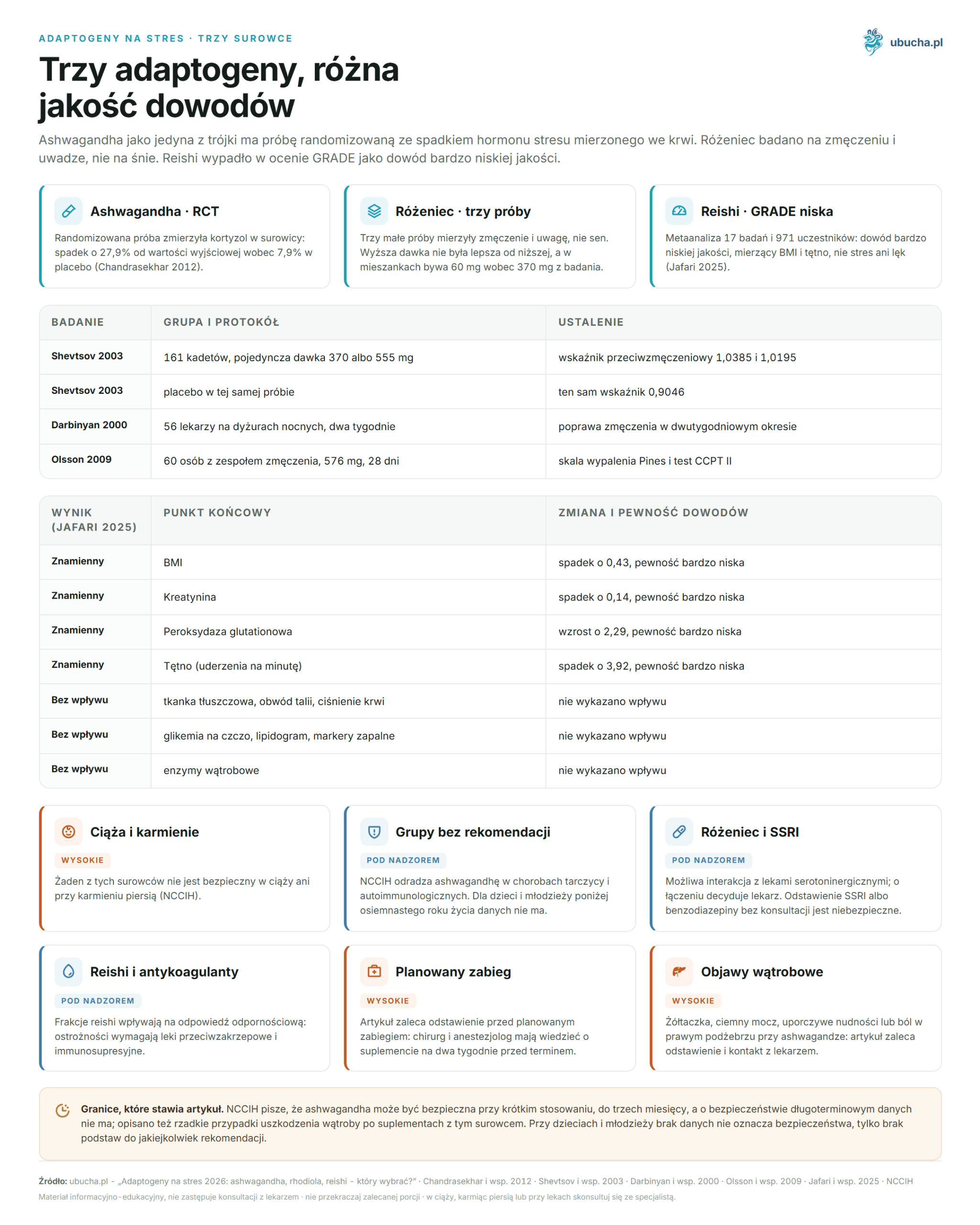
• Ashwagandha has the strongest data: cortisol reduced by 27.9% versus 7.9% in placebo (Chandrasekhar 2012).
• Rhodiola acts on fatigue and attention, not sleep (Olsson 2009).
• Reishi was rated by GRADE as very low-quality evidence (Jafari 2025).
• None of these raw materials are safe during pregnancy or breastfeeding (NCCIH).
• The store only has rhodiola in blends.
What are adaptogens and how do they act on the HPA axis?
An adaptogen is a plant or fungal raw material intended to increase the body’s nonspecific resistance to stress, rather than to eliminate a single symptom. The term was introduced in the 1960s by Soviet pharmacologist Nikolai Lazarev and developed by Israel Brekhman. The modern molecular rationale was compiled by Panossian and Wikman in a 2010 review published in Pharmaceuticals (Panossian and Wikman, 2010).
This review links the protective effect of adaptogens to regulation of homeostasis via several pathways simultaneously. It mentions the hypothalamic-pituitary-adrenal axis, heat shock proteins HSP70, kinase JNK1, transcription factor FOXO, cortisol, and nitric oxide. The authors also summarize human trials: anti-fatigue effects improving mental work capacity under stress and fatigue, especially attention improvement.
It is worth noting what is missing from this description. There is no sedation or suppression of anxiety response as seen with GABA-A receptor agonists. An adaptogen does not block the stressor response but shortens recovery time after its cessation. This is why the effect is subtler than with a sedative drug and harder to notice in the first week.
The practical takeaway for buyers is that the question “do adaptogens work” is poorly posed. Each raw material in this group has its own molecular profile, dose from studies, and set of limitations. The three raw materials discussed below are grouped in one marketing category but have less in common in the lab than their shared shelf in the store suggests.
It is also important to remember what these products are formally. Adaptogen is not a legal category: in Poland and the entire EU they are sold as dietary supplements, so the producer registers the product and is responsible for safety and label compliance but does not have to prove efficacy as with a drug. That is why the data underlying this article come from scientific studies, not marketing materials. The label states what is in the package; whether it works is told by clinical trials or their absence.
Ashwagandha, rhodiola, or reishi: how do they differ?
They differ in everything except commercial category: origin, biological class, active compounds, time of administration, and quality of evidence. Ashwagandha is a nightshade plant, rhodiola a stonecrop plant, and reishi a fungus. Ashwagandha has a randomized trial with serum cortisol measurement, rhodiola several trials on fatigue and attention, and reishi a meta-analysis rated as very low certainty.
The table below compares what can be directly compared. Doses are those used in the cited studies, not those suggested by supplement producers.
One note on the dose column before reading it. Milligrams from different rows are not interchangeable because they describe different things. For ashwagandha, we talk about extract standardized to withanolide percentage; for rhodiola, SHR-5 extract standardized to rosavins and salidroside; for reishi, fruiting body powder or extract in a very wide dose range. That is why the range for reishi looks absurdly wide: the meta-analysis collected studies from 200 mg to over 11 grams daily, using different raw materials and extraction methods.
| Feature | Ashwagandha | Rhodiola rosea | Reishi |
|---|---|---|---|
| Latin name | Withania somnifera | Rhodiola rosea | Ganoderma lucidum |
| What it is | root of nightshade plant | root of stonecrop plant | fungal fruiting body |
| Active compounds | withanolides | rosavins and salidroside | triterpenoids, polysaccharides, peptides |
| Dose in studies | 600 mg daily for 60 days | 370-576 mg daily | 200-11,200 mg daily |
| Measured effect | cortisol reduced by 27.9% | less fatigue, better attention | lower BMI and heart rate, higher GPx |
| Time of administration | evening or two doses | morning, not afternoon | evening |
| Quality of evidence | randomized trial and meta-analysis of 20 studies | several randomized trials, 2022 review | meta-analysis of 17 trials, very low certainty |
Why does ashwagandha have the strongest clinical evidence?
Because it is the only one of the three with a randomized trial with a hard blood endpoint. In the study by Chandrasekhar et al., 64 people with chronic stress took one capsule twice daily for 60 days. The capsule contained 300 mg of a highly concentrated, full-spectrum root extract labeled KSM-66 (Indian Journal of Psychological Medicine, 2012).
The results are numerically reported. Serum cortisol dropped by 27.9% from baseline in the ashwagandha group versus 7.9% in placebo; the difference was significant. On the Perceived Stress Scale, reduction was 44.0% versus 5.5% in placebo. Adverse effects were mild and comparable in both groups; no serious events occurred.
The second layer of evidence is a systematic review with meta-analysis covering 20 studies and 1249 participants (Zhu et al., 2026). Ashwagandha improved memory (SMD 0.52), attention and processing speed (SMD 0.29), and executive functions. Physically, it increased testosterone (SMD 0.33) and muscle strength (SMD 0.58), with strength gains only in physically active people (SMD 1.03), not sedentary. It had no effect on body weight or fat percentage.
This is substantial for an herbal raw material but numbers should be read cautiously. We still talk about standardized effect size, not symptom remission, and NCCIH notes many ashwagandha studies had small samples and used different preparations. Separate sleep trials, including Lopresti and Salve 2019, are discussed in the article on ashwagandha for sleep and stress.
How to dose ashwagandha and when to take it?
The dose replicating Chandrasekhar’s protocol is 600 mg standardized extract daily, split into two 300 mg doses, for eight to twelve weeks. This is the most frequently repeated scheme and the only one directly linked to measured cortisol reduction. Lower doses around 250-300 mg daily appear in sleep and anxiety studies.
Timing matters practically. Ashwagandha has a calming profile, so if taking only one dose daily, evening is more reasonable than morning. For full 600 mg, splitting into morning and evening doses is more convenient, as in the cited trial where capsules were given twice daily.
Standardization is a separate issue because without it, milligrams on the label mean nothing. Powdered root typically contains a fraction of a percent of withanolides; standardized extracts declare 5% or more. The Polish Dietary Supplements Team set an upper limit of 10 mg withanolides in the recommended daily portion, which at 5% extract corresponds to 200 mg raw material daily. This surprises those aiming for 600 mg from clinical trials because dietary supplements in Poland are by definition more cautious than research preparations.
NCCIH limits recommended duration even more: ashwagandha may be safe for short-term use up to three months; long-term safety data are lacking. This supports cycling with breaks, stronger than popular stories about receptor saturation.
What did studies really show about rhodiola?
Rhodiola has three often-cited trials that should be separated because they are regularly conflated online in Poland. The first is Shevtsov 2003 in Phytomedicine: 161 cadets aged 19-21, single dose of SHR-5 extract, two or three capsules (370 mg or 555 mg) (Phytomedicine, 2003). The anti-fatigue index was 1.0385 and 1.0195 in treatment groups versus 0.9046 in placebo, p < 0.001. The higher dose was not better than the lower.
The second is Darbinyan et al. 2000: 56 young doctors during night shifts, low dose SHR-5 once daily for two weeks in an alternating regimen (Phytomedicine, 2000). Fatigue index improvement was significant in the first two-week period; no adverse effects reported.
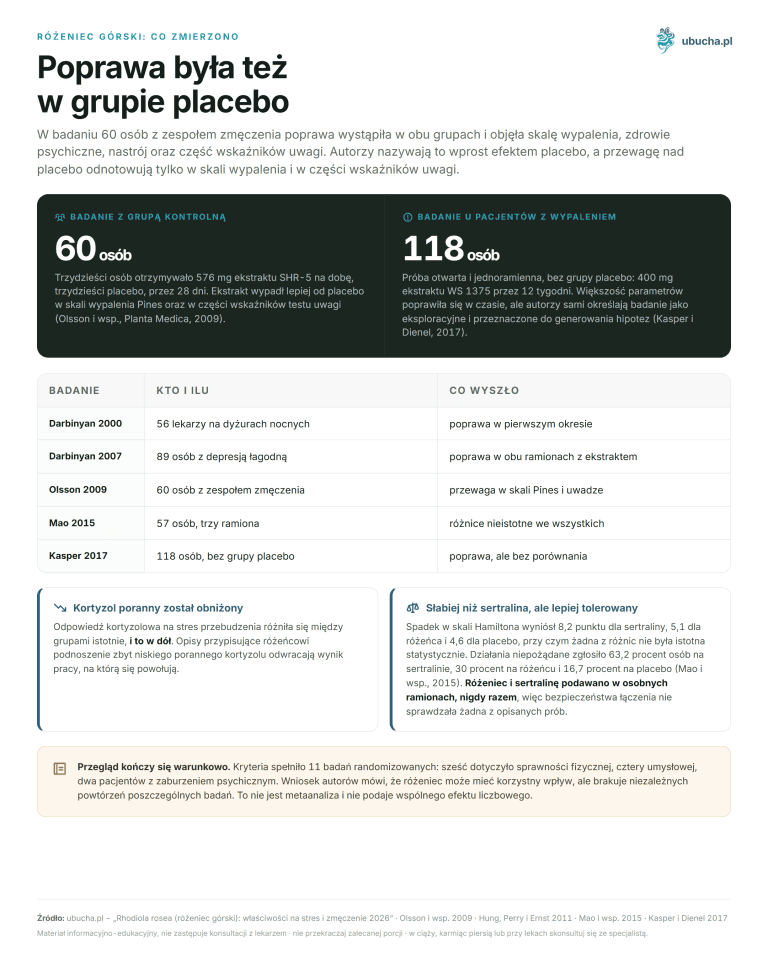
The third is Olsson et al. 2009 in Planta Medica: 60 people with stress-related fatigue, 576 mg SHR-5 daily for 28 days (Planta Medica, 2009). Significant effects versus placebo were on Pines burnout scale and some attention indices in CCPT II test. Cortisol awakening response also changed.
During source verification for this update, we noticed the night shift doctors study is sometimes attributed to Olsson, and the cadet study described as lasting twenty days. These are two different works and protocols. The overall picture from the 2022 review remains encouraging for stress, fatigue, and burnout symptoms (Ivanova Stojcheva and Quintela, 2022). SHR-5 extract standardization and species differences are discussed in a separate article on rhodiola rosea.
How to dose rhodiola and why not in the evening?
Study ranges are roughly 370-576 mg standardized extract daily; Darbinyan’s protocol used a clearly lower dose once daily for two weeks. Since 555 mg was not better than 370 mg in Shevtsov’s study, it makes sense to start at the lower end and increase only if no effect after two weeks.
Time of day is based on action profile. All three trials measured mental work capacity and fatigue, not sleep, and the product was given during active hours. Rhodiola taken late afternoon can delay sleep onset, so the last dose should be no later than early afternoon. One oil macerate producer in the catalog explicitly recommends the last dose five to six hours before bedtime.
When buying, pay attention to standardization. SHR-5 extract used in all three studies was standardized; without declared rosavins and salidroside content, labels cannot be compared. The store catalog shows declarations as DER ratios, e.g., 10:1, indicating extract concentration but not active compound content.
Caution is advised for people taking serotonergic drugs. Rhodiola is described as possibly interacting with this group; decisions on combining with SSRIs should be made by the treating physician, not the supplement seller.
Formulation also matters, though less than price suggests. Powder capsules provide a measured dose. Oil macerates are dosed in drops, with the daily portion usually fifteen drops, not one. Gummies are the most convenient and least concentrated of the three formats. In any case, compare declared extract mass per daily portion, not product weight, as only that can be matched to study protocols.
What is known and unknown about reishi?
It is known what reishi contains, but unknown if this translates to measurable human effects. A 2025 review lists triterpenoids, polysaccharides, and peptides as active fractions, then states solid clinical trials are needed (Eira et al., 2025). This sentence says more about the state of knowledge than all the marketing combined.
The most concrete answer comes from a GRADE-rated meta-analysis of 17 randomized trials with 971 participants, doses from 200 to 11,200 mg daily, durations from one week to 24 weeks (Jafari et al., 2025). Four significant results were: BMI decrease by 0.43, creatinine decrease by 0.14, glutathione peroxidase increase by 2.29, and heart rate decrease by 3.92 beats per minute.
Equally important is what was not found. No effect on fat tissue, waist circumference, blood pressure, fasting glucose, lipid profile, inflammatory markers, or liver enzymes. Authors conclude evidence certainty for all endpoints was very low.
What does this mean for a stressed person? Reishi currently lacks clinical data comparable to ashwagandha or rhodiola, and its attributed sedative or anxiolytic effects are mainly based on animal models and tradition. The heart rate decrease is interesting as it points toward calming, but it is a single result with very low certainty. Choosing reishi means selecting the raw material with the weakest documentation among the three.
Which adaptogen fits your symptom profile?
Choice should be based on the dominant symptom because the three raw materials were studied in different situations. Ashwagandha was studied in chronic stress with cortisol measured. Rhodiola was studied in mentally fatigued people with attention measured. Reishi was studied on metabolic endpoints, not stress.
If tension lasting weeks, difficulty falling asleep despite fatigue, and irritability at day’s end dominate, the closest protocol is ashwagandha at the study dose, taken in the evening or split doses. It is the only one of the three with measured stress hormone reduction rather than just mood.
If mental fatigue, attention decline, and night or shift work dominate, rhodiola taken in the morning fits better. Darbinyan’s protocol is best replicated by taking one low dose on a stress day, not increasing to maximum.
If you seek something for sleep or immunity, the honest answer is reishi is the least documented option and should be treated as an adjunct, not a solution. Also distinguish two states often confused in popular guides: stress with arousal and burnout with exhaustion are different, and a stimulating raw material in the first usually worsens the problem. None of these three replace sleep, regular meals, or exercise, and no dose can substitute for those. Other raw materials with directly measured cortisol are collected in the article on stress and cortisol supplements.
How to test on yourself without guessing? Change one thing at a time and give it four weeks. If starting with ashwagandha, do not add melatonin or a new evening ritual in the same week, or you won’t know what worked. Note two simple things: how long it takes to fall asleep and how you rate your energy around noon. This is enough to see a trend after a month and protects against the common scenario of adding a second product after two weeks and not knowing after four which did anything.
What does sklep u Bucha really have on the shelf?
We reviewed all 386 items in the store on August 8, 2026, including descriptions. Ashwagandha appears in the name of five products and in the composition of nineteen. Reishi has three products named and sixteen in composition. Rhodiola has no product named but is in twelve compositions. A single-ingredient rhodiola product simply does not exist in this store, though the raw material is present in several formulas.
Below are products with declared raw material content per portion, sorted by daily portion cost. Prices are from the store as of August 8, 2026.
| Product | Highlight | Portions per package | Price | Cost per portion |
|---|---|---|---|---|
| Ashwagandha extract 5%, 10 g | powdered raw material, 5% withanolide standardization | approx. 50 at 200 mg daily | 6.00 zł | 0.12 zł |
| Himalaya Ashwagandha, 60 tablets | 250 mg root extract per tablet, 2 tablets daily | 30 | 20.99 zł | 0.70 zł |
| 4 Mushroom Complex Vegan Gummies, 60 pcs | reishi 1000 mg per portion, plus three other mushrooms | 30 | 89.96 zł | 3.00 zł |
| NOCNA REGENERACJA Gummies, 30 pcs | ashwagandha 150 mg standardized 30:1, including 7.7 mg withanolides | 15 | 55.00 zł | 3.67 zł |
| UMYSŁ W FORMIE Gummies, 30 pcs | rhodiola 60 mg DER 10:1 plus guarana caffeine | 15 | 55.00 zł | 3.67 zł |
| Aura Care Adaptogens Energy, 15 ml | ashwagandha 360 mg and rhodiola 187.5 mg per daily portion | approx. 26 | 99.00 zł | 3.81 zł |
| Aura Care Adaptogens Immunity, 15 ml | reishi 150 mg per portion, plus purple coneflower | approx. 26 | 99.00 zł | 3.81 zł |
| Aura Care Ashwagandha, 60 capsules | 700 mg oil macerate per daily portion | 30 | 119.00 zł | 3.97 zł |
| Shroomix, adaptogenic cocoa, 240 g | reishi and rhodiola in a five-mushroom blend | approx. 30 portions of 8 g | 149.00 zł | 4.97 zł |
Which format is cheaper per portion?
The difference reaches forty times and is not due to raw material quality but form of administration. Powdered extract costs 0.12 zł per portion, tablet 0.70 zł, and oil macerate or cocoa from 3.81 to 4.97 zł. You pay this difference for convenience: ready portion, no scale, no taste, no measuring.
However, the conversion has limits and you should know them. Powdered extract is cheap but requires a jeweler’s scale because a 200 mg portion is too small to measure with a spoon. The producer only provides standardization; portion size responsibility falls on you.
The other limit concerns blends. In cocoa, chocolate, or gummies with five raw materials, the share of a single adaptogen is often small: rhodiola in UMYSŁ W FORMIE gummies is 60 mg DER 10:1, many times less than 370 mg in Shevtsov’s study. Such a product is bought for convenience of daily ritual, not to replicate a study protocol. Single-ingredient products are in the supplements category; powdered raw materials in herbs.
Is it worth combining adaptogens with CBD?
They have separate mechanisms and different quality of evidence, so combining is allowed but without promises. The most cited number on CBD and sleep comes from a retrospective case series in a psychiatric clinic: in 48 of 72 adults (66.7%), sleep improved in the first month; anxiety severity decreased in 79.2% (Shannon et al., 2019).
It is important to understand the study design before treating it as proof. It is a medical record review, not a controlled trial or consumer survey, and the authors conclude controlled studies are needed. Sleep results fluctuated in subsequent months, unlike anxiety results which remained stable.
A sensible daily schedule is: rhodiola in the morning, ashwagandha in the evening, CBD in the evening as an addition to the calming part. Combining rhodiola and CBD at the same time rarely makes sense because one is studied as stimulating and the other described as calming.
A pharmacological caveat is important. CBD inhibits cytochrome P450 isoenzymes involved in metabolism of many drugs, so with ongoing pharmacotherapy, the decision to combine should be made by a doctor or pharmacist. Sublingual oils are in the oils category.
Note one more thing about that case series: CBD was given as an addition to existing treatment in clinic patients, not as a replacement. Inferring that the oil alone solves sleep problems is an overinterpretation explicitly rejected by the study. If planning a protocol with adaptogen and CBD, treat both as an add-on layer, not a therapy substitute.
Who should avoid adaptogens?
The contraindication list is shorter than the promise list but firm. The American NCCIH states plainly: ashwagandha should be avoided in pregnancy and not used during breastfeeding (NCCIH). For rhodiola and reishi, safety data in pregnancy are lacking, which practically leads to the same conclusion.
The same NCCIH card advises against ashwagandha in thyroid and autoimmune diseases and before planned surgery. It also notes a signal rarely mentioned in Polish guides: cases of liver injury linked to ashwagandha supplements. These are rare but exist, arguing against taking this raw material continuously for years.
Situations related to medications are separate. Rhodiola requires caution with serotonergic drugs. Reishi requires caution with anticoagulants and immunosuppressants, as its fractions affect immune response. With any ongoing pharmacotherapy, a few minutes’ talk with a pharmacist resolves most doubts.
Children and adolescents under 18 are a third group with no data. Lack of data does not mean safety, only no basis for recommendation, and a dietary supplement is not a product to test on your own.
Two situations require stopping immediately. First is planned surgery: NCCIH explicitly lists the preoperative period, and surgeon and anesthesiologist should know about any supplement two weeks before. Second is liver symptoms during ashwagandha use: jaundice, dark urine, persistent nausea, or right upper quadrant pain. This rare but documented situation requires stopping and contacting a doctor, not waiting for the next dose.
What mistakes do buyers most often make?
The first mistake is comparing milligrams without standardization. Powdered root and 5% withanolide standardized extract are two different raw materials; 500 mg of one and 500 mg of the other differ by an order of magnitude in active compounds. A label without percent or DER ratio does not allow comparison.
The second mistake is expecting effect in a week. Ashwagandha’s measured cortisol drop occurred after 60 days, not seven. Rhodiola can act faster, as in the cadet study where effect appeared after one dose, but that was mental work capacity under fatigue, not stress response remodeling.
The third mistake is buying a blend with ten raw materials instead of a single-ingredient product. To get 600 mg of ashwagandha from such a formula, you’d need several portions at once, which is rarely a good idea with other ingredients. Blends are convenient and pleasant but do not replicate any study protocol.
The fourth mistake is ignoring the certificate of analysis. A COA for a batch shows actual active compound content, microbiological purity, and absence of heavy metals. A producer who does not provide it leaves you with marketing claims instead of data. The fifth mistake is hoping the supplement will make up for five hours of lost sleep.
The sixth mistake is made after purchase and hardest to notice. It is judging effect after the first days when mainly expectation acts. In Olsson’s study, improvement appeared after 28 days in both groups, including placebo; only between-group comparison showed what to attribute to the extract. Your own feeling after a week has the same weakness: no baseline to compare. That is why a month and notes - not a day and memory - are a reasonable evaluation unit.
Summary: which adaptogen to choose in 2026?
If you had to choose one raw material based on evidence, not popularity, it would be ashwagandha. It has a randomized trial with serum cortisol measurement, meta-analysis of 20 studies on 1249 people, and clearly described contraindications. It also has the most concrete protocol: 600 mg standardized extract daily for eight to twelve weeks, noting the Polish dietary supplement limit of 10 mg withanolides per day.
Choose rhodiola if mental fatigue and attention decline, not tension and sleep, are the problem. Evidence is weaker than for ashwagandha but consistent across three independent trials, and effective dose is lower than most labels suggest. Take in the morning, not afternoon.
Treat reishi as an adjunct. The GRADE meta-analysis showed significant results in four points but evidence certainty was very low; no effect on inflammatory markers was found. It is a raw material with long tradition and short list of hard data.
Finally, a practical note from the catalog review: in this store, rhodiola is only available as a blend ingredient; no single-ingredient rhodiola product exists. Ashwagandha is available in both forms, from powdered extract at 6 zł to oil macerate capsules at 119 zł. This price difference reflects convenience and form, not strength of effect.
Frequently Asked Questions
How does an adaptogen differ from a regular supplement?
An adaptogen is a raw material intended to increase nonspecific resistance to stress, rather than to eliminate a single symptom. The 2010 review by Panossian and Wikman links this effect to regulation of the hypothalamic-pituitary-adrenal axis and cellular stress proteins HSP70. A regular supplement replenishes a deficiency; an adaptogen modulates the response to stress.
How soon can you see the effect of an adaptogen?
It depends on the raw material. Rhodiola improved mental work capacity after a single dose in a 2003 study on 161 cadets. Ashwagandha required 60 days to reduce cortisol by 27.9% versus 7.9% in placebo. Clinical trials for reishi lasted from one week to 24 weeks.
Can ashwagandha, rhodiola, and reishi be combined?
Yes, but not in the same dose at the same time. Rhodiola has a stimulating profile and was studied in the morning; ashwagandha and reishi in the evening. A reasonable regimen is rhodiola in the morning and ashwagandha in the evening. Blends with a dozen raw materials rarely provide doses close to those in clinical trials.
Can adaptogens replace anti-anxiety or antidepressant medications?
No. They are dietary supplements, not registered drugs for treating depression or anxiety disorders. Discontinuing SSRIs or benzodiazepines without consultation is dangerous. Rhodiola is also described as a raw material with possible interactions with serotonergic drugs, so combining requires discussion with the treating physician.
Are adaptogens safe during pregnancy and breastfeeding?
No. The American NCCIH explicitly states that ashwagandha should be avoided during pregnancy and not used while breastfeeding. The same guidance advises against its use in people with thyroid or autoimmune diseases and before surgery. For rhodiola and reishi, safety data during pregnancy are simply lacking.
How do adaptogens compare to CBD for sleep problems?
They have separate mechanisms and different quality of data. In a retrospective series of 72 psychiatric outpatients, sleep improved in the first month in 66.7% of those taking CBD, but the authors note controlled studies are needed. Ashwagandha has a randomized trial with cortisol measurement.
Does the sklep u Bucha offer products with rhodiola?
Yes, although none have rhodiola in the name. As of August 8, 2026, rhodiola appears in the composition of twelve products: in Aura Care oil macerates, gummies, adaptogenic coffees and chocolates, and Shroomix cocoa. The store does not carry a single-ingredient rhodiola product.
Ready products with ashwagandha and blends with rhodiola or reishi are collected in the supplements category; chewables in the gummies category.
This article is for informational and educational purposes and does not replace consultation with a doctor. If you are pregnant, breastfeeding, taking medications, or have chronic conditions, consult a specialist before using supplements or herbs.
Author: Michał Waluk · Published: 2026-05-11 · Updated: 2026-08-08