
Adaptogens for Children: When They Are Safe and When They Are Not
Adaptogens for children: for most raw materials, there are no studies in children, and EMA advises against them below 18 years. Safety table and signals to see a doctor.
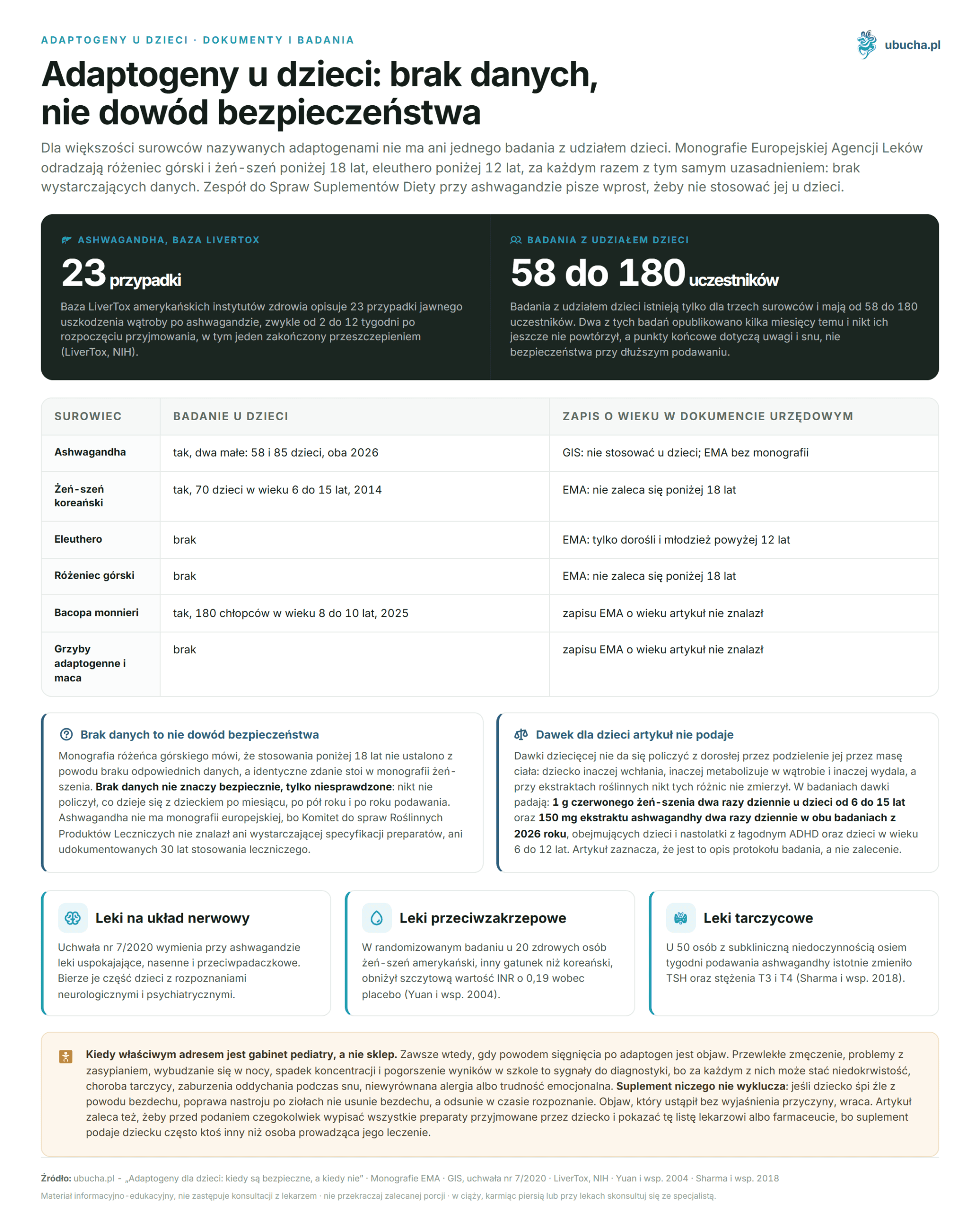
The default answer is: it is unknown, as no one has checked this in children. For most raw materials called adaptogens, there is not a single study involving children, and the monographs of the European Medicines Agency advise against rhodiola and ginseng below 18 years, eleuthero below 12 years, each time with the same justification: lack of sufficient data. The Polish Dietary Supplements Team goes further and states directly regarding ashwagandha that it should not be used in children. Below you will find a safety table raw material by raw material, a list of interactions with medications that the child may be taking more than is known to the person administering the supplement, and situations where the appropriate address is the pediatrician’s office, not the store.
KEY INFORMATION
• EMA monographs: rhodiola and ginseng not recommended below 18 years, eleuthero below 12 years, in both cases due to lack of data.
• For ashwagandha, EMA has not established a monograph at all (EMA/HMPC/681519/2012).
• GIS, resolution no. 7/2020: do not use in children, pregnant women, and during lactation.
• Studies in children exist only for three raw materials and have between 58 and 180 participants.
• The LiverTox database of American health institutes describes 23 cases of apparent liver damage after ashwagandha, including one resulting in transplantation.
• Chronic fatigue, sleep problems, and concentration issues in a child are symptoms to be diagnosed, not supplemented.
Are adaptogens safe for children?
For most raw materials, this cannot be determined, as there is no data. The monograph for rhodiola states that use below 18 years has not been established due to lack of appropriate data (EMA/HMPC/24177/2023). An identical statement is found in the ginseng monograph (EMA/HMPC/27744/2023).
Lack of data is not the same as proof of safety and not the same as proof of harm. It means exactly that no one has calculated what happens to a child after a month, after six months, and after a year of administration. With a plant that alters hormone levels and liver function, this is a real unknown, not a formality.
In one case, an official document says more than a lack of data. Ashwagandha does not have a European monograph because the Committee for Herbal Medicinal Products found neither sufficient specification of preparations nor documented 30 years of medicinal use (EMA/HMPC/681519/2012). In Poland, the Dietary Supplements Team stated in resolution no. 7/2020 that the product should not be used in children, pregnant women, and during lactation (GIS).
Which adaptogens have studies in children?
Three, and all studies are small. The oldest concerns red ginseng: 70 children aged 6 to 15 years with symptoms of inattention and hyperactivity, eight weeks, reduction in symptom severity compared to placebo (Ko et al. 2014).
The other two come from 2026 and concern ashwagandha. In the first, 58 children and adolescents with mild ADHD took either extract or placebo for 56 days; symptom severity decreased more after the extract (Naik et al. 2026). In the second, 85 children aged 6 to 12 years, of which 73 completed the study, received the extract for eight weeks; information processing speed and sleep quality improved (Saxena et al. 2026). Separately, there is a study on bacopa and gotu kola in 180 healthy boys aged 8 to 10 years (Verma et al. 2025).
What does this mean for a parent? That the evidence concerns narrow groups, short periods, and endpoints in the areas of attention and sleep, not safety with longer administration. Two of these studies were published a few months ago and no one has repeated them yet.
What does the safety table say for individual raw materials?
That for half of the entries in the column with studies in children, the word lack is present, and for the others, it concerns single small trials. The table collects four things at once: whether there is a study involving children, what the age document says, what known risks are described, and what to be cautious about with medications. The word lack does not mean safe here, but untested.
| Raw Material | Study in Children | Age Note in Official Document | Known Risk or Interaction |
|---|---|---|---|
| Ashwagandha (Withania somnifera) | yes, two small: 58 and 85 children, both 2026 | GIS: do not use in children; EMA has not established a monograph (2013) | described cases of liver damage; sedatives, sleeping pills, and anticonvulsants; changes in TSH, T3, and T4 |
| Korean Ginseng (Panax ginseng) | yes, 70 children aged 6 to 15 years, 2014 | EMA: not recommended below 18 years | insomnia, gastrointestinal complaints; American ginseng weakened the effect of warfarin |
| Eleuthero (Siberian ginseng) | lack | EMA: only adults and youth over 12 years | insomnia, irritability, rapid heartbeat, headaches |
| Rhodiola (Rhodiola rosea) | lack | EMA: not recommended below 18 years | EMA does not report clinically significant interactions |
| Bacopa monnieri (brahmi) | yes, 180 boys aged 8 to 10 years, 2025 | I did not find an EMA age note | besides this study, I found no safety data in children |
| Adaptogenic mushrooms and maca | lack | I did not find an EMA age note | no data in children in either direction |
Entries about our category adaptogens and descriptions of individual raw materials, for example rhodiola, concern adults and should be read as such.
Why won’t you find dosages for children here?
Because there is no source to take them from. It is not possible to calculate a child’s dose from an adult dose by dividing it by body weight, even though such a calculation seems reasonable. A child absorbs differently, metabolizes in the liver differently, and excretes differently, and with plant extracts, no one has measured these differences.
In the studies mentioned above, doses are of course mentioned: 1 g of red ginseng twice a day for children aged 6 to 15 years, 150 mg of ashwagandha extract twice a day in both studies from 2026. This is a description of the study protocol, not a recommendation, and should not be transferred to your own child. Besides these protocols, there is no value that could be honestly provided.
The limit that exists in Polish food law concerns adults: resolution no. 7/2020 speaks of powdered root in amounts below 3 g per day and a content of withanolides not exceeding 10 mg in the recommended daily portion. The same resolution states not to give it to children, so this is not a number to be calculated downwards.
What drug interactions need to be checked before administration?
Three groups: drugs acting on the central nervous system, anticoagulants, and thyroid medications. Resolution no. 7/2020 lists sedatives, sleeping pills, and anticonvulsants with ashwagandha. This is not a theoretical list, as exactly these medications are taken by some children with neurological and psychiatric diagnoses.
With ginseng, the best-documented interaction is with warfarin: in a randomized study of 20 healthy individuals, American ginseng, which is a different species than Korean, lowered the peak INR value by 0.19 compared to placebo (Yuan et al., Annals of Internal Medicine 2004). Ashwagandha, on the other hand, changes thyroid parameters: in 50 individuals with subclinical hypothyroidism, eight weeks of administration significantly changed TSH and levels of T3 and T4 (Sharma et al. 2018).
There is also a problem that has nothing to do with pharmacology. A supplement is often given to a child by someone other than the person conducting their treatment: a grandmother, a caregiver, a parent living separately. Allergy medications, inhalants, anticonvulsants, or psychiatric medications may then be beyond the reach of that knowledge. Before giving anything, list all the preparations taken by the child and show this list to the doctor or pharmacist. We wrote about this in more detail in the post about supplements for children.
When to go to the doctor with a child instead of to the store?
Always when the reason for reaching for an adaptogen is a symptom. Chronic fatigue, problems falling asleep, waking up at night, decreased concentration, and worsening school performance are signals for diagnostics. Each of them may be due to anemia, thyroid disease, sleep apnea, uncontrolled allergy, or emotional difficulty.
The reason is simple: a supplement excludes nothing. If a child sleeps poorly due to apnea, an improvement in mood from herbs will not eliminate apnea, but will delay diagnosis. The same principle applies to fatigue due to iron deficiency and decreased attention due to an undetected vision or hearing defect. A symptom that has disappeared without explanation of the cause will return. With ashwagandha, there is also the inherent risk of the preparation: the LiverTox database of American health institutes describes 23 cases of apparent liver damage, usually from 2 to 12 weeks after starting administration, including one case resulting in transplantation (LiverTox, NIH).
If after diagnostics there remains a question about supporting immunity or concentration, it makes more sense to start with things that have been tested in children: we write about both in texts about immunity supplements for children and about supporting concentration alongside treatment.
Frequently Asked Questions
Can a child take ashwagandha?
The Polish Dietary Supplements Team at the Chief Sanitary Inspectorate stated in resolution no. 7/2020: do not use in children, pregnant women, and during lactation. The European Medicines Agency has not established a monograph for this raw material at all, as it found insufficient data on preparations and the period of traditional use.
From what age can adaptogens be given?
The monographs of the European Medicines Agency advise against rhodiola and ginseng below 18 years, and eleuthero below 12 years, each time with the same justification: lack of sufficient data. This is not a safety threshold established by research, but a boundary below which no one has checked these raw materials.
Will adaptogens help a child with concentration?
There are three small studies in this area: red ginseng in 70 children aged 6 to 15 years, ashwagandha in 58 children with mild ADHD, and ashwagandha in 85 children with attention or memory problems. All lasted about eight weeks and none answer the question of long-term safety.
Will adaptogens help a child sleep?
One study from 2026 noted an improvement in sleep quality in children taking ashwagandha for eight weeks, with 85 participants and 73 completing. However, sleep problems in children have many causes that require diagnosis, from apnea to iron deficiency, and no supplement diagnoses any of them.
What medications exclude giving an adaptogen to a child?
Resolution no. 7/2020 lists sedatives, sleeping pills, and anticonvulsants with ashwagandha. American ginseng weakened the effect of warfarin in 20 healthy individuals. Ashwagandha also changes TSH and levels of T3 and T4, so it is a problem in thyroid treatment. Before giving anything, list all of the child’s medications and show the list to the doctor.
What to do if a child is constantly tired?
Schedule a visit to the pediatrician, not buy a supplement. Chronic fatigue, sleep problems, and concentration issues are symptoms that need to be diagnosed, as there is a list of possible causes from anemia and thyroid diseases to sleep apnea and school difficulties. No supplement excludes any of them.
This article is for informational and educational purposes and does not replace consultation with a doctor. If you are pregnant, breastfeeding, taking medications, or have chronic conditions, consult the use of supplements or herbs with a specialist.
Author: Michał Waluk · Published: 2026-08-24 · Updated: 2026-08-24