
Which herbs should not be combined: interactions and contraindications (table)
A table of herbal interactions with measurement methods and direction of action. Check which combinations have been confirmed in humans and which are based on mechanisms.
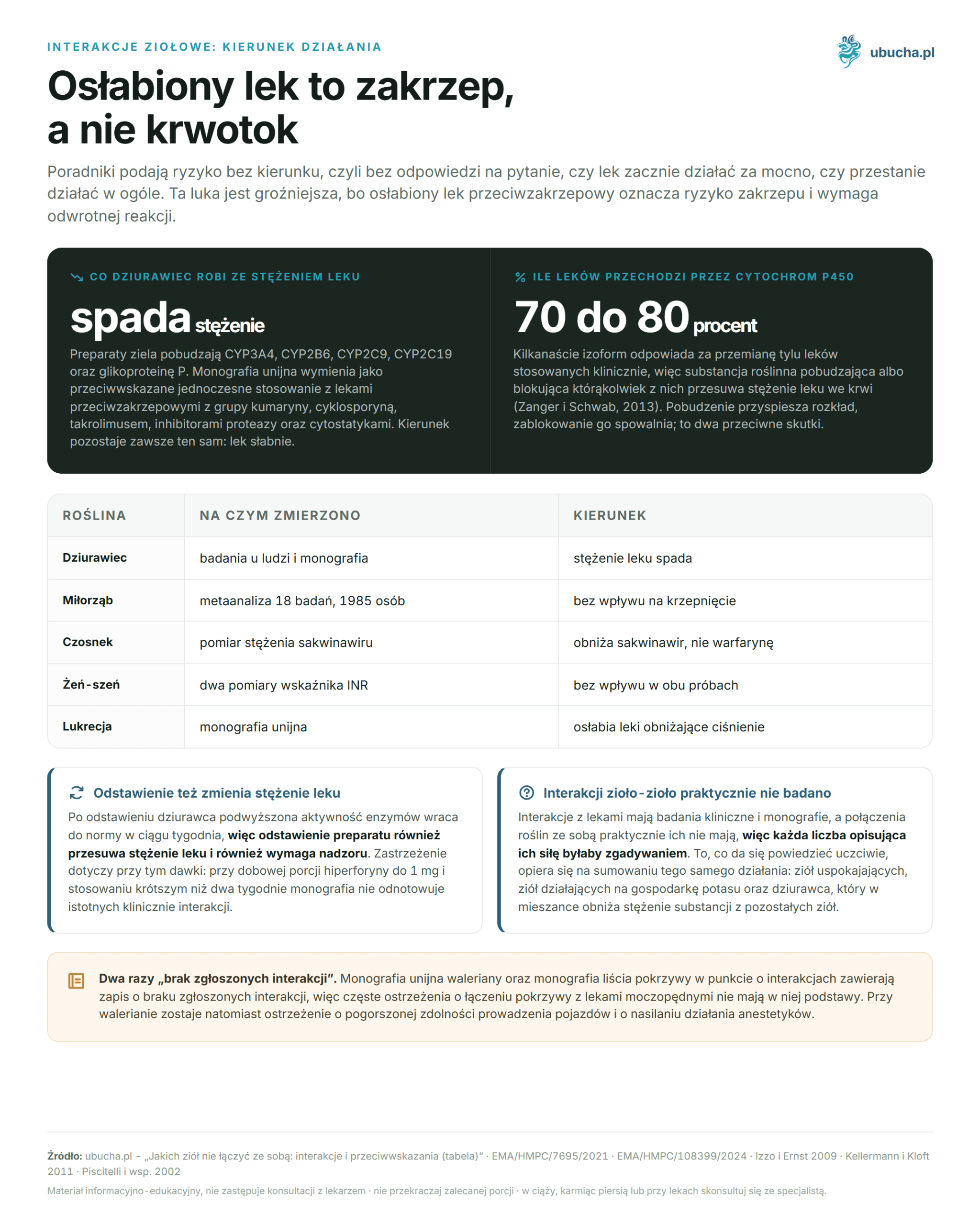
Guides on herbal interactions have two recurring flaws. They provide risks without indicating what they were measured against, and they present them without direction, meaning they do not answer whether a drug will start to work too strongly or will stop working altogether. The latter gap is more dangerous, as a weakened anticoagulant means a risk of thrombosis, not bleeding, and requires an opposite reaction. This text goes through seven plants, providing the measurement method and the direction of the interaction for each, and separately answers the question in the title: which herbs should not be combined with each other, not just with medication. For two items that frequently appear in guides, the correction goes against the common version, as the EU monograph does not record any interaction with them.
KEY INFORMATION
• Cytochrome P450 enzymes are responsible for the metabolism of 70 to 80 percent of clinically used drugs, so a plant that alters their activity changes the drug concentration (Zanger and Schwab, Pharmacol Ther, 2013).
• St. John’s Wort stimulates CYP3A4, CYP2B6, CYP2C9, CYP2C19, and P-glycoprotein, thus reducing the drug concentration. The EU monograph considers this combination contraindicated with anticoagulants from the coumarin group (EMA/HMPC/7695/2021).
• A meta-analysis of 18 randomized studies involving 1985 individuals did not show an increased risk of bleeding after standardized Ginkgo biloba extract (Kellermann and Kloft, Pharmacotherapy, 2011).
• Licorice weakens the effect of blood pressure-lowering medications, and with diuretics, it enhances potassium loss (EMA/HMPC/108399/2024).
• The EU monograph on valerian and the monograph on nettle leaf in the interaction section contain the statement “None reported”, meaning no reported interactions.
Why can an herb change the effect of a drug?
Because it targets the same enzymes and transporters through which the drug passes. Several isoforms of cytochrome P450 are responsible for the metabolism of 70 to 80 percent of all clinically used drugs, so a plant substance that stimulates or blocks any of them shifts the drug concentration in the blood (Zanger and Schwab, Pharmacol Ther, 2013). The second pathway is P-glycoprotein, a transporter that removes substances from intestinal cells and the blood-brain barrier.
The direction depends on what the plant does to the enzyme. Stimulation of the enzyme accelerates the breakdown of the drug, lowering its concentration and causing the drug to stop working. Blocking the enzyme slows down the breakdown, the drug accumulates, and adverse effects increase. These are two opposing effects and two opposing reactions from the doctor, yet guides notoriously lump them into one word about interaction.
The third pathway is different from both. In pharmacodynamic action, the plant and the drug target the same point in the body, so their effects sum without any involvement of enzymes. Such combinations can be the hardest to prove, as they simply do not show up in enzymatic studies, and there are almost no studies on humans with hard endpoints. Therefore, in the table below, we separate them from interactions measured by drug concentration in the blood.
Which combinations have measurement, and which are based on mechanism?
The following summary provides the method on which the warning is based for each plant, as well as the direction in which the interaction works. Rows without measurement in humans are described as mechanisms to distinguish them from those measured by drug concentration or coagulation parameters.
| Plant | Measured on | Direction | What this means for the patient |
|---|---|---|---|
| St. John’s Wort (Hypericum perforatum) | Clinical studies in humans and case reports; EU monograph | Stimulates CYP3A4, CYP2B6, CYP2C9, CYP2C19, and P-glycoprotein; drug concentration decreases | The drug stops working: loss of anticoagulant protection, transplant rejection, pregnancy despite contraception |
| Ginkgo biloba | 15 case reports versus a meta-analysis of 18 randomized studies involving 1985 individuals | Controversial: reports indicate bleeding, meta-analysis did not show an effect on coagulation parameters | Caution for individuals who already have a risk of bleeding; the extract itself does not create it |
| Garlic in supplements (Allium sativum) | 10 volunteers, measurement of saquinavir concentration; separately two studies with warfarin | Reduces saquinavir concentration; did not affect warfarin in both studies | Real risk concerns HIV treatment, not coagulation |
| Ginseng (Panax ginseng) | 12 healthy men and 25 patients after stroke; both INR measurements | No effect on warfarin in both trials; case reports indicate both sides | Unpredictability, not a determined direction; separately possible hypoglycemia |
| Licorice (Glycyrrhiza glabra) | EU monograph and opinion of the scientific committee on glycyrrhizic acid | Weakens blood pressure-lowering medications; with diuretics, enhances potassium loss | Increased blood pressure despite treatment, hypokalemia, heart rhythm disturbances |
| Valerian (Valeriana officinalis) | Mechanism; EU monograph states no reported interactions | Summation of calming effects, mainly described concerning anesthetics | Drowsiness and impaired ability to drive; report its use to the anesthesiologist before surgery |
| Echinacea (Echinacea purpurea) | 12 healthy individuals, marker drugs for four isoforms | Slows caffeine removal; acts oppositely on CYP3A in the intestine and liver | Effect depends on where the drug is metabolized; impact on immunosuppressive drugs remains a hypothesis |
Why does St. John’s Wort have a list of contraindications in its monograph?
Because it has undergone clinical studies showing a decrease in the concentration of dozens of drugs. A systematic review of seven popular plants gathered 128 case reports and series, as well as 80 clinical studies; for St. John’s Wort, the list of drugs whose concentration decreases or whose clearance increases includes cyclosporine, digoxin, indinavir, imatinib, oral contraceptives, and warfarin (Izzo and Ernst, Drugs, 2009).
The EU monograph goes further than just a warning. St. John’s Wort preparations stimulate CYP3A4, CYP2B6, CYP2C9, CYP2C19, and P-glycoprotein, and simultaneous use with anticoagulants from the coumarin group, cyclosporine, everolimus, sirolimus, tacrolimus, protease inhibitors, and cytostatics such as irinotecan and imatinib is listed as contraindicated (EMA/HMPC/7695/2021). The caution concerns the dose: with a daily portion of hyperforin up to 1 mg and a duration of use shorter than two weeks, the monograph does not record clinically significant interactions. The direction remains the same: the drug weakens. With an anticoagulant, this means thrombosis, not hemorrhage, and this is a difference that must be read literally.
Two things from the same monograph are often overlooked. After discontinuation, the increased enzyme activity returns to normal within a week, so stopping the preparation also changes the drug concentration and also requires supervision. Separately, it describes the effect on serotonin transmission when used simultaneously with antidepressants from the selective serotonin reuptake inhibitor group: serotonin syndrome occurs very rarely, and the combination itself is a warning in the monograph, not a contraindication. A broader list of sensitive drugs has been gathered in the text about which herbs should not be combined with medications.
Do Ginkgo biloba, garlic, and ginseng increase the risk of bleeding?
The evidence is conflicting, and the honest answer is: not to a degree that has been detected in controlled studies. A literature review gathered 15 published reports of bleeding temporally associated with Ginkgo biloba, including eight intracranial, but in 13 cases, other risk factors were present (Bent et al., J Gen Intern Med, 2005). A meta-analysis of 18 randomized studies involving 1985 individuals did not show an effect of standardized Ginkgo biloba extract on platelet aggregation, fibrinogen concentration, or coagulation times (Kellermann and Kloft, Pharmacotherapy, 2011).
For garlic, the measurements go even further towards a calming effect. In a crossover study involving twelve healthy men, garlic did not change either the pharmacokinetics or pharmacodynamics of warfarin (Mohammed Abdul et al., Br J Pharmacol, 2008), and in a twelve-week placebo-controlled trial involving 48 individuals treated with warfarin, no increase in the number of hemorrhages was recorded (Macan et al., J Nutr, 2006). The documented interaction of garlic follows a completely different pathway: in ten volunteers, it reduced the area under the curve of saquinavir by 51 percent, the maximum concentration by 54 percent, and the minimum concentration by 49 percent (Piscitelli et al., Clin Infect Dis, 2002).
Ginseng looks similar. In a crossover study involving twelve healthy men, it did not affect warfarin, although St. John’s Wort given in the same regimen reduced its effect (Jiang et al., Br J Clin Pharmacol, 2004), and in a randomized trial involving 25 patients after ischemic stroke, it did not change the INR or prothrombin time (Lee et al., J Altern Complement Med, 2008). The authors of the second study note that previous reports indicated both a weakening and a strengthening effect. Caution is therefore justified by unpredictability, not a determined direction, and primarily concerns individuals with already elevated bleeding risk and the perioperative period (Ang-Lee et al., JAMA, 2001).
Why does licorice act oppositely to what guides say?
Because it does not enhance blood pressure medications; it hinders them. The EU monograph on licorice root states directly that the preparation may counteract the effects of prescribed blood pressure-lowering medications and advises against simultaneous use with diuretics, cardiac glycosides, corticosteroids, and irritating laxatives, as all exacerbate electrolyte imbalance (EMA/HMPC/108399/2024). Symptoms of overdose described in the same document include water retention, decreased potassium concentration, increased blood pressure, and heart rhythm disturbances.
The common threshold of one hundred milligrams per day mentioned in guides also requires correction, as it does not apply to the root. The scientific committee of the European Commission stated that the data cannot be translated into acceptable daily intake and deemed it reasonable for regular consumption not to exceed 100 mg of glycyrrhizic acid per day, directly calling this value provisional (determined in 1991, referenced in the opinion SCF/CS/ADD/EDUL/225 from April 10, 2003). Glycyrrhizic acid is one component of the root, and its content varies significantly among products.
Practically, this means two things. The monograph limits the use of licorice to four weeks, and individuals with hypertension, kidney disease, liver disease, heart disease, or potassium deficiency are listed as particularly sensitive. All sources are included in the daily portion, including herbal teas and sweets, as some of the tested teas contained over 100 mg of glycyrrhizic acid per liter of infusion.
Which herbs should not be combined with each other?
The answer is shorter than the demand for it suggests. Interactions between herbs and drugs have clinical studies and monographs, while interactions between herbs practically do not, so any number describing their strength would be a guess. What can be said honestly is based on the summation of the same action.
The first pair to avoid is calming plants combined together: valerian, hops, passionflower, and lemon balm act in the same direction, and ready-made mixtures contain them alongside each other. The EU monograph on valerian in the interaction section states “None reported”, meaning no reported interactions, and separately warns that the preparation may impair the ability to drive. A perioperative review mentions enhancing the effects of anesthetics as a real problem in the operating room (Ang-Lee et al., 2001). Summation of drowsiness is therefore mechanistically credible and not numerically described.
The second pair concerns plants affecting potassium and blood pressure: licorice combined with herbs that have a diuretic effect deepens the same potassium loss that it itself causes. The third situation is the opposite and most often overlooked: St. John’s Wort in a mixture acts on the same enzymes, so it may lower the concentration of substances from the other herbs just as it lowers the concentration of drugs. Separately, it is worth remembering a plant that should not be in such combinations: the monograph on nettle leaf in the interaction section states “None reported”, so frequent warnings about combining it with diuretics have no basis in it. A similar distinction between measurement and mechanism has been described in interactions of cannabidiol with medications.
Frequently Asked Questions
Which herb should not be combined with prescription medications?
St. John’s Wort. It has contraindications listed in the EU monograph: it stimulates CYP3A4, CYP2B6, CYP2C9, CYP2C19, and P-glycoprotein, thus reducing the concentration of the drug. This applies to anticoagulants from the coumarin group, cyclosporine, tacrolimus, protease inhibitors, and imatinib (EMA/HMPC/7695/2021).
Does St. John’s Wort with anticoagulants pose a risk of bleeding?
No, it poses the opposite risk. St. John’s Wort accelerates the breakdown of the drug, thus lowering its concentration and weakening anticoagulant protection, which means a risk of thrombosis. Stopping St. John’s Wort has the opposite effect and also requires supervision, as the increased enzyme activity returns to normal within a week.
Does St. John’s Wort reduce the effectiveness of hormonal contraception?
Yes. The EU monograph states that a reduction in the concentration of contraceptive hormones can lead to intermenstrual bleeding and decreased protection against pregnancy, and recommends additional protection for women using hormonal contraception. The mechanism involves stimulation of liver enzymes and P-glycoprotein (EMA/HMPC/7695/2021).
Does Ginkgo biloba increase the risk of bleeding?
A meta-analysis of 18 randomized studies involving 1985 individuals did not show an effect of standardized Ginkgo biloba extract on platelet aggregation, fibrinogen, or coagulation times (Kellermann and Kloft, 2011). Separately, there are 15 case reports of bleeding, but in 13 of them, other risk factors were present. Caution is therefore advised for individuals who already have a risk of bleeding.
Can garlic in capsules be combined with warfarin?
Two controlled studies did not show an effect of garlic on warfarin. The documented interaction of garlic follows a different pathway: in ten volunteers, it reduced the area under the curve of saquinavir by 51 percent (Piscitelli et al., 2002). Caution is therefore primarily advised for individuals treated for HIV infection.
Does licorice enhance the effect of diuretics?
It enhances potassium loss, not the diuretic effect itself, and separately weakens blood pressure-lowering medications. The EU monograph advises against simultaneous use with diuretics, cardiac glycosides, and corticosteroids and limits the use of licorice to four weeks (EMA/HMPC/108399/2024).
Do mild herbs in infusions also interact?
Usually not to a clinically significant degree, as the infusion contains many times less active substance than a standardized extract. The problem arises with supplements taken daily for weeks. If you are taking any medication chronically, discuss the planned herbal preparation with your doctor or pharmacist before the first dose.
Herbal raw materials sold in the store can be found in the herbs category, and a separate compilation for individuals taking multiple medications at once has been gathered in the post about supplements for seniors.
This article is for informational and educational purposes and does not constitute medical advice. Before starting supplementation, consult your doctor, especially if you are taking medications regularly, are pregnant or breastfeeding, or have a chronic illness.
Author: Michał Waluk · Published: 2026-08-09 · Updated: 2026-08-16