
CBD water-soluble (nanoemulsion) - does it absorb better than oil (table)
CBD water-soluble: porownanie, roznice i co wybrac. Tabela od u Bucha.
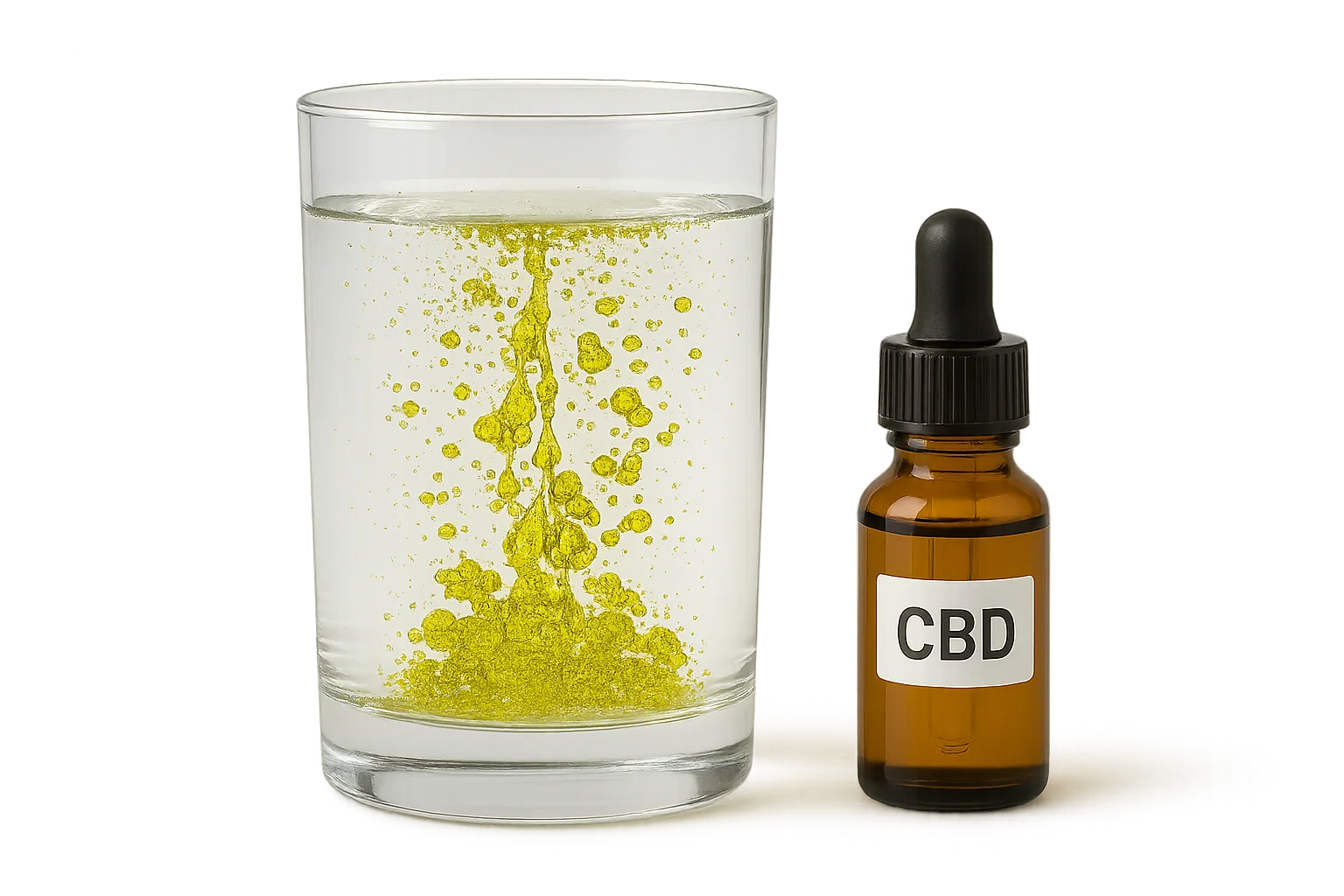
Most CBD oils available on the market share one common problem: CBD is a lipophilic substance that does not mix with water - and the human body is made up of about 60% water. This means that after swallowing standard CBD oil, the body has to perform additional emulsifying work before absorbing cannabidiol. The oral bioavailability of CBD from oil is only 6-19% - the rest passes through the intestines unabsorbed (Millar et al., Pharmaceuticals, 2019). Nanoemulsions and water-soluble CBD technologies attempt to solve this problem by increasing bioavailability several times over. This article compares both forms - what it means in practice and when it is worth paying for nanoemulsion technology.
KEY INFORMATION
• The bioavailability of oral CBD oil is 6-19%; CBD nanoemulsion achieves 31-56% (Millar et al., 2019).
• CBD water-soluble acts faster - onset 15-30 min vs 45-90 min for standard oil.
• Nanoemulsion mixes CBD with water by enclosing it in microscopic droplets (10-100 nm).
• Most water-soluble products on the market use CBD isolate - without the entourage effect.
• CBD water-soluble is more expensive to produce and has a shorter shelf life than traditional oil.
Why does standard CBD oil have low bioavailability?
Understanding the issue starts with chemistry. CBD is a hydrophobic molecule - its molecular structure is "fat-loving" and repels water. When you swallow a drop of CBD oil, it goes to the stomach, where the environment is watery. CBD without an emulsifier does not mix with the stomach contents but accumulates in small fat balls. Only bile secreted by the liver emulsifies these droplets, forming micelles, in which CBD is transported through the intestinal wall into the bloodstream.
The entire process is slow and variable. The efficiency of emulsification depends on the amount of bile (stimulated by fat intake), the speed of intestinal peristalsis, and individual metabolic characteristics. Therefore, CBD with oil is absorbed much better after a fatty meal - a study showed a 4-fold higher bioavailability of CBD taken after a high-fat meal compared to fasting (Millar et al., Pharmaceuticals, 2019). This also explains why different people have such varied experiences with the same CBD oil.
Moreover, a significant portion of CBD undergoes first-pass metabolism in the liver before it reaches the bloodstream. Enzymes CYP2C19 and CYP3A4 convert CBD into metabolites that have different pharmacological properties than the original molecule. The less CBD survives first-pass metabolism, the lower the effective dose that reaches target tissues.
How does CBD nanoemulsion work?
Nanoemulsion solves the bioavailability problem by physically reducing the size of CBD oil droplets to the nanometer scale - typically 10-100 nm, which is up to 1000 times smaller than standard emulsions. The small droplet sizes have several key consequences. First, the surface area of contact between oil and water increases dramatically - with the same volume of oil, divided into 50 nm droplets, the contact area is millions of times greater than with one large droplet. Second, such small particles can be absorbed directly by the enterocytes of the small intestine without the need for emulsification by bile. Third, transport to the bloodstream is faster and more reliable.
In practice, the nanoemulsion manufacturer mixes CBD (usually isolate or broad-spectrum distillate) with emulsifiers (lecithin, polysorbate 80, other GRAS surfactants), water, and possibly a carrier oil, and then processes the mixture through a high-pressure homogenizer or microfluidizer, which breaks the droplets down to the desired size. The final product is transparent (unlike the milky standard emulsions), mixes with water without separating, and has a long stability time.
Liposomal CBD is a related but different technology: CBD is enclosed in double-layer phospholipid spheres that mimic the structure of cell membranes. Liposomes are slightly larger than nanoemulsions (100-400 nm) but can carry both hydrophilic and hydrophobic substances, and their structure can protect CBD from degradation in the digestive system.
Comparison table - CBD oil vs CBD water-soluble (nanoemulsion)
The table below compares the key parameters of both forms of CBD. The bioavailability values are approximate and come from clinical studies on small groups - individual differences can be significant.
| Parameter | CBD oil (standard) | CBD water-soluble (nanoemulsion) | CBD in liposomes |
|---|---|---|---|
| Oral bioavailability | 6-19% | 31-56% | 15-40% |
| Time to effect (onset) | 45-90 minut | 15-30 minutes | 20-45 minut |
| Duration of action | 4-8 godzin | 2-5 godzin | 3-6 godzin |
| Water solubility | No (separation) | Yes (transparent) | Partially |
| Dependence on fatty meal | High (4× higher bioavailability with fat) | Low (independent of diet) | Low |
| Entourage effect | Full (full-spectrum) or none (isolate) | Rarely (mainly isolate) | Depends on the raw material |
| Shelf life | 12-24 months | 6-12 months | 6-18 months |
| Applications | Supplementation, classic oils | Beverages, powders, quick effect | Premium supplements |
| Relative production cost | Niski | High | Very high |
Data update: May 04, 2026 | Sources: Millar et al. Pharmaceuticals 2019, Izgelov et al. Eur. J. Pharmaceutics 2020
Does higher bioavailability always mean better effect?
This is a question worth asking before paying extra for nanoemulsion technology. Higher bioavailability means that with the same dose, more CBD enters the bloodstream - which is beneficial if the goal is systemic action (through the blood). However, some therapeutic properties of CBD may result from local action in the intestines or from liver metabolites, not just from unmetabolized CBD in the plasma.
There is also the opposite argument: if nanoemulsion provides 3-4 times higher bioavailability, one can use 3-4 times lower doses of CBD and achieve a comparable effect. This can offset the higher cost of the product. With the oil priced at 100 PLN for 10 ml with 1000 mg of CBD and nanoemulsion at 150 PLN for 10 ml with 500 mg of CBD - theoretically, nanoemulsion is cheaper when calculated per effective dose.
However, clinical data on large populations are still limited. Most studies on CBD bioavailability have been conducted on small groups of healthy volunteers, often using single doses, which do not reflect the realities of long-term supplementation. The entourage effect - potentially stronger in full-spectrum oil products - is also not considered in simple bioavailability comparisons.
For whom does CBD water-soluble make sense, and for whom is standard oil sufficient?
CBD water-soluble makes the most sense primarily for those who want to add CBD to beverages or food - smoothies, coffee, tea, powdered supplements. Standard oil would separate in such applications; nanoemulsion mixes uniformly. It also works well for those who need a quick effect (15-30 min vs 45-90 min) - e.g., for occasional evening use for relaxation or in stressful situations during the day.
A standard CBD oil is sufficient for individuals using CBD regularly, in the morning or evening, with a meal containing fat. When consumed with a fatty meal, the bioavailability of the oil approaches that of nanoemulsions. For wellness supplementation with a good eating routine, nanoemulsion technology does not provide a significant practical advantage — and it's not worth paying extra for it if you care about the entourage effect (which is often absent in nanoemulsions).
How to maximize the bioavailability of standard CBD oil without nanoemulsion?
If you do not want or cannot buy a water-soluble product, a few simple practices significantly increase the bioavailability of regular CBD oil. The first and most important: use the oil sublingually (under the tongue), keeping it there for 60-90 seconds before swallowing. The mucous membrane of the mouth absorbs some CBD directly into small blood vessels, bypassing first-pass metabolism in the liver. This is a simple method to enhance bioavailability without changing the product.
The second method: take CBD oil with a fatty meal. Eggs, avocado, nuts, a tablespoon of oil - each of these stimulates bile secretion and speeds up the emulsification of CBD. A study by Millar et al. documented a fourfold higher bioavailability of CBD with a high-fat meal compared to taking it on an empty stomach. This is a free and effective way to enhance supplementation efficiency.
The third practice: piperine from black pepper - the active ingredient in black pepper - is a documented inhibitor of first-pass metabolism by inhibiting CYP3A4 enzymes. Adding it to supplementation (as a separate supplement or by eating dishes with black pepper) can increase CBD bioavailability by 20-30%, although studies on this combination with CBD are still limited.
Are the emulsifiers used in CBD nanoemulsions safe?
A valid question - to create a nanoemulsion, CBD must be mixed with emulsifiers that stabilize microscopic oil droplets in an aqueous environment. The most commonly used emulsifiers are sunflower or soy lecithin (phosphatidylcholine), polysorbate 80 (Tween 80), and other surfactants from the GRAS (Generally Recognized As Safe) list according to the FDA. All these substances are approved for use in food and supplements.
Lecithin is a natural emulsifier derived from sunflower or soybeans and is considered safe at typical supplemental doses. Polysorbate 80 raises more controversy: studies on mice have shown that polysorbate 80 in large doses can alter the gut microbiome and affect intestinal barrier permeability. However, the doses used in these studies were many times higher than the amounts found in CBD supplements - the risk with normal use is considered minimal.
A key question when evaluating a water-soluble product: what emulsifier is used and in what quantity? A transparent manufacturer provides the composition of the emulsifier and its concentration. Products with sunflower lecithin as the sole emulsifier have the cleanest ingredient profile. Check the label and CoA - a good nanoemulsion CBD manufacturer tests the finished product not only for CBD content but also for residual solvents from the production process.
Is CBD water-soluble suitable for cooking and adding to hot drinks?
This is a practical question often asked by those looking for ways to incorporate CBD into their daily rituals. The answer depends on the temperature and type of product. CBD nanoemulsion is generally stable at room temperature and in cold drinks - it mixes well with water, juices, smoothies, and iced tea. The problem arises at high temperatures.
CBD as a molecule breaks down at temperatures above 160-180°C - which means that cooking and baking at standard kitchen temperatures (100-180°C) can lead to partial degradation. However, beverages such as coffee or tea are usually consumed at temperatures of 60-80°C, and CBD nanoemulsion is stable under these conditions for a short brewing time. Adding water-soluble CBD to brewed coffee (not boiling water) is an acceptable practice - CBD withstands contact with a hot beverage for a few minutes.
An important caveat: some CBD nanoemulsions contain terpenes, which are significantly more volatile than CBD. Terpenes can evaporate at high temperatures, reducing the potential entourage effect. If you care about preserving the full profile of phytocompounds, add CBD to beverages at temperatures below 60°C or after cooling. For traditional oils, this problem is even more pronounced - do not heat CBD oil directly or use it for frying.
Frequently Asked Questions
What is CBD water-soluble?
CBD water-soluble (water-soluble CBD) is a form of cannabidiol encapsulated in a nanoemulsion or liposomes, allowing it to mix with water. Standard CBD is lipophilic and does not mix with water. Nanoemulsion reduces oil droplets to 10-100 nm, increasing the absorption surface area and accelerating bioavailability to 31-56% with oral administration.
Does CBD water-soluble absorb better than CBD oil?
Yes. The bioavailability of CBD nanoemulsion is 31-56%, while standard CBD oil taken orally achieves 6-19% (Millar et al., Pharmaceuticals, 2019). The effect is similar to vaporization, but without inhalation. The onset of nanoemulsion is 15-30 minutes, while for oral oil it is 45-90 minutes.
How quickly does CBD water-soluble work compared to oil?
CBD water-soluble acts faster - the onset is 15-30 minutes compared to 45-90 minutes for traditional oral oil. The small nanoemulsion particles are absorbed faster by the intestinal mucosa without waiting for emulsification by bile. However, the duration of action is shorter - 2-5 hours vs 4-8 hours for the oil.
Does CBD water-soluble have an entourage effect?
It depends on the raw material. Most water-soluble products on the market use CBD isolate due to the simplicity of the nanoemulsification process - terpenes and other phytocompounds can disrupt the stability of the emulsion. Water-soluble products with full-spectrum or broad-spectrum are rarer and more expensive. Check the CoA before purchasing.
What are the disadvantages of CBD water-soluble?
CBD water-soluble is more expensive to produce than regular oil, has a shorter shelf life (6-12 months), and is more sensitive to temperature. Most water-soluble products are isolates - lacking the entourage effect. The duration of action is shorter than that of oil. For supplementation with a fatty meal, standard oil is practically equally effective and cheaper.
How to increase the bioavailability of regular CBD oil without nanoemulsion?
Three simple methods: (1) Use sublingually for 60-90 seconds - some CBD is absorbed directly through the mucous membrane of the mouth, bypassing liver metabolism. (2) Take with a fatty meal - studies have shown a fourfold higher bioavailability vs taking on an empty stomach. (3) Consider adding piperine (black pepper) - it inhibits CYP3A4 enzymes and may increase CBD bioavailability by 20-30%.
Can CBD water-soluble be used intravenously or in any way other than orally?
No. Commercially available water-soluble CBD products are intended solely for oral use or as additives to beverages and food. They are not sterile and are unsuitable for intravenous or intramuscular administration - such administration would pose a direct life-threatening risk due to the risk of embolism and infection. Liposomal CBD for intravenous administration exists only as a GMP-class pharmaceutical, regulated by regulatory agencies. Any "consumable" CBD product (oral, sublingual) remains an oral product regardless of the carrier form.
This article is for informational and educational purposes and does not replace consultation with a doctor. If you are pregnant, breastfeeding, taking medications, or have chronic conditions, consult the use of supplements or herbs with a specialist.
Author: Michał Waluk · Published: 2026-05-04 · Updated: 2026-05-04