
HHCH: production, action and legal status in Poland (table)
HHCH is hexahydrocannabihexol, a homolog of HHC with a six-carbon chain. Check how it is produced, what is unknown about it, and what Polish law says.
The market for semi-synthetic cannabinoids is growing faster than the law can respond, and each new molecule gets an abbreviation that no one explains. HHCH is a good example of this. A description circulating on the Polish internet states that it is hydrogenated cannabichromene, and this description is simply false: there is no compound by that name in the scientific literature. HHCH, also written as HHC-H, is hexahydrocannabihexol, a homolog of HHC with a six-carbon side chain. The difference of one carbon atom sounds trivial, but in this group of compounds, it can significantly change the binding strength to the receptor. For risk assessment, it gives little, as there are no studies on HHCH in humans. This article clarifies what HHCH really is, how it is produced, what is unknown about its action, and what regulations cover it in Poland in 2026.
KEY INFORMATION
• HHCH (HHC-H) is hexahydrocannabihexol, a homolog of HHC with a six-carbon side chain, mentioned alongside HHC-O and HHC-P among semi-synthetic cannabinoids (Helander et al., 2024).
• The name “hexahydrocannabichromene” does not appear in the literature and does not describe this compound.
• There are no studies on HHCH in humans, so its safety cannot be assessed.
• HHC and HHC-O have been controlled substances in Poland since May 5, 2023 (Dz.U. 2023 poz. 744).
What is HHCH and where did this name come from?
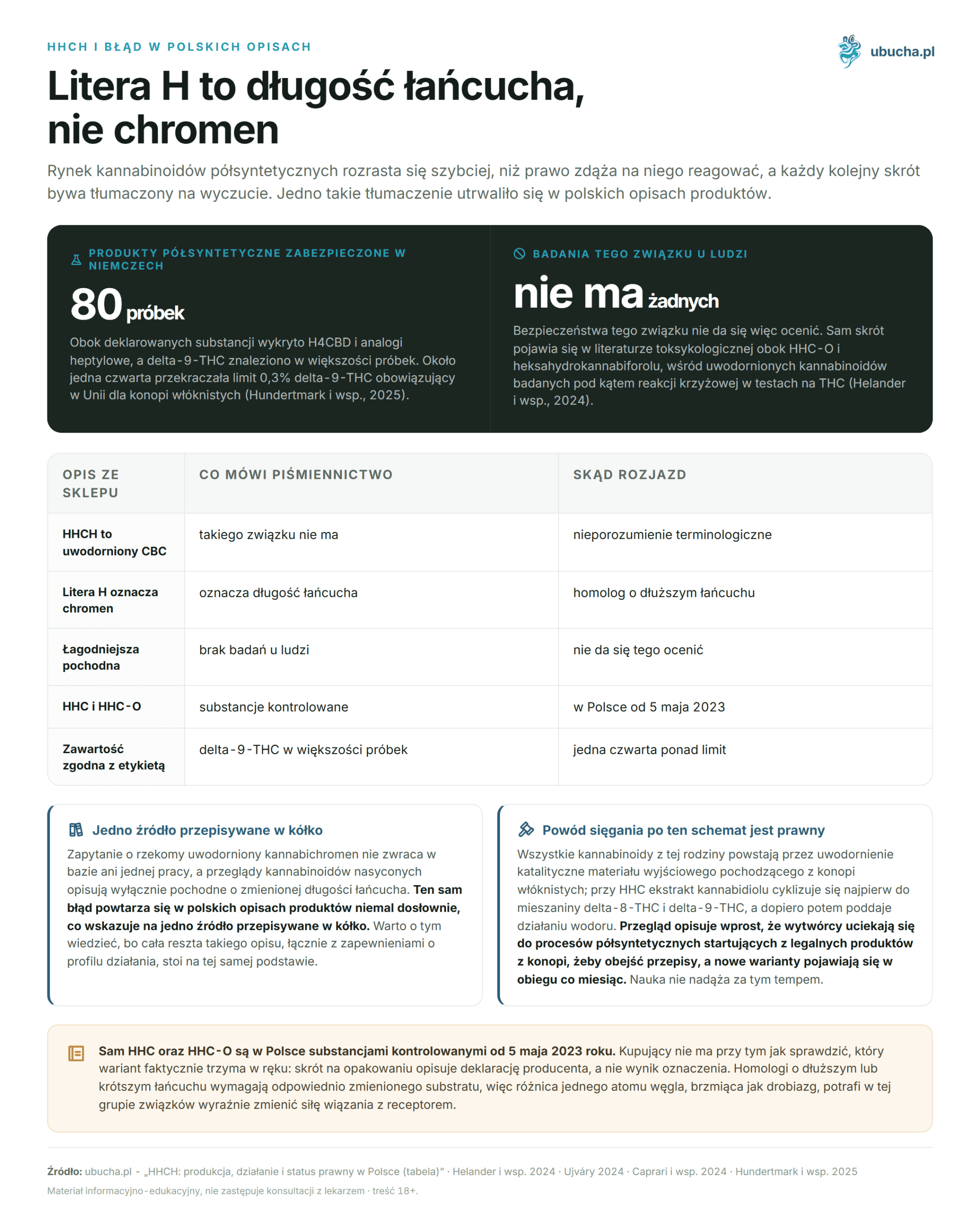
HHCH is hexahydrocannabihexol, a hydrogenated cannabinoid from the HHC family, in which the five-carbon side chain has been replaced with a six-carbon one. The abbreviation appears in toxicological literature alongside HHC-O and hexahydrocannabiforol, among hydrogenated cannabinoids studied for cross-reactivity in THC tests (Helander et al., Scandinavian Journal of Clinical and Laboratory Investigation, 2024). The name thus describes the length of the chain, not a different starting material.
Where did the misleading translation come from? The letter H at the end of the abbreviation is sometimes read as “chromene”, which is why HHCH is described as hydrogenated cannabichromene. A query for such a compound returns not a single paper in the Europe PMC database, and reviews of saturated cannabinoids describe only derivatives with altered chain lengths (Docampo-Palacios et al., Molecules, 2023). So if any store describes HHCH as a “milder derivative of CBC”, it is based on a terminological misunderstanding.
We have noticed that the same mistake is repeated in Polish product descriptions almost verbatim, suggesting one source being copied over and over. It is worth knowing this, as the rest of such a description, including assurances about the action profile, stands on the same basis. For comparison, the action of HHC itself has been gathered in a separate text about hexahydrocannabinol and its legal status.
How is HHCH and other HHC derivatives produced?
All cannabinoids from this family are produced in the same way: by catalytic hydrogenation of starting material derived from industrial hemp. In the case of HHC, the process is such that the cannabidiol extract is first cyclized to a mixture of delta-8-THC and delta-9-THC, and only then subjected to hydrogen in the presence of a metallic catalyst (Ujváry, Drug Testing and Analysis, 2024). Homologs with longer or shorter chains require appropriately modified substrates.
Producers resort to this scheme for purely legal reasons. A review dedicated to THC derivatives states directly that manufacturers resort to semi-synthetic processes starting from legal hemp products to circumvent regulations, and new variants appear in circulation every month (Caprari et al., Journal of Cannabis Research, 2024). Science cannot keep up with this pace, so for most of these abbreviations, there is not even basic pharmacology.
The scale of the discrepancy between the label and the content has been measured. In an analysis of 80 products with semi-synthetic cannabinoids secured in Germany, alongside the declared substances, H4CBD and heptyl analogs were also detected, and delta-9-THC was found in most samples, with about one quarter exceeding the 0.3% delta-9-THC limit applicable in the EU for industrial hemp (Hundertmark et al., Drug Testing and Analysis, 2025). Buyers have no way to check which variant they actually hold in their hands.
Is HHCH legal in Poland in 2026?
HHCH does not appear in the Polish list under its own name, but that does not mean it can be sold. A product containing a substance acting on the central nervous system, which can be used like a narcotic, and whose trade is not separately regulated, is a substitute in the sense of Article 4 point 27 of the Act on Counteracting Drug Addiction. The table below compares the status of the list for the entire family.
| Compound | Full name | Status in the Polish list | Basis |
|---|---|---|---|
| HHC | Hexahydrocannabinol | Controlled substance since May 5, 2023 | Dz.U. 2023 poz. 744 |
| HHC-O | Acetate of O-acetylhexahydrocannabinol | Controlled substance since May 5, 2023 | Dz.U. 2023 poz. 744 |
| HHCP | Hexahydrocannabiforol | New psychoactive substance since May 22, 2025 | Dz.U. 2025 poz. 598 |
| THCP | Tetrahydrocannabiforol | New psychoactive substance since May 22, 2025, delta-8 variant and acetate since July 28, 2026 | Dz.U. 2025 poz. 598, Dz.U. 2026 poz. 934 |
| HHCH | Hexahydrocannabihexol | Not in the list under its own name; product may be a substitute | Article 4 point 27 and Article 44b of the Act |
| H4CBD | Tetrahydrocannabidiol | Not in the list under its own name | list, status as of August 11, 2026 |
We checked the status of the list in the texts of regulations at the source, in the register eli.gov.pl, not in secondary studies. A broader comparison of HHC derivatives can be found in the entry about what is legal in Poland regarding HHC, HHC-O and THCP.
How does Polish law treat new psychoactive substances?
A new psychoactive substance is a closed category in Polish law, not a catch-all. Article 4 point 11a of the Act defines it as a substance acting on the central nervous system, other than a psychotropic substance and a narcotic, specified in executive regulations issued under Article 44f. In other words: a substance becomes a new psychoactive substance only when the Minister of Health adds it to the list (t.j. Dz.U. 2023 poz. 1939).
Therefore, HHC is not a new psychoactive substance, but a controlled substance from a separate list, while HHCP is, because it was precisely added to that annex. The penalties also differ. Possession of a new psychoactive substance is subject to a fine, and in the case of a significant amount, a fine, restriction of freedom, or imprisonment for up to 3 years (Article 62b). Production and trade for the purpose of illegal production of such substances are punishable by a fine and imprisonment for up to 5 years (Article 61).
For a compound not on the list, such as HHCH, a different mechanism applies. The production and marketing of a substitute is prohibited under Article 44b paragraph 1, and for its violation, Article 52a paragraph 1 provides for a monetary penalty from 20,000 PLN to 1,000,000 PLN, imposed by decision of the state sanitary inspector. The statement “it is not on the list, so it can be sold” is therefore a mistake that can cost the seller a six-figure amount.
What is known about the safety of HHCH?
The reliable answer is: nothing is known. There are no published clinical studies on humans for HHCH, no pharmacokinetic or toxicological data, and the compound appears in the literature mainly as an entry on lists of substances detected in products and samples. This is not editorial caution, but the state of the scientific database.
Even for the better-studied HHC, the picture is modest. A review of saturated cannabinoids states that the actions of HHC in humans have not been studied and the biological profile of this compound has not been established, despite data from cell cultures and several animal species (Docampo-Palacios et al., 2023). An in vitro study on cells with the human CB1 receptor showed that the 9R HHC epimer acts as a partial agonist with a potency five times lower than JWH-018, and S-configured epimers even weaker (Persson et al., Drug Testing and Analysis, 2025).
Transferring such results to HHCH would be an abuse. The length of the side chain affects the biological activity of the cannabinoid, so structural analogy does not replace measurement. Additionally, there is a risk of contamination from the catalytic process and a lack of any standardization of concentration. A review of THC derivatives calls this group a public health threat precisely due to unpredictable and unknown adverse effects (Caprari et al., 2024).
How does HHCH differ from HHC, HHCP and H4CBD?
All four abbreviations describe hydrogenated molecules, but they differ in two things: what has been hydrogenated and how long the side chain is. HHC has a five-carbon chain, HHCH a six-carbon chain, and HHCP a seven-carbon chain. H4CBD stands alongside this trio because it is derived from cannabidiol, not THC, and its full name is tetrahydrocannabidiol.
The length of the side chain is not a cosmetic detail. For tetrahydrocannabiforol, a natural cannabinoid with seven carbons in the chain, the affinity for the human CB1 receptor was Ki 1.2 nM, a level close to the strong full agonist CP55940 with Ki 0.9 nM (Citti et al., Scientific Reports, 2019). This shows how much one fragment of a molecule can change its strength.
The practical conclusion for the reader is that abbreviations from this family do not arrange in a scale of “milder, stronger”. Each has a separate profile, separate legal status, and a separate, usually zero, resource of research on humans. We separately described the hydrogenated derivative of cannabidiol in the entry about H4CBD and its legal status.
Frequently Asked Questions
What is HHCH?
HHCH, also written as HHC-H, is hexahydrocannabihexol: a hydrogenated cannabinoid from the HHC family, in which the side chain has six carbon atoms instead of five. The abbreviation appears in toxicological literature alongside HHC-O and hexahydrocannabiforol, among hydrogenated cannabinoids studied for cross-reactivity in screening tests for THC.
Is HHCH hydrogenated cannabichromene?
No. The query for “hexahydrocannabichromene” returns not a single paper in the Europe PMC database, and reviews of saturated cannabinoids describe only derivatives with altered side chain lengths. The description linking HHCH to cannabichromene is a terminological misunderstanding, repeated almost verbatim in Polish product descriptions.
Is HHCH legal in Poland?
HHCH does not appear in the list under its own name, but a product containing it may be a substitute in the sense of Article 4 point 27 of the Act on Counteracting Drug Addiction. The production and marketing of such a product is prohibited, and Article 52a paragraph 1 provides for a monetary penalty from 20,000 PLN to 1,000,000 PLN.
Is HHCP in the Polish list?
Yes. Hexahydrocannabiforol, designated as HHCP, was added to the list of new psychoactive substances on May 22, 2025, based on the regulation Dz.U. 2025 poz. 598. The same regulation included delta-9-tetrahydrocannabiforol, and the regulation Dz.U. 2026 poz. 934 added the delta-8 variant and acetate.
How is HHCH produced?
By catalytic hydrogenation of material derived from industrial hemp. In the case of HHC, the cannabidiol extract is first cyclized to a mixture of delta-8-THC and delta-9-THC, and then subjected to hydrogen in the presence of a metallic catalyst. Homologs with different chain lengths require appropriately modified substrates, but the scheme remains the same.
Is HHCH safe?
It is unknown. No clinical studies on humans or pharmacokinetic and toxicological data have been published for HHCH. Even for the better-studied HHC, the literature states that actions in humans have not been studied and the biological profile has not been established. Transferring results from one homolog to another has no basis.
If you are looking for hemp products outside the list of controlled substances and with real research backing, start with hemp oils available in the store at Bucha.
This article is for informational and educational purposes and does not constitute legal advice. The legal status described in the article is valid as of the date of publication: regulations regarding hemp may change. Before making a decision, consult a lawyer or current legal acts.
Author: Michał Waluk · Published: 2026-08-09 · Updated: 2026-08-11