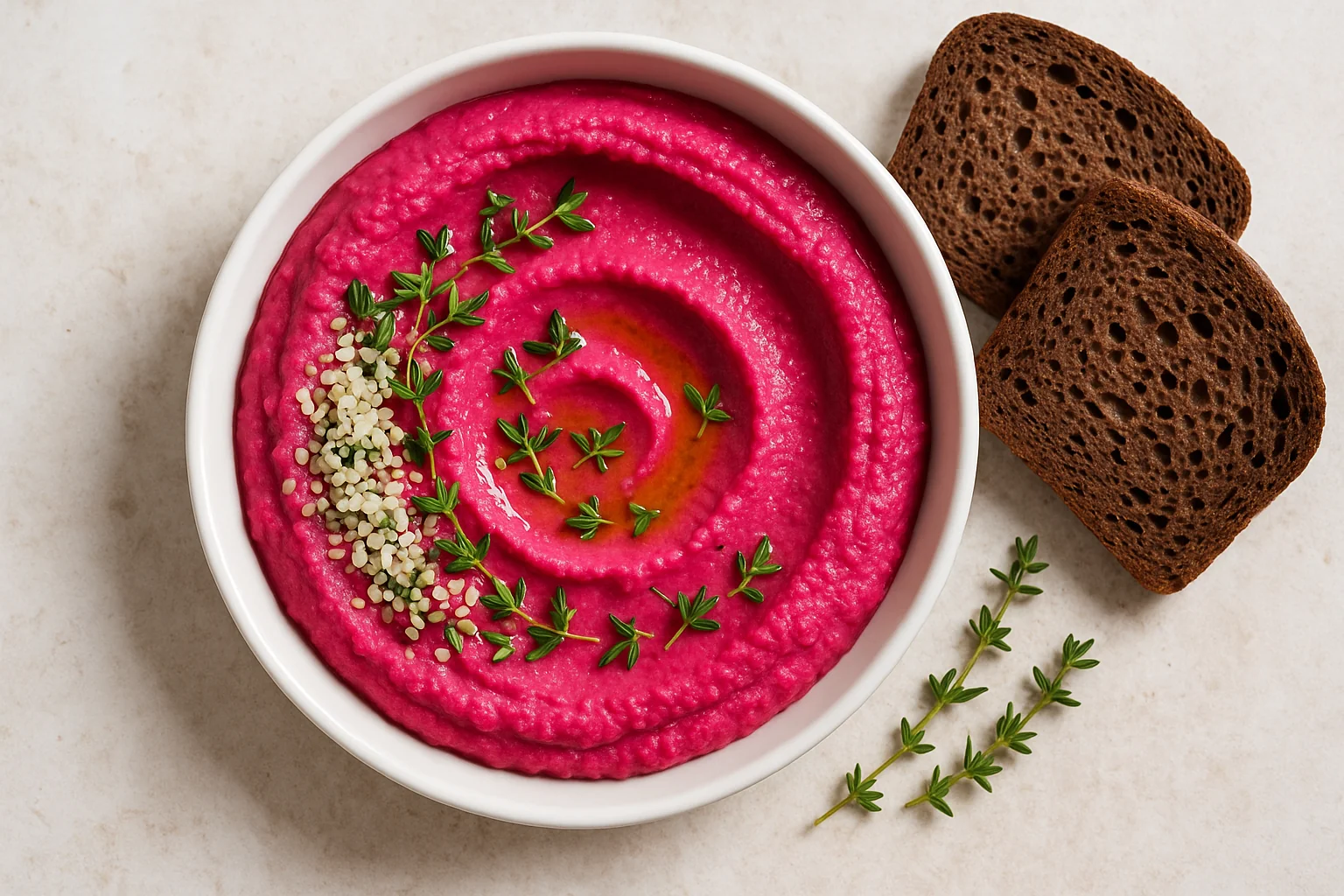

Beetroot Hummus with Hemp Seeds: The Pink Version of a Classic
Pink beetroot hummus with hulled hemp seeds. Proportions, order of actions, and calculated iron content per serving. Ready in fifteen minutes, no cooking.
The pink color draws attention on the table, but in this recipe, what is more interesting is what is not visible. Beetroot hummus with hemp seeds combines folates from beets, protein from chickpeas, and fats and iron from hulled hemp seeds. Beets are naturally sweet and earthy, so lemon and garlic must balance that flavor. Hemp seeds add nuttiness and increase the protein content of the entire bowl. Below you will find a step-by-step recipe, the calculated iron content per serving, and an explanation of why the color changes after cooling. You will also see which ingredient is really responsible for the iron here, because contrary to the name of the dish, it is not the beet, but two other elements from the same shopping list.
KEY INFORMATION
• Iron is primarily contributed by tahini and hemp seeds: 8.95 mg and 7.95 mg per 100 g compared to 0.79 mg in cooked beets (USDA FoodData Central: records 170189, 170148, 169146).
• Beets are responsible for folates: 80 µg per 100 g, which is about 20% of the daily requirement for an adult (USDA 169146).
• A meta-analysis of 16 studies involving 254 people showed a decrease in systolic blood pressure by 4.4 mm Hg after nitrates or beet juice (Siervo, J Nutr, 2013).
• The color comes from betalains and fades under heat, which is why we serve hummus cold.
What do beets and hemp seeds provide in combination?
Beets provide folates and nitrates, while hemp seeds provide fats and sulfur amino acids, which are lacking in chickpeas. USDA record 169146 states that cooked beets contain 80 µg of folates per 100 g, which is about one-fifth of the daily requirement for an adult. This is the only ingredient in this bowl that provides them in such quantity.
Nitrates from beets have a documented effect on blood pressure. A meta-analysis by Siervo et al. (J Nutr, 2013) included 16 studies with a crossover design and a total of 254 participants. After administering inorganic nitrates or beet juice, systolic blood pressure decreased by an average of 4.4 mm Hg, while the change in diastolic pressure did not reach statistical significance. The interventions lasted from two hours to fifteen days, so this study does not speak to long-term effects.
Supplementing amino acids works in one specific direction here, and it is worth remembering, as it is often described the other way around in recipes. Chickpeas have a lot of lysine and little sulfur amino acids: USDA record 173800 gives about 67 mg of lysine compared to 27 mg of methionine plus cysteine per gram. Hemp seeds are the mirror image, about 41 mg of lysine compared to 51 mg of sulfur amino acids (record 170148). It is the chickpeas that make up for the lysine that hemp lacks, not the other way around: House et al. (J Agric Food Chem, 2010) identified lysine as the first limiting amino acid in all studied hemp products.
The color is due to betalains, pigments with antioxidant properties. However, they are not exclusive to beets, as the same compounds are found in Swiss chard and amaranth.
How much iron and protein is in a serving of this hummus?
A 70 g serving, or two full tablespoons, contains about 1.4 mg of iron and about 5 g of protein. These numbers come from calculating the weights of the ingredients in this recipe based on values from the USDA FoodData Central database, not from measuring the finished dish, so treat them as approximations.
The breakdown is surprising. Of about 12 mg of iron in the entire bowl, more than two-thirds come from tahini and hemp seeds, while beets contribute less than 1.6 mg. The name of the dish suggests otherwise, but the beet is responsible in this recipe for color and folates, not for iron.
Iron from plants is non-heme, so it is absorbed less efficiently than that from meat. Vitamin C improves its absorption, and the juice from two tablespoons of lemon serves exactly that role in this recipe. This is a good reason not to skip it.
It is also worth honestly comparing this version with store-bought hummus. USDA record 174289 states that commercial hummus contains 2.54 mg of iron and 7.78 g of protein per 100 g, while our bowl comes out to about 1.96 mg and 7.1 g. Beets dilute the mixture with water, so the pink version is not nutritionally stronger than the classic one. It wins in color, folates, and nitrates.
Ingredients: what do you need?
Proportions for about 600 g of hummus, or six to eight servings. Preparation time with ready beets: fifteen minutes.
- 200 g of cooked or baked beets
- 1 can (400 g) of chickpeas, about 240 g after draining; keep the brine
- 5 tablespoons of hulled hemp seeds (3 for blending, 2 for topping)
- 3 tablespoons of tahini
- 2 tablespoons of extra virgin olive oil
- 2 tablespoons of fresh lemon juice
- 1 clove of garlic
- a pinch of ground cumin
- salt to taste
- 2-3 tablespoons of aquafaba for thinning
- for decoration: a tablespoon of oil and fresh thyme or parsley
Jarred beets shorten the work by an hour, but those in vinegar brine need to be rinsed thoroughly, as vinegar will dominate the flavor. Hemp seeds must be hulled: whole ones leave noticeable bits of hull in the smooth mixture.
Do not replace aquafaba with water. It is the brine from the canned chickpeas, thicker than water due to dissolved proteins and starch, and it gives the hummus its fluffiness. Water will thin the mixture but will not aerate it. If you are using chickpeas cooked yourself, drain and keep the cooking water: it works the same way.
How to prepare hummus step by step?
This recipe differs from classic hummus by one ingredient. The technique remains the same, only the amount of aquafaba changes, as beets bring their own moisture.
- Prepare the beets. Drain the ones from the jar and rinse under cold water. Cook fresh ones in their skins for about 45 minutes or bake wrapped in foil at 200°C for an hour, and after cooling, peel them. Baked ones are sweeter.
- Drain the chickpeas through a sieve set over a bowl to keep the aquafaba, and rinse the beans. If you have five minutes, squeeze each bean between your fingers and remove the skin: the mixture will turn silky.
- Put the chopped beets, chickpeas, tahini, oil, lemon juice, garlic, cumin, 3 tablespoons of hemp seeds, and salt into a food processor. Blend for 60 seconds. The mixture will be thick and intensely pink.
- Pour in the aquafaba tablespoon by tablespoon, blending continuously for 2 minutes. Start with two tablespoons. The finished mixture should flow slowly from the spoon, not drip.
- Taste and season. The sweetness of the beets balances the lemon juice, the salt sharpens the overall flavor, and the garlic adds spiciness. Adjust gradually, half a teaspoon at a time.
- Transfer the hummus to a wide bowl and make a well with the back of a spoon. Drizzle with oil, sprinkle with two tablespoons of hemp seeds and thyme leaves. Chill for 20 minutes before serving.
What variations are worth trying?
The sweetness of the beet can handle both acidity and spiciness, so there is plenty of room for changes:
- Variant with goat cheese: 30 g of crumbled cheese on the finished hummus. The acidity of the cheese balances the sweetness of the beets, and the white on the pink background looks impressive.
- Variant with horseradish: a teaspoon of grated horseradish added during blending. Horseradish and beet is a classic Polish combination, and the sharp accent breaks the sweetness.
- Variant with orange: orange juice instead of lemon plus a bit of zest. The profile becomes warmer and more wintery, especially with a pinch of cinnamon.
We noticed during testing that hummus made from roasted beets has a deeper and sweeter flavor than that made from boiled ones. Roasting evaporates water and caramelizes the sugars in the beet, which pushes the earthy note to the background. If you have an hour to spare, this is the best place to use it.
The version without beets is described in the recipe for classic hummus with hemp seeds. If you are preparing a table for a gathering, also check five hemp dips for a party or salad with beet, feta, and hemp oil.
Frequently Asked Questions
Where does the pink color of beetroot hummus come from?
From betalains, which are natural pigments of beets. Betanin retains its intensity in an acidic environment but fades under heat and high pH. Therefore, we serve hummus cold, and the lemon juice in the recipe works doubly: for flavor and color.
How much iron is in a serving of beetroot hummus with hemp seeds?
About 1.4 mg in a 70 g serving, calculated from the ingredient weights based on values from the USDA FoodData Central database. Most comes from tahini and hemp seeds, which records 170189 and 170148 attribute 8.95 mg and 7.95 mg per 100 g. Beets contribute the least.
Can you use jarred beets?
Yes, and they shorten preparation to ten minutes. Choose beets in water brine or rinse vinegar ones thoroughly, as acetic acid will dominate the flavor of the entire bowl. Baked beets provide a deeper flavor than any ready-made ones, so if you have time, choose them.
How long can beetroot hummus be stored?
Up to four days in an airtight container in the fridge. The color slightly fades after two days, but the flavor remains unchanged. Hemp seeds should be sprinkled on top just before serving, as they soften in the moist mixture within a few hours.
Is beetroot hummus healthier than classic hummus?
Not in terms of iron or protein. USDA record 174289 states that commercial hummus contains 2.54 mg of iron and 7.78 g of protein per 100 g, while the beet version comes out to about 1.96 mg and 7.1 g. The advantages of beets are folates, nitrates, and color.
Do hemp seeds contain THC?
Trace amounts can be detected, which is why the law sets an upper limit for them. Commission Regulation (EU) 2023/915, effective from May 25, 2023, allows for 3.0 mg of total delta-9-THC and THCA per kilogram in hemp seeds and products derived from them.
Hulled hemp seeds are not currently available in the store at Bucha. Among hemp food products, you will find hemp teas.
This article is for informational and educational purposes and does not replace consultation with a doctor. If you are pregnant, breastfeeding, taking medications, or have chronic conditions, consult the use of supplements or herbs with a specialist.
Author: Michał Waluk · Published: 2026-06-22 · Updated: 2026-08-16