
Vitamin K2 MK-7: what is really known and what is a myth about D3
Does vitamin D3 without K2 harm the arteries? We checked randomized studies in humans: there is no evidence for this. What K2 MK-7 really does and who cannot take it.
Most adults in Poland take vitamin D3 in winter, and increasingly often together with vitamin K2 MK-7. The justification has been circulating on the internet for years and always sounds the same: without K2, calcium released by D3 will deposit in the arteries instead of in the bones. We checked what this claim is based on. We reviewed interventional studies in humans, a meta-analysis with over 83,000 participants, and current Polish vitamin D supplementation guidelines. The popular thesis does not hold up. Below you will find what can be defended by data: what vitamin K2 does in the body, how MK-7 differs from MK-4, how much food provides it, and who cannot use it under any circumstances.
KEY INFORMATION
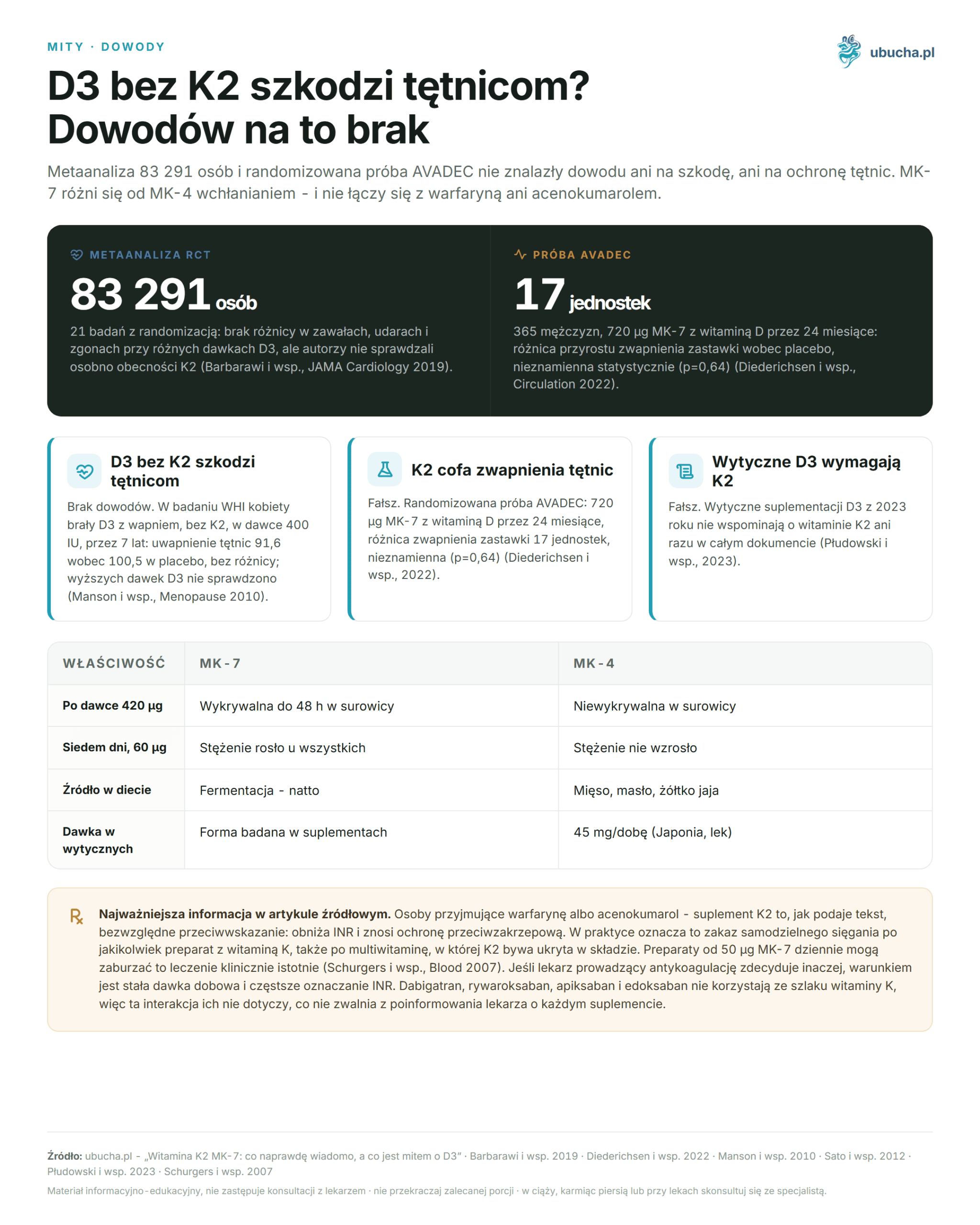
• Vitamin D supplementation did not increase the number of cardiovascular events in a meta-analysis of 21 randomized studies with 83,291 participants (Barbarawi et al., JAMA Cardiology 2019).
• In the AVADEC study, 720 µg MK-7 with vitamin D for 24 months did not slow down calcification of the valve or coronary arteries (Diederichsen et al., Circulation 2022).
• Polish vitamin D supplementation guidelines from 2023 do not mention vitamin K2 even once.
• Warfarin and acenocoumarol are absolute contraindications for K2 supplements.
Does vitamin D3 without vitamin K2 really harm the arteries?
There is no evidence for this in humans. No interventional study has been published in which vitamin D3 at recommended doses, given without K2, would increase arterial calcification or the number of heart attacks. The largest available compilation includes 21 randomized studies and 83,291 participants, and no difference is seen in any endpoint.
In this meta-analysis, the risk of serious cardiovascular events was 1.00 (95% CI 0.95-1.06), heart attack 1.00, stroke 1.06, cardiovascular death 0.98, and death from any cause 0.97 (Barbarawi et al., JAMA Cardiology 2019). The results were consistent regardless of the dose of vitamin D, the method of administration, and whether patients were simultaneously receiving calcium. The authors checked these factors in subgroups, not the presence of menaquinone, so the meta-analysis says nothing about whether adding vitamin K2 would change anything.
A more direct point: in the Women’s Health Initiative sub-study, 754 women took 1000 mg of calcium with 400 IU of vitamin D3 or placebo for an average of 7 years, after which their coronary artery calcification was measured tomographically. The average result was 91.6 compared to 100.5 in the placebo group, with no statistical difference (Manson et al., Menopause 2010). The doses were moderate, and no one studied 10,000 IU daily in this way, so the lack of evidence of harm is not the same as evidence of safety at any dose. But the claim circulating on the internet goes much further: it speaks of harm that has been demonstrated. It has not been.
What did the study show in which K2 was given with vitamin D?
It did not slow down vascular calcification. In a multicenter trial AVADEC, 365 men with an average age of 71 years, with advanced aortic valve calcification, were randomly assigned to 720 µg MK-7 with 25 µg of vitamin D daily or to placebo for 24 months. The increase in the calcification score was 275 units in the intervention group and 292 in the placebo group.
The difference of 17 units was not significant (p=0.64), nor were changes in valve area and flow velocity. Progression of aortic and coronary artery calcification also did not differ, nor did the number of valve surgeries, deaths, and cardiovascular events (Diederichsen et al., Circulation 2022). However, the most interesting detail is biochemical: the concentration of the inactive form of MGP protein decreased in the MK-7 group by 212 pmol/l, while in the placebo group it increased by 45. The biomarker acted exactly as the theory predicts. Calcification did not budge.
Analysis of coronary arteries in 304 participants without ischemic disease gave the same picture: an increase in score of 203 versus 254 units, p=0.089, which is a neutral result (Hasific et al., JACC Advances 2023). Two secondary outcomes were favorable: in the subgroup with initially high calcification, the difference exceeded the significance threshold, and safety events were less frequent in the supplementation group. The authors themselves describe both as hypotheses to be tested, not as conclusions. The caveat is fair: AVADEC compared MK-7 with vitamin D against placebo, not D3 alone against D3 with K2. However, it directly tested the mechanism on which the entire popular thesis is based.
Do Polish vitamin D supplementation guidelines require vitamin K2?
No. The update of Polish recommendations from 2023 does not mention vitamin K2, menaquinone, or MK-7 even once in the entire document. It describes doses of cholecalciferol according to age and body weight, principles of measuring 25(OH)D in at-risk groups, and upper safety limits.
The document was created under the editorship of Paweł Płudowski with a team of several dozen Polish scientific societies and was published in the journal Nutrients (Płudowski et al., 2023). A person who follows it and does not take K2 is not doing anything against the recommendations. If a supplement manufacturer presents vitamin K2 as a condition for the safety of vitamin D, it is not a quote from the guidelines.
It is worth distinguishing two things, as they can be confused. The European Food Safety Authority has allowed a health claim about the role of vitamin K in maintaining proper bone health, which manufacturers refer to; the authors of the cited study on MK-7 also remind of this. The claim concerns bones, not arteries, and says nothing about interaction with vitamin D3. We do not provide doses here as recommendations: it is the doctor or pharmacist who determines them based on the result of 25(OH)D and the medications taken. If you are looking for context for the entire supplementation after fifty, we described it in the post about supplements for sarcopenia in seniors.
What does vitamin K2 actually do in the body?
It activates vitamin K-dependent proteins. Vitamin K is a cofactor for gamma-glutamyl carboxylase, an enzyme that adds a carboxyl group to glutamic acid residues in these proteins. Without this reaction, osteocalcin in bones and MGP protein in the walls of blood vessels remain inactive and do not bind calcium ions.
MGP, or Matrix Gla Protein, is the strongest known inhibitor of calcium deposition in blood vessels. Its inactive form, marked as dp-ucMGP, serves as a laboratory indicator of low vitamin K supply. This biochemistry is well documented, and no one disputes it. The problem lies one level higher, where the indicator transitions to patient health.
In the prospective EPIC-NL study, dp-ucMGP was measured in baseline samples, and participants were followed for an average of 11.5 years. 1154 cases of coronary heart disease and 380 strokes were collected. The concentration of inactive MGP was not associated with the risk of coronary heart disease (HR for standard deviation 1.00; 95% CI 0.93-1.07) or stroke (HR 0.98) after adjusting for risk factors (Dalmeijer et al., Journal of Thrombosis and Haemostasis 2014). The authors stated directly that they did not confirm the association. The mechanism exists, but the causal chain to heart attack remains unclosed.
What is the difference between MK-7 and MK-4?
In the length of the side chain, and in practice, whether it even reaches the blood at a dose from the supplement. A direct comparison was made by Sato and colleagues in healthy Japanese women: after a single dose of 420 µg MK-7, the serum concentration peaked after six hours and was detectable even after 48, while MK-4 at the same dose did not appear in serum in any subject at any measurement point.
Seven days of taking 60 µg gave the same discrepancy: MK-7 concentration significantly increased in all, while MK-4 did not increase at all. The authors conclude that MK-4 present in food does not raise vitamin K supply measured by serum concentration (Sato et al., Nutrition Journal 2012). Separately, it was measured how MK-7 behaves with longer use: it accumulates to concentrations seven to eight times higher, gives more stable serum concentrations, and fully carboxylates osteocalcin than synthetic vitamin K1 (Schurgers et al., Blood 2007).
This does not mean that MK-4 is useless, only that in amounts found in supplements, it does not raise vitamin K levels in the blood. In the Japanese osteoporosis treatment guidelines from 2011, menatetrenone, or MK-4, is listed at a dose of 45 mg per day (Orimo et al., Archives of Osteoporosis 2012). This is a quantity hundreds of times greater than a typical drugstore capsule, so those results cannot be transferred to it.
Does vitamin K2 strengthen bones?
The data is ambiguous. In a three-year randomized study of 244 healthy postmenopausal women, a dose of 180 µg MK-7 daily improved vitamin K supply and slowed the age-related decline in lumbar spine and hip bone mineral density. There was no effect on the whole hip.
This study (Knapen et al., Osteoporosis International 2013) is the most frequently cited argument for MK-7. The same group of participants was used to assess arterial stiffness, where after three years, pulse wave velocity decreased, and inactive MGP halved (Knapen et al., Thrombosis and Haemostasis 2015). The vascular result comes from a separate publication from 2015, although it is sometimes attributed to the 2013 work. The preparation was the commercial MenaQ7, named directly in the publication, and both works and the above-mentioned comparison of K1 with MK-7 have common authors. AVADEC, with a hard endpoint and an independent team, weighs more in this comparison.
A broader picture is provided by a review of 36 randomized studies. In postmenopausal women and people with osteoporosis, the chance of clinical fracture was lower in vitamin K groups (OR 0.72; 95% CI 0.55-0.95), but after limiting the analysis to studies with low risk of error, the advantage disappeared (OR 0.76; 95% CI 0.58-1.01). No effect on vertebral fractures and bone density was found, and the authors summarized that the evidence is insufficient (Mott et al., Osteoporosis International 2019). The review was created partly because the reliability of some earlier evidence in this area has been questioned. More about supplementation during the perimenopausal period can be found in the post about supplements for women over 40.
Who cannot use vitamin K2?
People taking warfarin or acenocoumarol. These drugs work by blocking the epoxide reductase of vitamin K, which is the enzyme that regenerates its active form. The K2 supplement provides vitamin bypassing this enzyme, lowers INR, and negates anticoagulant protection. This is an absolute contraindication and the most important information in this entire text.
This is not a theoretical warning and has a specified magnitude. The authors of the comparison of K1 with MK-7 conclude their work with a note directed to hematologists: preparations providing 50 µg MK-7 daily or more may significantly clinically disrupt treatment with oral anticoagulants (Schurgers et al., Blood 2007). A typical drugstore capsule falls within this range or exceeds it.
In practice, this means a ban on independently reaching for any preparation with vitamin K, including a multivitamin in which K2 may be hidden in the composition. If the doctor managing anticoagulation decides otherwise, the condition is a constant daily dose and more frequent INR measurements. Fluctuations in vitamin K intake are a classic cause of result fluctuations and loss of control over treatment.
Newer generation drugs behave differently. Dabigatran inhibits thrombin, while rivaroxaban, apixaban, and edoxaban block factor Xa, none of which use the vitamin K pathway. This type of interaction does not apply to them, which does not exempt from informing the doctor about any supplement. A separate note concerns absorption: vitamin K2 is fat-soluble, so orlistat and cholestyramine limit it, while a meal with fat improves it. Pregnant and breastfeeding women and chronically ill individuals should discuss supplementation with a doctor before starting it.
How much vitamin K2 does food provide?
Definitely the most from natto, Japanese soy fermented by Bacillus subtilis. In a nutritional experiment, six healthy volunteers ate either 400 g of spinach or 200 g of natto; after natto, the concentration of vitamin K2 in the blood was about ten times higher than the K1 concentration after spinach. Besides natto, menaquinones are found in meat, liver, butter, egg yolk, and aged cheeses.
The base of the content of both vitamins in food was built by Schurgers and Vermeer (Haemostasis 2000), and the role of dairy and fermented foods was later summarized in a review in Advances in Nutrition; its authors note that the contribution of menaquinones to total vitamin K intake is still poorly calculated, although in many regions, dairy is often their main source (Walther et al., 2013). It is worth noting where the entire hypothesis came from. In the Rotterdam Study, 4807 people were observed from the turn of the years 1990-1993 to 2000, and in the highest tercile of menaquinone intake, the risk of coronary death was 0.43, death from any cause 0.74, and severe aortic calcification 0.48 compared to the lowest tercile (Geleijnse et al., Journal of Nutrition 2004). Vitamin K1 did not yield anything. Similarly, a cross-sectional study in 564 postmenopausal women showed the same results (Beulens et al., Atherosclerosis 2009). Both are observational, and menaquinones came from cheese, not capsules. People eating a lot of aged cheese differ from the rest of the population in many ways. When the same hypothesis was tested with random assignment to a supplement, the result was neutral.
Frequently Asked Questions
We have gathered the questions that most often arise regarding vitamin K2 MK-7 and its comparison with vitamin D3.
Do I need to take vitamin K2 with vitamin D3?
There are no guidelines or studies in humans that indicate this. The update of Polish vitamin D supplementation recommendations from 2023 does not mention vitamin K2 even once. No interventional study has been published in which vitamin D3 given without K2 would damage the vessels. Discuss the decision to combine both preparations with your doctor.
Does vitamin K2 reverse calcifications in the arteries?
A randomized study did not confirm this. In the AVADEC trial, 365 men received 720 µg MK-7 with vitamin D or placebo for 24 months. The increase in aortic valve calcification was 275 units compared to 292 in the placebo group, and the difference of 17 units was not significant (p=0.64). Calcifications of the aorta and coronary arteries also did not differ.
What is the difference between MK-7 and MK-4?
Absorption at doses found in supplements. After a single dose of 420 µg MK-7, it was detectable in serum even after 48 hours, while MK-4 did not appear in any of the subjects (Sato et al., Nutrition Journal 2012). MK-4 has documented effects only at a drug dose of 45 mg per day.
Can vitamin K2 be used with anticoagulant medications?
With warfarin and acenocoumarol, this is an absolute contraindication. These drugs block the epoxide reductase of vitamin K, while the supplement provides vitamin bypassing this enzyme, lowering INR and negating anticoagulant protection. NOAC drugs, such as dabigatran, rivaroxaban, apixaban, and edoxaban, do not act through the vitamin K pathway, so this interaction does not apply to them.
Can aged cheese replace natto as a source of K2?
Not in terms of quantity. After a serving of natto, the concentration of vitamin K2 in the blood was about ten times higher than the K1 concentration after a large serving of spinach (Schurgers and Vermeer, Haemostasis 2000). Aged cheeses and other dairy products remain the most important source of menaquinones in the European diet.
What do Polish guidelines say about vitamin K2 with D3 supplementation?
Nothing. The document by Płudowski and co-authors from 2023, published in the journal Nutrients, describes doses of cholecalciferol according to age and body weight and the principles of measuring 25(OH)D. The word menaquinone, the abbreviation MK-7, or any mention of vitamin K in any form does not appear throughout the text.
Preparations with vitamin K2 MK-7 and sets with vitamin D3 can be found in the supplements section in the store at Bucha.
This article is for informational and educational purposes and does not constitute medical advice. Before starting supplementation, consult your doctor, especially if you are taking medications regularly, are pregnant or breastfeeding, or have chronic illnesses.
Author: Michał Waluk · Published: 2026-05-29 · Updated: 2026-08-14