
Types of Eating Disorders - Can CBD Help in Treatment?
Anorexia, bulimia, BED, and ARFID in ICD-11, data on prevalence and mortality, and an honest review of what is unknown about CBD in these diseases.
Eating disorders are among the most dangerous mental illnesses, and anorexia nervosa is associated with a nearly sixfold higher risk of death than in the general population. At the same time, more and more content circulating on the internet suggests that CBD may be helpful. This article does two things at once. First, it organizes what types of eating disorders are distinguished by the ICD-11 classification and how often they occur. Second, it shows without embellishment what is known from research about cannabinoids in these diseases and what is not known at all. You will also find free helpline numbers and a description of signals that indicate it is worth consulting a specialist. To preempt conclusions: there is no clinical study that has demonstrated the effectiveness of CBD in treating anorexia, bulimia, or binge eating disorder.
KEY INFORMATION
• You need help now: 112 in case of life threat, 116 123 for adults, 116 111 for children and youth, 800 70 2222 in mental crisis. All free.
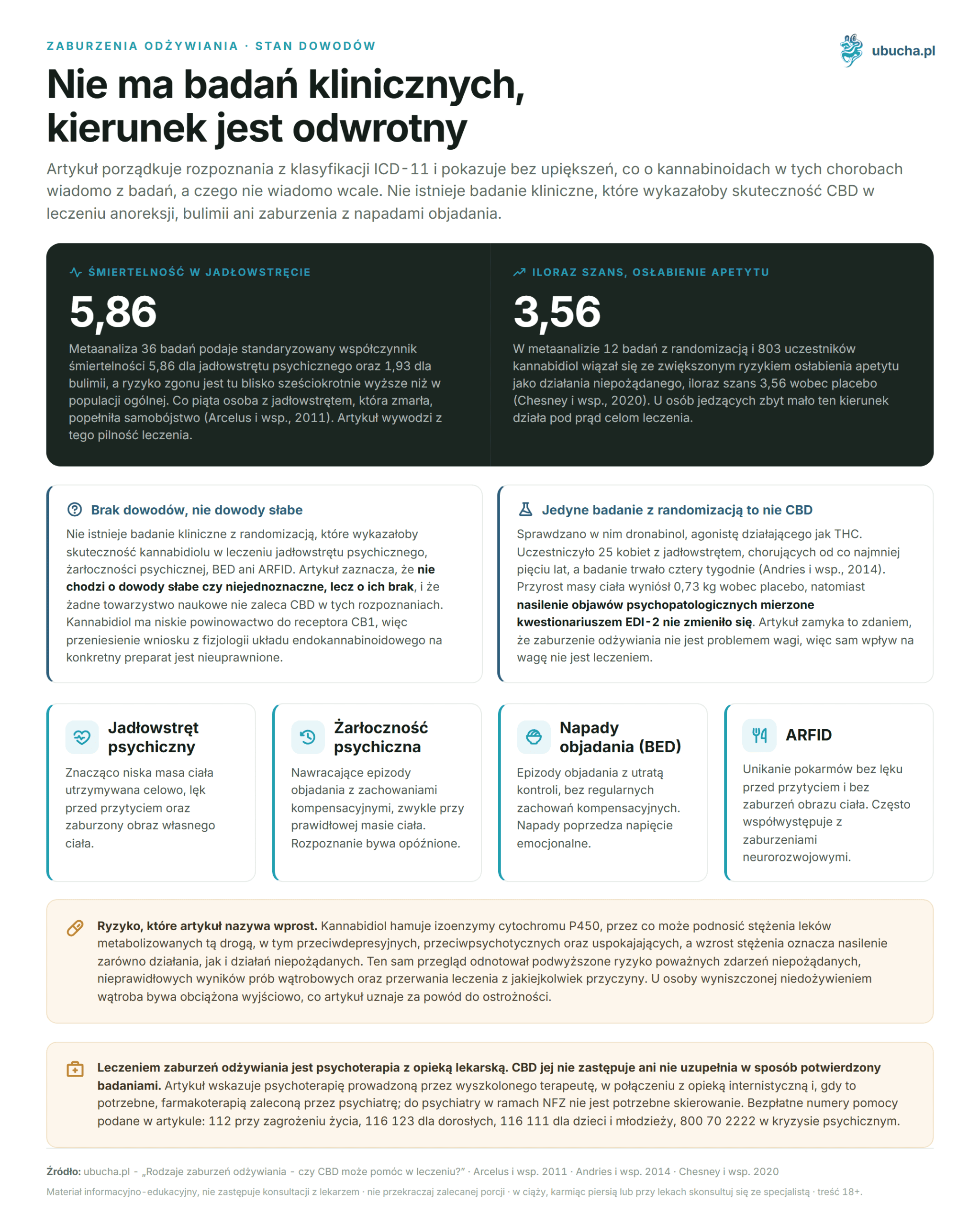
• Anorexia nervosa has a standardized mortality rate of 5.86, and one in five deaths in this group is suicide (Arcelus et al., 2011, PMID 21727255).
• Eating disorders affect 8.4 percent of women and 2.2 percent of men over their lifetime (Galmiche et al., 2019, PMID 31051507).
• There are no clinical studies on CBD in eating disorders. The only randomized study concerned dronabinol, an agonist of THC, and resulted in a weight gain of 0.73 kg compared to placebo without changing psychopathology (Andries et al., 2014, PMID 24105610).
• CBD is associated with an increased risk of appetite suppression as an adverse effect, with an odds ratio of 3.56 compared to placebo (Chesney et al., 2020, PMC7608221).
• Treatment of eating disorders involves psychotherapy with medical care. CBD does not replace or supplement it in a way confirmed by research.
What types of eating disorders are distinguished by ICD-11?
The ICD-11 classification of the World Health Organization, effective since 2022, describes feeding and eating disorders as a separate group of diagnoses. Three units dominate in clinical practice: anorexia nervosa, bulimia nervosa, and binge eating disorder. Alongside them, ARFID, pica, chewing disorder, and unspecified categories function.
| Diagnosis | Core Clinical Picture |
|---|---|
| Anorexia Nervosa | intentional food restriction, significantly low body weight, fear of gaining weight, distorted body image |
| Bulimia Nervosa | recurrent episodes of binge eating with compensatory behaviors, usually with normal body weight |
| Binge Eating Disorder (BED) | episodes of binge eating with loss of control, without regular compensatory behaviors |
| ARFID | avoidance or restriction of food without fear of gaining weight and without body image disturbances |
| Pica | persistent consumption of non-nutritive substances |
| Chewing Disorder | repeated regurgitation of food without effort, with re-chewing or spitting out |
A significant change from the older ICD-10 was the separation of BED and ARFID as full-fledged disease entities. Previously, they fell into the category of unspecified, which complicated both clinical research and treatment organization.
It is worth remembering that the diagnosis can be fluid. The same person may meet the criteria for different units in succession during the course of the illness, for example, transitioning from the restrictive form of anorexia to a bulimic picture. Therefore, the diagnosis is made based on the current clinical picture, not a one-time label from years ago.
How often do eating disorders occur?
A systematic review by Galmiche et al. from 2019, covering studies from 2000-2018, states that over a lifetime, eating disorders affect an average of 8.4 percent of women and 2.2 percent of men. The data also shows a clear upward trend over time.
This trend is directly calculated in this work. The weighted average point prevalence increased from 3.5 percent in the period 2000-2006 to 7.8 percent in the period 2013-2018, thus doubling over a few years. The authors call this a real public health challenge.
Separate data concern individual diagnoses. A review by van Eeden et al. (2021, PMC8500372) indicates that the lifetime prevalence of anorexia nervosa reaches 4 percent among women and 0.3 percent among men, while bulimia nervosa is 3 percent and over 1 percent, respectively. The authors note two opposing trends: the incidence of anorexia is increasing among those under fifteen years of age, while the overall incidence of bulimia is decreasing over time.
A population study by Udo and Grilo (2018, PMC6097933), conducted on a sample of 36,306 adult Americans according to DSM-5 criteria, gives lower values: the lifetime prevalence was 0.80 percent for anorexia, 0.28 percent for bulimia, and 0.85 percent for BED. The difference from the reviews arises from the method of diagnosis and the studied population. The chances of diagnosis were significantly higher in all three units among women than among men.
What characterizes anorexia nervosa?
Anorexia nervosa involves long-term, intentional restriction of food intake, leading to significantly low body weight. It is accompanied by intense fear of gaining weight and distorted perception of one’s body, which persists despite objective physical deterioration.
ICD-11 distinguishes a restrictive form, based on food restriction and excessive physical activity, and a form with episodes of binge eating and compensatory behaviors. The disease most often manifests during adolescence, but it can be diagnosed in both children and adults of any age.
Somatic consequences include amenorrhea, bradycardia, hypothermia, dry skin, and electrolyte disturbances. The refeeding syndrome, occurring at the beginning of treatment, is also a threat in itself, which is why the nutrition of a malnourished patient is conducted under medical supervision, not independently at home.
However, the most serious issue is mortality. A meta-analysis by Arcelus et al. (2011, PMID 21727255), covering 36 studies, showed 5.1 deaths per 1000 person-years of observation in anorexia nervosa. The standardized mortality rate was 5.86 for anorexia, 1.93 for bulimia, and 1.92 for unspecified disorders. One in five people with anorexia who died committed suicide. These data underscore the urgency of treatment.
How to recognize bulimia nervosa?
Bulimia nervosa involves recurrent episodes of uncontrolled binge eating, followed by compensatory behaviors. These include self-induced vomiting, misuse of laxatives or diuretics, fasting, and exhausting physical exercise.
Diagnosis can be delayed because body weight usually remains within normal limits or is only slightly elevated. Therefore, the environment does not see the signal that is obvious in anorexia. The disease is also actively hidden, as episodes are accompanied by shame and guilt.
An episode of binge eating is described as consuming a quantity of food clearly larger than typical in similar circumstances, with a sense of loss of control. Afterward, tension builds, which compensatory behavior temporarily alleviates. This closes the mechanism that sustains the disease.
Complications mainly arise from vomiting and electrolyte disturbances:
- hypokalemia, threatening heart rhythm disturbances;
- enamel erosion due to contact with stomach acid;
- enlargement of the parotid glands;
- irritation and damage to the esophagus;
- menstrual disturbances.
The review by van Eeden et al. reminds us that bulimia is also associated with an increased risk of death, although lower than in anorexia. A meta-analysis by Arcelus et al. determined the standardized mortality rate in bulimia to be 1.93, which is nearly twice as high as in the general population. Therefore, a normal body weight is not a sign of safety.
What is binge eating disorder?
Binge Eating Disorder (BED) involves recurrent episodes of binge eating with loss of control, without regular compensatory behaviors. It is precisely this absence that distinguishes it from bulimia and causes some individuals to experience weight gain over time.
In the study by Udo and Grilo, BED turned out to be the most common of the three main diagnoses among adult Americans, with a lifetime prevalence of 0.85 percent and a twelve-month prevalence of 0.44 percent. The diagnosis was introduced into the main classification relatively recently, so awareness of its existence can be low even among those suffering from it.
Binge eating episodes in BED are strongly associated with emotional regulation. A systematic review by Leehr et al. (2015, PMID 25530255) analyzed emotional regulation models in BED and obesity and indicated emotional tension as a precursor to episodes. Eating serves as a means of immediate relief rather than a response to physiological hunger.
The consequence can be a misguided path to help. A person with BED first goes to a dietitian or an obesity treatment clinic, where the focus is on weight rather than the mechanism of episodes. Psychiatric diagnosis appears only after a series of ineffective interventions, which delays proper treatment by years.
What is ARFID?
ARFID, or Avoidant/Restrictive Food Intake Disorder, describes individuals who eat too little or a very narrow range of products, but not due to fear of gaining weight. The absence of body image disturbances fundamentally distinguishes them from anorexia.
The reasons for avoidance can vary. For some, it is fear of choking or vomiting, often after a distressing experience. For others, sensory hypersensitivity to texture, smell, or appearance of food predominates. It can also be that food simply does not evoke interest and is easily forgotten.
A review by Bourne et al. (2020, PMID 32283448) included 78 publications from 14 countries and confirmed the validity of distinguishing ARFID as a separate entity. The authors also note that understanding this disorder remains limited in all studied areas, from diagnostics to treatment outcomes. ARFID often co-occurs with neurodevelopmental disorders.
The consequences can be serious despite the lack of a weight loss motive. These include nutritional deficiencies, stunted growth in children, and dependence on industrial nutrition. Treatment is conducted differently than in anorexia, as working on body image is not the starting point here.
How does the endocannabinoid system relate to eating?
The endocannabinoid system consists of CB1 and CB2 receptors, endogenous ligands such as anandamide, and enzymes regulating their concentration. It is involved in controlling food intake, experiencing pleasure from eating, and the body’s energy balance.
A review by Scherma et al. (2014, PMID 23829365) gathered preclinical neurochemical and behavioral data indicating the role of this system in eating disorders. It is worth noting that these are mostly animal studies and cell material, not clinical studies.
The most frequently cited result involving humans comes from Monteleone et al. (2005, PMID 15841111). It measured anandamide levels in plasma in 15 women with anorexia, 12 with bulimia, 11 with BED, and 15 healthy controls. Anandamide levels were elevated in both anorexia and BED, while in bulimia, they did not differ from the control group. An inverse relationship between anandamide and leptin was also noted.
This direction is often presented in popular texts as a decrease in anandamide in anorexia. The source work states the opposite, and the difference matters because it invalidates the simple reasoning that since the endocannabinoid system is weakened in anorexia, its stimulation will restore appetite. The authors themselves emphasize that the physiological significance of this change requires further research.
Does CBD treat eating disorders?
No. There is no randomized clinical study that has demonstrated the effectiveness of cannabidiol in treating anorexia nervosa, bulimia, BED, or ARFID. It is not about weak or ambiguous evidence, but about its absence. No scientific society recommends CBD for these diagnoses.
This answer requires elaboration because seemingly logical reasoning appears in advertising content. Since the endocannabinoid system regulates appetite, and cannabinoids act on it, it seems that they should help. The problem is that CBD has low affinity for the CB1 receptor and does not stimulate appetite like THC. Transferring conclusions from the physiology of the system to a specific preparation is unwarranted here.
Separately, it is necessary to distinguish treating the disease from alleviating accompanying symptoms. Anxiety, tension, and insomnia often coexist with eating disorders. There are indications that CBD affects anxiety, described in a review by Blessing et al. (2015, PMC4604171), and observations regarding sleep from a series of cases by Shannon et al. (2019, PMC6326553). However, none of these studies included individuals with eating disorders. More about the state of evidence in these areas can be found in posts about CBD and THC in anxiety states and CBD for insomnia.
The practical conclusion is this: none of these indications justify using CBD instead of treatment. Eating disorders are treated with psychotherapy conducted by a trained therapist, combined with internal medicine care and, when necessary, pharmacotherapy prescribed by a psychiatrist.
What do studies show about cannabinoids in these diseases?
The only randomized study that examined a cannabinoid in individuals with eating disorders concerned dronabinol, a synthetic agonist of cannabinoid receptors acting like THC. CBD was not studied in it. The result was positive but very modest.
| Study | What it concerned | Result and limitation |
|---|---|---|
| Andries et al., 2014 (PMID 24105610) | dronabinol in 25 women with long-term anorexia, 2.5 mg twice daily for 4 weeks | weight gain of 0.73 kg compared to placebo; EDI-2 questionnaire results unchanged; the substance is THC, not CBD |
| Monteleone et al., 2005 (PMID 15841111) | anandamide concentration in plasma in anorexia, bulimia, and BED | elevated anandamide in anorexia and BED; observational study, no intervention |
| Blessing et al., 2015 (PMC4604171) | CBD and anxiety | indications for anxiolytic action; no participation of individuals with eating disorders |
| Shannon et al., 2019 (PMC6326553) | CBD and anxiety and sleep | case series, the weakest level of evidence; no control group and randomization |
The study by Andries et al. is worth reading carefully, as it is often cited as an argument for cannabinoids in anorexia. It involved 25 women who had been ill for at least five years, in an alternating scheme with placebo. The weight gain was 0.73 kg above placebo over four weeks and was statistically significant. The severity of psychopathological symptoms measured by the EDI-2 questionnaire did not change.
This distinction is the most important here. The cannabinoid contributed a small weight gain but did not address what constitutes the essence of the disease: fear of gaining weight, distorted body image, or the compulsion to control eating. An eating disorder is not a weight problem, so the mere impact on weight is not treatment.
Separately, it is worth addressing cannabigerol, as it is sometimes presented as a milder alternative to CBD for tension. The work by Navarro et al. (2018, PMC6021502) describes CBG as a partial agonist of the CB2 receptor, also acting on the CB1 receptor. However, these were studies conducted on cell lines and concerned the pharmacology of the receptors themselves, not the treatment of any disease. No studies on CBG in individuals with eating disorders have been conducted, so descriptions attributing it calming effects in this group go beyond the available data.
Why can CBD be harmful in eating disorders?
The risk is specific and arises from the best available safety analysis. A meta-analysis by Chesney et al. (2020, PMC7608221) included 12 randomized studies and 803 participants. It showed that cannabidiol is associated with an increased risk of appetite suppression as an adverse effect, with an odds ratio of 3.56 compared to placebo.
In the context of anorexia or ARFID, it is hard to imagine a worse adverse effect profile. A substance advertised as support for those eating too little was found in studies to reduce appetite more often than placebo. The same review noted an increased risk of serious adverse events, abnormal liver function tests, and treatment discontinuation for any reason.
The second group of threats concerns interactions with medications. Cannabidiol inhibits cytochrome P450 isoenzymes, which may increase the concentrations of drugs metabolized this way. For individuals being treated for eating disorders, this includes antidepressants, antipsychotics, and sedatives. An increase in drug concentration means an intensification of both its effects and adverse effects.
The third issue is the liver. In the review by Chesney et al., abnormal liver function tests were mainly observed in studies on childhood epilepsy, where cannabidiol was administered alongside other antiepileptic drugs, at doses of around 20 mg per kilogram of body weight, as in the study by Thiele et al. (2018, PMID 29395273). However, in a malnourished individual, the liver may already be burdened, which is a reason for caution, not for trivialization. Depression co-occurring with an eating disorder requires separate treatment, which we discuss in more detail in the post about cannabis and depression.
Where to seek help in Poland?
The quickest way is by phone. Crisis lines operate for free, do not require a referral or registration, and the conversation is anonymous. If the situation threatens life, for example, in case of fainting, heart rhythm disturbances, or suicidal thoughts, call 112.
- 112 in case of immediate life or health threat;
- 116 123 is a free crisis hotline for adults;
- 116 111 is a free hotline for children and youth;
- 800 70 2222 is the Support Center for people in a mental crisis;
- your primary care physician will assess your somatic condition and guide you further;
- you do not need a referral to see a psychiatrist under the NFZ.
Signals that indicate it is worth seeking help do not have to be dramatic. They include rapid weight loss, avoiding shared meals, eating in secret, signs of vomiting, persistent discussions about calories and weight, exercising despite exhaustion or injury, loss of menstruation, and increasing withdrawal from contacts.
Many people postpone treatment, believing that their situation is not yet serious enough. This belief in itself can be a symptom of the disease. You do not need to meet any criteria to call and talk. If eating has become a source of suffering, that is a sufficient reason to ask for help. We describe the experiences of people with other psychiatric diagnoses in the material about CBD and bipolar disorders.
Summary
Eating disorders are a group of serious mental illnesses with high mortality, in which anorexia nervosa occupies a special place. The ICD-11 classification distinguishes bulimia, BED, ARFID, and rarer categories alongside it, and the diagnosis can change during the course of the illness.
The answer to the question in the title is negative, and it is worth remembering it in this form. There are no clinical studies showing that CBD helps in the treatment of eating disorders. The only randomized study concerned another substance, dronabinol, and resulted in weight gain without affecting psychopathology. Moreover, cannabidiol is associated in meta-analyses with an increased risk of appetite suppression, which works against the treatment goals in this patient group.
Effective treatment is based on psychotherapy, internal medicine care, and, when necessary, pharmacotherapy conducted by a psychiatrist. The earlier it starts, the easier it is to conduct, and postponing decisions due to shame is a common element of the disease itself. If you are considering any over-the-counter preparation, tell your doctor instead of making the decision independently. In a crisis, call 116 123 or 112.
Frequently Asked Questions
Can CBD treat anorexia or bulimia?
No. There is no randomized clinical study demonstrating the effectiveness of cannabidiol in eating disorders, and no scientific society recommends it for these diagnoses. Treatment involves psychotherapy combined with medical care, and if necessary, pharmacotherapy prescribed by a psychiatrist.
Does CBD stimulate appetite?
Data suggests rather the opposite. In a meta-analysis by Chesney et al. from 2020, which included 12 randomized studies and 803 participants, cannabidiol was associated with an increased risk of appetite suppression as an adverse effect, with an odds ratio of 3.56 compared to placebo. THC stimulates appetite, not CBD.
Has any cannabinoid been studied in anorexia?
Yes, dronabinol, which is an agonist acting like THC. In a study by Andries et al. from 2014, 25 women with long-term anorexia nervosa took 2.5 mg twice daily for four weeks. A weight gain of 0.73 kg was achieved compared to placebo, with no change in the severity of psychopathological symptoms.
Does CBD interact with psychiatric medications?
Yes. Cannabidiol inhibits cytochrome P450 isoenzymes, so it may increase the concentrations of drugs metabolized this way, including antidepressants, antipsychotics, and sedatives. For a person being treated for an eating disorder, this means a real risk of increased adverse effects. Inform your doctor before use.
How to recognize an eating disorder in a loved one?
Pay attention to avoiding shared meals, eating in secret, signs of vomiting, persistent discussions about weight and calories, exercising despite exhaustion, and rapid weight changes. A normal weight does not exclude anything, especially in bulimia. If in doubt, contact your family doctor.
Where to call for help in Poland?
In case of immediate life threat, call 112. The free crisis hotline for adults is 116 123, for children and youth 116 111, and the Support Center for people in mental crisis operates at 800 70 2222. You do not need a referral to see a psychiatrist under the NFZ.
This article is for informational and educational purposes and does not constitute medical advice. Before starting to use cannabis or CBD for therapeutic purposes, consult your doctor, especially if you are taking other medications, are pregnant, or breastfeeding.
Author: Michał Waluk · Published: 2026-05-04 · Updated: 2026-08-10