
Depression and Cannabis: How CBD Can Support Treatment and Why It Does Not Replace It
What is known about CBD in depression, why the largest study pointed to THC instead of CBD, how the risk of drug interactions looks, and where to seek help in a crisis.
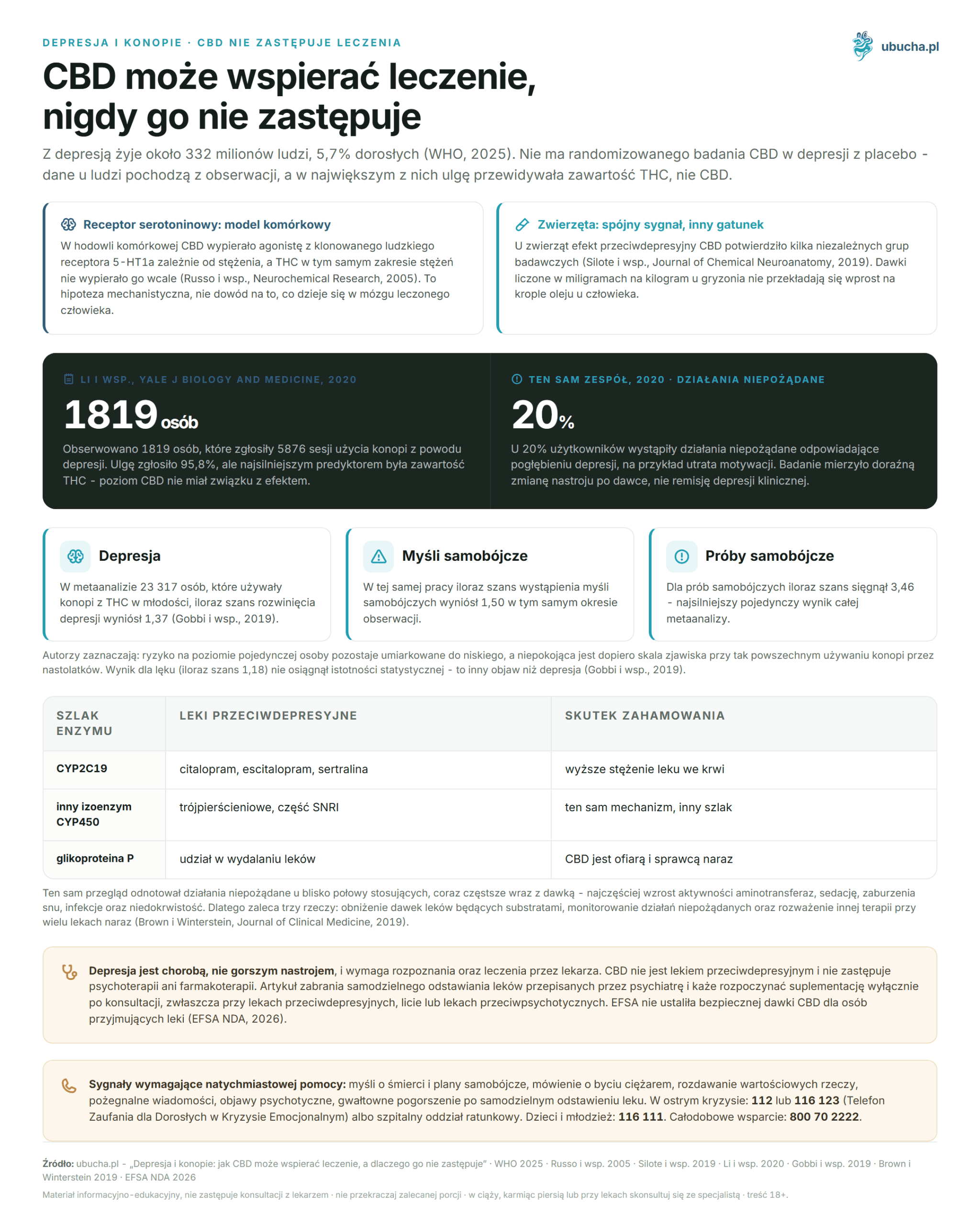
Depression is one of the most common diseases worldwide: about 332 million people live with it, which is 5.7% of adults, and in 2021, 727 thousand people died by suicide (“Depression fact sheet”, WHO, 2025). Given this scale and psychiatric waiting lists, it is easy to understand why people look for something available without a prescription. CBD seems like a good candidate: the mechanism can be explained, animal studies are consistent, and the product is on the shelf. This article examines what this means for humans, not mice. We also show what the most frequently cited human study really demonstrated, where EFSA set the safety limit, and why the order of actions in depression never changes.
KEY INFORMATION
• About 332 million people live with depression, i.e., 5.7% of adults (WHO, 2025).
• No randomized CBD study in depression with placebo group; human data come from observations.
• In the largest observational study, relief was predicted by THC content, and CBD level was unrelated to effect (Li et al., 2020).
• EFSA has not established a safe CBD dose for people taking medications (EFSA NDA, 2026).
Important medical information. Depression is a disease, not just a bad mood, and requires diagnosis and treatment by a doctor. CBD is not an antidepressant and does not replace psychotherapy or pharmacotherapy. If you have suicidal thoughts, plans, or are in an acute crisis, call 112 or 116 123, the Adult Emotional Crisis Helpline, or go to an emergency department. Do not discontinue prescribed medications on your own and do not start supplementation without consultation, especially if you take antidepressants, lithium, or antipsychotics.
What is clinical depression and how does it differ from a bad mood?
Clinical depression is a disorder in which low mood or anhedonia lasts at least two weeks and, along with somatic symptoms, impairs a person’s ability to function normally. The DSM-5-TR classification requires at least five of nine symptoms during this time, one of which must concern mood or loss of pleasure (American Psychiatric Association, 2022).
Other symptoms include sleep disturbances, appetite and weight changes, psychomotor retardation or agitation, fatigue, feelings of worthlessness, concentration difficulties, and thoughts of death. Reading them shows why depression is often confused with fatigue: most symptoms are physical, not emotional.
The ICD-11 classification, which replaced the previous version in 2022, divides the disease into single depressive episode, recurrent depressive disorder, and dysthymic disorder, i.e., chronic low mood lasting at least two years. The episode is further described as mild, moderate, or severe, with or without psychotic symptoms. This is not an academic division: severity determines whether treatment is by a family doctor or psychiatrist and whether hospitalization is needed.
Sadness reaction to loss or disappointment is normal and does not meet depression criteria. The difference is duration, depth, loss of function, and whether the person can still enjoy anything. If low mood, lack of energy, and withdrawal last more than two weeks and impair work or relationships, it is a signal to contact a doctor, not to buy a supplement.
| Form | What distinguishes it |
|---|---|
| single depressive episode | first episode, classified as mild, moderate, or severe |
| recurrent depressive disorder | subsequent episodes separated by remission periods |
| dysthymic disorder | chronic low mood lasting at least two years |
Who is most affected by depression?
The distribution of cases is uneven. According to the latest WHO estimates, depression affects 5.7% of adults, with 4.6% in men and 6.9% in women. This gender difference repeats worldwide and was calculated in two meta-analyses covering representative national samples.
The depression diagnosis analysis collected data from 65 datasets including over 1.7 million people from more than ninety countries. The odds ratio was 1.95, meaning women’s risk was nearly twice as high. The difference appears earlier than thought, already at age twelve, peaking during adolescence with an odds ratio of 3.02 for ages 13-15. The authors added a warning often forgotten: the scale of difference does not mean depression in men should be overlooked (Salk et al., Psychological Bulletin, 2017).
We use national data cautiously. The representative study of mental disorder prevalence in Poland is EZOP II, conducted by the Institute of Psychiatry and Neurology, with results presented at a 2021 conference (EZOP II). Media-circulated percentages are cited in several versions, none directly confirmed in study documents, so we do not repeat them here.
It is worth remembering something statistics do not show. In men, depression more often presents as irritability, withdrawal, and alcohol use, so it is diagnosed later. This is not a different disease, just a different presentation.
How is depression diagnosed and why can’t it be self-diagnosed?
A doctor makes the diagnosis based on examination; questionnaires serve only for screening and tracking changes over time. The best-validated screening tool is the PHQ-9 scale. In a meta-analysis of individual data from 58 studies including 17,357 people and 2312 depression diagnoses, a score threshold of 10 or higher gave the best combination of sensitivity 0.88 and specificity 0.85 against structured clinical interviews (Levis et al., BMJ, 2019).
The same work shows why online results can be misleading. Sensitivity was clearly lower when the reference was fully structured interviews designed for non-clinicians. In other words, the tool works well when a doctor is alongside.
The second reason is practical. Before diagnosing depression, somatic causes with similar symptoms must be excluded: hypothyroidism, anemia, vitamin D and B12 deficiencies, sleep apnea, and medication effects. Standard panels include blood count, TSH, electrolytes, glucose, liver and kidney tests. None of these can be done by questionnaire.
There is a third, most serious reason. Differentiating recurrent depression from bipolar disorder requires a lifetime patient history, and mistakes at this level change treatment entirely. The same applies to trauma-related disorders and depression masked by physical symptoms. Therefore, filling out an online test can prompt a visit but never replace it.
How does the endocannabinoid system regulate mood and stress response?
The endocannabinoid system is a network of CB1 and CB2 receptors, endogenous ligands (anandamide and 2-AG), and enzymes that produce and degrade them. Its link to mood runs through the stress axis. In many research paradigms, stress lowers anandamide and raises 2-AG levels, and chronic stress reduces CB1 receptor numbers in almost every brain region studied.
The action direction is well described. Anandamide decrease contributes to the stress response, including hypothalamic-pituitary-adrenal axis activation and increased anxiety behaviors, while 2-AG increase participates in extinguishing and adapting this axis. Translational studies show the system regulates the same areas in humans, and signaling disturbances may contribute to depression and PTSD susceptibility (Morena et al., Neuropsychopharmacology, 2016). The PTSD aspect is discussed separately in the post on PTSD and treatment support.
The second mechanism involves serotonin. In a cell culture study, CBD displaced an agonist from cloned human 5-HT1a receptor dose-dependently and acted as an agonist, increasing GTP-gamma-S binding and lowering cyclic AMP. THC at the same concentrations did not displace the agonist. The authors described CBD affinity as moderate (Russo et al., Neurochemical Research, 2005).
This is the entire mechanistic basis for the hypothesis of CBD’s antidepressant action. It is worth noting what it is not: a description of what happens in the brain of a treated human. Receptor in a dish and patient in a clinic are two different levels of evidence.
What do preclinical studies say about CBD as an antidepressant?
In animals, the signal is surprisingly consistent. The team that first showed CBD efficacy in 2010 in models predicting antidepressant action summarized a decade later: several independent groups confirmed the result, and newer studies indicate CBD produces both rapid and sustained effects (Silote et al., Journal of Chemical Neuroanatomy, 2019).
CBD pharmacology is complex. The molecule interacts simultaneously with several neurotransmission systems linked to depression: serotonergic, glutamatergic, and endocannabinoid. At the cellular level in animals, increased BDNF levels and enhanced synaptogenesis in the medial prefrontal cortex, as well as increased hippocampal neurogenesis, were described.
The latter is interesting because it touches on the puzzle of classical drugs. Serotonin reuptake inhibitors raise synaptic serotonin within hours, but mood improvement comes after weeks. The best explanation is that the drug acts through slow structural changes in the hippocampus. If CBD triggers the same processes faster, it would be an argument for further research, not self-treatment.
Limitations are exactly as with any animal model. Behavioral tests measure single depression components, e.g., loss of reward interest, not the full symptom complex with guilt and suicidal thoughts. Milligram-per-kilogram doses in rodents do not directly translate to oil drops, and internet conversions usually lack support from any published study.
What do clinical studies of CBD in human depression show?
The picture is much thinner than online suggests. The translational review by Crippa describes CBD as anxiolytic, antipsychotic, and neuroprotective, listing depression among conditions under study. The authors state that answers will come only from controlled clinical trials in neuropsychiatric populations (Crippa et al., Frontiers in Immunology, 2018).
The most cited human evidence is a study based on the Releaf app. It observed 1819 people from June 2016 to July 2019 who recorded 5876 cannabis use sessions for depression symptoms. Relief was reported by 95.8% of users, with an average symptom severity reduction of 3.76 points on a 0-10 scale. Importantly, the effect did not depend on declared strain or administration method (Li et al., Yale Journal of Biology and Medicine, 2020).
Here appears a sentence often omitted in Polish internet. Among cannabinoids studied, THC content was the strongest independent predictor of relief, and CBD level was unrelated to symptom change. Additionally, 20% of users experienced adverse effects corresponding to depression worsening, e.g., loss of motivation. The study measured acute mood change after a single dose, not clinical depression remission, so it is neither proof for nor against CBD efficacy. It is evidence that attributing these numbers to cannabidiol is an abuse.
Randomized placebo-controlled trials are still lacking. The clinical trials registry currently lists ten interventional CBD studies in depression, mostly phase 2. The largest, NCT05867849, includes 360 people with bipolar depression, and NCT07696871 studies CBD oil in treatment-resistant depression with 120 participants. Two earlier projects did not complete: NCT04732169 was withdrawn before start, and NCT03310593 was stopped after enrolling 36 people. Alternative directions pursued by psychiatry are described in the post on psychedelic therapies.
How does THC affect depression and why can it be dangerous?
THC is a completely different story than CBD, and here data are strong. A meta-analysis of 11 prospective studies with 23,317 people assessed cannabis use before age eighteen and depression occurrence between 18 and 32 years. The odds ratio for developing depression was 1.37, for suicidal thoughts 1.50, and for suicide attempts 3.46 (Gobbi et al., JAMA Psychiatry, 2019).
To give credit where due, the anxiety odds ratio was 1.18 and not statistically significant. The authors emphasize that individual risk remains moderate to low, and the alarming factor is the scale: with widespread adolescent cannabis use, even a small risk increase yields many cases.
The practical conclusion concerns age. The brain matures roughly until age 25, and the endocannabinoid system participates in synaptic remodeling during this period. This is why the same substance carries different risks for a 17-year-old versus a 40-year-old. For this reason, EFSA identifies people under 25 as a group for which CBD safety has not been established.
Separately, self-medication is worth mentioning. A person with depression using high-THC cannabis to improve mood hits exactly the mechanism described above. Acute relief is real, but the long-term direction is shown by Gobbi’s meta-analysis, not a single evening’s feeling.
What treatment must be first-line for depression?
The foundation remains a combination of pharmacotherapy and psychotherapy. The largest network meta-analysis to date included 522 studies and 116,477 participants comparing 21 antidepressants. All were more effective than placebo, with odds ratios from 1.37 for reboxetine to 2.13 for amitriptyline. Regarding tolerability, only agomelatine and fluoxetine had fewer treatment discontinuations than placebo, and evidence certainty was moderate to very low (Cipriani et al., The Lancet, 2018).
The same analysis offers a less cited insight. Differences between drugs were clearer in direct comparisons than when placebo studies were included, and confidence intervals for most pairs remained wide. In other words, the drug ranking is not as sharp as headlines suggest, and choice depends more on side effect profiles and comorbidities than table position.
| Drug group | Examples | Notes |
|---|---|---|
| SSRI | sertraline, escitalopram, fluoxetine | usually first choice due to safety profile |
| SNRI | venlafaxine, duloxetine | option if no response or with pain syndromes |
| other mechanisms | bupropion, mirtazapine, agomelatine | chosen for dominant symptoms, e.g., insomnia |
| tricyclics | amitriptyline, clomipramine | high efficacy but worse tolerance and cardiotoxicity |
Psychotherapy stands alongside drugs as a parallel pillar, not an addition. Cognitive-behavioral therapy, interpersonal therapy, and behavioral activation have documented efficacy and are recommended by WHO guidelines (WHO mhGAP, 2016). In severe depression, they work best combined with pharmacotherapy.
What to do if the first drug does not work?
This situation is more common than popular imagination suggests, and it is when people most often turn to supplements. The STAR*D study was designed to describe it: all participants started with the same drug, and those not achieving remission moved to subsequent randomly assigned steps, up to three attempts.
Results were sobering. Remission rates in usual clinical settings were lower than expected, most patients needed several steps, and the chance of remission after two vigorous drug trials clearly decreased. Both switching drugs and adding a second seemed reasonable, but neither was clearly superior (Gaynes et al., Psychiatric Services, 2009).
Practically, this means three things. First, no improvement after the first drug is not patient failure or proof drugs do not work. Second, assessment takes time: full effect may appear only after weeks at a properly chosen dose, so stopping after ten days resolves nothing. Third, next steps are planned, and psychiatrists have several options, from molecule change, adding a second drug, to methods reserved for treatment-resistant depression, such as esketamine in specialized centers or electroconvulsive therapy.
A supplement at this point does not replace any of these steps. It may delay them, and in depression, delay costs months of life outside illness. If the first drug did not help, the right address is the same psychiatrist, not a store.
How does CBD interact with antidepressants?
This is the most practical part of this text, as it concerns anyone already treated. A systematic review of CBD adverse events and interactions showed side effects in nearly half of users, increasing with dose. Most common were elevated aminotransferases, sedation, sleep disturbances, infections, and anemia (Brown and Winterstein, Journal of Clinical Medicine, 2019).
The interaction mechanism is well described. CBD acts on biological targets responsible for metabolism of many drugs, i.e., CYP3A4 and CYP2C19 isoenzymes, and on P-glycoprotein involved in excretion. The review authors describe CBD as both victim and perpetrator in interactions and recommend three things: dose reduction of substrate drugs, monitoring side effects, and considering alternative therapy in polypharmacy patients.
For psychiatry, this has concrete implications. Citalopram, escitalopram, and sertraline are metabolized via CYP2C19, and tricyclics and some SNRIs use other isoenzymes of the same family. Inhibiting these pathways raises drug blood levels and side effect intensity. This is not theoretical risk but a dose suddenly acting higher. We dedicated a separate article to combining cannabis with antidepressants.
The simple rule is to start CBD discussion by showing the psychiatrist a full list of medications, including supplements and OTC products. The doctor may then adjust doses or order liver tests. What not to do: discontinue antidepressants on your own to make room for supplements.
How to use CBD as a supplement, never as a replacement?
Let’s start with the limit set by an institution, not a seller. The European Food Safety Authority updated its CBD stance in 2026, deriving a temporary safe dose of 0.0275 mg per kilogram body weight daily, about 2 mg per day for a 70 kg person. This value was obtained by benchmark dose method with uncertainty factor 400 and applies only to supplements with at least 98% CBD purity, without nanoparticles (EFSA NDA, EFSA Journal, 2026).
Then comes a reservation deciding this article’s fate. EFSA states CBD safety cannot be established for three groups: under 25 years old, pregnant and breastfeeding women, and people taking medications simultaneously. Anyone pharmacologically treating depression belongs to the third group. Therefore, we do not provide a dosing protocol here: no study supports it, and numbers circulating in online stores do not come from any published depression research.
It is also worth clarifying legal status, often misrepresented. Cannabidiol is not listed as a controlled substance, and the 0.3% threshold concerns hemp definition, counting the sum of delta-9-THC and tetrahydrocannabinolic acid, rounded to one decimal place. The basis is Art. 4 point 5 of the Act of July 29, 2005 on counteracting drug addiction (consolidated text Journal of Laws 2023 item 1939) as amended by the Act of March 24, 2022 (Journal of Laws 2022 item 763). The sanitary notification by producers placing products on the market is not a novel food authorization and does not change ingredient status.
If after consulting your psychiatrist you want to compare available products, look for independent lab certificates referring to specific batches, declared purity, and absence of detectable THC. Current compositions are in the hemp oils category. We discuss evidence more broadly in the text does CBD help in depression treatment.
What signals require immediate help, not supplements?
Untreated depression can be fatal, which is why this text ends as it does. A meta-analysis organizing suicide risk in affective disorders showed a clear hierarchy: 8.6% lifetime risk in people ever hospitalized for suicide risk, 4.0% in patients hospitalized for affective disorder without such indication, and 2.2% in mixed populations, versus less than 0.5% in people without affective disorders (Bostwick and Pankratz, American Journal of Psychiatry, 2000).
The same work contains a sentence worth remembering: no single risk factor reliably predicted suicide. So you cannot check off a list and consider it safe. A practical tip from this analysis is that the decision to hospitalize well reflects threat level.
Epidemiology adds context. In the second and third decades of life, suicide is the second leading cause of death, suicide attempts can be up to thirty times more frequent than completed suicides, and most suicides are linked to mental illness, with depression, substance use, and psychosis as key factors (Bachmann, International Journal of Environmental Research and Public Health, 2018).
Signals requiring immediate response include thoughts of death and suicide plans, talking about being a burden, giving away valuables, farewell messages, psychotic symptoms, and sudden worsening after stopping medication on your own. In such cases, do not choose oil but call 112 or 116 123, go to emergency, or urgently contact a psychiatrist. For children and youth, the number is 116 111, and 24-hour mental crisis support is at 800 70 2222.
How do sleep, exercise, and diet support depression treatment?
Lifestyle interventions are not polite additions but treatment elements with their own evidence. A meta-analysis of 25 randomized studies, accounting separately for publication bias, showed a large effect of physical exercise on depression symptoms: standardized mean difference after correction was 1.11 with confidence interval 0.79 to 1.43. Stronger effects were seen in major depression, with moderate or higher aerobic intensity, and supervised training (Schuch et al., Journal of Psychiatric Research, 2016).
The authors add a methodological note working unexpectedly: earlier reviews probably underestimated exercise benefits by not accounting for publication bias. This is a rare case where statistical correction strengthens the result.
Sleep is both a depression symptom and a sustaining factor. Cognitive-behavioral therapy for insomnia has an advantage over hypnotics as it carries no addiction risk and effects persist after therapy ends. Simpler tools also work: fixed sleep times, limiting screens in the evening, caffeine only before early afternoon, and daylight exposure right after waking.
Diet and social contact complete the list. A diet based on vegetables, fish, nuts, and olive oil is associated in population studies with lower depression risk, though these are observations, not experiments. Mindfulness-based programs have data for relapse prevention in people after several episodes. None of these replace treatment, but each provides an effect you cannot buy in a bottle.
Summary: what we know and don’t know about CBD in depression
We know the mechanism is plausible. CBD acts as a moderate affinity 5-HT1a receptor agonist, and the endocannabinoid system regulates the stress axis, whose disturbance accompanies depression. In animals, the antidepressant signal is consistent and reproducible across labs.
We do not know what matters most to readers: whether it works in humans. There is not a single published randomized placebo-controlled CBD study in depression, and the most cited observational work points to THC, not CBD, as the factor predicting relief. Ten interventional studies are ongoing and will provide answers, though two earlier projects did not complete.
Separately, it is worth noting what this text does not contain and why. There is no CBD dosing protocol for depression because no study supports it, and the only institutional value, EFSA’s temporary dose, excludes people taking medications. There are also no prices or product names, as the assortment changes faster than the article, and last year’s price point misleads rather than helps.
The takeaway sentence is short. The order of actions in depression does not change: psychiatric consultation, risk assessment, first-line treatment, psychotherapy, work on sleep and exercise, and supplement only at the end and exclusively in agreement with a doctor who knows the medication list. Reversing this order costs time, and in depression, time is often the only thing truly lacking.
Frequently Asked Questions
Can CBD cure depression?
No. CBD is not an antidepressant and is not registered for this indication. Human data are limited to observations and small open studies, and randomized placebo-controlled trials are still ongoing. Depression is treated by a psychiatrist using pharmacotherapy and psychotherapy, and a supplement can only be an addition after consultation.
Did CBD perform better than THC in studies?
In the largest observational study, the opposite was true. Among 1819 users, the strongest independent predictor of relief was THC content, and CBD level was not associated with current symptom severity changes. At the same time, 20% of people experienced effects corresponding to worsening depression, such as loss of motivation.
Can I take CBD together with sertraline or escitalopram?
Only after psychiatric consultation. CBD affects CYP3A4 and CYP2C19 isoenzymes and P-glycoprotein, and SSRIs use the same pathways, so their blood concentration may increase. The doctor may reduce the dose or order liver function tests. Never discontinue medication on your own.
What daily CBD dose is considered safe?
EFSA derived a temporary dose of 0.0275 mg per kilogram of body weight in 2026, about 2 mg per day for a 70 kg person, and only for supplements with at least 98% purity. Safety for people taking medications has not been established, so the dose is set by a doctor, not a store.
Does marijuana help with depression or worsen it?
A meta-analysis of 23,317 people showed that cannabis use before age eighteen was associated with an odds ratio of 1.37 for depression, 1.50 for suicidal thoughts, and 3.46 for suicide attempts in young adulthood. The result for anxiety was not statistically significant. Temporary mood improvement does not change this direction.
Where to seek help in Poland during a depressive crisis?
In an acute crisis, call 112 or 116 123, the Adult Emotional Crisis Helpline. Children and youth have the number 116 111, and the 24-hour Support Center for People in Mental Crisis operates at 800 70 2222. All these lines are free and anonymous.
If after consulting your doctor you want to compare compositions and certificates of available products, browse the hemp oils category.
This article is for informational and educational purposes and does not constitute medical advice. Before starting cannabis or CBD for therapeutic purposes, consult a doctor, especially if you take other medications, are pregnant, or breastfeeding.
Michał Waluk is a cannabis education specialist collaborating with u Bucha. His articles are based on peer-reviewed publications from Europe PMC and Cochrane databases and the ClinicalTrials.gov registry, focusing on evidence quality and realities of Polish patients.
Author: Michał Waluk · Published: 2026-05-04 · Updated: 2026-08-10