
Magnesium and Calcium: Do They Need to Be Separated and Where Did the 2:1 Ratio Come From (FAQ)
Does calcium block magnesium? A review of absorption says that with normal doses, it does not. EFSA values, ceiling of 250 mg of magnesium from supplements, and what is known about forms.
Magnesium and calcium act in the body on opposite sides of several processes: calcium induces muscle fiber contraction, while magnesium acts as its physiological antagonist at calcium channels. From this symmetry arose the belief that both minerals compete with each other in the intestine, so they need to be separated in time and their ratio monitored. A review that gathered studies on magnesium absorption says otherwise, and European reference values do not contain any ratio. Below, we separate what has been measured from what is repeated on packaging, and we provide each number along with what it actually is. We separately show the official limits for both elements, as the ceiling of intake and the reference value are two different numbers.
KEY INFORMATION
• Inhibition of magnesium absorption by calcium has been described with non-physiological doses; no effect was observed with intake close to a normal diet.
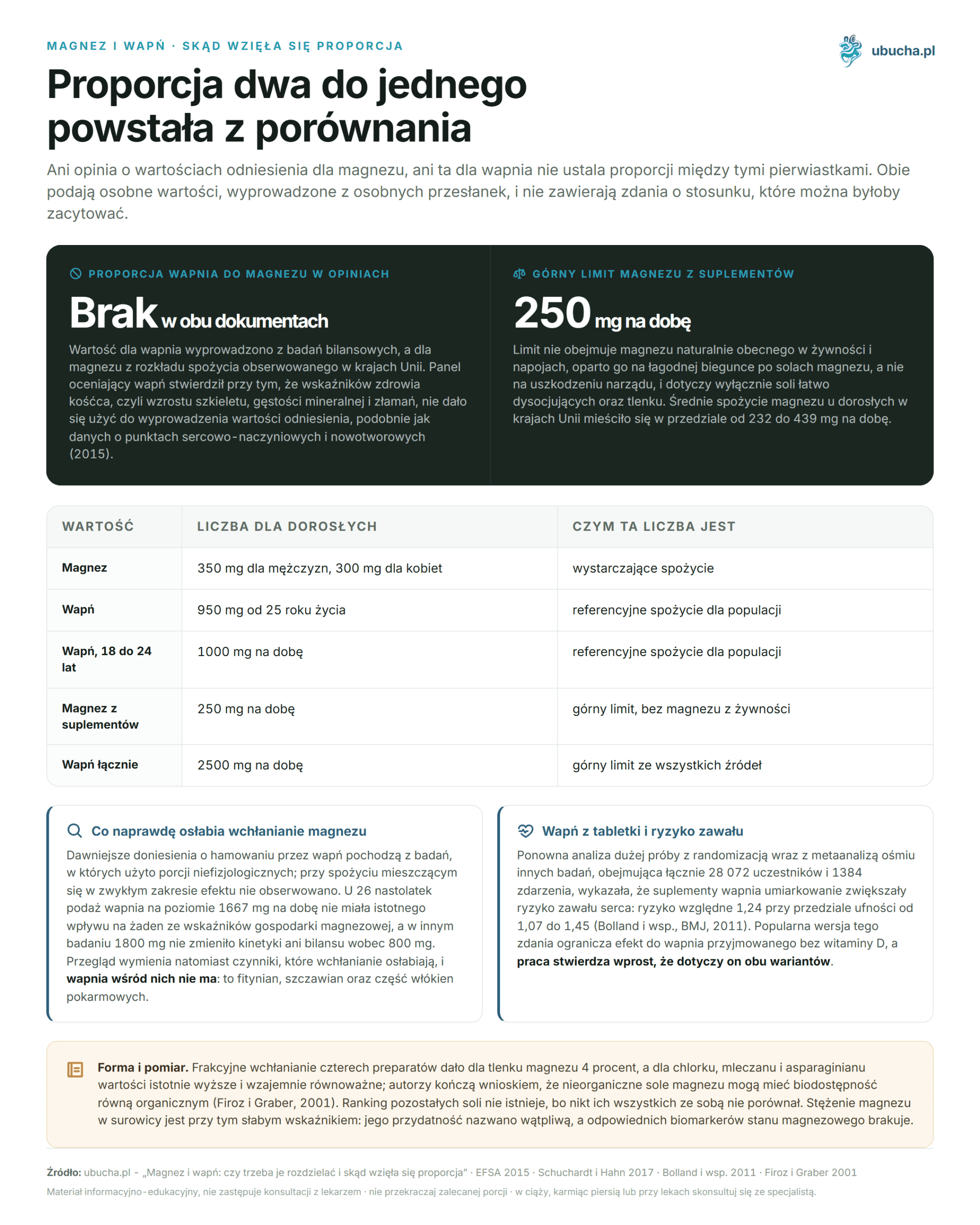
• EFSA states that adequate intake for magnesium is 350 mg per day for men and 300 mg for women, and for calcium, the reference intake is 950 mg per day for adults from 25 years of age. None of these opinions establishes a calcium to magnesium ratio.
• The upper limit of magnesium from supplements is 250 mg per day and does not include magnesium naturally present in food; for calcium, the total intake limit is 2500 mg per day.
• Serum magnesium concentration is a poor indicator: EFSA calls its usefulness questionable and states that there are no appropriate biomarkers for magnesium status.
• The Cochrane review deemed it unlikely that magnesium supplementation would provide clinically significant prevention of cramps in older adults.
Does calcium really block magnesium absorption?
With doses found in diet and typical supplementation, there is no confirmation of this. The current review of magnesium absorption states that earlier reports of inhibition by calcium come from studies that used non-physiological doses, and with intake within the normal range, this effect was not observed.
The review cites specific measurements. Long-term balance studies with calcium intake above 1000 mg per day did not show a negative impact on magnesium absorption. In a study involving 26 teenage girls, a calcium intake of 1667 mg per day had no significant effect on any indicators of magnesium metabolism: neither on absorption rate, nor on urinary excretion, nor on fecal excretion. In another balance study with teenage girls, an intake of 1800 mg of calcium per day did not change the kinetics or balance of magnesium with an intake of 800 mg (Schuchardt and Hahn, Current Nutrition and Food Science, 2017).
It is worth correcting the name of the channel that usually comes up in this story. The active magnesium absorption pathway involves TRPM6 and TRPM7 proteins, with TRPM6 described as the channel responsible for magnesium absorption in the intestine and for its reabsorption in the kidney (Voets et al., Journal of Biological Chemistry, 2004). The review by Schuchardt and Hahn lists factors that actually weaken magnesium absorption, and calcium is not among them. These are phytic acid and oxalic acid, as well as some dietary fibers: hemicellulose, and cellulose with lignin.
One observation from this review is often confused with a recommendation: the relative absorption of magnesium is higher when the element reaches the gastrointestinal tract in several smaller doses than when it is administered all at once. This is a result of absorption measurement, not a plan for supplement intake.
What calcium to magnesium ratio is supported by data?
None. Neither the European opinion on reference values for magnesium nor that for calcium establishes a ratio between these elements. Both provide separate values for each, derived from separate premises, and do not contain a statement about a ratio that could be quoted.
The popular two-to-one ratio has no source in these documents. It arose from comparing two independent reference values, not from a study that would have checked whether such a ratio yields better health outcomes than another.
Source documents actually go in the opposite direction than the intuition about ratios. The panel assessing calcium stated that bone health indicators, such as skeletal growth, mineral density, and fractures, could not be used to derive reference values, and that data on cardiovascular and cancer endpoints were also unsuitable for this (EFSA, Dietary Reference Values for calcium, 2015). The value for calcium was ultimately derived from balance studies, and for magnesium from the distribution of intake observed in EU countries (EFSA, Dietary Reference Values for magnesium, 2015).
The practical conclusion is simpler than a ratio: what matters is how much of each of these elements you get along with food and supplements, not the relationship of one number to another. We discussed how this looks with the popular evening combination in the text about zinc and magnesium at night.
How much magnesium and calcium do adults consume and where are the ceilings?
European values are four, and each means something different. Two of them describe intake considered adequate or reference, and two are limits that should not be exceeded. Confusing these two types of numbers is the most common mistake in texts about mineral supplementation.
| Value | Number for adults | What this number is |
|---|---|---|
| Magnesium | 350 mg per day for men, 300 mg for women | adequate intake, based on observed intake in the EU; the same values for pregnancy and breastfeeding |
| Calcium | 950 mg per day from 25 years of age, 1000 mg at ages 18 to 24 | reference intake for the population, derived from balance studies |
| Magnesium from supplements | 250 mg per day | upper limit; does not include magnesium naturally present in food and drinks |
| Total calcium | 2500 mg per day | upper limit of total intake from all sources |
The ceilings come from the list of upper limits maintained by EFSA, in the version from August 2025 (EFSA, Overview on Tolerable Upper Intake Levels). The magnesium limit is based on mild diarrhea from magnesium salts, not on organ damage, and it applies only to easily dissociable salts and oxides given in supplements, water, or added to food. The average magnesium intake among adults in EU countries ranged from 232 to 439 mg per day.
Separately about calcium from tablets. A re-analysis of a large randomized trial along with a meta-analysis of eight other studies, involving a total of 28,072 participants and 1384 events, showed that calcium supplements, with or without vitamin D, moderately increased the risk of heart attack: a relative risk of 1.24 with a confidence interval from 1.07 to 1.45 (Bolland et al., BMJ, 2011). The popular version of this statement limits the effect to calcium taken without vitamin D; the paper states directly that it applies to both variants.
Does the form of magnesium determine its effectiveness?
One form stands out from the rest downward, and besides that, the differences are smaller than labels suggest. Magnesium oxide is poorly absorbed, and this has been measured; there is no ranking of the other salts because no one has compared all of them together.
Measurement of fractional absorption of four commercially available preparations gave a value of 4 percent for magnesium oxide, while for chloride, lactate, and aspartate, significantly higher and mutually equivalent values. The authors conclude that inorganic magnesium salts, depending on the preparation, may have bioavailability equal to organic salts (Firoz and Graber, Magnesium Research, 2001). A clinical review provides the same number for the oxide in tablet form and 8 percent for the effervescent form, and for magnesium from mineral water rich in this element, 59 percent (Schwalfenberg and Genuis, Scientifica, 2017).
A study comparing citrate with oxide checked two things. In laboratory conditions, oxide proved practically insoluble in water and dissolved 43 percent even under peak hydrochloric acid secretion simulation, while citrate dissolved 55 percent already in plain water. After oral loading, the increase of magnesium in urine was significantly higher after citrate than after oxide (Lindberg et al., Journal of the American College of Nutrition, 1990). The circulating ranges like thirty or forty percent for citrate do not come from any of these works.
The review that collects the whole formulates it most cautiously: the type of magnesium salt seems less significant than commonly thought, it is unknown which form provides the highest bioavailability, and the amount of intake in combination with the body’s magnesium status is more important. We discussed the differences between forms more extensively in the text about magnesium for stress and sleep. It is worth remembering why this change would be necessary: the Cochrane review included eleven randomized studies with 735 people, and for spontaneous cramps in older adults, it deemed clinically significant prevention unlikely (Garrison et al., Cochrane Database of Systematic Reviews, 2020).
Is magnesium needed for vitamin D to work?
Enzymes processing vitamin D require magnesium as a cofactor, and this is described in the review literature. However, the result of the randomized study is more nuanced than the slogan about the vitamin-mineral trio, and it is worth presenting it in full, as the direction of the effect depended on the starting point.
A review dedicated to this issue states that all enzymes involved in the metabolism of vitamin D seem to require magnesium, which acts as a cofactor for reactions in the liver and kidney (Uwitonze and Razzaque, Journal of the American Osteopathic Association, 2018). This is a review paper, not a measurement, and it should be read as such.
The measurement was provided by a study included in a randomized trial involving 180 people aged 40 to 85, in which magnesium intake was individually adjusted to dietary intake. The relationship turned out to be bidirectional: magnesium supplementation raised the concentration of 25-hydroxyvitamin D3 when the baseline vitamin D concentration was close to 30 ng/ml, and lowered it when the baseline concentration was higher, in the range of about 30 to 50 ng/ml (Dai et al., American Journal of Clinical Nutrition, 2018). This is not a result from which a principle can be derived for everyone.
Frequently Asked Questions
Do magnesium and calcium need to be separated in time?
A review of magnesium absorption does not confirm such a need with normal doses. Inhibition was described with non-physiological doses, and balance studies with calcium intake above 1000 mg per day did not show a negative impact on magnesium absorption. Separation makes sense with calcium-bound medications, not with the minerals themselves.
What calcium to magnesium ratio does EFSA recommend?
None. The opinions on reference values for calcium and magnesium provide separate numbers for each element and do not contain a recommendation regarding the ratio. The popular two-to-one ratio arose from dividing one value by the other, not from a study that would have verified it.
How much magnesium from a supplement is too much?
The upper limit for magnesium from supplements, water, and fortified foods is 250 mg per day and does not include magnesium naturally present in food. The basis for this limit is mild diarrhea from magnesium salts, not organ damage. The limit is a ceiling, not a target to achieve.
Do calcium supplements burden the heart?
A re-analysis of a large sample along with a meta-analysis of eight other studies, involving 28,072 participants, showed a moderate increase in the risk of heart attack: a relative risk of 1.24 with a range from 1.07 to 1.45. The authors note that this applies to calcium supplements both with and without vitamin D.
Which form of magnesium should I choose?
It has been measured that magnesium oxide in tablet form is absorbed the least, about 4 percent. For the other salts, the review states that the type of salt is less significant than commonly thought, and it is unknown which form provides the highest bioavailability. The percentage ranges given for citrate and glycinate do not come from these studies.
Will serum magnesium show deficiency?
Poorly. EFSA calls the usefulness of serum magnesium concentration as an indicator of intake and nutritional status questionable and states that there are currently no appropriate biomarkers on which reference values could be based. Most magnesium in the body is found in bones, about 60 percent, and in muscles, about 25 percent.
Does magnesium help with leg cramps?
The Cochrane review included eleven randomized studies with 735 people. For spontaneous cramps in older adults, the differences compared to placebo were small and statistically insignificant, and the authors conclude that clinically significant prevention is unlikely. More gastrointestinal side effects were noted.
Magnesium preparations in various forms can be found in the supplements category; the store does not carry calcium in a separate form.
This article is for informational and educational purposes and does not constitute medical advice. Before starting supplementation, consult your doctor, especially if you are taking medications regularly, are pregnant or breastfeeding, or have a chronic illness.
Author: Michał Waluk · Published: 2026-08-09 · Updated: 2026-08-16