
Psychedelics and Inflammation: What Research Really Shows
The anti-inflammatory effects of psychedelics have been studied mainly in rodents and cells. We examine what has been measured in humans, how strong the evidence is, and the legal status.
Headlines about a breakthrough in treating inflammation with psychedelics jump several steps ahead of the data. The anti-inflammatory effect is real but has been measured mainly in cell cultures and rodents. Clinical trials in humans concern depression, anxiety, and post-traumatic stress disorder, not inflammatory diseases, and none of these substances is registered for inflammatory indications. Nichols and Foster in their 2025 review state plainly: human studies on the anti-inflammatory effects of psychedelics are few. This text separates these two domains. You will learn what was measured in animals, what in humans, how strong the psychiatric evidence is, what the risks are, and why in Poland these substances are discussed as part of the narcotics law schedule rather than as available therapy.
KEY INFORMATION
• The anti-inflammatory effect of psychedelics has been described in rodents and cells (Flanagan and Nichols, International Review of Psychiatry 2018), not in clinical trials.
• In humans, a decrease in CRP concentration after ayahuasca in depression has been measured so far (Galvão-Coelho et al., 2020).
• The strongest clinical evidence concerns treatment-resistant depression and PTSD, not inflammatory conditions.
• In Poland, psilocybin, LSD, MDMA, and DMT are substances listed in group I-P.
What are psychedelics and why have they returned to laboratories?
Psychedelics are substances that stimulate the serotonin 5-HT2A receptor, thereby altering perception, mood, and the sense of self. They returned to clinical research after 2006, when Roland Griffiths’ team at Johns Hopkins described lasting psychological effects of a single psilocybin dose in healthy volunteers (Griffiths et al., Psychopharmacology 2006).
The boundary between classic psychedelics and other pharmacological neighbors is sometimes blurred, including in popular texts. Classic psychedelics act via 5-HT2A. MDMA releases serotonin and noradrenaline, ketamine blocks the NMDA receptor, and ibogaine has multiple targets. Grouping them together obscures the evidence because each group has its own studies and risks. You may also see the term “psychedelics” as a calque from English; the correct Polish form is psychodeliki.
| Substance | Class | Target | Furthest stage of human research |
|---|---|---|---|
| Psilocybin | tryptamine, classic psychedelic | 5-HT2A agonist | Phase III, treatment-resistant depression |
| LSD | ergoline, classic psychedelic | 5-HT2A agonist | Phase II, generalized anxiety |
| DMT and ayahuasca | tryptamine | 5-HT2A agonist | Phase II, depression |
| MDMA | entactogen, not a classic psychedelic | serotonin and noradrenaline release | Phase III completed, no approval |
| Ketamine and esketamine | dissociative | NMDA antagonist | Esketamine registered for treatment-resistant depression |
| Ibogaine | indole alkaloid | multiple targets including NMDA and hERG channel | observational studies, cardiac risk signal |
The history of this research has a clear break. Albert Hofmann synthesized LSD at Sandoz labs in 1938 and described its psychoactive effects five years later. For the next two decades, the substance was used in academic centers as a research tool and experimental psychiatric drug. The 1971 Convention on Psychotropic Substances placed classic psychedelics under the strictest control regime, effectively halting clinical research for over three decades.
The renaissance was driven by three factors simultaneously: lack of response to antidepressants in many patients, development of functional neuroimaging, and US regulator approval of breakthrough therapy status for MDMA in PTSD in 2017 and for psilocybin in depression a year later. This status accelerates administrative procedures but does not determine efficacy. BMJ review authors estimate the current wave of research at about fifteen years and note that psilocybin and MDMA have reached phase III but neither has marketing authorization.
Do psychedelics really have anti-inflammatory effects in humans?
There is no conclusive data. No clinical trial has tested a psychedelic as a drug for inflammatory disease. What we know about humans comes from secondary measurements in depression studies, and the 2025 review by Nichols and Foster describes these data as few and at best suggestive (International Review of Neurobiology, 2025).
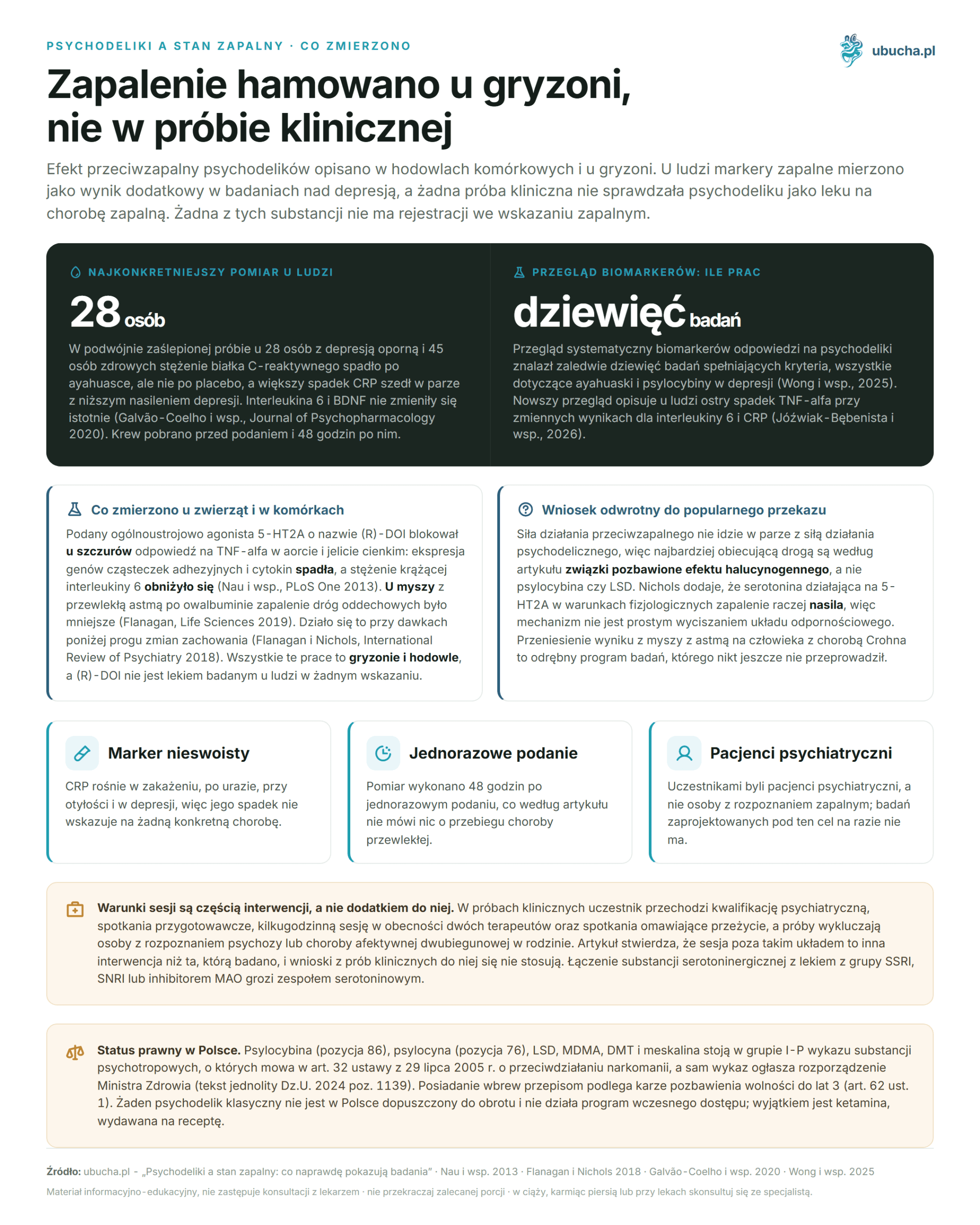
The most concrete human measurement comes from a double-blind ayahuasca trial: 28 patients with treatment-resistant depression and 45 healthy controls, blood drawn before and 48 hours after administration. C-reactive protein (CRP) levels decreased in those treated with ayahuasca but not placebo, and greater CRP reduction correlated with lower depression severity. Interleukin 6 and BDNF did not change significantly, and none of the markers predicted response or remission (Galvão-Coelho et al., Journal of Psychopharmacology 2020).
A systematic review of biomarkers of psychedelic response found only nine studies meeting criteria, all concerning ayahuasca and psilocybin in depression (Wong et al., 2025). A newer review summarizes knowledge as: humans show an acute TNF-alpha decrease with variable results for interleukin 6 and CRP (Jóźwiak-Bębenista et al., 2026). These are mechanistic studies within psychiatry, not evidence of inflammation treatment.
Three points distinguish the ayahuasca result from proof of inflammation treatment. First, CRP is a nonspecific marker: it rises in infection, injury, obesity, and depression, so its decrease does not indicate any specific disease. Second, measurement was 48 hours after a single dose, which says nothing about chronic disease course. Third, participants were psychiatric patients, not people diagnosed with inflammatory disease. Both reviews conclude with the same call: studies designed specifically for this purpose are needed, and none exist yet.
While organizing this article, we noticed something that should alert any reader of psychedelic texts: under the statement about anti-inflammatory effects of 5-HT2A agonists was linked a paper about dissolving nanowires in electron microscopy. The authors and year matched, but the publication number did not. This is reason enough to verify every cited number leads to the paper containing it.
What exactly did animal and cell studies show?
They showed strong inflammation inhibition at doses too low to cause psychedelic effects. Systemic administration of the 5-HT2A agonist (R)-DOI blocked TNF-alpha response in rat aorta and small intestine, reducing expression of adhesion molecules and cytokines and lowering circulating interleukin 6 (Nau et al., PLoS One 2013).
| Model | Substance | What was measured | Publication |
|---|---|---|---|
| Rat, TNF-alpha induced inflammation | (R)-DOI | decreased expression of Icam-1, Vcam-1, Il-6, Il-1b, Mcp-1; lower circulating interleukin 6 | Nau, PLoS One 2013 |
| Mouse, chronic ovalbumin asthma | (R)-DOI, 5-HT2 agonist | less airway inflammation, less mucus, reduced structural remodeling | Flanagan, Life Sciences 2019 |
| Rat, allergic asthma, 21 compounds | tryptamines, ergolines, phenylalkylamines | anti-inflammatory pharmacophore unrelated to behavioral potency | Flanagan, ACS Pharmacol Transl Sci 2021 |
| Mouse, ovalbumin asthma | (R)-DOI vs (R)-DOTFM | only (R)-DOI inhibited inflammation via arginase 1 suppression | Flanagan, ACS Pharmacol Transl Sci 2024 |
Flanagan and Nichols summarized this research line in 2018, writing that 5-HT2A receptor stimulation produces strong anti-inflammatory effects in animal models of human inflammatory diseases at doses below behavioral effect threshold (International Review of Psychiatry, 2018). This review is often cited in popular texts as evidence for “anti-inflammatory psychedelics,” usually without noting it concerns rats and mice.
The conclusion from this set contradicts popular narrative. Since anti-inflammatory potency does not correlate with psychedelic potency, the most promising path is compounds without hallucinogenic effects, not psilocybin or LSD. Nichols adds that serotonin acting on 5-HT2A under physiological conditions tends to increase inflammation, so the mechanism is not simple immune suppression. All these studies are in rodents and cultures. Translating results from asthmatic mice to humans with Crohn’s disease is not obvious but a separate research program not yet conducted. Dose is also an issue: effective rodent concentrations do not directly translate to human doses, and (R)-DOI is not studied as a drug in humans for any indication.
How do psychedelics change brain function?
They stimulate 5-HT2A receptors on cortical pyramidal neurons, increasing glutamate release and activating TrkB and mTOR signaling pathways. Ly et al. showed psychedelics increase neurite growth and synapse number in neuron cultures and rodents, similarly to ketamine (Cell Reports, 2018).
The second part of this story, the loosening of the default mode network, should be told more cautiously than most popular materials do. An international meta-analysis of eleven independent resting-state fMRI datasets including psilocybin, LSD, mescaline, DMT, and ayahuasca found a common pattern: increased connectivity between higher-order networks and sensory-motor networks. Decreases in within-network connectivity were weak to moderate and selective, contrary to earlier single-center reports (Girn et al., Nature Medicine 2026).
5-HT2A receptors are not only in the brain. They occur in most tissues, including endothelial, endocrine, and immune cells, and this peripheral location links the psychiatric and inflammatory threads. The term “psychoplastogen” was introduced for substances that rapidly and persistently increase neuronal plasticity, unlike antidepressants acting over weeks. Plasticity data come from cortical neuron cultures and rodents, not human brain, and the gap between a single dose and sustained mood improvement remains the least explained point of the hypothesis.
In other words, the “default mode network shutdown” image is an oversimplification. The brain under these substances does not so much turn off one structure as shift how sensory areas communicate with regions responsible for self-reflection and planning. A separate thread linking both topics of this article: cerebrospinal fluid and iPSC cell analysis identified interleukin 15 and MCP-1 protein as common nodes in response to ketamine, LSD, and psilocybin (Jones et al., Molecular Psychiatry 2026). Immune signaling may thus participate in the antidepressant effect, which is not the same as treating inflammatory disease.
Which human studies have the strongest evidence?
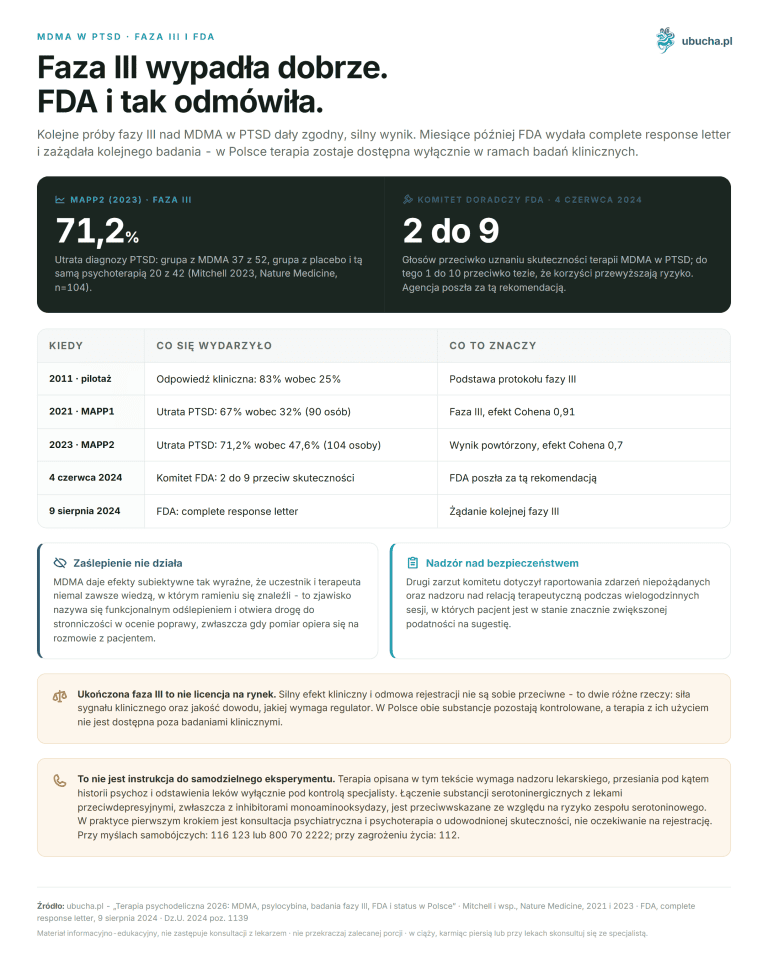
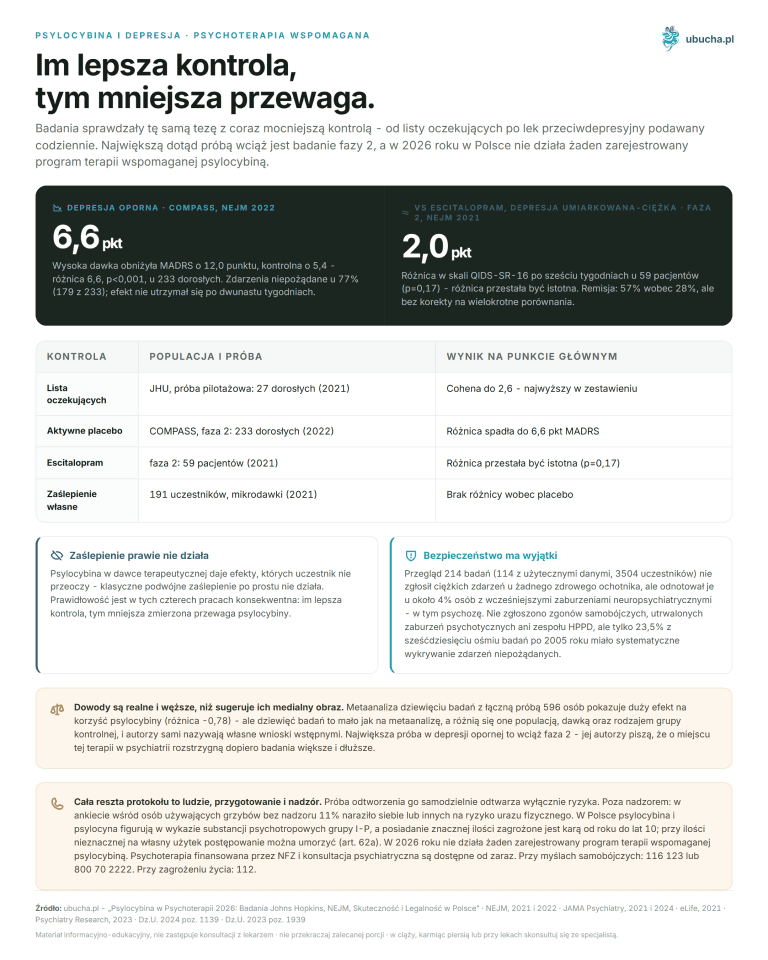
Two sets: psilocybin in treatment-resistant depression and MDMA in post-traumatic stress disorder. An umbrella review of 23 meta-analyses estimated psilocybin’s effect size in depression at Hedges g about 1.05, and MDMA in PTSD about 1.24, with a clear caveat about low methodological quality of most studies (Dominiak et al., Journal of Clinical Medicine 2025).
| Study | Substance and indication | Participants | Result |
|---|---|---|---|
| Carhart-Harris 2016 | psilocybin, treatment-resistant depression | 12, open-label without control group | QIDS scale lower by 11.8 points at one week and 9.2 points at three months |
| Davis 2021 | psilocybin, major depression | 27 randomized, waitlist control | GRID-HAMD from 22.8 to 8.0 points at one week and 8.5 points at four weeks |
| Goodwin 2022 | psilocybin COMP360, treatment-resistant depression | 233, phase II, three doses | MADRS 6.6 points lower than 1 mg dose at week 3, no confirmation at 12 weeks |
| Mitchell 2023 | MDMA, moderate to severe PTSD | 104, phase III | CAPS-5 23.7 points lower vs 14.8 points in placebo with therapy, d = 0.7 |
| Bogenschutz 2022 | psilocybin, alcohol dependence | 95 randomized, control: diphenhydramine | 9.7% heavy drinking days vs 23.6% over 32 weeks |
| Johnson 2026 | psilocybin, smoking cessation | 82, pilot without blinding | 40.5% confirmed abstinence at 6 months vs 10.0% with nicotine patches |
| Robison 2025 | LSD (MM120), generalized anxiety | 198, phase IIb | HAM-A 5.0 points lower at 100 mcg and 6.0 points at 200 mcg vs placebo |
A separate branch concerns anxiety and depression in life-threatening illness. Two 2016 trials on 51 and 29 oncology patients, both with group crossover, showed sustained improvement in about 60-80% of participants at six months (Griffiths et al., Ross et al.). In both, the intensity of mystical experience on session day mediated the therapeutic effect, a result difficult to reconcile with a purely pharmacological model.
Note the participant numbers. Outside phase III, groups are usually several dozen, and the most cited 2016 study included twelve people without a control group. This signals the need for further research, not a basis for treatment.
Where is the evidence strong and where is it simply lacking?
Strong where randomized controlled trials and repeated meta-analyses exist, i.e., in depression and PTSD. Weak or none where inflammatory, autoimmune, and neurodegenerative diseases are concerned. The 2026 BMJ review identifies psilocybin in treatment-resistant depression and MDMA in PTSD as the only areas with the strongest evidence base (Jacobs et al.).
It is worth seeing how numbers change with study quality. The 2016 open-label trial on twelve patients showed spectacular depression score drops. Two phase III trials completed in 2025 and 2026 reached primary endpoints but differences versus control were 3.6 and 3.8 points on MADRS at week six (sponsor statement, Feb 2026). These results have not yet undergone peer review. Statistical significance is not the same as a large clinical change.
Two methodological caveats recur in every serious review. First, blinding fails: participants given 25 mg psilocybin know their group, and so do researchers. Second, meta-analyses counting within-group change yield huge effects, but the same data compared to placebo show moderate effects. A meta-analysis of four studies on 117 people gave effect sizes from 1.16 to 1.47 within groups and 0.82 to 0.83 versus placebo (Goldberg et al., Psychiatry Research 2020). For comparison, older randomized LSD studies in alcoholism, pooled from six trials on 536 people, gave odds ratio 1.96 (Krebs and Johansen, 2012).
The strongest evidence in this area is actually for a substance no one calls a psychedelic. A meta-analysis of 26 randomized trials with 1166 people with depressive episodes showed a single intravenous ketamine infusion reduces suicidal thoughts severity after 24 hours by 0.69 standard deviations and depression symptoms after 4 hours by 1.74 standard deviations (Shim et al., JAMA Psychiatry 2026). Lower scores do not equal prognosis: esketamine’s product characteristics state no proven efficacy in suicide prevention or reduction of suicidal thoughts (ChPL Spravato). If you have such thoughts, the way to help is a psychiatrist or emergency department, not a substance. The free 24/7 numbers 116 123 and 800 70 2222 are available. In life-threatening situations: 112.
What are the risks and who is excluded from these studies?
Risks are real and well described. In a phase II psilocybin trial, adverse events occurred in 179 of 233 participants, and suicidal thoughts or behaviors were reported in all dose groups including control (Goodwin et al., NEJM 2022).
| Risk | Data show | Publication |
|---|---|---|
| Difficult experience during session | Among 1993 people describing their hardest mushroom experience, 39% rated it among five hardest in life, 11% risked harm to self or others, 7.6% sought help for persistent symptoms | Carbonaro 2016 |
| Increase in suicidal thoughts | Case report of a phase IIb participant: increased suicidal thoughts and prolonged food restriction beyond acute substance effects | Wahba 2024 |
| Persistent perceptual disorders (HPPD) | Medical records of 25,778 diagnosed; anxiety and post-infectious fatigue syndrome predicted occurrence in psychedelic users | Butler 2026 |
| Interaction with serotonergic drugs | Combining serotonergic substances with SSRIs, SNRIs, or MAO inhibitors risks serotonin syndrome; sessions are conducted only in specialized centers with extensive therapeutic support | Jacobs 2026 |
| Cardiac complications after ibogaine | QTc prolongation and dangerous ventricular arrhythmias, rare but reported after therapeutic doses even in people without prior heart disease | Brunt 2026 |
It is worth reading numbers according to their source. Data on difficult experiences come from surveys of people using mushrooms outside any care, and the same study’s authors state that in laboratory conditions, after participant screening and preparation, the frequency of risky behaviors and prolonged psychological suffering is very low. All trials exclude people with psychosis or bipolar disorder in family history, and most also exclude those with serious heart disease.
The conditions in which sessions are conducted are part of the intervention, not an add-on. Participants undergo psychiatric screening, preparatory meetings, a several-hour session with two therapists present, and integration meetings. BMJ review authors point to this dependence as the main barrier to implementation: the model requires extensive therapeutic support in specialized centers and is hard to replicate simply. Sessions outside such settings are a different intervention than studied, and clinical trial conclusions do not apply.
What is the legal status of psychedelics in Poland?
They are prohibited. Psilocybin (item 86), psilocin (item 76), LSD, MDMA, DMT, and mescaline are in group I-P of the psychotropic substances schedule referred to in Article 32 of the Act of July 29, 2005 on counteracting drug addiction. The schedule is not an annex to the act but is announced by the Minister of Health’s regulation, consolidated text Dz.U. 2024 item 1139.
The schedule does not list mushrooms by name. The ban covers them because they contain psilocybin and psilocin. Possession contrary to regulations is punishable by up to 3 years imprisonment (Art. 62(1)). For significant amounts, the penalty is 1 to 10 years (Art. 62(2)), and for lesser amounts, the court may impose a fine, restriction of liberty, or imprisonment up to one year (Art. 62(3)). Trafficking is penalized more severely. The schedule is updated, most recently effective July 28, 2026.
An exception is ketamine, a psychotropic substance with recognized medical use, dispensed by prescription and administered in hospital settings in Poland. Esketamine nasal spray has had European registration for treatment-resistant depression since 2019 and is available in selected psychiatric wards. For classic psychedelics, there is no available therapeutic pathway in Poland: none are authorized for marketing, and no early access program allows doctors to request permission for individual patients.
A separate issue is traveling to sessions in countries where such centers operate legally or in a gray zone. Travel does not change the legal status of substances in Poland, and bringing them back constitutes transport and possession offenses. Moreover, commercial centers rarely apply screening procedures known from clinical trials, so the safeguards that give these studies their safety profile - exclusion of psychosis risk, supervised discontinuation of serotonergic drugs, and post-session care - are absent.
This article describes the state of research and regulations. It is not an instruction for use, does not encourage use of these substances, and does not suggest that legally available plant or hemp preparations are substitutes. If you struggle with treatment-resistant depression, PTSD, or suicidal thoughts, talking to a psychiatrist is the only way to access anything proven.
What is happening with registration in the USA, Australia, and the European Union?
Australia has gone furthest, being the first country to allow use outside clinical trials. Since July 1, 2023, the Australian regulator moved psilocybin and MDMA from the banned substances list to controlled medicines, allowing designated psychiatrists to prescribe them for treatment-resistant depression and PTSD (TGA, 2023).
The Australian solution is sometimes described as legalization, but it is not. Only psychiatrists who have undergone regulator approval after bioethics committee consent can prescribe, and administration occurs in controlled medical settings combined with psychotherapy by trained staff. The substances were moved from banned to controlled medicines, roughly equivalent to prescription drugs with special dispensing conditions in Poland.
In the United States, the path has been rocky. The US regulator previously granted breakthrough therapy status for MDMA in PTSD and psilocybin in depression but in August 2024 refused approval of MDMA-assisted therapy and requested another phase III trial, citing concerns about blinding and psychotherapy’s role in the protocol. The psilocybin COMP360 manufacturer plans to submit a registration application by late 2026. The announcement does not determine decision timing or content, as the regulator evaluates full efficacy and safety data only after submission.
In the European Union, no classic psychedelic has marketing authorization. The European Medicines Agency held a multi-stakeholder workshop in April 2024 on regulatory frameworks for this group and published a report (EMA, 2024). This is a guideline preparation stage, not a registration procedure. One discussed issue is that the intervention combines a drug with psychotherapy, while European pharmaceutical law evaluates medicinal products, not therapeutic procedures. The only related drug authorized in the EU remains nasal esketamine. If you want to follow the Polish discussion on psilocybin’s role in psychotherapy, we described it separately in the post on psilocybin as a psychotherapy element.
How do psychedelics differ from cannabis and CBD?
They differ in target receptor, psychoactive potency, and legal status. Classic psychedelics stimulate 5-HT2A and are banned in Poland. Cannabidiol does not strongly bind CB1, does not cause hallucinations, and is legal in products meeting hemp fiber requirements.
| Feature | Classic psychedelics | THC | CBD |
|---|---|---|---|
| Target | 5-HT2A agonism | partial CB1 and CB2 agonism | e.g., 5-HT1A, TRPV1, PPAR-gamma |
| Psychoactive effect | strong, alters perception and sense of self | present | no intoxicating effect |
| Administration in studies | one or two sessions with hours of therapist support | chronic use by prescription | chronic use |
| Status in Poland | banned, schedule I-P | prescription, pharmacy dried flower | allowed in hemp fiber products |
The difference in administration is often less obvious than receptor difference and is more important for readers. Psychedelics are studied as a one- or two-time intervention with extensive psychological support, after which patients take nothing for weeks. Hemp products are used daily, independently, and without supervision. These are two different worlds in terms of risk, cost, and what can be said based on research.
What they share is that both groups are studied regarding effects on pro-inflammatory cytokines and neuroplasticity, though via different signaling pathways. They also share the problem of evidence quality: both areas are dominated by small trials, short observations, and results that do not always replicate in larger studies. If you are interested in the other side, we described separately the endocannabinoid system and research on cannabidiol’s effects on inflammation. Similar mechanisms do not mean interchangeability: no hemp product is equivalent to psilocybin or LSD and should not be treated as such. The same caution applies to supplements acting on the serotonin system, such as the serotonin precursor described in our post on 5-HTP, as they also interact with antidepressants.
Frequently Asked Questions
Has it been proven that psychedelics treat inflammation?
No. The anti-inflammatory effect has been shown in cell cultures and rodents, mainly for the 5-HT2A agonist called (R)-DOI. No clinical trial has tested psychedelics as a treatment for inflammatory disease, and the 2025 review by Nichols and Foster describes human data as scarce.
What inflammatory markers have been measured in humans?
Inflammatory markers were measured as secondary outcomes in depression studies. In a trial with ayahuasca involving 28 patients with treatment-resistant depression and 45 healthy controls, CRP levels decreased after the substance but not after placebo, with no changes in interleukin 6 (Galvão-Coelho et al., 2020).
Is psilocybin legal in Poland?
No. Psilocybin and psilocin are listed in group I-P of the psychotropic substances schedule, announced by the Minister of Health’s regulation of August 17, 2018 (consolidated text Dz.U. 2024 item 1139). The schedule does not list mushrooms separately but includes both substances. Possession is punishable by up to 3 years imprisonment.
How strong is the evidence for psilocybin in treatment-resistant depression?
In a phase II trial, the difference compared to the control dose was 6.6 points on the MADRS scale after three weeks, but maintenance of response after 12 weeks did not confirm the primary endpoint (Goodwin et al., NEJM 2022). A 2026 BMJ review considers this indication the best documented.
Has MDMA been approved for PTSD treatment?
No. In a phase III trial, symptom severity on the CAPS-5 scale decreased by 23.7 points versus 14.8 points in the placebo group receiving the same psychotherapy (Mitchell et al., Nature Medicine 2023). In August 2024, the US regulator refused approval and requested another phase III trial.
Can psychedelics be combined with antidepressants?
Not without medical supervision. Combining serotonergic substances with SSRIs, SNRIs, or MAO inhibitors risks serotonin syndrome. Research protocols require discontinuation of serotonergic drugs before sessions, which itself requires psychiatric care.
What is HPPD and how common is it?
It is persistent visual perception disorder after using hallucinogenic substances. The largest medical record analysis described 25,778 people with this diagnosis, who often had anxiety disorders and functional somatic syndromes before diagnosis (Butler et al., 2026).
Is ketamine a psychedelic and is it available in Poland?
Ketamine is not a classic psychedelic because it blocks the NMDA receptor rather than stimulating 5-HT2A. In Poland, it is a psychotropic substance with medical use, dispensed by prescription. Esketamine nasal spray has had European registration for treatment-resistant depression since 2019.
If you are looking for legally available hemp products for personal use, you will find them in the hemp oils and hemp flower categories. They have nothing to do with the substances described in this article and do not replace psychiatric care.
This article is informational and educational. It describes clinical trials where substances are administered under medical supervision after participant screening; use on your own does not replicate these conditions. These substances are controlled in Poland under the narcotics law. If you have suicidal thoughts, call the free 24/7 numbers 116 123 or 800 70 2222. In life-threatening situations: 112.
Author: Michał Waluk · Published: 2026-05-11 · Updated: 2026-08-11