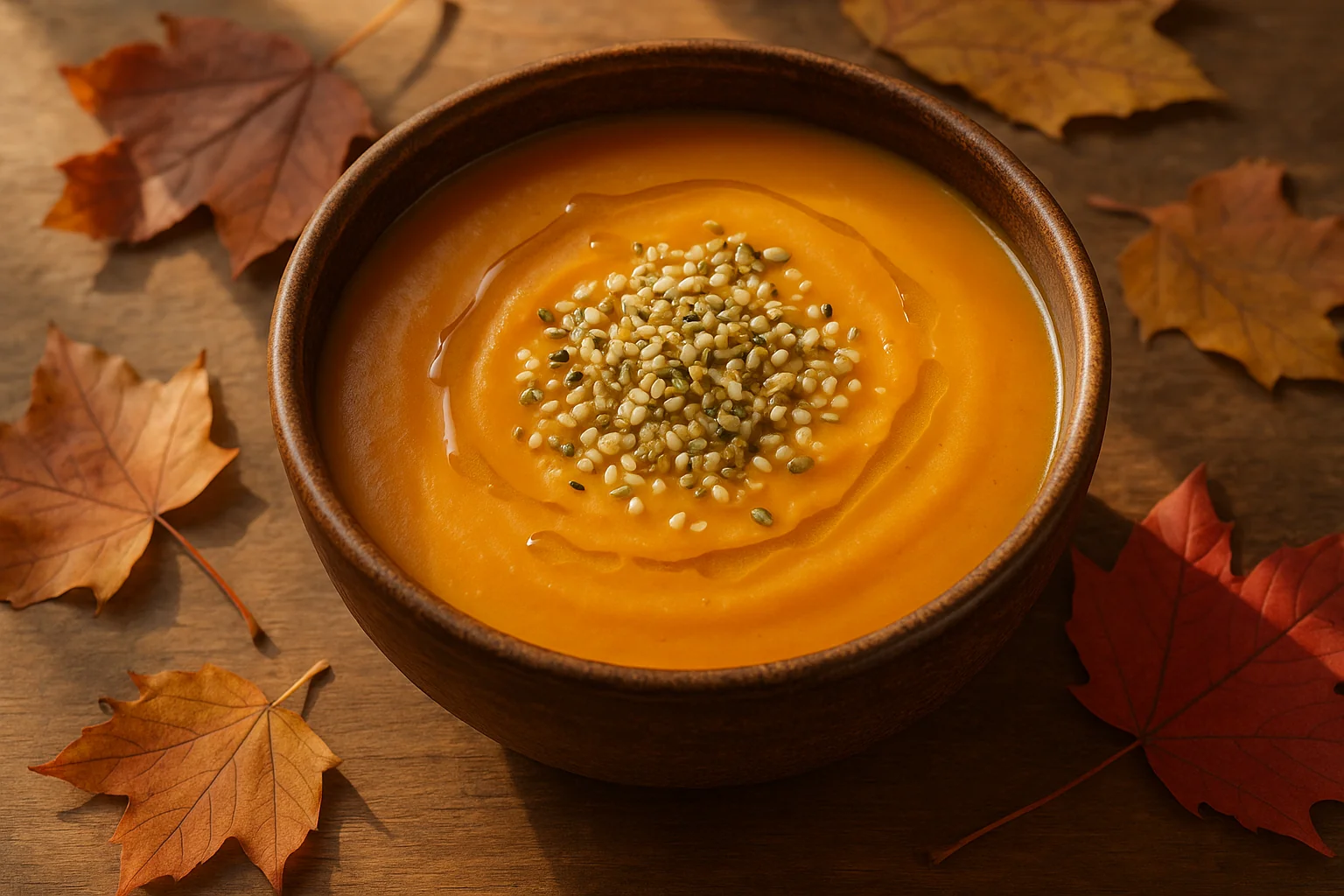

pumpkin cream with roasted hemp seeds
Pumpkin cream with roasted hemp seeds in 35 minutes. Step-by-step recipe, seed composition according to House 2010, and the reason why seeds should not be added to the pot.
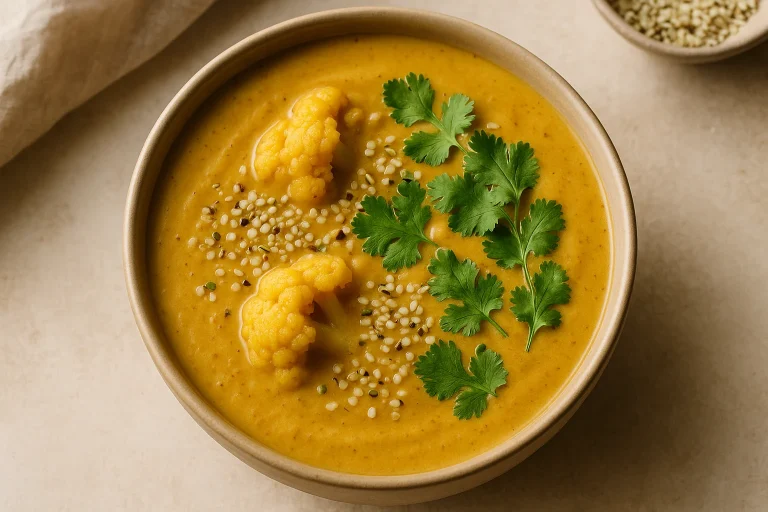
Pumpkin cream almost makes itself, yet it is easy to ruin: overcooked pumpkin releases flavor into the water and remains a sweet, watery mass. One addition changes this soup more than any spice. A handful of hulled hemp seeds toasted in a dry pan and sprinkled on top just before serving adds crunch and a nutty aroma, while also compensating for what the pumpkin lacks most, namely protein and fat. The soup is ready in 35 minutes, is vegan, and tastes great all year round. Below you have the step-by-step recipe, calculated nutritional values, and an explanation of why seeds should not be thrown into the pot. The numbers regarding the seed composition come from a single study that you can open and check yourself.
KEY INFORMATION
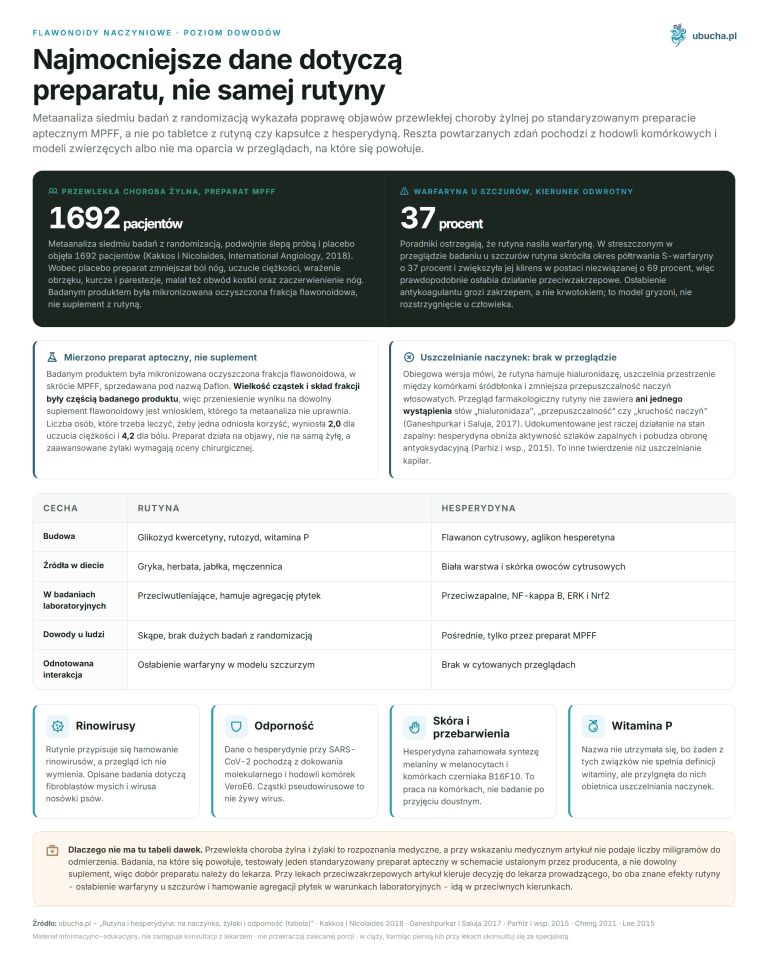
• Hulled hemp seeds contain on average 35.9% protein and 46.7% fat (House et al., Journal of Agricultural and Food Chemistry, 2010).
• The same work states that lysine is the first limiting amino acid in them.
• W oleju z nasion stosunek omega-6 do omega-3 wynosi od 2:1 do 3:1 (Callaway, Euphytica, 2004).
• Roast the seeds separately and sprinkle them on the finished soup.
Why do hemp seeds change pumpkin cream?
Because pumpkin is a vegetable that is almost devoid of protein and fat, while hulled hemp seeds have an abundance of both. House et al. measured 35.9% protein and 46.7% fat in hulled seeds (Journal of Agricultural and Food Chemistry, 2010). A tablespoon of seeds per serving translates to about 3.6 g of protein and 4.7 g of fat.
However, it is worth pausing at the word complete, which appears most often in recipes with hemp seeds. Callaway describes the proteins in seeds as containing nutritionally significant amounts of all essential amino acids (Euphytica, 2004), but House measured something different: quality, not just presence. In his study of thirty samples, lysine was the first limiting amino acid in all hemp products, and the PDCAAS score for hulled seeds was 63-66%. This is a decent result for a plant, comparable to certain grains and nuts, but it is not a reference protein. For this soup, it does not have practical significance, as pumpkin cream is not a protein meal and is not meant to be.
Roasting does more than just add decoration. Raw seeds have a delicate, slightly grassy flavor that simply disappears in sweet pumpkin. After 3-4 minutes in a dry pan, they become golden and distinctly nutty, while retaining the crunchiness that the creamy soup lacks. I cannot support how much fatty acids they lose with a measurement: Callaway describes the composition of the seed oil, not its behavior in the pan. Therefore, we roast them briefly and with a timer, not by eye.
A separate note from our kitchen, without any claims to measurement: we prefer to bake pumpkin rather than boil it. In water, the vegetable releases some sugars into the broth, while in the oven, those same sugars caramelize on the edges of the cubes. The difference in taste is so pronounced that we have stopped returning to the boiled version. This is a matter of taste preference, not a research result.
How much protein and fat does a serving of seeds contribute?
A tablespoon of hulled hemp seeds is about 10 g, which translates to approximately 3.6 g of protein and 4.7 g of fat, based on the proportions measured by House et al. The rest of the values in the serving come from the pumpkin, broth, and oil, so we present it as an estimate based on the recipe proportions, not as a laboratory measurement.
The entire serving, which is about 300 ml of soup with a tablespoon of seeds, amounts to roughly 200 kcal in this calculation. There is no reason to pretend greater precision: the weight of the pumpkin after baking, the density of the broth, and the amount of oil shift this result by several percent in either direction. The composition of the seeds themselves has been measured independently twice. The USDA FoodData Central database lists in record 170148, described as hulled hemp seeds, 553 kcal, 31.6 g of protein, and 48.8 g of fat per 100 g. House et al. found 35.9% protein in thirty commercial samples. The difference comes from the selection of samples, not from error.
What matters is which hemp product you buy. House et al. separated three and found three different compositions: whole seeds 24.0% protein with 30.4% fat, hulled seeds 35.9% with 46.7%, and the cake after oil pressing 40.7% protein with only 10.2% fat. For sprinkling, you take hulled seeds. The cake, usually sold under the name hemp flour, has a different taste and completely different texture, and it just burns in the pan.
What ingredients do you need?
The proportions are enough for 4 servings. The baking time for the pumpkin is 25 minutes, with about 15 minutes of active time at the pot. You buy hulled hemp seeds at a health food store or in the grain section: we do not have them in our assortment, so I direct you here outside of our own shelf.
When it comes to seeds, pay attention to two things. First, the date: fat makes up almost half of their weight, so old seeds go rancid, and you can smell it immediately upon opening the package. Second, the description, because under the term hemp, oil cake is also sold, which looks like flour and is not suitable for roasting.
- 800 g of hokkaido or butternut pumpkin, cleaned
- 4 tablespoons of hulled hemp seeds, about 40 g, for roasting as a topping
- 1 large onion
- 3 cloves of garlic
- 700 ml of vegetable broth, plus extra to adjust thickness
- 2 tablespoons of olive oil for baking
- 1 tablespoon of lemon juice
- half a teaspoon of ground ginger
- a pinch of nutmeg
- salt and pepper
- optionally, a teaspoon of edible hemp oil per serving, added cold
- optionally, pumpkin seeds or fresh cilantro for decoration
How to cook pumpkin cream with hemp seeds step by step?
The whole process takes 35 minutes, of which the pumpkin spends 25 minutes in the oven without your involvement. Two things determine the outcome: baking instead of boiling and roasting the seeds separately. The rest is blending and seasoning to taste, which cannot be messed up.
- Preheat the oven to 200°C, with top and bottom heating. Wash the hokkaido pumpkin and cut it into cubes about 3 cm; you can leave the skin on as it softens and disappears after blending. Peel other varieties.
- Spread the pumpkin, onion, and garlic on a baking sheet lined with paper. Drizzle with olive oil, sprinkle with salt and pepper. Bake for 25 minutes on the middle rack of the oven. The pumpkin should caramelize at the edges and pierce easily with a fork.
- While the pumpkin is baking in the oven, toast the hemp seeds in a dry pan over medium heat for 3-4 minutes, stirring constantly. They are ready when they turn golden and start to smell intensely. Transfer them to a plate to stop cooking from the hot pan.
- Transfer the roasted vegetables to a pot, and squeeze the garlic from its skins. Pour in 700 ml of hot broth and blend with an immersion blender for 2 minutes until completely smooth. Stir in lemon juice, then ginger and nutmeg. If the soup is too thick, thin it with an additional 100-150 ml of broth.
- Heat on low for 3-4 minutes, stirring. Taste: hokkaido pumpkin is naturally sweet, and the lemon juice balances that sweetness. Season with salt and pepper.
- Pour the soup into bowls and only now sprinkle a tablespoon of toasted seeds on each serving. If you are using hemp oil, pour it into the bowl, not into the pot. The idea is to keep the seeds crunchy, and the oil should not be heated.
The recipe for the topping itself, in a version with spices and for longer storage, is described separately in the text about roasted hemp seeds with spices.
How to modify the recipe without ruining the texture?
This soup tolerates quite a few changes, with one condition: the seeds remain a topping. Everything else, meaning spices, fat, and the method of processing the pumpkin, can be adjusted freely. Below are three variants that we tested in the kitchen, and one mistake that ruins the effect regardless of the rest.
The spiced version is created by adding a teaspoon of turmeric and a piece of fresh ginger the size of a thumb to the roasted vegetables. The flavor becomes more pronounced and sharper, and the color deeper. I do not attribute any health benefits to this combination, as no one has measured such effects for this soup.
The coconut version involves replacing 200 ml of broth with coconut milk. The soup becomes thicker and milder, and the fat from the milk helps with the carotenoids from the pumpkin, which dissolve in fats, not in water. If you are looking for a similar soup with a different flavor profile, we have a recipe for krem z kalafiora z nasionami konopi i curry oraz na broccoli cream soup with hemp seeds.
The no-oven version is a lifesaver when time is short. Cut the pumpkin into cubes, cook in broth for 20 minutes until soft, and blend. The flavor will be milder, but the soup will still be good. You still roast the seeds separately, because without that, there is no crunch.
The mistake that ruins everything at once is adding the seeds to the boiling soup. The seeds soak up moisture, lose their crunch, and disperse in the soup as tasteless bits. I do not have a measurement for how much fatty acids are lost in this situation, but the culinary effect alone is enough reason not to do it.
Frequently Asked Questions
Why do hemp seeds pair well with pumpkin cream?
Pumpkin provides carotenoids and potassium, but it has almost no protein or fat. Hulled hemp seeds make up for both: House et al. measured 35.9% protein and 46.7% fat in them (Journal of Agricultural and Food Chemistry, 2010). Roasted seeds also add crunch, which contrasts with the smooth soup.
Do hemp seeds need to be toasted for soup?
No, but without toasting you lose half the point of this addition. Raw seeds are soft and bland; toasted for 3-4 minutes in a dry pan, they become golden and nutty. Always toast them separately and sprinkle them on the finished soup in the bowl, never into the pot on the heat.
Which pumpkin should you choose for hemp seed cream?
Hokkaido is the most convenient because its skin does not need to be peeled and disappears after blending. Musky pumpkin gives a sweeter, more buttery cream. Nutmeg pumpkin can be cheaper and more watery, requiring less broth. All three blend well and pair nicely with nutty seeds.
What is the difference between hulled seeds and hemp flour?
These are two different products from one plant. Hulled seeds contain 35.9% protein and 46.7% fat, while the cake left after oil pressing, sold as hemp flour, has 40.7% protein with 10.2% fat (House i in., 2010). Only hulled seeds are suitable for roasted toppings.
Can pumpkin cream be frozen?
The soup itself yes, without seeds and without oil. Portions in airtight containers last up to 3 months in the freezer. You will toast fresh seeds on the day of serving, and add hemp oil after reheating, because after thawing, the crunchiness of the topping would be lost.
The article is informational and educational in nature and does not replace consultation with a doctor. If you are pregnant, breastfeeding, taking medications, or have chronic conditions, consult the use of supplements or herbs with a specialist.
Author: Michał Waluk · Opublikowano: 2026-05-20 · Aktualizacja: 2026-08-16