
Psilocybin in Psychotherapy 2026: Johns Hopkins Research, NEJM, Effectiveness and Legality in Poland
Psilocybin in psychotherapy: what NEJM and JAMA Psychiatry studies really showed, associated risks, and why it is listed in Schedule I-P in Poland.
Psilocybin has returned to psychiatry after a thirty-year hiatus bringing data that cannot be ignored. A meta-analysis of nine studies with a total of 596 participants showed psilocybin-assisted therapy had a large effect compared to control groups, with a standardized mean difference of -0.78 (Psychiatry Research, 2023). However, the authors of that work call their conclusions preliminary. Meanwhile, in Poland, psilocybin is a Schedule I-P psychotropic substance, and its independent use remains a crime. This guide separates one from the other. It shows what was actually measured in clinical trials, why blinding is so difficult, where the evidence boundary lies, and what legal mental health support paths are available in Poland today. Numbers are given as stated in publications, along with the authors’ caveats.
KEY INFORMATION
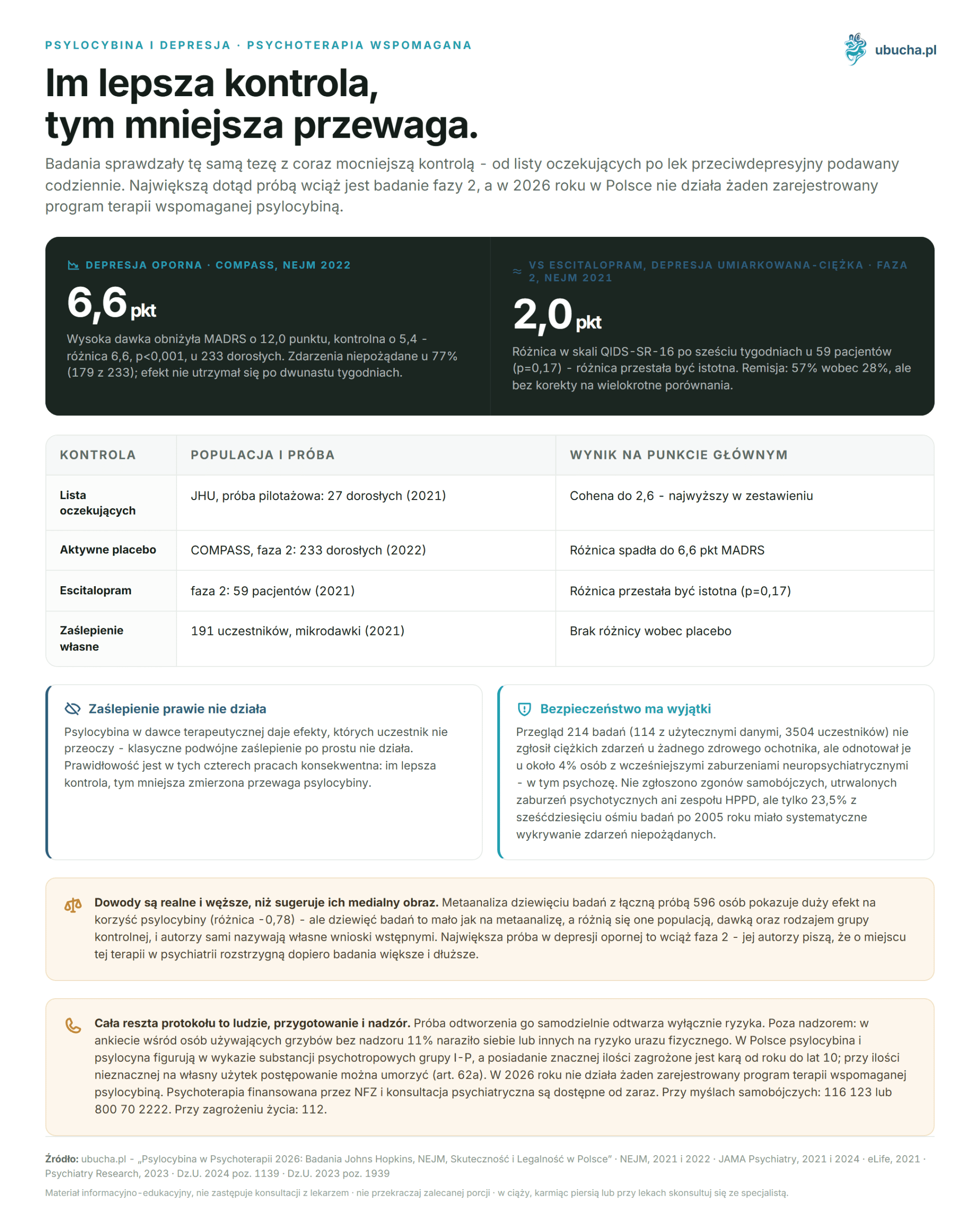
- In direct comparison with escitalopram, psilocybin showed no significant difference in the primary endpoint, though it performed better in remission: 57% versus 28% (NEJM, 2021).
- In treatment-resistant depression, a single high dose reduced MADRS score by 12.0 points versus 5.4 in the control arm, with adverse events in 77% of participants (NEJM, 2022).
- Serious adverse events occurred in about 4% of participants with prior neuropsychiatric disorders and in no healthy volunteers (JAMA Psychiatry, 2024).
- Microdosing did not differ from placebo in the largest blinded study of 191 people (eLife, 2021).
- In Poland, psilocybin and psilocin are listed in Schedule I-P psychotropic substances, and possession of a significant amount is punishable by 1 to 10 years imprisonment.
What is psilocybin and where does it come from?
Psilocybin is a tryptamine alkaloid found in mushrooms of the genus Psilocybe. In the late 1950s, Albert Hofmann from Sandoz laboratories identified and synthesized psilocybin and psilocin, and Sandoz marketed it for research under the name Indocybin, intended for psychopharmacological and clinical studies (ACS Chemical Neuroscience, 2018).
Chemically, psilocybin is a prodrug. After ingestion, it is dephosphorylated to psilocin, which is responsible for the central nervous system effects. This distinction is practical because both substances are listed separately in the Polish controlled substances list.
Mushrooms containing these compounds were used in rituals of Mesoamerican peoples long before their chemical identification. Mazatec healers from Oaxaca used them in ceremonies called velada, and Western attention was drawn by a report from American ethnobotanist R. Gordon Wasson in the late 1950s.
The brief research period ended quickly. Psilocybin was placed in the US Schedule I in 1970, halting clinical research on it and other classical psychedelics for decades (ACS Chemical Neuroscience, 2018). The renaissance came with Roland Griffiths’ team at Johns Hopkins. In a double-blind study, a high dose of psilocybin was compared to methylphenidate in thirty volunteers without prior hallucinogen experience. Two months after sessions, participants rated the psilocybin experience as having significant personal and spiritual value, confirmed by independent observers (Psychopharmacology, 2006). This study opened the way for other centers.
How does psilocybin affect the brain?
Psilocin, the active metabolite of psilocybin, acts as a partial agonist of the serotonin 5-HT2A receptor. This receptor is densely located in pyramidal neurons of the prefrontal cortex, and its activation changes how large brain networks exchange signals. Up to this point, there is consensus. Beyond that, misunderstandings arise that need clarification.
The most repeated simplification is that psilocybin quiets the default mode network. Carhart-Harris’ imaging study says otherwise. In nineteen patients with treatment-resistant depression, cerebral blood flow and resting connectivity were measured before and after treatment. After treatment, blood flow decreased in the temporal cortex, including the amygdala, correlating with symptom reduction. Connectivity within the default mode network increased, not decreased, and the authors propose a reset metaphor. Clinical response after five weeks was 47% (Scientific Reports, 2017).
This difference is important because popular texts describe the acute effect during the session but attribute it to the brain state a week later. These are two different measurements, and the authors explicitly separate them.
The second thread is neuroplasticity. In mice, using two-photon microscopy, a single dose of psilocybin increased the size and density of dendritic spines by about 10% in the frontal cortex. The change appeared within a day and persisted a month later (Neuron, 2021). This is an animal model, not human, and neither mood nor blood markers were measured. The statement about increased BDNF levels often accompanying this work in popular texts does not come from it.
What did the comparison of psilocybin with escitalopram show?
This is the only direct comparison of psilocybin with a first-line antidepressant so far, and its result is more cautious than headlines suggest. The phase 2 study included 59 patients with long-term moderate to severe depression. Thirty were assigned to psilocybin, twenty-nine to escitalopram, all receiving psychological support. Results were published in the New England Journal of Medicine (NEJM, 2021).
The primary endpoint was change in QIDS-SR-16 score after six weeks. The psilocybin group improved by -8.0 points, escitalopram by -6.0 points. The 2.0-point difference had a confidence interval from -5.0 to 0.9 and p = 0.17, not statistically significant. The authors state the study did not show a significant difference in antidepressant effect between interventions.
Secondary endpoints favored psilocybin: clinical response was 70% vs. 48%, remission 57% vs. 28%. However, the authors note that secondary analyses were not corrected for multiple comparisons and should not be read as confirmed results.
Three misconceptions circulate about this work. First, it was published in NEJM, not Nature Medicine. Second, it concerned moderate to severe depression, not treatment-resistant depression. Third, it did not show psilocybin superiority, only no significant difference in the primary measure with a favorable remission distribution. This is elaborated in the Johns Hopkins and phase 3 COMPASS study results article.
What did the largest psilocybin study in treatment-resistant depression show?
The largest trial to date is the phase 2 Compass Pathways study, published in NEJM in 2022. It involved 233 adults with treatment-resistant depression, randomized to three doses of synthetic psilocybin. The lowest dose served as active placebo. Each participant had one dosing session with psychological support (NEJM, 2022).
The primary endpoint was change in MADRS score after three weeks. Mean changes were -12.0 points in the high-dose arm, -7.9 in the intermediate, and -5.4 in control. The difference between high dose and control was -6.6 points (CI -10.2 to -2.9, p < 0.001). The intermediate dose difference was not significant.
Two points often lost in summaries: safety and durability. Adverse events occurred in 179 of 233 participants (77%), most commonly headache, nausea, and dizziness. Suicidal thoughts or behaviors were noted in all arms, including control. Response and remission rates supported the main result at three weeks but not at twelve weeks.
The authors conclude that a high dose reduced depression severity more than control at three weeks, at the cost of adverse events. Larger and longer studies comparing to existing treatments will determine this therapy’s place in psychiatry, as the authors state.
How did psilocybin perform in treatment-resistant depression at Johns Hopkins?
The Johns Hopkins team studied psilocybin in people with depressive disorder not taking antidepressants. The study included 27 adults randomized to immediate or delayed treatment (waiting list control), with 24 completing both sessions and assessments. The protocol involved two dosing sessions and about eleven hours of supportive psychotherapy (JAMA Psychiatry, 2021).
Baseline GRID-HAMD score averaged 22.8 points. In the immediate group, it dropped to 8.0 one week after intervention and 8.5 four weeks after, while the delayed group scored 23.8 and 23.5 at comparable times. Effect sizes were large, Cohen’s d 2.5 and 2.6, p < 0.001.
Clinical response (≥50% score reduction) was achieved by 71% at one and four weeks post-intervention. Remission was 58% at one week and 54% at four weeks.
Keep in mind the scale: 27 people randomized to two arms is a pilot, and waiting list control does not protect against expectancy effects like active placebo. Effect sizes look spectacular because comparison is to no intervention, not another therapy. The authors describe the result as an extension of earlier observations, not definitive proof.
Does the effect last longer than a few weeks?
The longest observation from the same center was published in 2022. Twenty-four Johns Hopkins participants were followed for twelve months after the second session, all attending all follow-ups. Large reductions in GRID-HAMD scores persisted at 1, 3, 6, and 12 months, with Cohen’s d of 2.3, 2.0, 2.6, and 2.4 respectively (Journal of Psychopharmacology, 2022).
After twelve months, 75% met clinical response and 58% remission criteria. No serious adverse events related to psilocybin were reported, and no participant reported use outside the study.
However, this study found that personal significance, spiritual, and mystical experience ratings predicted increased well-being after a year but did not predict depression improvement. The idea that stronger mystical experience leads to better antidepressant effect is not supported here.
Limitations are the same: 24 people, no control group during follow-up, self-reported symptoms. The result means some patients had durable improvement, and nothing more. Authors cautiously state antidepressant effects may last at least twelve months in some patients.
What does the pooled analysis of all psilocybin depression studies show?
Single studies can be cherry-picked, so it’s worth seeing the whole. A systematic review with meta-analysis in Psychiatry Research searched for randomized and open-label studies measuring depression symptoms after psilocybin therapy. The search yielded 1734 records, with thirteen studies including 686 people in qualitative or quantitative analysis (Psychiatry Research, 2023).
Nine studies with 596 participants entered the meta-analysis. The pooled standardized mean difference between psilocybin and control arms was -0.78, p < 0.001. This is a large effect in psychiatric terms. Relative risks for clinical response and remission were also large and significant favoring psilocybin, and open-label studies showed clear symptom reductions.
Three factors temper this result. First, nine studies is few for meta-analysis, differing in population, dose, and control type, so the pooled result averages non-comparable things. Second, some included studies were open-label without blinding. Third, authors call their findings preliminary evidence, stating further research on safety, efficacy, and protocol optimization is needed.
It’s useful to compare effect sizes: 2.5 Cohen’s d from the waiting list study and -0.78 pooled from comparisons with real controls are not contradictory but measure how much improvement is due to the substance versus context.
Why is blinding so difficult in these studies?
Therapeutic doses of psilocybin produce effects participants cannot miss, so classic double-blinding fails. Each study addressed this differently, and the choice affects result meaning. Understanding these four approaches explains most apparent contradictions in headlines.
The weakest control was Johns Hopkins’ depression study with waiting list control (JAMA Psychiatry, 2021). Participants knew if they received nothing, so expectancy effects fully influenced results, yielding Cohen’s d around 2.5, the highest in the set.
Stronger control was Compass Pathways’ trial, where the control arm received the lowest psilocybin dose as active placebo (NEJM, 2022). Participants felt something in all arms, making allocation guessing harder. The difference between arms dropped to 6.6 MADRS points. Even further was the escitalopram comparison, where both arms received daily pills and dosing sessions (NEJM, 2021). Here, the primary measure difference was not significant.
This is not theoretical: the microdosing study attributed residual group differences to some participants recognizing their capsule and breaking blinding (eLife, 2021). The pattern is consistent: better control means smaller measured psilocybin advantage.
What is known about psychedelic use outside the clinic?
Besides clinical trials, epidemiological literature describes people using psychedelics independently. The broadest review was by Johnson’s team in Pharmacology and Therapeutics. They write that several population studies link naturalistic, non-laboratory use of classical psychedelics with better mental health and prosocial behaviors (Pharmacology and Therapeutics, 2019).
This sentence is sometimes cited as proof psychedelics are safe outside clinics, which is incorrect. The same authors add that some people suffer harm from classical psychedelics without supervision. Epidemiological data describe correlation, not causation: psychedelic users differ from others in many uncontrolled ways.
The same review clarifies mystical experience: classical psychedelics reliably induce it, and its occurrence is linked to better psychological outcomes in healthy volunteers and patients. This must be read alongside the twelve-month Johns Hopkins observation, where mystical experience intensity predicted later well-being but not depression improvement.
The practical takeaway is simple. Survey associations do not translate to individual decisions because surveys describe population distributions, not individual outcomes. Risks of unsupervised use are described directly and are measurable.
Does psilocybin help oncology patients?
This area has the longest observation in the field. Two independent 2016 studies included oncology patients with anxiety and depression related to life-threatening illness. At Johns Hopkins, 51 patients received alternating very low (near placebo) and high doses. The high dose produced large reductions in depressive mood and anxiety, improved quality of life, and reduced death anxiety. After six months, about 80% still showed clinically significant improvement (Journal of Psychopharmacology, 2016). The authors report that mystical experience on dosing day mediated the dose-effect relationship. Instructions aimed to limit expectancy effects.
A parallel New York University study included 29 patients in a crossover design with niacin as comparator. Psilocybin produced rapid and sustained improvement in anxiety and depression, reduced demoralization and hopelessness. At six and a half months, 60% to 80% still met clinically significant response criteria (Journal of Psychopharmacology, 2016).
Participants were recontacted after a mean of 3.2 and 4.5 years. Fifteen of sixteen living agreed. Anxiety, depression, hopelessness, and death anxiety reductions persisted, and 60% to 80% still met response criteria at 4.5 years (Journal of Psychopharmacology, 2020).
The authors limit conclusions: the crossover design means everyone eventually received active substance, so efficacy conclusions are limited. This is discussed in the psychedelics in end-of-life anxiety review.
What is the set-setting-integration protocol?
This is a three-phase clinical framework in which psilocybin is administered in studies. It is not an add-on but part of the intervention: none of the cited studies tested psilocybin alone, always combined with preparation, therapist presence, and post-session work. When media say psilocybin cures depression, they omit half of what was actually measured.
The support scale is visible in protocols. In Johns Hopkins depression study, participants received about eleven hours of psychotherapy around two sessions, and in smoking cessation, psilocybin was given within a cognitive-behavioral therapy program spanning weeks.
| Phase | Includes | Clinical function |
|---|---|---|
| Set | Preparation sessions, interview, history and concerns discussion, intention setting | Builds predictability and screens contraindications before dosing |
| Setting | Quiet room, eye mask, prepared music, two therapists present throughout session, vital signs monitoring | Limits anxiety escalation and allows response to somatic events |
| Integration | Post-session meetings, work on translating experience into daily choices | Maintains therapeutic contact during symptom return window |
We must honestly say what we don’t know. None of the discussed studies compared the full protocol with psilocybin to protocol without support, as such a design would be unethical. The importance of each phase separately remains unestimated. We do know the safety profile under supervised conditions, which is a separate measurable matter.
Does psilocybin help with addictions?
The strongest single work is a randomized double-blind study in alcohol dependence, published in JAMA Psychiatry. Ninety-five participants were randomized to psilocybin or diphenhydramine as active placebo, all receiving twelve weeks of structured psychotherapy. The percentage of heavy drinking days over 32 weeks was 9.7% in the psilocybin arm versus 23.6% in control, with a mean difference of 13.9 percentage points and p = 0.01. No serious adverse events were reported in the psilocybin group (JAMA Psychiatry, 2022).
The second thread is nicotine, with much weaker data than its popularity suggests. An open pilot study included only fifteen long-term smokers who received two or three psilocybin doses within cognitive-behavioral therapy. After twelve months, biologically confirmed abstinence was 67% (ten people). At longer follow-up, about thirty months, abstainers were nine (60%) (American Journal of Drug and Alcohol Abuse, 2017).
Fifteen people without control is not a basis for pharmacotherapy comparisons, yet such comparisons circulate online as fact. The authors describe the result as a promising signal needing further research, not proven superiority over existing treatment.
Interestingly, both studies suggest a similarity: the substance was given a few times, and behavioral change persisted months after the substance was gone. This does not look like classical pharmacological action and is why it is further studied.
What are the main risks of psilocybin therapy?
The best available risk picture comes from a systematic review with meta-analysis published in JAMA Psychiatry. It included 214 studies, 114 reporting analyzable data, covering 3504 participants. No serious adverse events were reported in healthy volunteers, about 4% occurred in those with prior neuropsychiatric disorders, including psychosis and suicidal behaviors. Depression worsening and seizures were also noted (JAMA Psychiatry, 2024).
This review dispels two scare stories. In modern research conditions, no deaths by suicide or persistent psychotic disorders were reported after high doses of classical psychedelics. No HPPD syndrome was reported either. However, the authors caution that only 23.5% of 68 studies published after 2005 described systematic adverse event detection. The low rate may partly reflect lack of monitoring.
| Risk area | What is known |
|---|---|
| Psychiatric | Serious events in about 4% with prior neuropsychiatric disorders, including psychosis and suicidal behaviors |
| Acute reactions | Most common events: headache, anxiety, nausea, fatigue, dizziness, similar frequency for psilocybin and LSD |
| Unsupervised use | One in nine survey respondents endangered self or others with physical injury risk |
| Drug interactions | Protocols exclude patients on serotonergic drugs; safety of such combinations remains unstudied |
The drug interaction topic with antidepressants is discussed separately in the contraindications, SSRI and IMAO drugs, and serotonin syndrome article.
What does the survey among unsupervised mushroom users show?
A separate picture comes from a survey of people using mushrooms without any supervision. 1993 people described their most difficult psilocybin experience. 39% rated it among the five hardest life experiences, and 11% endangered themselves or others with physical injury risk. Medical help was sought by 2.7%, and among those whose experience was over a year ago, 7.6% sought treatment for persistent mental symptoms (Journal of Psychopharmacology, 2016).
The same survey shows risk factors: likelihood of endangering self or others increased with estimated dose, episode length, and subjective difficulty, and decreased where physical comfort and support were provided. This is exactly the set controlled by clinical protocols but uncontrolled in random settings. Aggressive or violent behavior was reported by 2.6%, three reports linked to onset of persistent psychotic symptoms, and three to suicide attempts.
Comparing this survey with clinical research is instructive. Despite difficulties, 84% said the experience helped them, and difficulty degree correlated positively with later well-being. The authors do not encourage use but conclude that risky behaviors and persistent suffering are extremely rare when psilocybin is given to screened, prepared, and supported people.
One methodological caveat: respondents self-selected, recalled their worst experience, and researchers could not verify dose or substance composition. Thus, numbers do not estimate complication frequency in the population but describe characteristics distribution among those with difficult experiences who chose to report.
How does synthetic psilocybin differ from mushrooms?
All discussed clinical studies used synthetic psilocybin, not dried mushrooms. The reason is practical, not ideological: without known active substance content, randomization and arm comparison are impossible. Mushrooms contain psilocybin, psilocin, and other tryptamine alkaloids in variable proportions depending on strain and growth conditions.
The molecule itself is identical. Psilocybin isolated from mushrooms and synthesized in a lab is the same compound, undergoing the same conversion to psilocin after ingestion (ACS Chemical Neuroscience, 2018). The difference lies not in the active chemistry but in what else is in the material and in what amount.
This distinction directly affects readers. Clinical trial results describe effects of a known dose of a known compound given under supervision. They do not describe effects of unknown amounts of unknown plant material taken at home. Transferring numbers from the first to the second situation is a mistake repeated in almost every popular text on the topic.
We noticed in Polish psychedelic discussions that three very different things are regularly mixed: recreational mushroom use, unsupervised home microdosing, and structured clinical therapy. Only the third has the data described above. The first two appear in cited studies only as sources of surveys on difficult experiences.
Does microdosing psilocybin work?
The best available test does not confirm its efficacy. A self-blinded study, conducted as citizen science, included 191 participants, making it the largest psychedelic placebo-controlled trial to date. Participants received online instructions on how to intersperse placebo in their microdosing schedule without clinical supervision (eLife, 2021).
All psychological measures improved significantly after four weeks in the microdosing group. They also improved in the placebo group, with no significant differences between groups. Some acute and subacute scales showed small but significant microdose advantages, but authors attribute these to participants recognizing their capsule and breaking blinding. The study concludes anecdotal microdosing benefits can be explained by placebo effect.
This does not mean participants felt nothing. Placebo group improvement was real and measurable. It means the benefit is due to the practice itself: regularity, journaling, intention to address one’s state.
It is worth noting how this study was done. Participants sourced the substance, prepared capsules, and conducted measurements per online instructions without clinical center involvement. This addresses a real obstacle: no one will easily fund or register a classical microdosing trial since the substance is controlled in most countries.
For Polish readers, one more layer: microdose is still the same substance from the same list, so quantity difference does not change legal assessment. Possession of mushrooms containing psilocybin for microdosing is subject to the same laws as possession for any other purpose.
What have psilocybin studies not yet resolved?
The list of open questions is longer than answers, and none are trivial. First concerns durability. The longest controlled protocol observation ends at twelve months, and in the largest treatment-resistant depression trial, maintained response at twelve weeks did not confirm the three-week result (NEJM, 2022). Whether patients need repeated sessions and what happens after years is unknown.
Second concerns the substance’s contribution. No study compared the full protocol with psilocybin to protocol without preparation and post-session work, so we don’t know how much effect is due to the molecule versus hours of therapist contact. This question is simple but determines cost and scalability.
Third concerns drugs. Protocols exclude patients on serotonergic drugs, so safety of combining psilocybin with antidepressants has not been studied in controlled human conditions. This describes exactly the person most often seeking information on this topic.
Fourth concerns data quality on safety. Among studies published after 2005, only 23.5% described systematic adverse event detection, and all 214 included studies differed in reporting methods (JAMA Psychiatry, 2024). The low complication rate may partly reflect how events were sought. The review authors call explicitly for better safety monitoring, not reassurance.
What is the legal status of psilocybin in Poland?
Psilocybin and psilocin are listed in Schedule I-P psychotropic substances, annex to the Minister of Health’s regulation on psychotropic substances, narcotics, and new psychoactive substances (Dz.U. 2024 poz. 1139). Mushrooms themselves are not listed, but the substances they contain are, which suffices to cover material containing them under the anti-narcotics law.
Sanctions are defined by the July 29, 2005 anti-narcotics act, consolidated text 2023 (Dz.U. 2023 poz. 1939). The table below states the provisions, not their interpretation.
| Provision | Act | Penalty |
|---|---|---|
| art. 62 sec. 1 | Possession of psychotropic substance contrary to law | Imprisonment up to 3 years |
| art. 62 sec. 2 | Possession of significant amount | Imprisonment from 1 to 10 years |
| art. 62 sec. 3 | Lesser offense | Fine, restriction of liberty, or imprisonment up to 1 year |
| art. 62a | Small amount for personal use | Proceedings may be discontinued, even before investigation |
| art. 56 sec. 1 and 3 | Introducing into or participating in trade | Fine and imprisonment from 6 months to 8 years, or 2 to 12 years for significant amount |
Two clarifications are needed as they circulate in Polish internet. Article 63, concerning illegal cultivation, lists poppy, non-fiber hemp, and coca bush. Mushrooms are not listed, so citing this article regarding mushroom cultivation is incorrect. Second, article 62 sec. 2 prescribes a penalty from one year to ten years, meaning no suspended sentence. In 2026, no registered psilocybin-assisted therapy program operates in Poland.
What legal mental health support is available in Poland?
The first and best documented path remains psychotherapy. Cognitive-behavioral therapy, acceptance and commitment therapy, and EMDR have decades of research in depression, anxiety, and PTSD. The National Health Fund (NFZ) funds psychotherapy in mental health clinics, and referral is not required.
The second path is pharmacotherapy by psychiatrists. SSRIs and SNRIs remain first-line for moderate to severe depression. Esketamine nasal spray is available for treatment-resistant depression, approved in the EU and administered under medical supervision (EMA, 2019). The third is prescription cannabis, available in Poland for selected indications.
Supplements stand apart and require caution. CBD is sometimes presented as psilocybin without legal risk, which is a misunderstanding: different mechanism, evidence profile, and effect scale. In a retrospective analysis of 72 adults with anxiety or sleep disorders in a psychiatric clinic, anxiety severity decreased in the first month in 79.2%, and sleep quality improved in 66.7%, though sleep results fluctuated (Permanente Journal, 2019). This was an observational study without control, not a clinical trial.
It is also important to know the current safety assessment. The EFSA panel derived a temporary safe CBD dose in 2026 of 0.0275 mg/kg body weight per day, about 2 mg daily for a 70 kg person, and noted safety cannot be established for people under 25, pregnant or breastfeeding women, and those taking medications (EFSA Journal, 2026). The last group includes many readers of this text. We discuss CBD and mood in the does CBD help treat depression article.
Summary: what is known today about psilocybin in psychotherapy?
Evidence is real but narrower than media portrayals suggest. A meta-analysis of nine studies with 596 participants shows a large effect versus controls, standardized mean difference -0.78 (Psychiatry Research, 2023). The largest treatment-resistant depression trial showed a 6.6 MADRS point difference versus control, with adverse events in three-quarters of participants.
Direct comparison with escitalopram showed no significant difference in the primary endpoint. Psilocybin’s remission advantage comes from uncorrected secondary analyses and should be read accordingly.
The safety profile under supervision looks good but not empty: serious events affected about 4% with prior neuropsychiatric disorders, the very group targeted by therapy. Outside supervision, the picture changes qualitatively, as seen in a survey of nearly two thousand people.
Microdosing did not differ from placebo in the largest blinded study. Reported improvement is real but relates to practice, not substance.
For Polish readers, the practical conclusion is one. Psilocybin remains a Schedule I-P substance, no registered therapy program exists, and attempting to replicate research protocols independently reproduces only risks, as the rest of the protocol is people, preparation, and supervision. If you struggle with depression, anxiety, or addiction, talking to a psychiatrist is an immediately available path and the best place to start.
Frequently Asked Questions
Is psilocybin legal in Poland in 2026?
No. Psilocybin and psilocin are listed in Schedule I-P psychotropic substances (Dz.U. 2024 poz. 1139). Possession is punishable by imprisonment up to 3 years, and for significant amounts from 1 to 10 years. In 2026, no registered psilocybin-assisted therapy program operates in Poland.
Is psilocybin more effective than antidepressant drugs?
This has not been demonstrated. In the only direct comparison with escitalopram, the difference in the primary endpoint was 2.0 points on the QIDS-SR-16 scale and was not statistically significant (NEJM, 2021). Remission was 57% versus 28%, but this comes from secondary analyses without correction for multiple comparisons.
Does psilocybin quiet the default mode network?
Not after treatment. In an imaging study of patients with treatment-resistant depression, connectivity within the default mode network increased after treatment, while cerebral blood flow decreased in the temporal cortex and amygdala (Scientific Reports, 2017). The popular notion of quieting describes the acute effect during the session, not the brain state a week later.
How long does the effect of psilocybin therapy last?
In the Johns Hopkins observation after twelve months, 75% of participants met clinical response criteria and 58% remission (Journal of Psychopharmacology, 2022). Among oncology patients, 60% to 80% still met response criteria after 4.5 years, but the sample included fifteen people without a control group.
Does the mystical experience determine the antidepressant effect?
Data from a one-year observation contradict this. Ratings of personal significance and mystical experience after sessions predicted higher well-being after twelve months but did not predict improvement in depression itself (Journal of Psychopharmacology, 2022). This finding contradicts the popular narrative about the power of the experience.
What are the most serious risks of psilocybin?
In a review of 214 studies, serious adverse events occurred in about 4% of participants with prior neuropsychiatric disorders and in no healthy volunteers. These included psychosis, suicidal behaviors, and seizure episodes (JAMA Psychiatry, 2024). Only 23.5% of newer studies described systematic detection of adverse events.
Is microdosing psilocybin proven effective?
No. In a self-blinded study of 191 people, the microdosing group and placebo group improved similarly, with no significant differences between them (eLife, 2021). The authors attribute observed benefits to placebo effect and breaking of blinding by participants.
What legal mental health support is available in Poland?
Psychotherapy funded by NFZ in mental health clinics, pharmacotherapy conducted by psychiatrists, intranasal esketamine for treatment-resistant depression (EMA, 2019), and prescription cannabis for selected indications. CBD supplements may be a complement, not a substitute for psychiatric treatment.
Legal support for sleep and tension can be found in our hemp oils category.
This article is informational and educational. It describes clinical studies where the substance is administered under physician supervision after participant qualification; independent use does not replicate these conditions. These substances are controlled in Poland under the anti-narcotics law. If you have suicidal thoughts, call free 24/7 numbers 116 123 or 800 70 2222. In life-threatening situations: 112.
Author: Michał Waluk · Published: 2026-05-04 · Updated: 2026-08-10