
Hemp Cannabinoids as Natural Pesticides - Research, Mechanisms, and Agricultural Perspectives 2026
Acidic CBDA and CBGA limit larval feeding in Cornell University studies. Evidence, mechanisms, and legal status in the European Union and Poland.
Industrial hemp has produced cannabinoids for millions of years, and the question of why this metabolically costly investment exists remained unresolved for a long time. In 2023, a team from Cornell University published a study in Horticulture Research that combined field observation, detached leaf tests, and administration of pure cannabinoids in an artificial insect diet. The conclusions were more cautious than the popular narrative about a natural pesticide suggests, but they were based on measurements. This article breaks down that study, shows exactly what was measured, explains why insects respond to cannabinoids despite lacking CB1 and CB2 receptors, and describes the legal status in the European Union that currently determines any possible use.
KEY INFORMATION
• The study by Stack et al. from Cornell University (Horticulture Research, 2023) showed an inverse relationship in the field between cannabinoid concentration in leaves and damage from chewing insects.
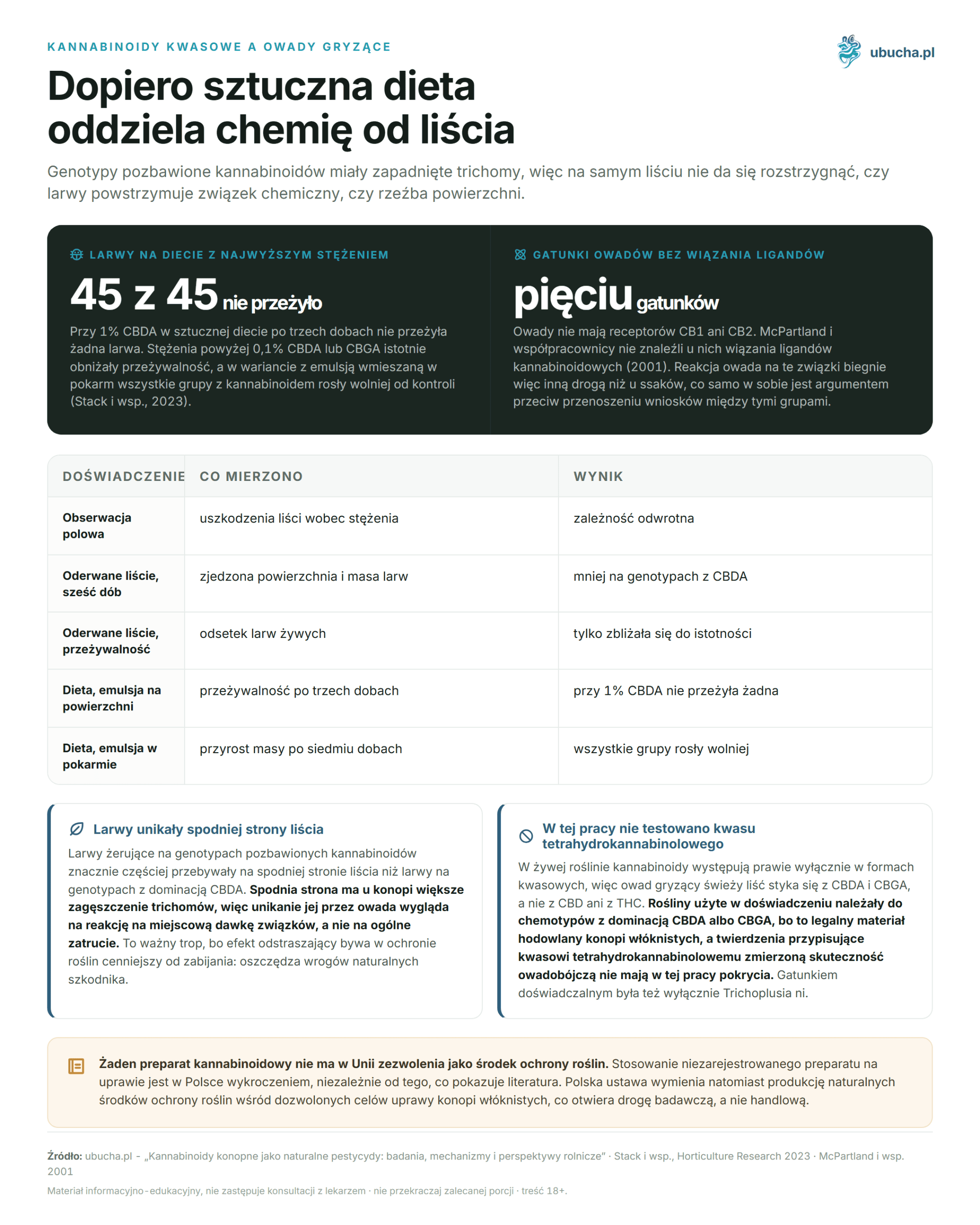
• In an artificial diet, concentrations above 0.1% CBDA or CBGA significantly reduced survival of Trichoplusia ni larvae; at 1% CBDA after three days none of 45 larvae survived.
• The study included CBDA and CBGA. THCA was not tested, and the experimental species was exclusively Trichoplusia ni, not Spodoptera frugiperda.
• Insects lack CB1 and CB2 receptors. McPartland et al. (Journal of Comparative Neurology, 2001) found no cannabinoid ligand binding in five studied species.
• No cannabinoid preparation has authorization as a plant protection product in the European Union. Using an unregistered product on crops is a misdemeanor in Poland.
• Polish law lists production of natural plant protection products among permitted purposes for fiber hemp cultivation, which opens a research path but not a commercial one.
What exactly did the Cornell University study show?
The team of Stack et al. from Cornell University tested the herbivore defense hypothesis on an F2 population derived from crossing Carmagnola and USO-31 varieties (Horticulture Research, 2023, PMC10681003). The population segregates into three chemotypes: plants dominant in CBDA, plants dominant in CBGA, and plants practically devoid of cannabinoids. This setup allows comparison of genotypes with common origin differing mainly in cannabinoid profile.
The work consists of three independent experiments rather than a single laboratory test. The first was a field observation of leaf damage by chewing insects. The second was a detached leaf test with Trichoplusia ni larvae, conducted over six days. The third was administration of purified cannabinoids in an emulsion to an artificial insect diet, in two variants: applied on the surface and mixed into the food mass.
One result from the detached leaf test deserves special attention because it concerns behavior rather than mortality. Larvae feeding on cannabinoid-free genotypes spent significantly more time on the underside of the leaf than larvae on CBDA-dominant genotypes. The underside of hemp leaves has a higher density of trichomes, so avoidance by the insect appears to be a reaction to local doses of compounds rather than general poisoning. This is an important clue, as repellent effects can be more valuable in plant protection than killing: they spare natural enemies of the pest.
Separating these levels matters because only the artificial diet isolates the cannabinoid itself from other plant traits. Cannabinoid-free genotypes had collapsed trichomes, so on the leaf it is impossible to determine whether larvae are deterred by chemistry or by surface structure.
| Experiment | What was measured | Result |
|---|---|---|
| Field observation | Leaf damage by chewing insects relative to cannabinoid concentration in leaf | Inverse relationship: the more cannabinoids, the less damage |
| Detached leaves, Trichoplusia ni larvae, 6 days | Leaf area eaten, larval mass, position on leaf, survival | Less leaf area eaten and lower mass on CBDA genotypes. Survival approached statistical significance |
| Artificial diet, emulsion applied on surface | Larval survival after three days | Concentrations above 0.1% CBDA or CBGA significantly reduced survival. At 1% CBDA none of 45 larvae survived |
| Artificial diet, emulsion mixed into food | Mass gain after seven days | All cannabinoid groups grew slower than control. The 1% CBDA variant performed worse than 1% CBGA |
Why were acidic CBDA and CBGA studied instead of neutral CBD and THC?
In the living plant, cannabinoids occur almost exclusively in acidic forms. Neutral variants form only after decarboxylation, i.e., removal of the carboxyl group by heat or prolonged storage. An insect chewing a fresh leaf contacts CBDA and CBGA, not CBD or THC. Choosing acidic forms in the Cornell experiment replicates what happens in the field, not what reaches the consumer product.
It is worth clarifying a recurring misunderstanding. THCA was not tested in this work. The plants used belonged to chemotypes dominant in CBDA or CBGA, as this is legal fiber hemp breeding material. Claims attributing measured insecticidal efficacy to tetrahydrocannabinolic acid in this study are unsupported. More about the molecule itself and how it differs from the neutral form can be found in the article THCA: what it is and how it differs from THC.
Neutral CBD also has documented activity against insects, but from other studies. Park et al. showed in Scientific Reports that Manduca sexta larvae prefer tissue with lower CBD content and grow slower and die more often on a diet with high CBD (Scientific Reports, 2019). This is a separate line of evidence, conducted on a different species and chemical form.
How do cannabinoids affect insects without CB1 and CB2 receptors?
Insects lack an endocannabinoid system as known in mammals. McPartland et al. directly tested this: in tissues of honeybee, fruit fly, damselfly, Spodoptera frugiperda, and Zophobas atratus beetle, they found no specific binding of synthetic cannabinoid ligands, and in the fruit fly genome found no orthologs of CB1 and CB2 receptors or fatty acid amide hydrolase (Journal of Comparative Neurology, 2001). The authors hypothesized that receptors were lost due to lack of ligands, as insects produce little or no arachidonic acid.
Lack of receptor does not mean lack of effect. Measured effects indicate pathways independent of classical cannabinoid signaling, though none has been fully described. Below are findings cited by the Cornell team.
- Change in nervous system electrical activity. Electrophysiological recordings from Manduca sexta larval ganglia treated with CBD showed delayed but stronger responses to stimuli than controls (Scientific Reports, 2019).
- Disruption of feeding and growth. Larvae on diets with higher cannabinoid concentrations eat less and grow slower, seen in both Cornell and Park et al. studies.
- Changes in detoxification and digestive enzyme activity. Abendroth et al. described changes in cytochrome P450 and beta-glucosidase activity in Spodoptera frugiperda after CBD exposure (Arthropod-Plant Interactions, 2023).
- Molting disruption. A thesis cited by Cornell describes cuticle formation disruption in Manduca sexta leading to fatal molting errors. This is the weakest link in this list in terms of source rank.
The Cornell team also notes that all mechanistic studies so far have been on caterpillars and moth larvae, a single insect order with one feeding mode. It is unknown if the same mechanism applies to piercing-sucking insects like aphids, which do not consume leaf tissue but pierce vascular bundles, bypassing the surface layer and trichomes. If the effect depends on contact with the leaf surface, this group may be unaffected.
Popular descriptions add TRP channels, octopamine receptors, mitochondrial respiration uncoupling, and cyclooxygenase inhibition in insects. None of these pathways has been confirmed in studies that actually measured cannabinoid effects on larvae. Treat them as hypotheses to test, not established mechanisms.
Which insects respond to cannabinoids and which do not avoid them?
The answer depends on species and can be opposite to expectations. Cannabinoids do not act as broad-spectrum poisons but as signals that some insects interpret as warnings while others ignore or even prefer. This selectivity is scientifically more interesting than toxicity itself, as it informs about plant-insect evolutionary relationships.
| Species | Study | Observation |
|---|---|---|
| Trichoplusia ni, cabbage looper | Stack et al., Horticulture Research, 2023 | Reduced feeding and slower growth on CBDA leaves, higher mortality on CBDA or CBGA diet |
| Manduca sexta, tobacco hornworm | Park et al., Scientific Reports, 2019 | Preference for tissue with lower CBD, poorer growth and higher mortality on high CBD diet |
| Spodoptera frugiperda | Abendroth et al., Arthropod-Plant Interactions, 2023 | Reduced food intake and slower growth depending on CBD dose |
| Tribolium confusum, Oryzaephilus surinamensis, Plodia interpunctella | Mantzoukas et al., Biology, 2020 | Larvicidal effect of CBD oil against three stored product pests |
| Pieris brassicae, large white butterfly | Rothschild and Fairbairn, Nature, 1980 | Females laying eggs distinguish extracts from two hemp varieties and THC from CBD |
| Drosophila melanogaster, fruit fly | He et al., Scientific Reports, 2021 | Opposite direction: flies developed preference for food with added phytocannabinoids |
Two things stand out. First, reliable data come almost exclusively from caterpillars and moth larvae and stored product beetles. Aphids, spider mites, thrips, and harmful dipterans in field crops have not been properly studied in this context. Second, fruit flies behave exactly opposite to caterpillars, which alone excludes a universal repellent story.
The most interesting result in this set is often overlooked because it does not fit the simple poison narrative. In the same study, Park et al. tested larvae poisoned with ethanol used as a cannabinoid carrier. Adding CBD increased survival of poisoned larvae by 40% and restored their ability to seek food. The same molecule that kills a caterpillar at high concentration rescues it in another experimental setup. The conclusion is a methodological warning: cannabinoid effect depends on dose, carrier, and insect condition, so a single number out of context describes nothing.
Why does the hemp plant produce cannabinoids at all?
Cannabinoid biosynthesis requires specialized enzymes and separate secretory tissue, so it must be beneficial to the plant. Three hypotheses were considered: defense against herbivores, protection against ultraviolet radiation, and action against pathogens. The Cornell study strengthens the first by providing the missing experimental link.
The argument from distribution is simple. Cannabinoids form in glandular trichomes on the outer surface of leaves and female inflorescences, exactly where the plant contacts insects. Trichome density is highest in reproductive tissues, which have the greatest value for genetic line survival. The authors also note that the difference in cannabinoid concentration between male and female inflorescences may be a clue in the question of the evolution of dioecy in hemp.
The study itself formulates an important caveat. Because the cannabinoid-free trait is linked to collapsed trichomes, the whole-leaf experiment cannot separate chemical effects from physical surface barrier effects. Only administration of purified compounds in artificial diet showed that the cannabinoid itself alters larval growth and survival independently of leaf structure. This is the proper conclusion, not a general statement about millions of years of evolution.
Does the UV-B protection hypothesis hold up?
This hypothesis has a longer history than evidence. Pate proposed in the 1980s that cannabinoids might absorb ultraviolet radiation and protect reproductive tissues, and an early study by Lydon et al. in 1987 noted increased THC content in plants exposed to UV-B. Many popular texts rely on this, usually without mentioning later measurements.
Newer data go the opposite way. Rodriguez-Morrison et al. exposed two hemp varieties to controlled doses of 287 nm radiation for nine weeks of flowering and found no increase in flower yield or cannabinoid concentration (Frontiers in Plant Science, 2021). In one variety, total THC and CBD concentrations even decreased with dose, terpene content declined in both, and plants showed damage: reduced leaf blade, deformities, and decreased photosynthetic efficiency.
The practical conclusion is twofold. For science, the UV hypothesis lacks support in controlled experiments and should not be presented as established fact. For growers, UV supplementation is not a tool to increase cannabinoid content and at higher doses harms the plant.
Do cannabinoids also act on fungi and bacteria?
Insects are not the only target. Appendino et al. tested five main cannabinoids - CBD, CBC, CBG, THC, and CBN - against clinically relevant methicillin-resistant Staphylococcus aureus strains and found strong activity for all five (Journal of Natural Products, 2008). The study analyzed structure-activity relationships, showing which molecular modifications reduce activity.
The study design reveals something valuable about the molecule. Antibacterial activity was little affected by the prenyl chain structure or position, and even by the presence of the carboxyl group, thus maintained in acidic forms. Methylation, acetylation of hydroxyl groups, and esterification of the carboxyl group abolished activity. The authors interpreted this as the olivetol core carrying activity, with the prenyl chain modulating lipid affinity. For a potential product, this means formulation-facilitating modifications may disable activity.
However, it must be honestly stated where this result’s applicability ends. Activity against human pathogenic bacteria in lab conditions says nothing about efficacy against plant pathogens in the field. Studies on cannabinoids’ ability to inhibit plant disease agents are few, and an older observation by McPartland on fungistatic activity against a hemp pathogen from 1984 has not been properly followed up.
In practice, this means we know less about cannabinoids as fungicides than as insecticides, and even there knowledge is limited. Concentrations circulating online for inhibiting gray mold or fusariosis growth, given with unit precision, have no counterpart in peer-reviewed literature. The issue of residue testing and raw material purity is a separate topic discussed in the article on what independent labs test in CBD products.
How do cannabinoids compare to neem, Bt, and pyrethrins?
The comparison today clearly disfavors cannabinoids, but not due to weaker activity. The reason is simpler: azadirachtin, Bacillus thuringiensis, natural pyrethrins, and spinosad have full registration pathways, years of field data, and established doses and application timings. Cannabinoids have none of these.
Acheuk et al. described the state of plant biopesticides in Europe and the Mediterranean, noting a paradox: many substances show promising activity, but few products are registered (Biomolecules, 2022). The bottleneck is not chemistry but cost and time of dossier preparation and lack of ecotoxicological data of quality required by the registering authority.
| Criterion | Recognized Plant Biopesticides | Cannabinoids |
|---|---|---|
| Authorization in the European Union | Yes, for selected active substances | None, for any form |
| Field efficacy data | Multi-year, for many crops | One correlational observation on an experimental plantation |
| Spectrum of pests studied | Broad, with taxonomic group breakdown | Mainly caterpillars, moths, and stored product beetles |
| Product persistence in the field | Described, with pre-harvest intervals | Not studied |
| Data on non-target organisms | Required and available in documentation | Fragmentary, except for a few studies on honeybees |
There is one direct comparison of both worlds in the same protocol. Mantzoukas et al. compared CBD oil with neem oil against fourth instar larvae of three stored product pests on wheat, rice, and corn grains. Both oils showed clear insecticidal activity, causing significant mortality at higher doses, and both experimental groups produced less offspring than controls. The effect was dose-dependent in both cases. This is the closest contest we have today, and it ended in a draw, but it concerns stored product insects, not field pests.
The honest answer to the question of competitiveness is: today cannabinoids do not compete with anything because they are not authorized for use. The question of their place in plant protection will become relevant only when data currently lacking are produced.
Are cannabinoids safe for bees and beneficial insects?
This question determines the fate of any new insecticide, and the answer for cannabinoids is fragmentary. Two pieces of evidence exist, both to be read cautiously as neither is a toxicity study as required for registration.
The first comes from McPartland et al., where the honeybee was one of five species without detectable cannabinoid ligand binding. The second is a hive experiment by Skowronek and Strachecka: workers receiving oil with 30% CBD in syrup or on fabric strips showed higher antioxidant enzyme activity than controls, and higher calcium, magnesium, and phosphorus levels in hemolymph (Antioxidants, 2023). The authors concluded a supportive effect, not absence of harm.
The difference is important and easy to overlook. The antioxidant system study did not measure mortality, brood development, or flight behavior, so it does not replace an ecotoxicological study. There are no data on predators and parasitoids used in biological control, such as ladybugs, green lacewings, or parasitic wasps. Until such data appear, claims of a mild cannabinoid profile for beneficial insects remain speculative.
What does European Union and Polish law say about such use?
The rule is simple and leaves no room for interpretation. A plant protection product may be placed on the market and used only after obtaining authorization, as per Regulation (EC) No 1107/2009, which is directly referenced by the Polish Act of March 8, 2013, on plant protection products (Journal of Laws 2013 item 455). No cannabinoid substance has such authorization in the EU.
The practical consequence applies to everyone, not just commercial producers. The Act provides for a fine for violations, adjudicated under misdemeanor procedures. A specific fine range circulating in discussions is not in the Act text, as fine amounts derive from general misdemeanor regulations, not the plant protection products Act.
A second layer concerns the raw material. Fiber hemp is defined in Polish law as Cannabis sativa L. plants with a sum of delta-9-THC and THCA in flowering or fruiting tops not exceeding 0.3% dry weight. The sum of both compounds counts, not delta-9-THC alone, which affects lab test results and causes costly misunderstandings; this is explained in the article why farmers destroy legal hemp over a fraction of a percent. The basis is Article 4 point 5 of the Act on Counteracting Drug Addiction as amended March 24, 2022 (Journal of Laws 2022 item 763). The national threshold matches the EU threshold numerically but they are separate regulations.
There is one surprising detail. Fiber hemp cultivation requires registration with the producer register maintained by the regional director of KOWR, and the Act lists purposes for which such cultivation may be conducted. Among them is production of natural plant protection products. Thus, the Polish legislator allowed this direction as a cultivation purpose, though a finished preparation still cannot be used without authorization for the product itself.
What does the authorization process look like in the European Union?
It is important to understand there is no single decision but two separate ones at different levels. First, the active substance must be approved at the EU level. Only then can a specific product containing that substance receive authorization for marketing, issued by a member state. The Polish Act on plant protection products does not define these terms independently: it refers directly to definitions in Article 3 of Regulation (EC) No 1107/2009, including the definition of authorization in point ten of that article.
For cannabinoids, this means there is not even a first step. No form, acidic or neutral, has been submitted or approved as an active substance, so the question of national authorization is moot. Regulatory-wise, CBDA and CBD are two different substances, not two forms of the same, so each would require its own documentation.
The law provides for shortened pathways, but none bypasses assessment. Article 53 of Regulation 1107/2009 allows temporary authorization in case of threat; in Poland, such authorization is issued by the minister responsible for agriculture upon request, after consulting the ministers of health and environment. A separate pathway concerns minor uses, i.e., crops too niche to justify full registration. Both pathways assume the active substance is already approved.
This explains why promising lab results rarely lead to a product. The bottleneck is not showing something kills larvae but compiling data on product behavior in the environment, residues in agricultural produce, and effects on non-target organisms. Cannabinoids currently lack all these data sets.
Is it allowed to spray roses with CBD oil from a store?
No, and it is worth breaking this down into three separate reasons, each sufficient alone. This question recurs regularly, usually about aphids on roses or spider mites on tomatoes in a home greenhouse, so it deserves a concrete answer, not dismissal.
The legal reason is simplest: a food or cosmetic product used for plant protection becomes a plant protection product, and no consumer oil has such authorization. This does not change with the size of the crop or that it grows in a pot on a balcony.
The second reason is chemical. Concentrations at which the Cornell study observed effects on larvae concerned emulsions applied to insect food under experimental conditions, not plant spraying. Consumer oil is a suspension in carrier oil with additives not tested for leaf contact. The third reason follows from the second: plant oil applied to leaves in sunlight can cause burns, and the side effect of a home experiment can be worse than the aphids themselves.
For aphids, there are approved and inexpensive solutions: potassium soap, paraffin oils, azadirachtin-based products with current authorization, and introduction of predators. The current list of approved products is maintained by the State Plant Health and Seed Inspection Service, which is the proper source for product choice, not a popular science article.
What do we still not know about cannabinoids as biopesticides?
The Cornell study is a beginning, not a summary. The authors openly state they are far from a complete picture and point out specific gaps. Listing them here is more honest than enumerating supposed advantages, as it shows how much work separates current knowledge from anything applicable.
| Knowledge Gap | Why it blocks any application |
|---|---|
| Fates of stages beyond larval | Larvae in diet experiments were reared six to seven days, so effects on molting, pupation, and adult stage were not measured |
| Spectrum beyond moths and butterflies | Without data on aphids, spider mites, and thrips, usefulness in any real crop cannot be estimated |
| Product behavior in the field | Degradation by light, wash-off by rain, and residual activity after several days not studied |
| Role of trichomes versus chemistry | On intact leaves, cannabinoid effects cannot be separated from surface structure effects |
| Impact on non-target organisms | No data on pollinators or predators used in biological control excludes risk assessment |
There is one more risk rarely discussed because it requires reversing perspective. Since fruit flies developed preferences for food with phytocannabinoids, a preparation based on these compounds may not only repel some insects but also attract others. Risk assessment considers not just toxicity but the overall balance of effects on insect assemblages in crops, including economically neutral and beneficial species. Without such a balance, it is impossible to predict whether treatment will reduce pest pressure or just reshuffle its composition. This question is routinely asked for every new active substance and remains unanswered for cannabinoids.
Added to this is the question of chemical form. Experiments were conducted on acidic forms and neutral CBD, but no systematic comparison of the entire family of compounds in one protocol exists, and hemp produces many more. Method standardization is a prerequisite, as results from different centers vary by extraction method, purity assessment, and larval rearing.
What does this mean for farmers, scientists, and readers?
For farmers, the conclusion is clear and practical. Cannabinoids may not be used today for crop protection in any form, and if you cultivate fiber hemp and observe lower pest pressure than neighboring fields, treat it as a biological curiosity, not an agrotechnical tool. Choose products from the current register maintained by PIORiN.
For scientists and agronomy students, this is an open and well-defined field. Knowledge gaps are explicitly named by the Cornell authors, and Polish centers have a natural advantage: tradition of fiber hemp breeding, access to plant material, and analytical facilities. The context of low-input agriculture is described in the article on hemp in organic farming.
For readers buying hemp products, the distinction is simple. CBD oil is a consumer product, not a plant protection product, and the studies described here say nothing about its use method. Hemp’s value extends far beyond supplements and includes fiber, food, and building materials, each with its own regulations and documentation. Mixing them leads to either financial loss or fines.
Finally, a note on reading reports in this field. The Cornell study is solid and says exactly what it measured: two acidic cannabinoids limit feeding and growth of one caterpillar species, and in the field higher cannabinoid concentration in leaves correlates with less damage. Anything in popular summaries beyond this should be checked in the source before repeating.
Frequently Asked Questions
Do cannabinoids really act on insects like pesticides?
They do, but under experimental conditions and against a narrow group of species. In the study by Stack et al. from Cornell University, concentrations above 0.1% CBDA or CBGA in an artificial diet reduced the survival of Trichoplusia ni larvae, and at 1% CBDA after three days none of the 45 larvae survived. This does not create a product for use in crops.
Which cannabinoids were studied in this context?
The Cornell study tested acidic CBDA and CBGA, as these forms occur in the living plant. THCA was not included in this study. Neutral CBD has separate documentation: Park et al. showed in Scientific Reports poorer growth and higher mortality of Manduca sexta larvae on a diet with a high concentration of this compound.
Is it legal to use cannabinoids for crop protection in Poland?
No. A plant protection product requires authorization according to Regulation (EC) No 1107/2009, which is referenced by the Act of March 8, 2013, on plant protection products. No cannabinoid preparation has such authorization in the European Union, and using an unauthorized product is punishable by a fine under misdemeanor regulations.
Why does the hemp plant produce cannabinoids?
The best documented answer is defense against herbivores. Cannabinoids are produced in glandular trichomes on the outer surface of leaves and female inflorescences, and the Cornell study showed that purified CBDA and CBGA limit growth and survival of larvae even when administered without the plant.
How do cannabinoids affect insects without CB1 and CB2 receptors?
This has not yet been fully determined. McPartland et al. demonstrated in 2001 the absence of cannabinoid ligand binding in five insect species. Measured effects include altered electrical responses of nerve ganglia, reduced feeding, and changes in detoxification enzyme activity, but a consistent mechanism is still lacking.
Can cannabinoids replace chemical plant protection products?
Not in the foreseeable future. There is a lack of field data on product persistence, studies on economically important pests beyond caterpillars, and risk assessment for non-target organisms. Without these three elements, no registration dossier can be created, and without registration, use is not permitted.
Will hemp seed oil or CBD oil work against pests?
Not effectively and not legally. Hemp seed oil practically contains no cannabinoids. CBD oil is a suspension in carrier oil with additives not intended for leaf contact, and using a consumer product for plant protection makes it an unregistered plant protection product.
What does this mean for fiber hemp cultivation in Poland?
For now, it means research potential. Cultivation requires registration with the producer register maintained by the regional director of KOWR, and the law lists production of natural plant protection products among permitted cultivation purposes. The preparation itself would still require separate authorization as a plant protection product.
If you are looking for hemp in a form intended for consumption rather than crop treatment, visit the hemp food section.
This article is informational and educational and does not constitute legal advice. The legal status described is valid as of publication date: hemp regulations may change. Consult a lawyer or current legal acts before making decisions.
Author: Michał Waluk · Published: 2026-05-04 · Updated: 2026-08-10