
New Marijuana Aroma Dictionary: What the Scent Tells About the Strain and What It Doesn’t
The 2025 cannabis aroma lexicon includes 25 terms. Discover which compounds create flower scent and why you cannot read strain effects from the bouquet.
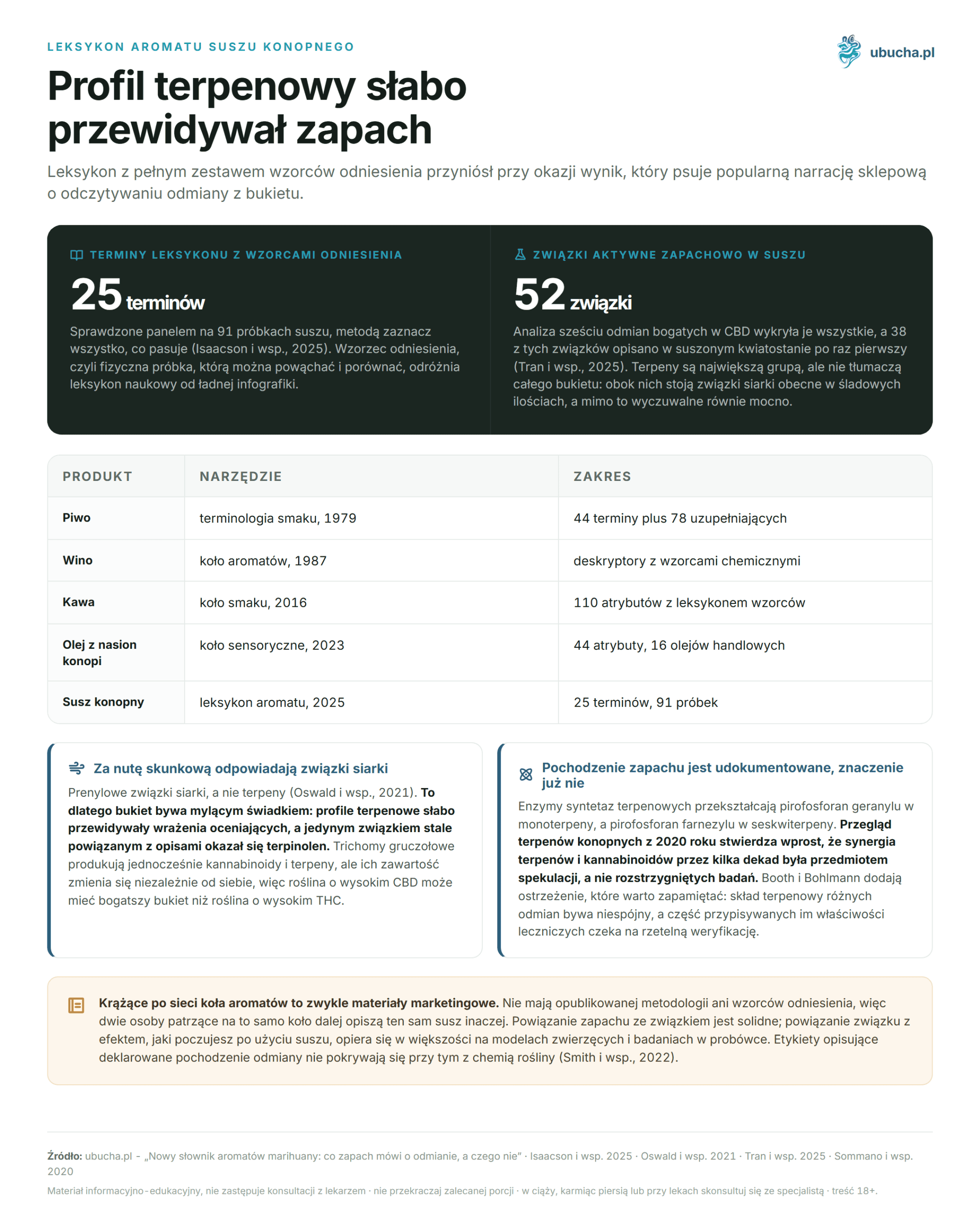
Two cannabis strains with the same THC content can smell completely different. For years, the industry described this scent with words like “skunk,” “kush,” or “diesel,” which meant little to anyone outside a narrow circle. In 2025, the first lexicon of cannabis flower aroma with a full set of reference standards was published: 25 terms tested on 91 samples. Its authors also revealed something that challenges popular retail narratives. Terpene profiles poorly predicted what panelists perceived. The scent proved a better indicator of batch freshness than potency. This article explains which compounds truly create cannabis aroma, how to describe it sensibly, and why you cannot read a strain’s effect from its bouquet.
KEY INFORMATION
• The 2025 cannabis flower aroma lexicon includes 25 terms with reference standards, tested on 91 samples (Isaacson et al., PLoS ONE 2025).
• Terpene profiles poorly predicted panelists’ impressions; the only compound consistently linked to descriptions was terpinolene.
• The skunky note is caused by prenylated sulfur compounds, not terpenes (Oswald et al., ACS Omega 2021).
• The “indica” and “sativa” labels do not correspond to plant chemistry (Smith et al., PLoS ONE 2022).
Is there an official marijuana aroma dictionary?
There is no single, industry-recognized cannabis aroma wheel. The most advanced is the lexicon published in 2025 in PLoS ONE: 25 terms with reference standards, tested by a panel on 91 flower samples (Isaacson et al., PLoS ONE 2025). A review from the same year presents a universal cannabis aroma wheel as a future goal, not a current reality (Kaminski et al., Molecules 2025).
The model for all such tools remains wine. Ann Noble from UC Davis and colleagues published a modified wine aroma terminology system in 1987, organizing general categories and branching into detailed descriptors with chemical standards (Noble et al., Am. J. Enol. Vitic. 1987). Brewers preceded them, coffee joined later, and cannabis waited the longest.
| Product | Tool | Year | Scope |
|---|---|---|---|
| Beer | Meilgaard flavor terminology | 1979 | 44 basic terms plus 78 supplementary |
| Wine | Wine Aroma Wheel, Noble et al. | 1987 | general categories expanded into descriptors with standards |
| Coffee | Coffee Taster’s Flavor Wheel, SCA and World Coffee Research | 2016 | 110 attributes with lexicon of standards |
| Hemp seed oil | sensory wheel, Tura et al., Foods | 2023 | 44 attributes, 16 commercial oils |
| Cannabis flower | aroma lexicon, Isaacson et al., PLoS ONE | 2025 | 25 terms, 91 samples, check all that apply method |
Graphics circulating online as cannabis aroma wheels are usually marketing materials from breeders or labs. They lack published methodology or reference standards, so two people looking at the same wheel will still describe the same flower differently. A reference standard - a physical sample to smell and compare - distinguishes a scientific lexicon from a pretty infographic.
Where does cannabis scent come from?
Cannabis scent is created by volatile compounds secreted by glandular trichomes on bract leaves. The largest group is terpenes. However, they do not explain the entire bouquet: analysis of six CBD-rich strains detected 52 odor-active compounds, 38 of which were described in dried flower for the first time (Tran et al., J. Agric. Food Chem. 2025).
The biochemistry is straightforward. Terpene synthase enzymes convert geranyl pyrophosphate into monoterpenes (myrcene, limonene, pinene, linalool) and farnesyl pyrophosphate into sesquiterpenes, mainly caryophyllene and humulene. Booth and Bohlmann described this pathway in cannabis with a caution worth remembering: terpene composition varies inconsistently among strains, and some attributed medicinal properties await rigorous verification (Booth and Bohlmann, Plant Sci. 2019).
Terpenes are light and volatile, dominating the first impression upon opening a jar. In dilution analysis of the aroma extract, alpha-pinene, myrcene, and linalool maintained high dilution factors across all CBD-rich strains tested, confirming their bouquet contribution. Alongside them were sulfur compounds present in trace amounts but equally perceptible.
A 2020 review of cannabis terpenes states plainly that synergy between terpenes and cannabinoids has been speculation rather than resolved research for decades (Sommano et al., Molecules 2020). This distinction is important: the origin of scent is well documented, its pharmacological significance is not.
It is also useful to clarify proportions. Glandular trichomes produce cannabinoids and terpenes simultaneously, so the same structures determine potency and scent, but their contents vary independently. A high-CBD plant can have a richer bouquet than a high-THC plant because bouquet depends on a different biosynthetic branch.
Which terpenes correspond to specific scent notes?
Seven recurring scent notes can be linked to specific terpenes measurable by gas chromatography. The link between scent and compound is solid. The link between compound and effect you feel after use is mostly based on animal models and in vitro studies, so it should be read cautiously.
| Scent Note | Compound | Also Found In | Attributed Effects and Evidence |
|---|---|---|---|
| Citrus: lemon, grapefruit | limonene | citrus peel, orange oil | Stimulant and anxiolytic effects described in rodents. Not clinically tested in humans inhaling flower. |
| Floral: lavender, rose | linalool, geraniol | lavender oil, rose oil, coriander | Calming effects studied mainly in animal models at doses incomparable to flower content. |
| Fruity: mango, berries | myrcene, ocimene | hops, thyme, bay leaf | Sedation attributed to myrcene comes from limited animal studies and is often over-cited. |
| Pine and herbal: needles, rosemary | alpha-pinene, beta-pinene | pine resin, rosemary, sage | Bronchodilation and memory effects studied in vitro and animals; no evidence linking to flower inhalation. |
| Spicy: pepper, clove | beta-caryophyllene, eugenol | black pepper, cloves, hops | Caryophyllene is a CB2 receptor agonist in vitro. This is a biochemical fact, not a remedy for THC side effects. |
| Earthy and musky | humulene, sesquiterpene oxidation products | hops, damp wood, forest litter | Associated with strains described as indica, though this division lacks chemical basis. |
| Sweet and candy-like | terpinolene | apples, caraway, nutmeg | The only compound consistently linked to sensory descriptions in the 2025 lexicon, specifically citrusy and chemical notes. |
The third column carries a lesson easily overlooked. None of these compounds is unique to cannabis. You can buy limonene in a chemical store, grind caryophyllene in a pepper mill. To build olfactory memory, your standards are in the kitchen, not a jar of flower. More about these compounds is in the post what are cannabis terpenes.
Where do scent notes that terpenes don’t explain come from?
From trace compounds outside the terpene group. Strains with drastically different aromas have surprisingly similar terpene profiles, so differences come from sulfur compounds (sulfides and thiols) and phenols and indoles present in quantities orders of magnitude lower (Oswald et al., ACS Omega 2023).
| Scent Note | Compound | Also Found In | Notes |
|---|---|---|---|
| Skunky | 3-methylbut-2-ene-1-thiol and related prenyl thiols | light-struck beer, garlic | Concentration rises in the last weeks of flowering, peaks during conditioning, drops after one week of storage. |
| Citrus and tropical, sharp | 3-sulfanylhexan-1-ol, 4-methyl-4-sulfanylpentan-2-one | Sauvignon Blanc, passion fruit, grapefruit | Thiols responsible for the citrus character of some strains, also detected in CBD-rich flower. |
| Chemical, animalic | skatole, i.e. 3-methylindole | feces, jasmine flower in trace amounts | Highly diluted smells floral, at higher concentrations repulsive. Source of chemical note in some strains. |
| Smoky, medicinal | p-cresol | smoke, tar, cured meats | One of the stronger odor compounds detected in dried CBD-rich flowers. |
| Caramel and malty | furaneol, sotolon | strawberries, caramel, fenugreek | Typical for strains colloquially described as sweet or dessert-like. |
| Grapey | methyl anthranilate | Concord grapes, orange blossom | Present only in some strains, strongly influences first impression. |
The authors’ conclusions are inconvenient for the industry. The importance of terpenes for cannabis aroma has been overestimated, and trace non-terpene compounds differentiate strains with unusual, sweet, or dry bouquets. A terpene profile label thus describes only part of what the nose perceives.
Analogy from other products helps understand this. Coffee, wine, and hops aromas are also built by compounds present in amounts invisible to standard composition analysis but detectable at billionth concentrations. Equipment that measures terpene percentages well may simply miss the substance deciding batch character. That is why odorant research involves humans smelling chromatograph outlets, not just detectors.
Can you predict a strain’s effect from its aroma?
Not reliably. In the 2025 study, terpene profiles formed clear chemical clusters but poorly predicted panel impressions. Sulfur compound profiles performed similarly. Since chemistry struggles to predict scent itself, inferring pharmacological effects from aroma is one step beyond the data.
Where then does the common belief that limonene stimulates and linalool sedates come from? From the entourage effect hypothesis, described by Ethan Russo in 2011, reviewing terpene and cannabinoid literature and suggesting synergistic action (Russo, Br. J. Pharmacol. 2011). It was a review proposing a hypothesis, not a confirming study, but marketing treated it as a result.
Criticism targeted a specific point. Cogan reminded that the entourage effect appeared in 1998 as a hypothetical side note, and its attributed pharmacological actions remain vaguely defined and unconfirmed; they mainly serve product sales (Cogan, Expert Rev. Clin. Pharmacol. 2020). This does not mean terpenes are pharmacologically inert. It means the path from jar scent to body effect has not been measured.
There is also the expectation problem. If a seller announces a citrus strain as stimulating, part of the effect is created by the announcement itself, as expectation works with psychoactive substances. Without blind comparison, pharmacology cannot be separated from suggestion, and blind studies on strain aroma simply do not exist.
We noticed in conversations with customers that this distinction is calming, not disappointing. The scent then remains what it really is: the reason one strain pleases and another does not. That is a sufficient reason to choose.
Does the indica/sativa division correspond to plant chemistry?
No. Analysis of over 100 cannabis samples, tested for terpenes and cannabinoids and genotyped for over 100,000 polymorphisms, showed that material labeled sativa and indica is genetically indistinguishable at the whole-genome scale (Watts et al., Nature Plants 2021).
The label correlated at best with a few terpenes whose concentrations depend on variants in tandem terpene synthase gene clusters. In other words: the trade name correlates with aroma slightly better than with genome, but still poorly. An earlier study on 81 marijuana and 43 hemp samples genotyped for 14,031 polymorphisms showed something important for interpreting this result: marijuana and hemp are genetically distinct, but declared sativa or indica origin correlates only moderately with genetic structure, and strain names often do not correspond to any consistent genetic identity (Sawler et al., PLoS ONE 2015).
The strongest argument came from the market. A team analyzing cannabinoid and terpene composition in commercial samples from six US states found repeatable chemotypes, i.e., real chemical plant types. However, sales labels did not consistently match these types (Smith et al., PLoS ONE 2022).
An alternative was proposed long ago. Hazekamp and Fischedick in 2012 advocated abandoning strain names in favor of chemovars, classification based on measured chemical composition (Hazekamp and Fischedick, Drug Test. Anal. 2012). The market, however, clings to names because they sell better.
What does this mean for purchases? The trade name is a trademark, not a chemical designation. The same name from two suppliers can hide material with different composition, and the adjectives indica and sativa mainly add expectation to the description. Asking about the batch’s chemotype and aroma profile makes more sense, as both can be measured or smelled before buying.
What exactly does the 2025 aroma lexicon contain?
The lexicon describes intact flower and includes 25 terms, each with a defined reference standard. The panel evaluated 91 samples using a check-all-that-apply method, and multivariate analyses confirmed that this word set distinguishes samples by orthonasal scent.
The authors compared two chemotypes. Type I samples, rich in THC and low in CBD, were more often described as skunky, musty, and animalic. Type III samples, rich in CBD and low in THC, more often received citrus, fruity, and candy descriptors. However, profiles overlapped, so you cannot determine chemotype from orthonasal scent alone.
Type III samples contained 43 volatile sulfur compounds, including dimethyl sulfide and dimethyl trisulfide and methional, with some tentatively identified or novel. Despite detailed analysis, neither terpene nor sulfur profiles strongly predicted panel perceptions.
A summary sentence worth remembering: chemical composition poorly substitutes for quality scent assessment. An earlier study on untrained consumers showed people distinguish strains by scent and group them into consistent clusters, with bouquet influencing perceived potency and price (Gilbert and DiVerdi, PLoS ONE 2018). The nose works. It only fails when translating scent into predicted effect.
The lexicon’s limitation is honestly named by its authors. It describes orthonasal scent of dried flowers, i.e., what you smell over an open jar. It says nothing about smoke taste or vapor aroma, as heating changes volatile compound composition. That is a separate issue lacking a comparable tool.
What determines the aroma profile of a specific batch?
The same strain name does not guarantee the same scent. The 2025 review identifies three factor groups: genetics, cultivation method, and post-harvest processing. Each alters synthesis, accumulation, and transformation of volatiles in the flower, so two batches from identical material can smell distinctly different.
Genetics sets the potential limits. Concentrations of individual terpenes depend on variants in tandem terpene synthase gene clusters, differing among breeding lines. A plant lacking the right gene variant simply will not produce a given compound, regardless of cultivation.
Cultivation determines how much of that potential is realized. Light, temperature, nutrition, harvest timing all affect trichome number and maturity. Early harvest yields a greener, vegetal profile; late harvest shifts toward heavy, earthy notes as some monoterpenes evaporate on the plant.
Most changes happen post-harvest. Prenylated thiols responsible for the skunky note accumulate in the last flowering weeks and peak during conditioning, i.e., after drying. Too rapid drying kills this stage and flattens the bouquet. Thus, two batches of the same strain treated differently in the last processing week fall into very different lexicon positions.
How to describe flower aroma yourself?
You need three things: silence, two samples side by side, and a notebook. Comparison teaches faster than smelling single jars spaced by weeks, as olfactory memory is short and fickle, and differences between samples hit the nose immediately.
Conduct the session in three phases. First, smell the intact flower in an open jar and write one or two general terms. Then gently crush the bud tip and check what is released, as only broken trichomes release the full bouquet. Finally, wait a few seconds and note what remains in memory.
- Do not drink coffee or smoke for an hour before the session; avoid perfumes and scented candles in the room.
- Between samples, smell the inside of your own wrist to reset your reference.
- Keep standards handy: lemon peel, peppercorns, rosemary twig, hop cone, dried lavender.
- Write two general descriptors and one specific one, always in the same order.
- After describing ten samples, return to the first and check if you would describe it the same way.
In our retail practice, one such session changes how questions are asked. Instead of asking for something strong, customers ask for a citrus profile without fuel notes. The former is hard to fulfill, the latter is manageable. Practical quality criteria are collected in the post about how to assess CBD flower quality.
One habit is worth dropping. Do not start by guessing terpene names, as it leads nowhere and quickly discourages. First write a common word from the kitchen or forest, then add the compound name later when you check the certificate of analysis. The order matters: chemistry should confirm the description, not suggest it.
What does scent tell about freshness and quality?
Much more than about effect. Prenylated thiols responsible for the skunky note accumulate in the last flowering weeks, peak during conditioning, and drop after one week of storage (Oswald et al., ACS Omega 2021). The scent is thus a clock, not a potency measure.
Terpenes behave similarly but at different rates. Light monoterpenes - limonene, myrcene, pinene - evaporate faster than heavier sesquiterpenes like caryophyllene and humulene. The effect is predictable: aged flower shifts toward earthy and woody notes, losing citrus and pine. The bouquet itself also weakens.
Separate are scents that are batch defects, not strain traits. Hay and dry grass notes usually indicate too aggressive or fast drying. Musty, cellar, or wet cardboard odors point to moisture and mold growth. Ammonia smell appears with anaerobic spoilage of overly moist material. None of these odors can be aired out.
Storage conditions decide how much bouquet remains. Industry practice is an airtight, opaque container, room temperature or lower, and relative humidity around 55 to 62%. Details are in the post about how to properly store cannabis and CBD flower, and accessories are in the storage category.
There is also a practical buying tip. If flower smells intense and multilayered, it is likely fresh and well conditioned, as the most volatile compounds have not yet escaped. A flat, one-dimensional scent indicates only that the material is months old or stored poorly. That is the only forecast the nose can reliably make.
How does the Polish CBD flower market look?
Legal flower in Poland comes from hemp, i.e., plants where the sum of delta-9-THC and tetrahydrocannabinolic acid does not exceed 0.3% dry weight. This is article 4 point 5 of the Anti-Narcotics Act (consolidated text Dz.U. 2023 item 1939) effective from May 7, 2022. The threshold counts the sum of two compounds, not delta-9-THC alone. Low THC content does not impoverish the bouquet, as data show: type III samples were more often described as citrusy, fruity, and candy-like than THC-rich samples.
This is confirmed by aroma analysis of six CBD-rich strains, where strong thiols, eugenol, p-cresol, and methyl anthranilate appeared alongside known terpenes. Cannabis flower is thus not a weaker version of something else in terms of aroma. It has its own well-documented profile, described for the first time only in 2025.
The practical consequence for buyers is one. A certificate of analysis declaring terpene profile tells you how the flower will likely smell, not how it will act. This is good information for choosing between batches and a poor basis for therapeutic claims. The Polish regulator does not require terpene declaration, so its presence signals producer diligence, not obligation.
If you want to check differences with your own nose, the easiest is to compare two batches from the same category. u Bucha, you will find cannabis flower with various profiles, and if you prefer a form without smelling and grinding, check hemp oils. We wrote about how terpenes affect oil perception in the post terpenes in CBD.
One element is still missing from Polish retail practice. Declared terpene profiles are usually given as mass percentages, while the lexicon uses words. Without a conversion table and, above all, reference standards to smell in-store, both sides of the conversation still speak different languages. Until then, the most honest description remains what you smell over an open package.
Summary: what scent tells and what it doesn’t
Cannabis scent is real and measurable, and strains truly differ in it. It is created by terpenes secreted in trichomes and trace sulfur compounds, phenols, and indoles that eluded analysis for years. The new 2025 lexicon gives all this 25 names with reference standards, the first dictionary two people can use identically.
What does this dictionary not do? It does not turn scent into an effect forecast. Terpene profiles poorly predicted even trained panel perceptions, and indica and sativa labels diverge from both genome and chemotype. The entourage effect hypothesis remains a hypothesis, as terpene doses in normal use are low.
A humbler and more useful version remains. Learn to describe scent, as it helps choose a product you will like, recognize batch freshness, and detect drying or storage defects. Treat aroma description as a sensory note, not a drug leaflet. That is how science uses it and how it is safest to use it when buying.
Concept revision can be more interesting than the myth it replaces. Instead of thirteen categories promising effects, you get a list of real compounds: thiols from Sauvignon Blanc, phenols from smokehouses, indoles from jasmine, and terpenes from the forest. This is a richer plant picture than dividing into two temperaments, and it matches what instruments show. Future lexicon versions will likely expand this picture, as only recently analytics caught up with what the nose knew long ago.
Frequently Asked Questions
What is the marijuana aroma dictionary?
It is an organized set of words describing the scent of cannabis flower, where each term has an assigned reference standard. The latest such lexicon was published in 2025 in PLoS ONE: 25 terms verified by a panel on 91 flower samples. A universal cannabis aroma wheel remains a research proposal, not an industry standard.
Does a skunky smell mean higher THC content?
No. The skunky note is caused by a family of prenylated sulfur compounds, primarily 3-methylbut-2-ene-1-thiol, described in ACS Omega in 2021. These compounds are outside the cannabinoid and terpene groups, so their concentration does not indicate psychoactive potency. CBD-rich flower can smell as sharp as high-THC flower.
Can I tell from the strain’s aroma if it will be stimulating or sedating?
Not reliably. In the 2025 study, terpene profiles formed distinct chemical clusters but poorly predicted panelists’ impressions. Since chemistry struggles to predict the scent itself, inferring pharmacological effects from aroma remains speculation, not established knowledge.
Does CBD flower smell weaker than high-THC flower?
No. In the 2025 lexicon, type III samples, rich in CBD and low in THC, were more often described as citrusy, fruity, and candy-like, while type I samples were described as skunky and musty. Profiles differed but overlapped. Analysis of six CBD-rich strains detected 52 odor-active compounds.
How long does it take to learn to describe flower aroma?
Sensory panels in scientific studies undergo many hours of training on reference standards before their ratings become repeatable. For personal use, much less is needed: a few comparative sessions with two or three samples side by side and a notebook. Comparison teaches faster than smelling single samples at intervals.
Does the aroma change during storage?
Yes, and quickly. Prenylated thiols responsible for the skunky note peak during conditioning, then drop after just one week of storage. Light monoterpenes evaporate faster than heavier sesquiterpenes, so old flower shifts toward earthy and woody notes, losing citrus and pine.
Is the indica/sativa division justified?
Not as a description of plant chemistry. Analysis of over 100 samples genotyped for over 100,000 polymorphisms showed that material labeled sativa and indica is genetically indistinguishable at the genome scale. Labels correlate at best with a few terpenes dependent on terpene synthase gene variants.
Want to compare profiles with your own nose? Start with two batches from the cannabis flower category and write descriptions before checking certificates of analysis.
This article is for informational and educational purposes and does not replace consultation with a doctor. If you are pregnant, breastfeeding, taking medications, or have chronic conditions, consult a specialist before using supplements or herbs.
Author: Michał Waluk · Published: 2026-05-11 · Updated: 2026-08-14