
What Should We Know About Marijuana? A Comprehensive Guide 2026
Medical marijuana and CBD in Poland: what research says about efficacy and risks, how the Rpw prescription works, and where the 0.3 percent THC legal boundary lies.
In October 2024, Polish doctors issued 72 thousand Rpw prescriptions for medical marijuana. A month later, after the entry into force of the regulation requiring a personal patient examination, there were 31 thousand, i.e., 57% fewer (data from the e-Health Center). This single change shows how young and unstable the cannabis therapy market is in Poland. Around the plant itself, so many conflicting claims have arisen that it is difficult to separate data from marketing and propaganda. This guide organizes the topic from botanical, pharmacological, and legal perspectives, citing the source for each figure. Many popular cannabis data do not pass this test, including several that have circulated in the Polish internet for years as obvious truths. At each such point, we state clearly what the source says and what the popular version added.
KEY INFORMATION
• Medical marijuana has been legal in Poland since November 1, 2017, exclusively on an Rpw prescription, as a pharmaceutical raw material for compounded medicines (Act of July 7, 2017, Journal of Laws 2017 item 1458).
• The boundary between industrial hemp and cannabis other than industrial hemp is defined by the sum of delta-9-THC and THCA not exceeding 0.3% dry weight, rounded to one decimal place (Art. 4 point 5 of the Act on Counteracting Drug Addiction).
• A Cochrane review covering 16 studies and 1750 patients showed relief in neuropathic pain in 39% of treated versus 33% on placebo, with a clearly higher frequency of adverse effects (Mücke et al., 2018).
• Daily use of cannabis with THC content of at least 10% was associated with nearly fivefold higher odds of psychotic disorder (Di Forti et al., Lancet Psychiatry, 2019).
• Cannabidiol is not listed in any controlled substances lists in Poland.
What is marijuana and how does it differ from industrial hemp?
Marijuana is the dried inflorescences and leaves of hemp (Cannabis sativa L.) with psychoactive substance content exceeding the legal threshold. Industrial hemp is the same plant with a profile below that threshold. The difference is therefore legal and breeding-related, not botanical: both forms belong to one species, separated by a laboratory test result.
Polish law describes this threshold more precisely than common conversation. Industrial hemp plants are those in which the sum of delta-9-THC and tetrahydrocannabinolic acid (THCA) in flower or fruiting tops, from which resin has not been removed, does not exceed 0.3% dry weight, rounded to one decimal place. The basis is Art. 4 point 5 of the Act of July 29, 2005 on Counteracting Drug Addiction (consolidated text Journal of Laws 2023 item 1939), as amended by the Act of March 24, 2022 (Journal of Laws 2022 item 763).
This single definition resolves two things most often confused in cannabis texts. First, the threshold concerns the sum of delta-9-THC and THCA, not delta-9-THC alone, so the test result depends on whether the lab converted the acid form. Second, the national threshold corresponds to the EU threshold from Regulation (EU) 2021/2115 but does not derive from it: these are two separate regulations with the same numeric value.
| Feature | Industrial Hemp | Cannabis Other Than Industrial Hemp |
|---|---|---|
| Sum of delta-9-THC and THCA | does not exceed 0.3% dry weight | above 0.3% dry weight |
| Legal status | cultivation after registry entry, product trade allowed | controlled substance |
| Availability to patients | without prescription | only on Rpw prescription |
| Botanical species | Cannabis sativa L. | Cannabis sativa L. |
What about the division into sativa, indica, and hybrids? In commerce, it functions as a shorthand describing expected effects, but modern varieties are mostly hybrids, and the effect depends on the chemical profile of a specific batch, not the genetic line name. More about the compounds themselves is collected in the text on CBD properties.
The cultivation of industrial hemp in Poland has a separate regime rarely mentioned with consumer products. It requires registration in the producers’ registry maintained by the National Agricultural Support Center, and the act lists a closed catalog of permitted cultivation purposes. For personal use, sowing up to one hectare per year is allowed.
What cannabinoids does the hemp plant contain?
Two compounds determine how a batch of dried material acts. THC (delta-9-tetrahydrocannabinol) is responsible for psychoactive effects; CBD (cannabidiol) does not cause them. Besides these, the plant produces other phytocannabinoids, including tetrahydrocannabivarin, cannabigerol, and cannabichromene, which are attributed separate pharmacological effects (Russo, Br J Pharmacol, 2011).
Alongside cannabinoids, terpenoids work. The same study lists limonene, myrcene, alpha-pinene, linalool, beta-caryophyllene, caryophyllene oxide, nerolidol, and phytol as aromatic components with their own biological activity, also present in the daily diet. Terpenoids share biosynthesis precursors with phytocannabinoids, explaining why they appear in the same plant.
Two properties of terpenoids explain why they are discussed at all. First, they are flavor and aroma substances recognized by the US FDA as safe in normal consumption, so they do not add new toxicological risk to the preparation. Second, they act at very low concentrations: effects on animal and even human behavior have been described with inhalation from air and blood concentrations in the range of single nanograms per milliliter.
This underlies the entourage effect hypothesis, i.e., the assumption that the full plant profile acts differently than an isolated single compound. However, the author of this concept states it as a synergy hypothesis requiring proof, not an established fact. In marketing texts, this condition regularly disappears, and the hypothesis becomes a certainty.
| Compound | Psychoactive Effect | Notes |
|---|---|---|
| THC | yes | CB1 receptor agonist, responsible for perception change and appetite stimulation |
| CBD | no | active substance of a registered antiepileptic drug |
| CBG, CBC, THCV | not established | studied on a smaller scale, limited clinical evidence |
| Terpenoids | no | aromatic components with own activity, also present in diet |
How does the endocannabinoid system work?
The endocannabinoid system is a neuromodulatory system present throughout the body, involved in nervous system development, synaptic plasticity, and response to internal and environmental stimuli. It consists of cannabinoid receptors, endogenous cannabinoids, and enzymes responsible for their synthesis and breakdown (Lu and Mackie, 2016).
The most abundant are CB1 receptors. Besides them, some cannabinoids also act on CB2 receptors, TRP channels, and PPAR receptors, explaining why a single substance can cause effects in several systems simultaneously. The best-known endocannabinoids are 2-arachidonoylglycerol and anandamide. Despite structural similarity, they are produced and broken down by separate enzymatic pathways, thus fulfilling different physiological roles.
Plant substances act on this system from outside. THC binds directly to cannabinoid receptors, causing changes in perception, mood, and appetite. CBD binds weakly and affects the body differently, so it does not cause psychoactive effects despite chemical kinship with THC.
It is worth adding why this system evolved at all, as popular descriptions reduce it to “marijuana receptors.” The order is reversed: the endocannabinoid system functions in the body independently of any external substances and participates in synaptic plasticity, i.e., how connections between neurons change their strength. Disorders of this system have been described in schizophrenia, and plant substances hit a system already working.
This difference has practical implications for reading labels and press reports. The phrase “cannabinoid action” without specifying which compound carries no information, as THC and CBD target different molecular sites. We detailed these differences in a separate comparison of phytocannabinoids, endocannabinoids, and synthetic compounds.
What administration methods are used in cannabis therapy?
The route of administration determines how much substance reaches the bloodstream and how quickly. Pharmacokinetic data are less precise than tables circulating online suggest. THC bioavailability after smoking was reported from 2% to 56%, with systemic availability estimated at about 8-24%, depending strongly on the user’s inhalation experience (Huestis, 2007).
Oral administration shows similarly wide variability. One study reported bioavailability of 10-20%, another estimated 6% after eating a cookie with 20 mg THC, with peak concentrations reached from one to five hours post-meal. Orally, onset is delayed, peak is lower, and return to baseline is clearly longer than after inhalation.
| Route of Administration | THC Bioavailability | Effect Profile |
|---|---|---|
| Smoke inhalation | 2-56%, estimated 8-24% systemic | rapid onset, shorter duration |
| Vaporization | similar to smoke inhalation | no combustion products, material not burned |
| Oral | 6-20% depending on study | delayed onset, lower peak, longer return to baseline |
| Oral mucosal spray | registered drug form | dosing measured by sprays, per leaflet |
The practical conclusion is that oral administration is easiest to overdose. The effect appears with delay, so an inexperienced person may take another dose before the previous one acts. In inhalation, feedback is immediate, and dosing errors self-correct.
The same data imply another less often stated fact. The variability of bioavailability after inhalation is so large that two people taking the same amount of material may receive vastly different doses, depending on inhalation depth, duration, and experience. Therefore, clinical protocol descriptions specify raw material amount and administration method, not just percentage content, and comparing experiences between people leads astray.
For which indications is medical marijuana used?
The broadest systematic review covered 79 studies with 6462 participants, only four of which were rated low risk of bias. Authors considered evidence moderate quality for chronic pain and spasticity, and low quality for chemotherapy-induced nausea, weight gain in HIV infection, and sleep disorders (Whiting et al., JAMA, 2015).
Numbers from this study are worth quoting precisely, as they are often selectively cited. Full response for nausea and vomiting was 47% in cannabinoid-treated versus 20% on placebo. For pain, relief was noted in 37% versus 31%, but the confidence interval included unity, so the difference was not statistically significant. The statement about 37% relief without this caveat says more than data support.
A separate Cochrane review on neuropathic pain included 16 studies and 1750 participants. At least 30% relief was achieved by 39% treated versus 33% placebo; 50% relief by 21% versus 17%. Due to adverse effects, 10% withdrew versus 5% placebo. Authors concluded possible benefits may be outweighed by harms (Mücke et al., 2018).
Two cannabis preparations have registered drug status in Europe. Epidyolex, a pure cannabidiol solution, obtained EU approval on September 19, 2019, as adjunctive therapy for seizures in Lennox-Gastaut and Dravet syndromes, combined with clobazam, in patients from two years old (EMA). Sativex, a cannabis extract spray, was approved in Poland in December 2012 for spasticity in multiple sclerosis patients unresponsive to other drugs.
The cannabidiol registration study in Lennox-Gastaut syndrome involved 225 people aged 2 to 55. Median reduction in atonic seizures was 41.9% at 20 mg/kg dose and 37.2% at 10 mg/kg, versus 17.2% in placebo. Elevated liver aminotransferase activity was observed in 9% treated (Devinsky et al., NEJM, 2018). The study lasted fourteen weeks.
The effect scale in other indications is more modest than popular descriptions suggest. In the JAMA review, mean improvement on an 11-point pain scale was 0.46 points versus placebo, and on the Ashworth spasticity scale 0.36 points. These are measurable but small values.
What is the legal status of marijuana in Poland?
Recreational marijuana remains illegal in Poland. Possession, cultivation, and trade are prohibited under the Act of July 29, 2005 on Counteracting Drug Addiction. The act does not specify any gram threshold, contrary to the widespread belief about a three-gram limit; quantity affects offense classification and penalty, not legality of possession.
Medical marijuana operates on a completely different basis. The Act of July 7, 2017 (Journal of Laws 2017 item 1458), effective November 1, 2017, allowed cannabis other than industrial hemp, its extracts, and resins as pharmaceutical raw material for compounded medicines after obtaining permission. Formally, the patient does not receive a “cannabis drug” but a compounded medicine prepared from such raw material, dispensed on an Rpw prescription.
The third category is products from industrial hemp. Cannabidiol is not listed in any controlled substances lists, so dried flowers, oils, and cosmetics from this group are available without prescription, provided they meet the threshold described above. A practical tip when purchasing is an independent laboratory analysis certificate for the batch; its absence does not determine quality but removes the possibility to verify the producer’s declaration.
For food from hemp seeds, a separate limit applies, expressed differently than the plant threshold. EU regulation on food contaminants sets the maximum allowed sum of delta-9-THC and its acid form at 3.0 mg/kg for hemp seeds and processed products, and 7.5 mg/kg for seed oil. These are different measures: percentages versus milligrams per kilogram. Confusing them is the most common error in texts about hemp food.
Besides, it is worth remembering that not all cannabinoids have cannabidiol’s status. HHC, hexahydrocannabinol, is a controlled substance in Poland, although sometimes sold as a hemp product. A compound’s plant origin does not determine its legal status, and a label saying “hemp” is no confirmation of legality.
| Category | Basis | Access |
|---|---|---|
| Recreational marijuana | Act on Counteracting Drug Addiction | prohibited |
| Pharmaceutical raw material from cannabis | Art. 33a of the Act, since Nov 1, 2017 | compounded medicine on Rpw prescription |
| Products from industrial hemp | 0.3% sum of delta-9-THC and THCA threshold | without prescription |
How is access to an Rpw prescription in practice?
An Rpw prescription is issued by a doctor after assessing indications, and from November 7, 2024, only after a personal patient examination. The regulation cut off issuing prescriptions via automatic online services and immediately changed the scale of the phenomenon: in October 2024, 72 thousand prescriptions were issued, and in November 31 thousand, i.e., 57% less (data from the e-Health Center, Rynek Zdrowia).
The scale of the earlier increase explains why the regulator reacted. In January 2024, doctors issued 42 thousand prescriptions, in August and September about 65 thousand each, and in October the mentioned 72 thousand. After the November drop, numbers returned in subsequent months to pre-regulation levels, which the Chief Pharmaceutical Inspector described directly in a statement to industry media.
For the patient, this means three practical consequences. The consultation must be in person, so the shortcut via an online form is gone. Cannabis therapy remains a treatment of last resort, used after exhausting standard methods. Compounded medicine from hemp raw material is not reimbursed, so the full cost is borne by the patient, and prices depend on the pharmacy and raw material, so we do not provide any fixed amount here.
We noticed in conversations with people interested in this therapy that the most common misunderstanding concerns status. An Rpw prescription is not a formality to obtain but a clinical decision, and a doctor refusing to issue it does not violate any patient rights. More about the procedure is collected in the guide on what medical marijuana is.
It is also worth noting what this statistic measures and what it does not. The number of prescriptions issued is not the number of patients: one person may receive several or a dozen in a year. Monthly data show the intensity of the phenomenon, not the size of the treated population, and any statement like “this many Poles treat themselves with cannabis” based directly on prescription numbers overstates the result.
What are side effects and risks?
Adverse effects are common and well described. A review of 79 studies lists dizziness, dry mouth, nausea, fatigue, drowsiness, euphoria, vomiting, disorientation, confusion, balance disorders, hallucinations, and increased risk of adverse events, including serious ones, in the short term (Whiting et al., 2015). In the Cochrane review, nervous system disorders occurred in 61% treated versus 29% placebo, and psychiatric disorders in 17% versus 5%.
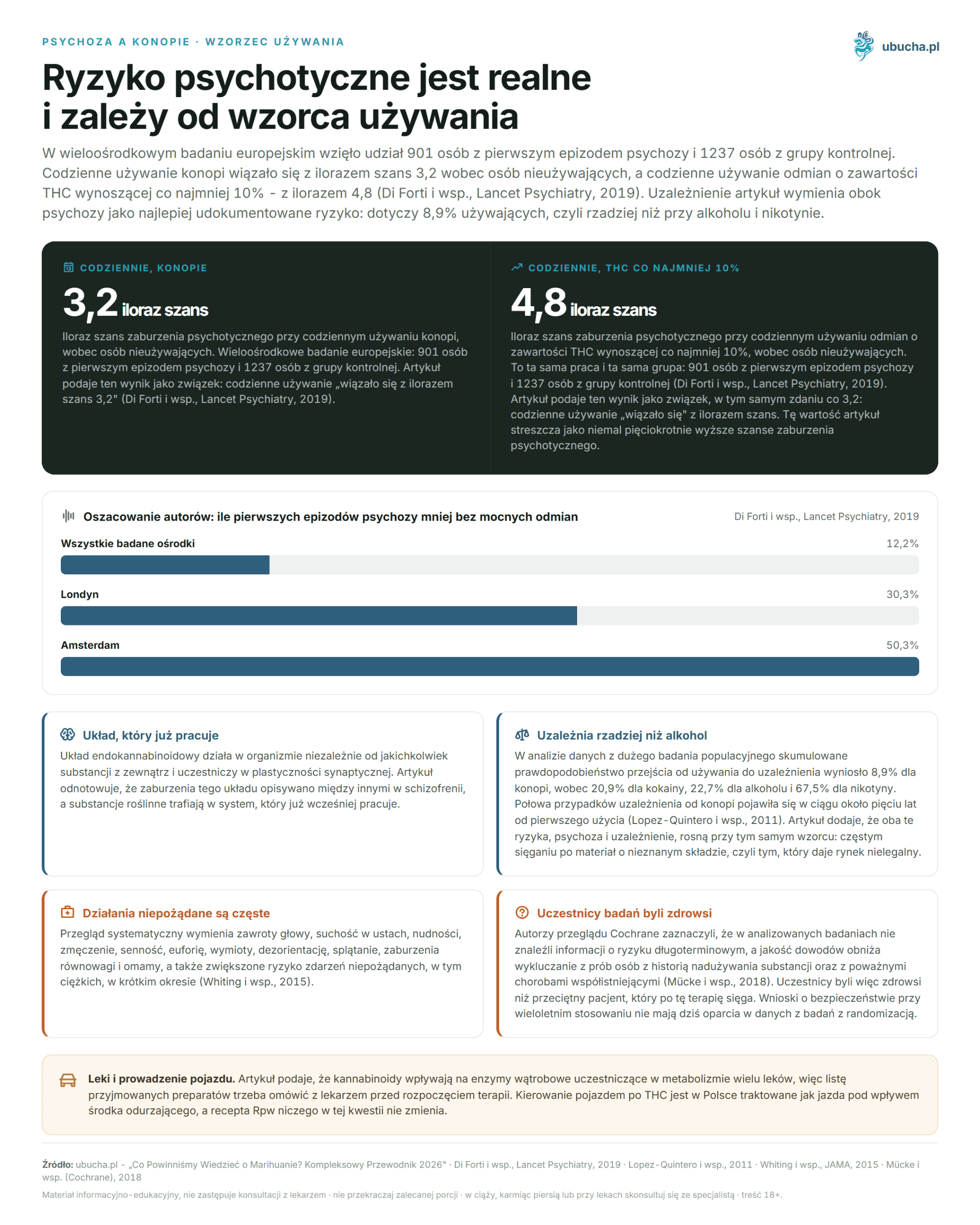
Psychotic risk is real and depends on usage pattern. In a European multicenter study including 901 people with first-episode psychosis and 1237 controls, daily cannabis use was associated with odds ratio 3.2 versus non-users, and daily use of varieties with at least 10% THC with odds ratio 4.8. Authors estimated that lack of access to high-potency varieties could prevent 12.2% of first-episode psychosis cases in studied centers, with 30.3% in London and 50.3% in Amsterdam (Di Forti et al., Lancet Psychiatry, 2019).
Addiction occurs, though less often than with other substances. In a large population study analysis, cumulative probability of transition from use to addiction was 8.9% for cannabis, 20.9% for cocaine, 22.7% for alcohol, and 67.5% for nicotine. Half of cannabis addiction cases appeared within about five years of first use (Lopez-Quintero et al., 2011). Long-term effects are examined separately in the text on long-term effects of marijuana use.
Additionally, there are drug interactions and driving issues. Cannabinoids affect liver enzymes involved in metabolism of many drugs, so the list of medications must be discussed with a doctor before starting therapy. Driving under THC influence is treated in Poland like driving under the influence of intoxicants, and an Rpw prescription does not change this.
One of these pictures cannot yet be completed. Cochrane review authors noted that analyzed studies lacked information on long-term risk, and evidence quality is lowered by excluding participants with substance abuse history or serious comorbidities. In other words, study participants were healthier than the average patient seeking this therapy. Conclusions about safety with long-term use lack support from randomized trials today.
How does medical marijuana differ from recreational?
The difference is not just legality but dose predictability. Pharmacy raw material has declared active substance content, batch number, and lab analysis result, so patient and doctor know what they handle. Material from the illegal market has none of these and its composition may vary even within one delivery.
The scale of this variability is measured. Analysis of 38,681 samples seized in the US from 1995-2014 showed THC content rising from about 4% to about 12%, with CBD content dropping from about 0.28% in 2001 to below 0.15% in 2014. The THC to CBD ratio changed from fourteenfold to about eightyfold (ElSohly et al., 2016).
This second indicator is more important than it seems. Increasing THC with vanishing CBD gives a profile maximizing psychoactive effect and removing the compound that mitigates its effects. Combining this observation with psychosis data explains why the potency debate is not about taste but public health.
The second difference is supervision. A patient on compounded therapy has control visits where the doctor assesses efficacy, side effects, and interactions, and dosing starts low and increases gradually. Unsupervised use lacks these mechanisms, and dosing pattern is shaped by tolerance, not clinical assessment.
The same sample analysis shows another shift, this time on the supply side. Over the studied period, ordinary marijuana decreased in seized material, while sinsemilla, i.e., unpollinated female flowers with higher active substance content, increased. Potency rise was thus not a random breeding effect but a consequence of production technology change, which the illegal market adopted over two decades.
Which popular beliefs about marijuana are false?
Several claims circulate around cannabis, repeated by both sides of the debate. The following table organizes the most common, indicating in each case what the cited studies say. None is entirely false or entirely true, which is why they have taken hold so well.
| Popular Claim | What Data Show |
|---|---|
| “Marijuana is harmless” | addiction affects 8.9% of users, and daily use of strong varieties is linked to nearly fivefold higher psychosis odds |
| “Medical marijuana is legalized recreation” | it is a compounded medicine from standardized raw material, dispensed on Rpw prescription after indication assessment |
| “CBD acts like THC, just weaker” | CBD binds weakly to cannabinoid receptors and does not cause psychoactive effects |
| “Cannabis cures cancer” | no clinical evidence for anticancer effect in humans; described uses are symptomatic |
| “The entourage effect is proven” | the concept’s author describes it as a hypothesis requiring proof, not an established fact |
| “Vaporization is as harmful as smoking” | vaporization does not burn material, so combustion products do not form; this does not mean the method is harmless |
One claim from this list requires clarification. Products from industrial hemp contain trace THC amounts, so very high consumption could theoretically affect drug test results. People in professions subject to regular testing should consider this in purchasing decisions.
Two legal beliefs persist stubbornly and both are outdated. The first says the psychoactive substance threshold in industrial hemp is 0.2%. It was until May 6, 2022; from May 7, 2022, it is 0.3%, and only in the historical sentence is the lower value correct. The second belief derives the Polish threshold from EU regulation. It does not: these are two separate regulations coincidentally giving the same number, and the Polish basis is the Act on Counteracting Drug Addiction.
Frequently Asked Questions
What is the difference between medical and recreational marijuana?
Medical marijuana is a standardized pharmaceutical raw material with a known content of active substances, from which a pharmacy prepares a compounded medicine dispensed on an Rpw prescription. Recreational marijuana comes from uncontrolled sources, has an unknown composition, and remains illegal in Poland. The difference therefore concerns dose predictability, not just legal status.
Is marijuana legal in Poland?
Recreational marijuana is not. Hemp raw material for preparing compounded medicines has been legal since November 1, 2017, and is dispensed only on an Rpw prescription. Products from industrial hemp, in which the sum of delta-9-THC and THCA does not exceed 0.3% dry weight, are available without a prescription, and cannabidiol is not listed in controlled substances.
How does THC affect the body?
THC binds directly to cannabinoid receptors of the endocannabinoid system, most abundant in the central nervous system. Hence changes in perception, mood, and appetite. The same system includes endogenous cannabinoids and enzymes for their synthesis and breakdown, and some cannabinoids also act on TRP channels and PPAR receptors.
What are the most common side effects?
A review of 79 studies lists dizziness, dry mouth, nausea, fatigue, drowsiness, euphoria, vomiting, disorientation, and balance disorders. In the Cochrane review, nervous system disorders occurred in 61% of treated patients versus 29% on placebo, and psychiatric disorders in 17% versus 5%.
How to obtain an Rpw prescription?
A doctor issues the prescription after assessing indications, and from November 7, 2024, only after a personal examination of the patient. Issuing the prescription is a clinical decision, not a formality, and is usually preceded by exhaustion of standard methods. Compounded medicine from hemp raw material is not reimbursed.
Is marijuana addictive?
Yes, though less often than other substances. In a population data analysis, the cumulative probability of transitioning from use to addiction was 8.9% for cannabis, 20.9% for cocaine, 22.7% for alcohol, and 67.5% for nicotine. Half of cannabis addiction cases occurred within about five years of first use.
Does cannabidiol have drug status?
Yes, in a strictly defined indication. A pure cannabidiol solution obtained EU approval on September 19, 2019, as adjunctive therapy for seizures in Lennox-Gastaut and Dravet syndromes, in combination with clobazam, in patients from two years old. Consumer products with cannabidiol are not drugs.
Summary
Cannabis is neither a miracle drug nor a substance without significance. Clinical evidence most strongly supports use in chronic pain and spasticity, and even there we speak of moderate-quality evidence and benefits that must be weighed against adverse effects. Two cannabis preparations have registered drug status, each in a narrow, precisely described indication.
On the risk side, the best documented are the link between daily use of strong varieties and psychotic disorders, and the possibility of addiction. Both increase with a pattern involving frequent use of material with unknown composition, i.e., exactly what the illegal market provides.
Law in Poland separates three categories, and it is worth distinguishing them in every cannabis conversation: recreational material, pharmaceutical raw material on Rpw prescription, and industrial hemp products available without prescription. Mixing these three orders is the source of most misunderstandings, including those reaching headlines.
If you are looking for industrial hemp products available without prescription, you will find them in the dried flower category.
This article is for informational and educational purposes and does not constitute medical advice. Before starting cannabis or CBD for therapeutic purposes, consult a doctor, especially if you take other medications, are pregnant, or breastfeeding.
Author: Michał Waluk · Published: 2026-04-27 · Updated: 2026-08-10