
Menthol, arnica and capsaicin in muscle pain ointments: what works and what doesn’t
The three most common ingredients in muscle pain ointments under the microscope of research. Mechanisms, duration of action, and what the Cochrane review says about the strength of evidence for each of them.
Pharmacy shelves are bending under the weight of muscle pain ointments, and labels list dozens of ingredients. Three of them come up most often: menthol, arnica, and capsaicin. Each of them does something, but they do it completely differently, at different times, and with very different strengths of evidence. The distinction is practically significant because an ingredient chosen for the wrong situation will not work, even if the manufacturer does not lie a word. It also determines how much it is worth paying: one of these three has moderate quality evidence behind it, while the other two mainly have well-described mechanisms and little more than that. Below, we break down each of them into mechanisms and what studies involving humans have shown, providing the number of participants and the observation time, and finally checking where in this ranking the largest available Cochrane review places them among topical preparations.
KEY INFORMATION
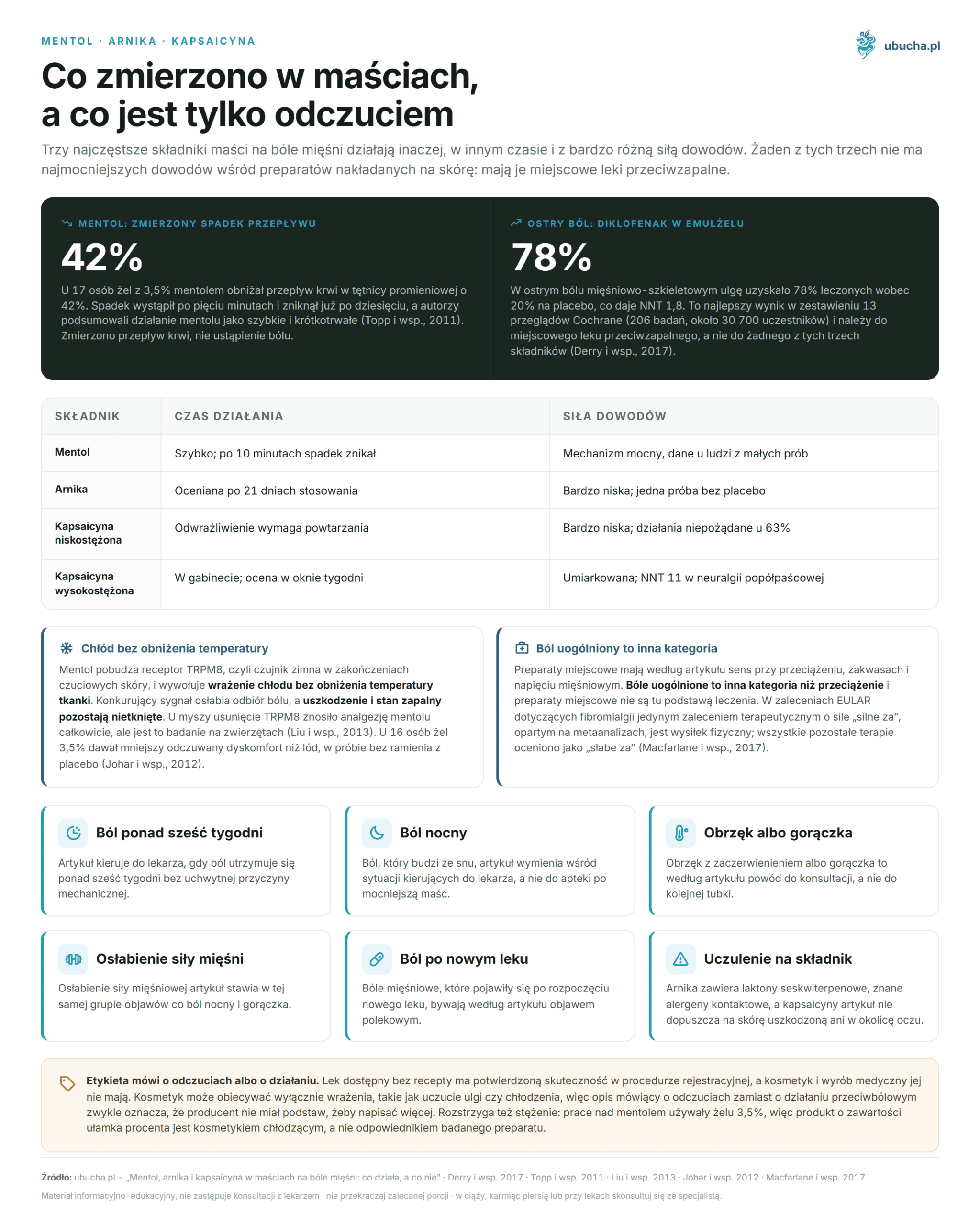
• A review of 13 Cochrane reviews (206 studies, about 30,700 participants) provides the strongest evidence for topical anti-inflammatory drugs, not herbs (Derry et al., 2017).
• High-concentration capsaicin has moderate quality evidence in postherpetic neuralgia and limited effectiveness: NNT 11 (Derry et al., 2017).
• Herbal preparations, including arnica, have very low quality evidence in this review; a separate trial in 204 people showed that arnica gel was no better than ibuprofen gel (Widrig et al., 2007).
• The analgesic effect of menthol is abolished by turning off the TRPM8 receptor, and it is blocked by naloxone, indicating the involvement of the opioid pathway (Liu et al., Pain 2013).
How does menthol work and how long does the effect last?
Menthol does not heal, it only masks. It activates the TRPM8 receptor, which is a cold sensor in the sensory nerve endings of the skin, creating a sensation of coolness without lowering tissue temperature. The competing sensory signal weakens the perception of pain, while damage and inflammation remain untouched.
That it is indeed the TRPM8 receptor, and not any of menthol’s other targets, was shown by Liu et al. (Pain, 2013). In mice, L-menthol reduced pain responses caused by chemical stimuli, heat, and inflammation, and genetic deletion of TRPM8 completely abolished this effect. A selective receptor blocker produced the same result. The authors also noted a less expected finding: analgesia was abolished by naloxone, indicating the involvement of the endogenous opioid pathway. This is an animal study, so the mechanism is well documented here, and the translation to humans remains a conclusion.
In humans, the material is more modest. Johar et al. (International Journal of Sports Physical Therapy, 2012) compared a 3.5% menthol gel with an ice pack in 16 people with delayed onset muscle soreness after exercise. The perceived discomfort was significantly lower after the gel than after ice, and the electrically induced contraction force was higher. However, the trial is small and lacks a placebo arm, so it speaks of an advantage over ice, not the magnitude of the effect compared to nothing.
As for the duration of action: Topp et al. (Journal of Sport Rehabilitation, 2011) measured blood flow in the radial artery in 17 people after the same 3.5% gel. A 42% decrease occurred after five minutes and disappeared after ten. The authors summarized menthol’s action as quick and short-lived. The circulating product descriptions of windows around an hour and a half have no basis in these measurements.
Does arnica work for muscle pain and bruises?
The mechanism is well described, but clinical evidence is weak and not where marketing suggests looking. The active ingredient in mountain arnica is helenalin, a sesquiterpene lactone with anti-inflammatory action.
Lyss et al. (Biological Chemistry, 1997) demonstrated that helenalin selectively inhibits the transcription factor NF-κB, and not by changing the active complex itself, but by preventing the release of its inhibitory subunit. The selectivity was clear: the activity of four other transcription factors remained unchanged. The authors emphasize that this is a mechanism different from that of indomethacin and acetylsalicylic acid. This is a cell culture study, not on patients.
The best clinical trial with arnica concerns joints, not bruises. Widrig et al. (Rheumatology International, 2007) in a randomized double-blind study divided 204 people with osteoarthritis of the interphalangeal joints of the hands into two groups: arnica gel and 5% ibuprofen gel. After 21 days, there was no difference in pain intensity or hand function. Adverse effects were reported by 6.1% of people in the ibuprofen group and 4.8% in the arnica group. The authors concluded that this arnica preparation is no better than ibuprofen for this indication.
It is worth reading this result carefully. The study compares arnica with a drug, not with a placebo, so it does not determine whether both worked or both performed similarly poorly. The Cochrane review mentioned below assesses the evidence for herbal preparations in pain as very low quality. The statement that arnica makes sense for fresh injuries, not for degenerative changes, turns this finding exactly on its head.
How does capsaicin work and how long does it take to have an effect?
In two stages and slowly. Capsaicin stimulates the TRPV1 receptor in pain neurons, causing a burning sensation, and only with repeated use does it lead to desensitization by depleting substance P, a neuropeptide that transmits pain signals. A single application therefore mainly provides the first stage.
Distinguishing between two concentrations is more important here than anything else. High-concentration capsaicin, in the form of the patch Qutenza approved by the European Medicines Agency, is a drug applied in the office and intended for neuropathic pain. Low-concentration pharmacy preparations are a completely different category, despite the same ingredient name.
The effectiveness of even this high concentration is moderate. In a Cochrane review, Derry et al. (2017) report relief in postherpetic neuralgia in 33% of treated patients compared to 24% on placebo, with two studies and 571 participants, giving an NNT of 11. The evidence was rated as moderate quality, and the effectiveness itself as limited. The result still means that some patients experience real benefits, but that part is smaller than the word “approved” suggests.
For low concentrations, i.e., those from home ointments, the same review provides evidence of very low quality and a clear cost: local adverse effects occurred in 63% of people compared to placebo, and the percentage of people discontinuing due to them was 15% compared to 3%. Burning after the first use is therefore an expected receptor response, but discontinuing for this reason is not a beginner’s mistake: discontinuation due to adverse effects is five times more common in these data than on placebo.
| Ingredient | Mechanism | Duration of action | Strength of evidence |
|---|---|---|---|
| Menthol | Activation of TRPM8, cold signal competing with pain | Quick; effect on blood flow disappeared after 10 minutes | Strong mechanism, data in humans from small trials without placebo |
| Arnica | Helenalin inhibits NF-κB, anti-inflammatory action | Assessed after 21 days of use | Very low according to Cochrane; one trial without a placebo arm |
| Low-concentration capsaicin | Activation of TRPV1, then depletion of substance P | Desensitization requires repeated use | Very low; adverse effects in 63% |
| High-concentration capsaicin | Same pathway, single application in the office | Effectiveness assessed in weeks | Moderate, effectiveness limited: NNT 11 |
Which ingredient has the strongest evidence?
None of these three. The strongest evidence among topical preparations is for non-steroidal anti-inflammatory drugs, not plant ingredients or sensory-affecting agents.
This is determined by the review Derry et al. (Cochrane Database of Systematic Reviews, 2017), which included 13 Cochrane reviews, 206 studies, and about 30,700 participants. In acute musculoskeletal pain, such as sprains and strains, diclofenac in emulgel form performed best: 78% of treated patients experienced relief compared to 20% on placebo, giving an NNT of 1.8. In chronic pain, mainly in osteoarthritis of the hands and knees, the same diclofenac assessed over 6 to 12 weeks gave an NNT of 9.8, which is significantly less.
The authors emphasize something that gets lost in product descriptions: in acute pain, the specific form of the preparation matters, not just the name of the substance. Different formulations of diclofenac performed distinctly differently in this review. The conclusion for the buyer is uncomfortable because it means that the name of the ingredient on the front of the package matters less than everyone assumes.
Methyl salicylate, present in many warming ointments, falls into the same review among agents with limited evidence and prone to publication bias. Menthol was not assessed at all in this review, which in itself is information about the state of research on it. If you are looking for a topical preparation with a different mechanism, we described it in the text about CBD hemp ointment.
How to combine ointments with different ingredients?
Do not apply menthol and capsaicin to the same area at the same time. Simultaneous stimulation of the cold receptor and the heat receptor causes unpleasant, strong burning and irritates the skin, with no benefit from it. Use them alternately or on different parts of the body.
A sensible division looks like this: menthol as needed, when you need relief for an hour, capsaicin in a repeated program, in the evening, for several weeks. The goals are different and do not compete with each other as long as they do not hit the same area simultaneously. Arnica can be combined with menthol without this problem, and such ready-made preparations are available for sale.
There is, however, a pattern to avoid, which manufacturers like to use. We have noticed that the longer the list of active ingredients on the label, the lower the concentration of each of them tends to be. A product with six substances in trace amounts sounds impressive and has a lower chance of working than a single ingredient at the concentration in which it was studied. A shorter ingredient list is usually a better signal than a longer one.
A hemp preparation can be used alongside menthol or arnica: cannabinoid receptors are different pathways than TRPM8 and TRPV1. Just remember that it adds another ingredient to the skin, which is already receiving quite a few, so if you are prone to irritation, it is better to introduce preparations one at a time.
When is muscle pain ointment not enough?
When the pain has no tangible mechanical cause or when it is accompanied by general symptoms. Topical preparations make sense for overload, soreness, and muscle tension. Reaching for another tube instead of diagnostics can be the most costly mistake in this whole topic.
To a doctor, not to a pharmacy for a stronger ointment, the following situations direct:
- pain lasting more than six weeks without a tangible mechanical cause;
- night pain that wakes you from sleep;
- swelling with redness or fever;
- weakness of muscle strength;
- muscle pain that appeared after starting a new medication, as it can be a drug-related symptom.
Generalized pain is a different category than overload, and topical preparations are not the basis of treatment here. In the recommendations of Macfarlane et al. for EULAR (Annals of the Rheumatic Diseases, 2017) regarding fibromyalgia, the only therapeutic recommendation with a “strong for” strength, based on meta-analyses, is physical exercise; all other therapies were rated as “weak for”. Treatment starts with education and non-pharmacological methods, and pharmacotherapy is added only when there is no response.
Allergies to ointment ingredients occur more often than one might think. Arnica contains sesquiterpene lactones, known contact allergens, menthol at higher concentrations can irritate sensitive skin, and capsaicin should not be applied to damaged skin or around the eyes. A rash, blisters, or increasing pain instead of relief is a signal to discontinue the preparation and consult a doctor.
What to look for when choosing an ointment?
Look at the concentration of the active substance and what the product is in the eyes of the law, not the length of the ingredient list. These are two pieces of information that actually differentiate preparations, and both are on the packaging.
The concentration determines whether anything similar has been studied at all. The studies on menthol described above used a 3.5% gel, so a product with a fraction of a percent is a cooling cosmetic, not a counterpart to the studied preparation. With capsaicin, the difference between a pharmacy preparation and a patch applied in the office is not a matter of strength, but two different product categories. With arnica, there is simply no standard concentration, and homeopathic preparations contain dilutions in which the active substance is practically absent; if you are looking for the effect described in Widrig’s study, you need a preparation with an extract, not a dilution.
The second thing is legal status. An over-the-counter drug has proven effectiveness in the registration procedure, while a cosmetic and a medical device do not. A cosmetic can only promise sensations, such as a feeling of relief or cooling, and this is a clue on how to read the label: a description talking about sensations instead of pain-relieving action usually means that the manufacturer had no basis to write more.
The form of the preparation changes convenience, not pharmacology. A water-based gel absorbs quickly and cools, which suits menthol; an oily ointment creates an occlusion that increases absorption, which can be beneficial for capsaicin requiring regular exposure; a patch releases the substance over many hours, so it requires less frequent application. None of these forms, however, makes a poorly documented ingredient more effective.
Frequently asked questions
Does menthol in ointments really reduce muscle pain?
Yes, but briefly and only at the level of sensation. Liu et al. (Pain, 2013) showed in mice that menthol analgesia disappears after the TRPM8 receptor is turned off. In 16 people with delayed onset muscle soreness, a 3.5% gel caused less discomfort than ice (Johar et al., 2012). The effect on blood flow disappeared after ten minutes.
Does arnica work for soreness and bruises?
The evidence is weak. A Cochrane review assesses herbal preparations for pain as very low quality material (Derry et al., 2017). The best trial with arnica concerns osteoarthritis of the hands, not fresh injuries: in 204 people, arnica gel was no better than a 5% ibuprofen gel after 21 days (Widrig et al., 2007).
How long does it take for capsaicin to have an effect?
Not after the first application. Capsaicin first stimulates the TRPV1 receptor, causing a burning sensation, and desensitization requires repeated use. At low concentrations, the evidence is of very low quality, and local adverse effects occurred in 63% of people, with 15% stopping use due to them compared to 3% on placebo (Derry et al., 2017).
Can menthol and capsaicin ointment be used simultaneously?
Not on the same area. Simultaneous stimulation of the cold receptor TRPM8 and the heat receptor TRPV1 causes strong, unpleasant burning and skin irritation, with no benefit. Use them alternately or on different parts of the body: menthol as needed, capsaicin in the evening in a repeated program for several weeks.
Which topical ingredient has the strongest evidence?
None of the three discussed. In a review of 13 Cochrane reviews, including 206 studies and about 30,700 participants, diclofenac in emulgel form performed best for acute musculoskeletal pain: 78% of treated patients compared to 20% on placebo, NNT 1.8 (Derry et al., 2017). High-concentration capsaicin achieved NNT 11.
Cooling and warming massage gels, including hemp ones, can be found in the gels category. The mechanism of the TRPV1 receptor itself is described separately in the text about capsaicin receptor.
This article is for informational and educational purposes and does not replace consultation with a doctor. If you are pregnant, breastfeeding, taking medications, or have chronic conditions, consult the use of supplements or herbs with a specialist.
Author: Michał Waluk · Published: 2026-08-09 · Updated: 2026-08-15