
Methods of Consuming Marijuana and CBD: 6 Techniques, Bioavailability, and Duration of Effect 2026
Smoking, vaporization, edibles, sublingual oil, capsules, and topical forms. How these administration routes really differ and what pharmacology has yet to measure.
The choice of cannabinoid administration route is often described as a simple percentage table: this much is absorbed from smoke, that much from under the tongue, this much from a cookie. This table is convenient but mostly unsupported by human measurements. A systematic review of cannabidiol pharmacokinetics established absolute bioavailability only for the inhalation route. No study measured it for other routes. This guide organizes six methods of consuming marijuana and hemp products based on what has actually been measured: onset of effect, duration, byproducts formed along the way, and the legal status of each form in Poland. Every number is given with the study source and the group it was obtained from. Where no measurement exists, we state this directly instead of repeating values circulating in product descriptions. You will learn how a cream differs from a transdermal patch, why a cookie acts differently than a joint, and why results vary between vaporizers.
KEY INFORMATION
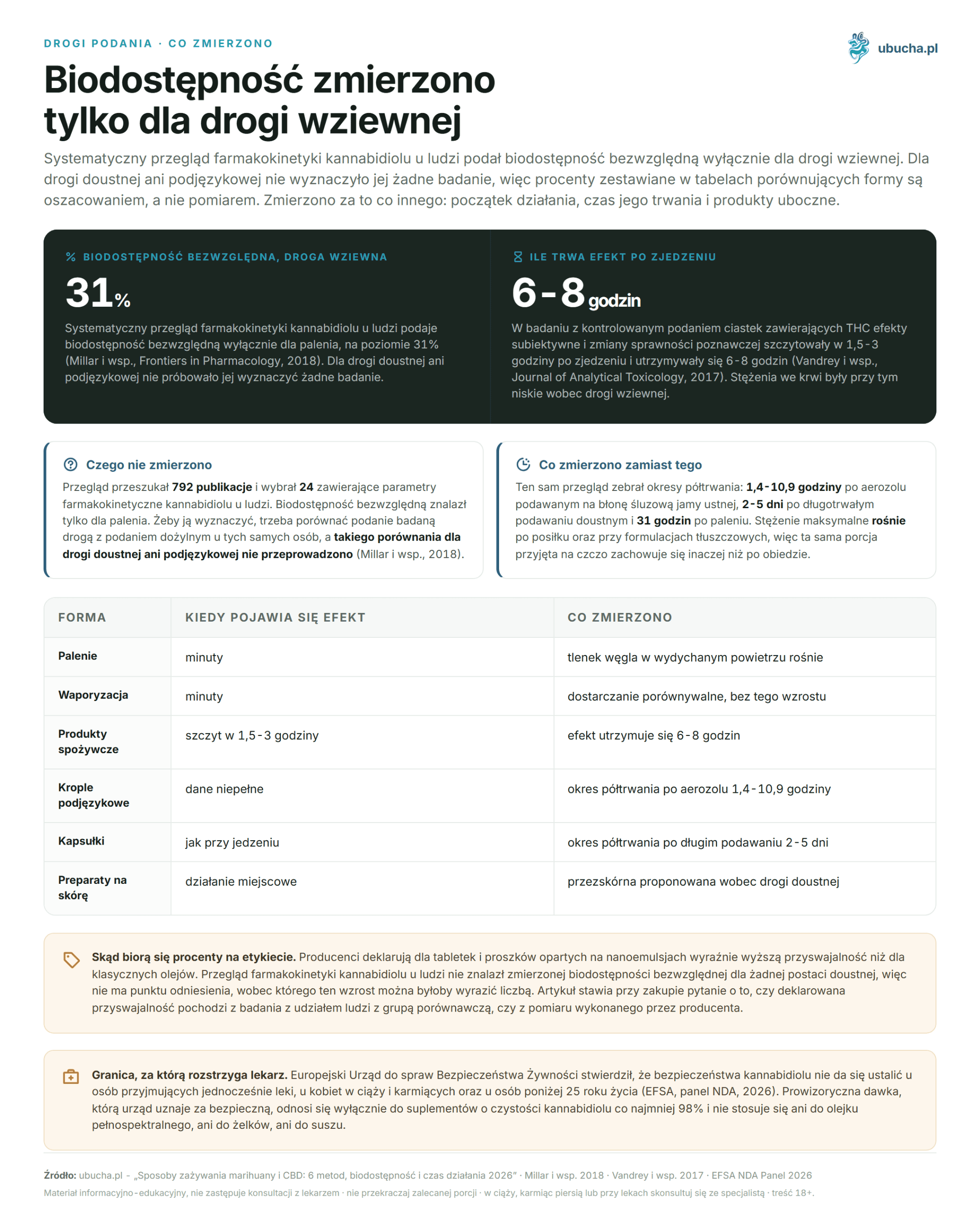
• Absolute bioavailability of cannabidiol in humans was measured only for inhalation: 31% (Millar et al., 2018).
• Smoking and vaporization deliver comparable cannabinoid amounts, but smoking raises carbon monoxide levels in exhaled air (Newmeyer et al., 2016 and 2017).
• After oral administration, peak effect occurs in 1.5-3 hours and lasts 6-8 hours (Vandrey et al., 2017).
• In Poland, the 0.3% threshold applies to the plant and is calculated as the sum of delta-9-THC and THCA.
What are the main methods of consuming marijuana and CBD?
Six administration routes include smoking, vaporization, edibles, sublingual drops, capsules, and topical preparations. They differ in speed of onset, duration, and how much substance reaches the bloodstream. The choice of form is a pharmacological decision, not a matter of habit.
The sharpest divide is between inhalation and oral routes. When inhaled, the substance enters the blood via lung alveoli, bypassing the liver, so effects appear within minutes. When swallowed, the path goes through the intestines and portal vein directly to the liver, where part of the substance is metabolized before entering systemic circulation.
| Form | Onset of Effect | What Was Measured |
|---|---|---|
| Smoking | minutes | heart rate increase within half an hour, elevated carbon monoxide |
| Vaporization | minutes | delivery comparable to smoking, no carbon monoxide increase |
| Edibles | peak at 1.5-3 hours | effect lasts 6-8 hours, low blood concentrations |
| Sublingual drops | incomplete data | half-life after oral aerosol 1.4-10.9 hours |
| Capsules | like eating | half-life after long oral administration 2-5 days |
| Topical preparations | local effect | transdermal route proposed due to low oral bioavailability |
The third route, less often discussed, is through the skin and internally divides into two. A preparation intended to act only at the application site, and one designed so the substance passes through the skin into the bloodstream are two separate constructs with different purposes. Brand names rarely clarify this, so we break down this category separately.
Two points from this table often surprise readers. First, no measured bioavailability exists for sublingual drops, despite being the most commonly recommended starting form. Second, the half-life after long oral administration is counted in days, not hours, so the substance accumulates in the body. A practical overview of methods is also available in the post about the four most popular ways to take CBD.
Why can’t bioavailability be given as a single percentage table?
Because such measurements simply have not been done. A systematic review that searched 792 publications and selected 24 containing human cannabidiol pharmacokinetic parameters found absolute bioavailability only for smoking, at 31% (Millar et al., Frontiers in Pharmacology, 2018). No study attempted to determine it for oral or sublingual routes.
To measure absolute bioavailability, one must compare administration by the tested route with intravenous administration in the same subjects. Intravenous cannabidiol forms exist, yet no such comparison was conducted. The review authors explicitly note data scarcity and discrepancies despite widespread use.
What is known? The review collected half-life periods: 1.4 to 10.9 hours after oral mucosal aerosol, 2 to 5 days after long oral administration, 24 hours after intravenous administration, and 31 hours after smoking. Area under the curve and maximum concentration increase with dose, and peak concentration is reached faster after inhalation than swallowing.
| Parameter | Value from Source |
|---|---|
| Absolute bioavailability after smoking | 31% |
| Oral and sublingual bioavailability | not measured in humans |
| Half-life, oral mucosal aerosol | 1.4-10.9 hours |
| Half-life, long oral administration | 2-5 days |
| Time to maximum concentration | 0 to 4 hours |
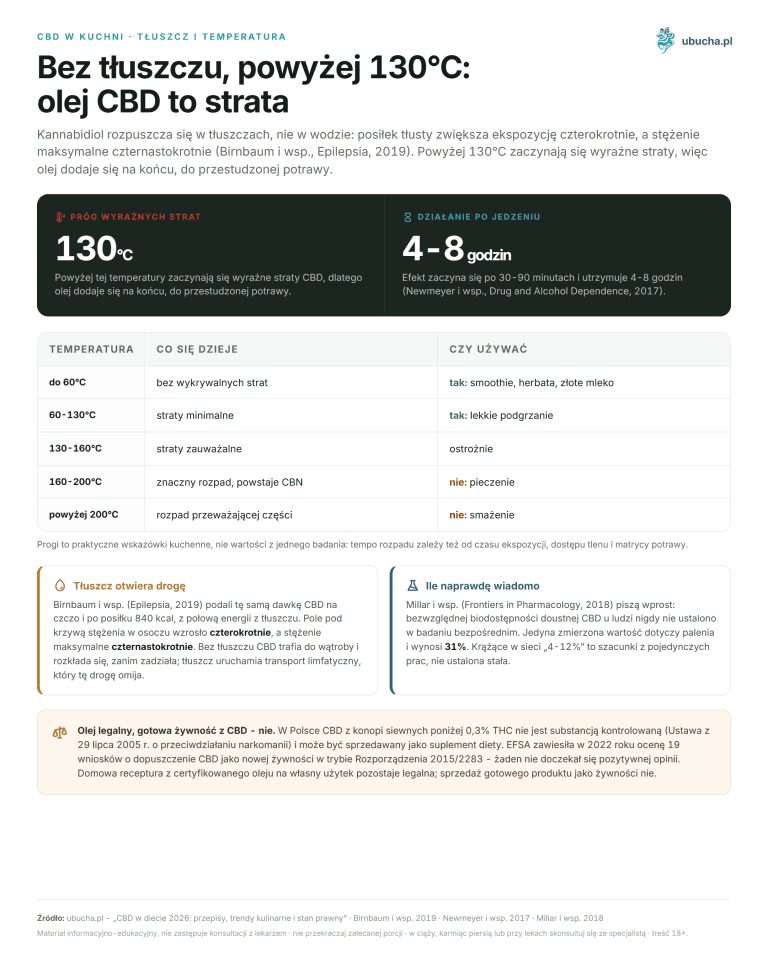
One more variable is mentioned separately and easily used in practice. Maximum concentration rises after a meal and with fatty formulations. This means the same dose taken fasting or after a fatty meal behaves differently, and a producer giving a single number without specifying conditions provides it without context that changes the result.
How does smoking work and what else reaches the lungs then?
Smoking gives the fastest onset because cannabinoids absorb through lung alveoli and bypass the liver. In a study comparing three administration routes, heart rate increase above baseline was noted within half an hour after smoking, averaging 12.2 beats per minute (Newmeyer et al., Drug and Alcohol Dependence, 2017).
The cost of this speed is what forms with the smoke. The glowing joint tip reaches several hundred degrees Celsius, so alongside cannabinoids, pyrolysis products are released: tar substances, carbon monoxide, and compounds also present in tobacco smoke. In the same study, carbon monoxide levels in exhaled air were significantly higher after smoking than vaporization for 15 minutes to six hours post-dose.
It is worth noting what the study did not show. Maximum subjective ratings in occasional smokers did not differ significantly among the three active administration routes. In frequent smokers, the difference between inhalation and oral routes was visible, which the authors attribute to partial tolerance developing with regular exposure.
Activated charcoal filters or wooden mouthpieces lower smoke temperature and trap some particles but do not eliminate combustion itself. This is a compromise for those who remain with smoking for some reason, not a solution. A bong cools smoke through water, changing inhalation sensation but also not eliminating pyrolysis.
Separately stands the issue of how much depends on inhalation technique. Depth of inhalation, breath-holding time, and number of puffs change the amount of substance reaching alveoli. This is why inhalation measurement results vary much more between individuals than oral administration, where the dose is fixed.
The practical consequence is simple. If you want only a fast onset, vaporization gives the same effect without elevated carbon monoxide. Smoking remains a recreational form and is not a recommended medical administration route.
How does vaporization differ from smoking in numbers?
Two things measured separately. Regarding substance delivery, practically no difference: a controlled administration study showed similar cannabinoid pharmacokinetics in blood after smoking and vaporization (Newmeyer et al., Clinical Chemistry, 2016). Regarding byproducts, the difference is clear and favors vaporization.
A separate study tested five market devices in laboratory conditions, measuring how much cannabinoid reaches the vapor (Lanz et al., PLOS ONE, 2016). Four electric devices delivered 54.6% to 82.7% of total THC and 51.4% to 70.0% of total CBD, depending on model. Decarboxylation efficiency, i.e., conversion of acidic forms to active ones, exceeded 97% for THC and 94% for CBD.
| What Was Measured | Result |
|---|---|
| Total THC recovery in vapor, electric devices | 54.6-82.7% |
| Total CBD recovery in vapor, electric devices | 51.4-70.0% |
| THC decarboxylation | at least 97.3% |
| Gas-powered device | recovery at lower range and observed herb combustion |
The variation between models reaches nearly thirty percentage points, so equipment really matters. The authors note one gas-powered device where combustion was observed, exactly what vaporization aims to avoid. Their conclusion applies only to electric devices with temperature control.
Note the decarboxylation measurement itself, explaining why heating the herb is necessary. In the raw plant, cannabinoids mainly exist in acidic form, which does not act like the neutral form. Heating removes the carboxyl group, producing the active compound. This mechanism explains why eating raw herb yields different results than heated herb.
It must be added what this study did not measure. It was conducted in laboratory conditions on analytical equipment and did not assess tar content or effects on human airways. Carbon monoxide data come from a separate human study described above. More about devices is in the post about what vaporizers are.
Why do edibles act slower but longer?
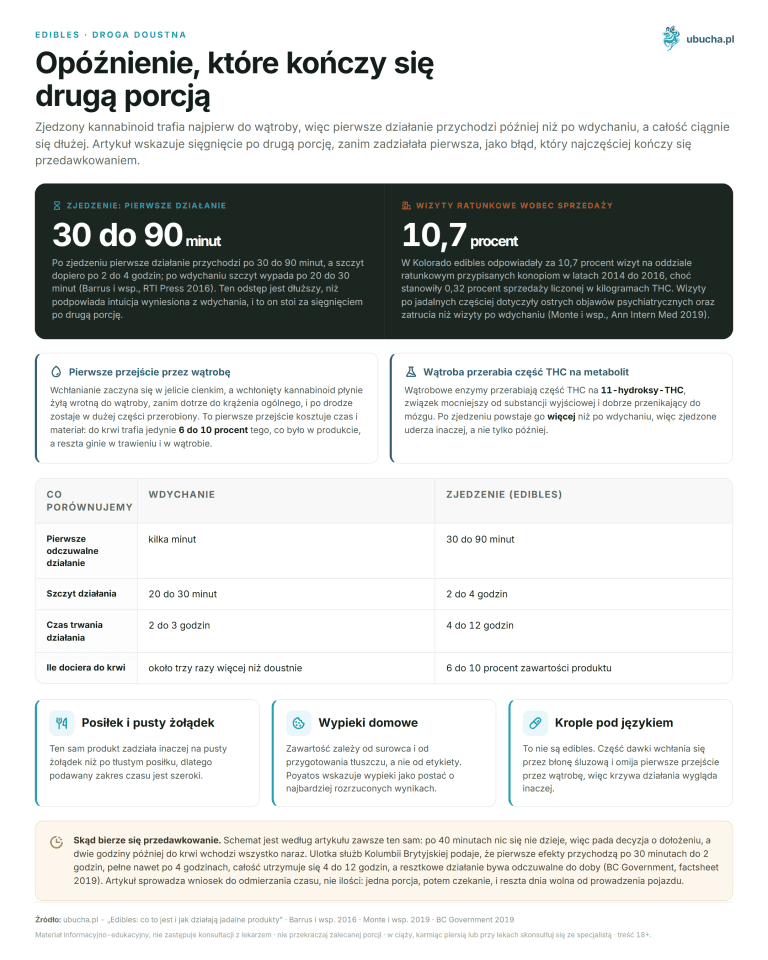
Because the path through the digestive tract is longer and passes through the liver. In a controlled THC cookie administration study, subjective effects and cognitive performance changes peaked 1.5 to 3 hours after eating and lasted 6 to 8 hours (Vandrey et al., Journal of Analytical Toxicology, 2017).
Participants received cookies with three different THC contents, and blood and saliva samples were taken over nine days. Blood cannabinoid concentrations were low compared to inhalation. Maximum concentration and time to peak for the 11-hydroxy-THC metabolite were similar to THC itself.
The scale of difference between routes is also visible in another metabolite. After oral administration, THCCOOH and its glucuronide conjugate concentrations were significantly higher than after smoking or vaporization (Newmeyer et al., Clinical Chemistry, 2016). This is a direct marker of liver passage, the same phenomenon reducing substance amount reaching circulation.
Two typical errors arise from this system. First, taking a second dose after half an hour when nothing happens. Since the peak occurs at the second or third hour, the second dose acts together with the first, producing a stronger effect than planned. Second, comparing sensations with smoking, where feedback comes in minutes and allows dose adjustment on the fly.
Also remember the food variable. Maximum cannabidiol concentration rises after a meal and with fatty formulations (Millar et al., 2018), so the same product behaves differently fasting versus after a meal. The mechanism producing a stronger metabolite is described in detail in the post about edible CBD and the 11-hydroxy metabolite.
Does the administration route change what a test detects?
It does, more than numbers repeated online suggest. The authors of a controlled administration study with three routes remind in the introduction that after frequent cannabis use, THC can be detected in blood for up to thirty days, while in occasional users the window is short (Newmeyer et al., Clinical Chemistry, 2016). The difference comes from substance accumulation in fat tissue, not single dose size.
After oral administration, the picture is different. In the THC cookie study, detection windows in whole blood ranged from zero to twenty-two hours, and in saliva from 1.9 to twenty-two hours (Vandrey et al., Journal of Analytical Toxicology, 2017). Concentrations were low compared to inhalation.
Saliva involves a trap described directly by the same study. After eating, maximum saliva concentration appeared immediately post-dose, reflecting residual substance in the mouth, not what reached the bloodstream. A saliva sample taken right after eating indicates product contact, not body state.
Separately, it is worth knowing the difference in blood composition. Cannabigerol and cannabinol were often detected after inhalation in short time windows but not after oral administration (Newmeyer et al., 2016). The authors propose them as markers of recent inhalation, with the caveat that their absence does not exclude recent use.
The takeaway for readers is caution with ready tables. Detection windows depend on administration route, frequency, tested material, and analytical threshold. The Clinical Chemistry study authors recommend using several complementary criteria simultaneously and interpreting results alongside observation of the tested person’s condition.
Are sublingual drops faster than edibles?
Probably yes, but no comparative human measurement exists. The rationale for this form is anatomical: under the tongue is a dense network of vessels through which the substance can pass directly into the bloodstream, bypassing the portal vein and liver. How much of the dose actually goes this way versus swallowed with saliva remains unmeasured.
What is known concerns aerosol administered to the oral mucosa. For this form, cannabidiol half-life ranged from 1.4 to 10.9 hours, significantly shorter than after long oral administration (Millar et al., 2018). The wide range indicates variability between individuals and preparations.
Administration technique matters technically. Drops are placed under the tongue, on the mucosa of the mouth floor, not on its upper surface, and held without swallowing for several tens of seconds. Part of the dose is swallowed anyway, so the effect is often two-stage: faster onset plus longer maintenance from the portion absorbed via the digestive tract.
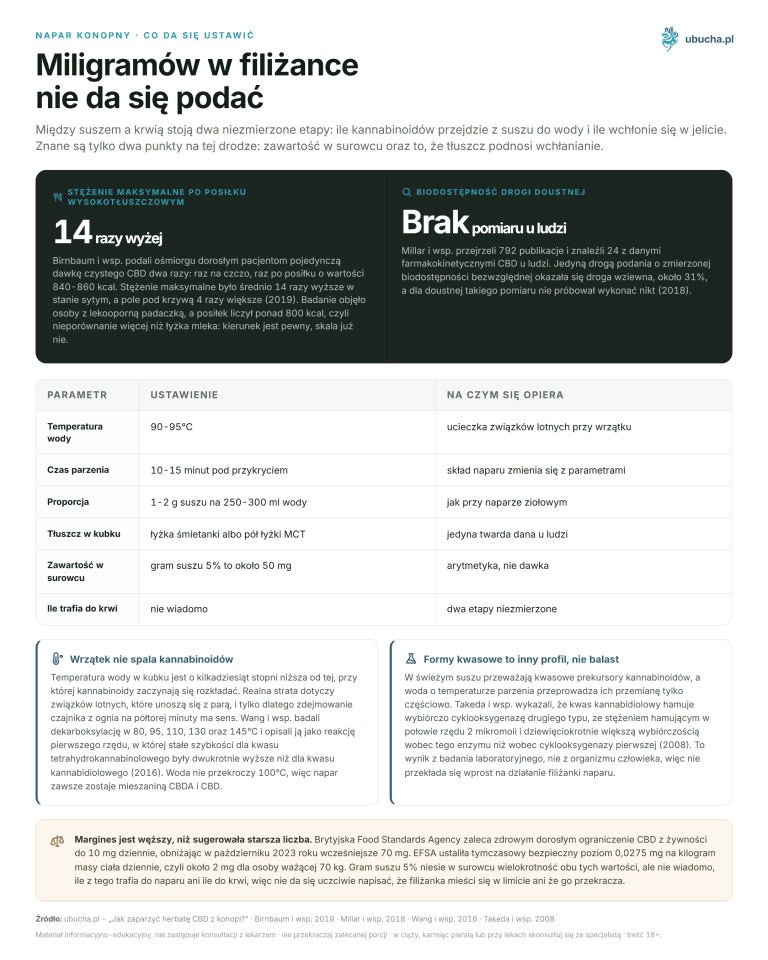
Alcohol tinctures and infusions work similarly but with an important caveat. Cannabinoids are lipophilic and poorly water-soluble, so herb steeped in boiling water releases little. Adding fat improves this, but the amount passing into the drink is hard to estimate and varies between brews.
The practical conclusion concerns expectations, not dosing. If a producer gives a bioavailability percentage for drops, they provide a number not measured in humans. The phenomenon this number was meant to describe is explained in the post about the first-pass effect.
How does a cream differ from a transdermal patch?
By range of action. Creams and balms remain in skin layers and act locally without significant blood concentration. A transdermal patch is designed so the substance passes through the stratum corneum and enters systemic circulation. These are two different product categories, though both are applied to the skin.
A review of cannabinoid delivery systems explains the interest in this route. Low oral bioavailability prompted researchers to seek alternatives, including transdermal, nasal, and mucosal administration (Bruni et al., Molecules, 2018). Strong lipophilicity makes cannabinoids good candidates for nanoparticle carriers.
The barrier to overcome is the stratum corneum. Made of dead, keratinized cells embedded in a lipid matrix, it selectively and reluctantly allows molecules through. Cannabinoids are highly lipophilic, so they penetrate lipid layers easily but remain there instead of passing further to vessels. A transdermal patch must solve this structurally, not just by substance concentration.
The practical consequence is clear. A cream applied to a painful knee will not cause drowsiness or central effects because the substance does not reach the brain in significant concentration. A patch designed as transdermal may behave completely differently, so treating both forms as interchangeable is a mistake.
The market does not make this distinction easy, as brand names do not always reflect product design. A patch may be a simple dressing with a cosmetic layer, without carriers transporting the substance through the stratum corneum. Checking whether the producer declares local or systemic action is more important than the category name.
Bruni’s review covers delivery technologies from preclinical to advanced clinical studies, not efficacy in specific ailments. Conclusions about who and what a cream or patch helps must come from other sources, as this work does not resolve that.
What does the capsule form offer compared to drops and edibles?
Dose repeatability. A capsule contains a measured amount of substance enclosed in a shell, so each intake is the same. In gummies, cookies, or chocolate bars, substance distribution in the mass can be uneven, especially in artisanal production. The time profile remains the same as eating because absorption route is the same.
A second practical difference is taste and smell. Capsules have no hemp flavor or odor, which for some determines the possibility of regular use. They also do not require a dropper or measuring, reducing dosing errors outside home. They look like any other supplement, which can be important at work.
A third point concerns accumulation, rarely mentioned by producers. Cannabidiol half-life after long oral administration is 2 to 5 days (Millar et al., 2018). This means daily use causes blood concentration to rise over several days before stabilizing, and after stopping, it declines equally slowly.
This accumulation explains a phenomenon confusing beginners. Nothing happens on day one, effects appear on day three, and the user attributes it to dose change, though only body saturation changed. For the same reason, assessing whether a form works requires several days of regular use, not a single trial.
Separately stand tablets and water-soluble powders based on nanoemulsions. Producers claim clearly higher absorption than classic oils. The difficulty is that the cannabidiol pharmacokinetics review found no measured absolute bioavailability for any oral form, so no reference point exists to express this increase numerically.
The takeaway for readers is one question when buying. Ask if declared absorption comes from a human study with a control group or from a manufacturer’s measurement. This distinction changes the label number’s value more than its magnitude.
How to choose a method for your cannabis use goal?
The starting point is the symptom pattern over time, not the problem name. A symptom appearing suddenly and passing within an hour requires a form with fast onset. A continuous symptom present all day or night requires a form with long duration. These two requirements rarely meet in one preparation.
Data on user behavior come from a large survey of Canadian patients registered with a licensed producer. From 2032 completed questionnaires, 74.6% used cannabis daily, with an average daily dose of 1.5 grams (Lucas et al., Harm Reduction Journal, 2019). Pain and mental health issues accounted for 83.7% of all indications.
The same study measured substitution of other substances. Prescription drugs were most often replaced, indicated by 69.1% of respondents, then alcohol at 44.5%, and tobacco products at 31.1%. Among prescription drugs, opioids accounted for 35.3% of indications, and with 610 mentions of a specific opioid, 59.3% reported complete cessation.
| What You Expect | Form Feature That Provides It |
|---|---|
| Fast response to sudden symptom | inhalation route, effect in minutes |
| Coverage through the night | oral route, 6-8 hours effect |
| Dose repeatability | capsule with measured content |
| Effect limited to one site | cream or balm, no systemic effects |
| No combustion byproducts | electric vaporizer with temperature control |
However, the survey describes patient declarations, not controlled trial results. These are data on how people use cannabis and their opinions, not proof of efficacy for any indication. Keep this distinction in mind when reading such numbers.
How much substance to take and why you won’t find a number here?
Because a number given in a consumer article pretends to precision that cannabinoid pharmacology does not yet have. The European Food Safety Authority stated in an updated opinion that cannabidiol safety cannot be established in people taking medications simultaneously, pregnant or breastfeeding women, and those under 25 years old (EFSA, NDA panel, 2026).
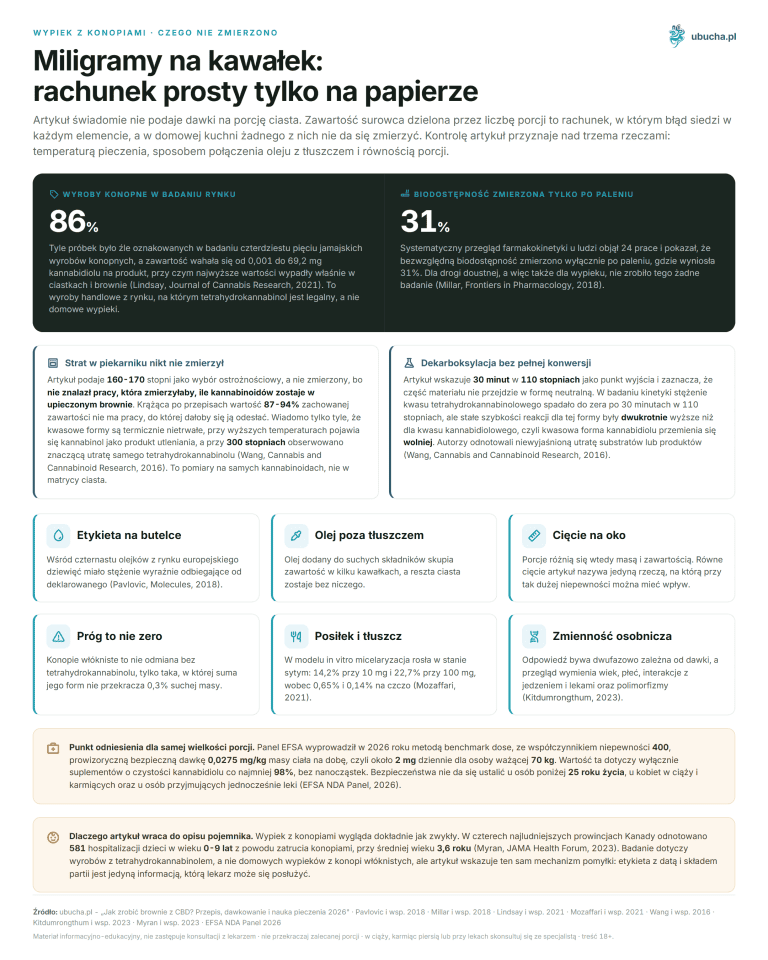
The provisional safe dose calculated applies only to supplements with cannabidiol purity of at least 98%, without nanoparticles, with excluded genotoxicity and safe manufacturing. It does not apply at all to full-spectrum oil, gummies, or herb. Applying this number to any hemp product is misuse.
There is also the problem of comparability between forms. Since absolute bioavailability was measured only for inhalation, converting doses between drops and gummies relies on coefficients no one has determined in humans. The same declared content in two different forms does not mean the same body exposure.
Safety signals listed by the authority concern liver, fetal development, and hormonal balance. Animal studies showed consistent liver toxicity, and in humans, potential hepatotoxicity increasing with concurrent medication use. Placental transfer and thyroid hormone changes were also noted. No study examined immunotoxicity.
Practically, this means one thing. If you take medications regularly, are pregnant, breastfeeding, or under 25, decide on any form and dose with a doctor, not an article. Other readers gain awareness that label content does not indicate how much substance reaches the blood.
What does Polish law say about individual forms?
The boundary is based on THC content in the plant, not the finished product. Industrial hemp plants have a sum of delta-9-THC and tetrahydrocannabinolic acid in flowering or fruiting tops not exceeding 0.3% on dry mass, rounded to one decimal place. The basis is Article 4 point 5 of the Act of July 29, 2005 on Counteracting Drug Addiction (consolidated text Dz.U. 2023 item 1939), as amended by the Act of March 24, 2022 (Dz.U. 2022 item 763).
The calculation method matters in laboratory testing. The result for delta-9-THC alone will be lower than the sum of both compounds, so a batch compliant in one approach may exceed the threshold in another. The national threshold matches the EU threshold numerically but they are separate regulations.
Non-industrial hemp herb is available as pharmaceutical raw material for magistral prescriptions under Article 33a of the Act, as amended by the Act of July 7, 2017 (Dz.U. 2017 item 1458), effective from November 1, 2017. It is dispensed by pharmacies only on Rpw prescription issued after personal patient examination. A narcotic prescription is valid for 30 days and covers up to 90 days of use.
| Form | Status |
|---|---|
| Hemp herb from plants below threshold | trade allowed |
| Oils and capsules below threshold | trade allowed |
| Cosmetics and topical preparations | trade allowed |
| Non-industrial hemp herb | pharmacy only, Rpw prescription |
| Hexahydrocannabinol (HHC) | controlled substance |
Separately stands driving. The basis for testing drivers for substances acting like alcohol is Article 129j of the Road Traffic Act (consolidated text Dz.U. 2024 item 1251), not Article 129i which concerns alcohol. The value of 1 nanogram per milliliter, repeated as a responsibility threshold, is in the regulation the detection limit of the method, not a criminal threshold. For saliva, the regulation sets no limit value.
Sanctions fall into two regimes not to be confused. Driving under the influence of an intoxicating substance is a crime under Article 178a paragraph 1 of the Penal Code, punishable by imprisonment up to three years and mandatory financial penalty of at least 5000 PLN. Driving after use is an offense under Article 87 paragraph 1 of the Code of Petty Offenses, punishable by a fine not less than 2500 PLN.
What to remember when choosing a consumption method?
First, humility toward numbers. Bioavailability tables circulating online suggest precision absent in data: for cannabidiol, it was measured in humans only for inhalation. Any other value is an estimate, and should be read as such when comparing products.
Second, distinguish speed from duration. Inhalation routes give effects in minutes and allow dose adjustment on the fly. Oral route peaks between 1.5 and 3 hours and lasts 6-8 hours but removes the possibility of correction during effect. This is not about product potency but absorption physiology.
Third, consider byproducts. Smoking and vaporization deliver comparable cannabinoid amounts, but smoking raises carbon monoxide in exhaled air, vaporization does not. If inhalation is your choice, an electric device with temperature control makes a measurable difference compared to a joint.
Fourth, product design matters, not its name. Cream and transdermal patch belong to different categories, though both are applied to skin. Capsule and gummy share the same time profile but differ in dose repeatability. Labels rarely clarify this, so asking about declared local or systemic action is a sensible first question.
Fifth, the boundary where the article ends and the clinic begins. For those on regular medications, pregnant, breastfeeding, or under 25, cannabidiol safety cannot be established today, so the decision belongs to a doctor. This boundary does not depend on the chosen administration route.
Frequently Asked Questions
Is vaporization less harmful than smoking?
In terms of cannabinoid delivery, both methods perform similarly, but smoking significantly increases carbon monoxide levels in exhaled air for several hours after the dose, which vaporization does not (Newmeyer et al., Drug and Alcohol Dependence, 2017). The authors call vaporization an attractive alternative for medical applications.
How much cannabidiol actually reaches the blood from sublingual drops?
Unknown. A systematic review of cannabidiol pharmacokinetics in humans established absolute bioavailability only for the smoking route, at 31%, and found that no study determined it for oral or sublingual routes (Millar et al., Frontiers in Pharmacology, 2018). Percentages given for drops lack measurement support.
Why do cannabis edibles have a delayed effect?
Because the substance must pass through the stomach, intestines, and liver before entering systemic circulation. In a controlled cookie administration study, effects peaked between one and a half to three hours after ingestion and lasted six to eight hours (Vandrey et al., Journal of Analytical Toxicology, 2017). Blood concentrations were low compared to inhalation.
Do all vaporizers work the same?
No. In a laboratory study of five devices, total THC recovery in vapor ranged from 54.6% to 82.7% depending on the model, and combustion of the herb was observed with a gas-powered device (Lanz et al., PLOS ONE, 2016). The conclusion about effective and repeatable extraction applies to electric devices with temperature control.
Does cannabidiol cream penetrate the blood?
Classic creams and balms are intended to act within the skin without significant systemic concentration. A transdermal patch is a different design, engineered so the substance passes through the stratum corneum into circulation. The transdermal route is studied precisely because of the low oral bioavailability of cannabinoids (Bruni et al., Molecules, 2018).
Can multiple methods of administration be combined?
A survey of 2032 Canadian patients shows that combining forms is common in this group, with 74.6% using cannabis daily (Lucas et al., Harm Reduction Journal, 2019). These are behavioral data, not proof of safety in combining. Discuss with your doctor if on stable pharmacotherapy.
What THC threshold applies in Poland and how is it calculated?
The threshold is 0.3% calculated on dry mass and applies to the plant, not the finished product. It is calculated as the sum of delta-9-THC and tetrahydrocannabinolic acid in flowering or fruiting tops, rounded to one decimal place. The basis is Article 4 point 5 of the Act on Counteracting Drug Addiction (consolidated text Dz.U. 2023 item 1939).
What are the penalties for driving under the influence of THC?
Driving under the influence of an intoxicating substance is a crime under Article 178a paragraph 1 of the Penal Code, punishable by up to three years imprisonment and a financial penalty of at least 5000 PLN. Driving after use is an offense under Article 87 paragraph 1 of the Code of Petty Offenses, with a fine not less than 2500 PLN.
This article is informational and educational and does not constitute legal advice. The legal status described applies as of publication date: cannabis regulations may change. Consult a lawyer or current legal acts before making decisions.
Forms for vaporization and devices are collected in the vaporizers category.
Author: Michał Waluk · Published: 2026-05-06 · Updated: 2026-08-10