
Reimbursement of Medical Marijuana: Prices and Barriers
NFZ does not reimburse cannabis flower. How much does a gram and a month of therapy cost, what barriers limit access, and how does Poland compare to the Czech Republic and Germany.
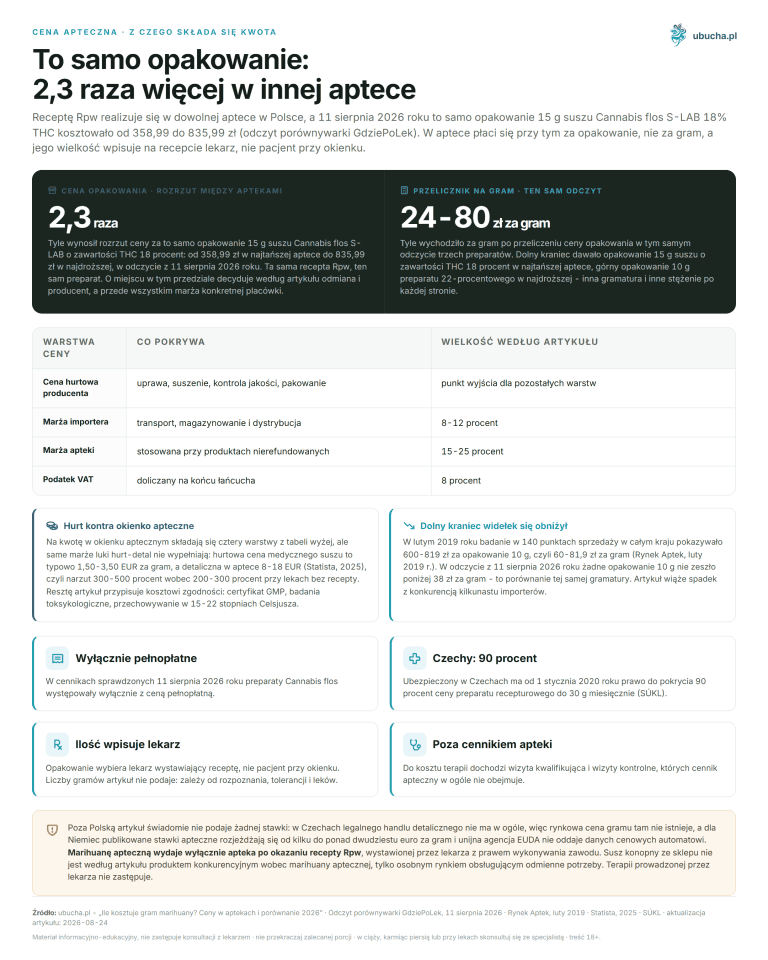
The National Health Fund does not reimburse cannabis flower, and the patient covers the cost entirely, with prices ranging from 24 to 80 PLN per gram, making a month of therapy cost from several hundred to several thousand PLN, depending on the quantity prescribed. Poland legalized cannabis therapy in November 2017, and since then, the system has evolved from empty pharmacies to routine e-prescriptions. Eight and a half years later, the picture is ambiguous: the regulations are in place, the procedure is described, yet surveys indicate that most doctors do not feel prepared to conduct such therapy, and patients pay for the raw material out of pocket. This overview clarifies the state as of August 2026: the legal basis along with the act numbers, the rules for issuing prescriptions after the changes in 2024, the quality of scientific evidence, real barriers to access, and Poland’s position compared to Germany and the Czech Republic. Instead of circulating estimates of the number of patients, we provide only data that can be indicated in publications or legal acts, as there is no public register of individuals treated with cannabinoids in Poland, and no one knows such a number.
KEY INFORMATION
• The legal basis is the act of July 7, 2017 (Dz.U. 2017 poz. 1458), effective from November 1, 2017; it introduced cannabis flower and extracts as pharmaceutical raw materials.
• From November 7, 2024, the first Rpw prescription for this raw material can only be issued after a personal examination of the patient (Dz.U. 2024 poz. 1600).
• The Rpw prescription is valid for 30 days, and a quantity corresponding to a maximum of 90 days of use can be prescribed at one time.
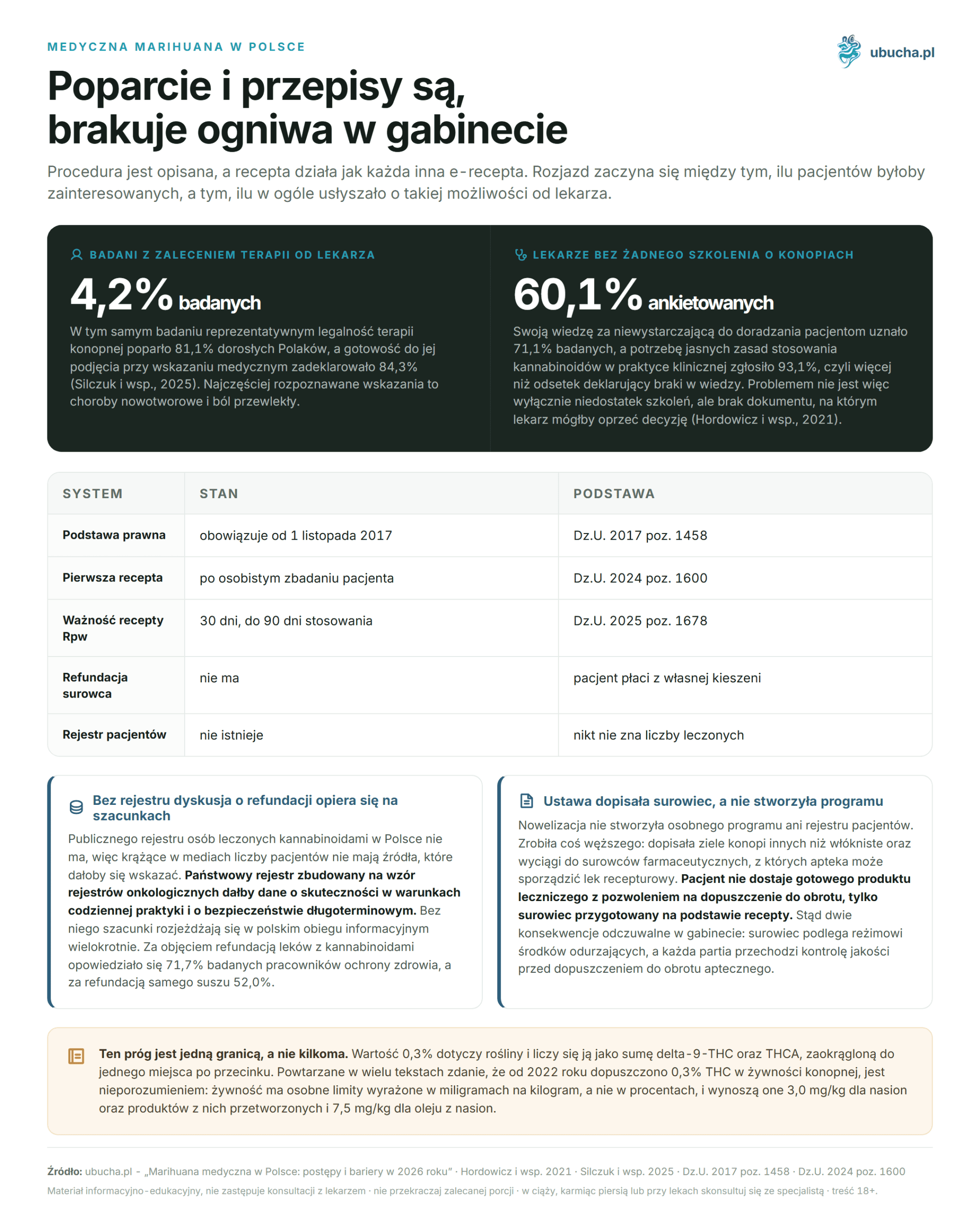
• In a survey among Polish doctors, 60.1% have never undergone any training on medical cannabis, and 71.1% considered their knowledge insufficient to advise patients (Hordowicz et al., 2021).
• The raw material is not reimbursed, and in a representative study from 2025, only 4.2% of adult Poles received a recommendation for cannabis therapy from a doctor.
From when and on what basis is medical marijuana legal in Poland?
From November 1, 2017. On that day, the act of July 7, 2017 on amending the act on counteracting drug addiction and the act on the reimbursement of medicines, special nutritional purpose foods, and medical devices (Dz.U. 2017 poz. 1458) came into force, which is still in effect today.
The amendment did not create a separate program or patient registry. It did something narrower and more technical: it added cannabis flower and extracts, pharmaceutical tinctures, and other extracts from these cannabis plants to the pharmaceutical raw materials from which a pharmacy can prepare a compounded medication. Therefore, the patient does not receive a ready-made medicinal product with marketing authorization, but rather a raw material prepared based on a prescription.
The parent regulations are found in the act of July 29, 2005 on counteracting drug addiction, the current consolidated text of which was published in 2023 (Dz.U. 2023 poz. 1939). This solution has two consequences felt in the office. First, the raw material is subject to the regime of narcotic substances, thus requiring a prescription in the Rpw category. Second, each batch must undergo quality control before being allowed for pharmacy distribution, which extends the path from the importer to the shelf.
It is worth distinguishing between two dates, as they are often confused. The act was passed on July 7, 2017, but it only came into force on November 1 of the same year, and the first batches of raw material appeared in pharmacies even later, in 2019. Thus, the period between legalization and real availability lasted over a year.
The boundary between pharmaceutical raw material and consumer product is defined by the definition in Article 4 point 37 of the 2005 act. Cannabis flower is any above-ground part of the plant other than seeds, in which the sum of delta-9-THC and tetrahydrocannabinolic acid exceeds 0.3% of dry weight. Everything below this value belongs to industrial hemp and is not subject to prescription regulations.
What does the patient’s journey from visit to prescription fulfillment look like?
Three stages: examination by a doctor, issuance of the Rpw prescription, and fulfillment at a pharmacy that has access to the raw material. The prescription can be issued by any doctor with the right to practice, regardless of specialization, as the regulations do not create a separate authorization or list of facilities.
The Rpw prescription has its own terms. It is valid for 30 days from the date of issuance, and a quantity corresponding to a maximum of 90 days of use can be prescribed at one time. These rules stem from the regulation of the Minister of Health regarding narcotic drugs, psychotropic substances, category 1 precursors, and preparations containing these substances, the consolidated text of which was published at the end of 2025 (Dz.U. 2025 poz. 1678).
The third stage can be the most surprising for the patient. The pharmacy is not obliged to keep cannabis raw material in its permanent assortment, and the compounded medication is prepared only after the prescription is received. Therefore, obtaining a specific strain from the wholesaler takes additional time, and not every pharmacy collaborates with wholesalers dealing in controlled substances. A phone call before the visit usually saves a second trip.
Formally, the Rpw prescription today works the same as any other e-prescription. The patient receives a four-digit code, which along with their PESEL number is sufficient to dispense the medication, and the pharmacist can see the fulfillment history in the system. The paper printout has thus ceased to be a bottleneck, although the Rpw category still imposes separate record-keeping obligations on the pharmacy.
Another thing that patients discover only at the counter: this is not a ready-made medication from a package. The pharmacy prepares a compounded medication from the raw material, so the waiting time depends not only on delivery but also on whether the facility actually conducts compounding with controlled substances.
The entire procedure step by step, along with documents and typical questions from the doctor, is described separately in the text What does the process of obtaining a prescription for medical marijuana look like.
What changed on November 7, 2024?
The first Rpw prescription for cannabis raw material can no longer be issued without a personal examination of the patient. This change was introduced by the regulation of the Minister of Health of October 29, 2024 (Dz.U. 2024 poz. 1600), effective from November 7, 2024.
The regulation introduced a list of narcotic drugs, psychotropic substances, and category 1 precursors, for which the issuance of a prescription must be preceded by a personal examination of the patient by the prescriber. This list includes cannabis flower, extracts, pharmaceutical tinctures, and other extracts from these cannabis plants, as well as cannabis resin. The change was a response to the scale of prescriptions issued by services operating exclusively remotely.
However, there is an important exception that is often overlooked in summaries. The requirement for a personal examination does not apply to the continuation of treatment with the same preparation if the prescription is issued by a primary healthcare physician operating under a contract with the National Health Fund, excluding contracts for night and holiday care. Subsequent prescriptions for a stabilized patient can therefore be created after a teleconsultation.
Equally important is what the regulation did not change. It did not narrow the circle of doctors authorized to issue prescriptions, did not introduce a list of indications, did not alter the validity periods of prescriptions, nor the limit of 90 days of use. It only limited the mode of first contact, recognizing that the assessment of the justification for therapy with a controlled substance requires examination, not just an interview on a form.
The practical effect for a new patient is simple: the first visit must take place in person, and only subsequent ones can be remote. What this means for planning therapy from scratch is developed in the guide How to become a medical marijuana patient in Poland.
What do Polish doctors and pharmacists know about cannabinoid therapy?
Less than their role would require, and they themselves declare this. In a survey conducted from June to October 2020 among 173 Polish healthcare workers, 60.1% of respondents had never undergone any training on medical cannabis, and 71.1% considered their knowledge insufficient to advise patients (Hordowicz et al., 2021).
However, the same study shows that the resistance does not stem from reluctance. Responses to the question about expectations are very clear: 92.4% of respondents would like to be able to answer patients’ questions, 93.1% reported a need for clear guidelines for the use of cannabinoids in clinical practice, 71.7% supported the reimbursement of medications containing cannabinoids, and 52.0% supported the reimbursement of cannabis flower.
Newer data from one province show exactly where the gap lies. In a study of 293 primary healthcare physicians from Lublin, 90.8% correctly identified the active substance, but only 21.2% knew that there are regulations in Poland allowing for the issuance of a prescription for medical marijuana, and 15.7% accurately assessed its addictive potential (Florek-Łuszczki et al., 2025). Thus, the gaps concern the procedure and pharmacology, not the idea of therapy itself.
On the pharmacy side, the picture is similar. In a study of 422 pharmacists and pharmacy students, over 66% declared comfort in discussing medical cannabis with patients, but significantly fewer felt confident in providing detailed advice, and recurring concerns were related to long-term effects and legal liability when dispensing the raw material (Merks et al., 2025).
Patients see this state very similarly. In a representative study of 1113 adult Poles from July 2025, 29.9% of respondents expressed trust in doctors’ knowledge about medical cannabis, while only 16.1% trusted their own knowledge (Silczuk et al., 2025). Both sides of the conversation in the office assess their own preparation as low, independently of each other.
What do studies say about the effectiveness of cannabinoid therapy?
The evidence is uneven and strongest in three indications. A systematic review encompassing 79 randomized studies and 6462 participants showed moderate quality evidence for chronic pain and spasticity, and low quality for nausea and vomiting after chemotherapy, weight gain in HIV infection, sleep disorders, and Tourette’s syndrome (Whiting et al., JAMA, 2015).
The numbers from this review are worth reading carefully, as they can be oversimplified. Among the 79 studies, only four were rated as having low risk of bias. Cannabinoids were associated with a higher rate of complete antiemetic response than placebo, with a reduction in pain intensity on a numerical scale averaging 0.46 points out of ten, and a decrease in spasticity scores on the Ashworth scale averaging 0.36 points. At the same time, the risk of short-term adverse events, including serious ones, increased. The most common included dizziness, dry mouth, nausea, fatigue, drowsiness, euphoria, vomiting, disorientation, confusion, loss of balance, and hallucinations.
This comparison is worth keeping alongside declarations of effectiveness, as both sides of the balance come from the same review. Moderate quality evidence means that further studies may change the effect estimate, not that the effect is certain. With such a small number of studies with low risk of bias, caution in formulating promises to the patient is not a precaution but a reading of the data as they say.
An American institutional report from 2017 reached similar conclusions, indicating the strongest evidence for chronic pain in adults, nausea and vomiting after chemotherapy, and spasticity in multiple sclerosis (The Health Effects of Cannabis and Cannabinoids, National Academies Press, 2017). Separately, a committee of experts from the World Health Organization in a critical review from June 2018 concluded that cannabidiol itself does not exhibit addictive potential or actions indicating a risk of abuse (WHO ECDD, 2018).
Indications being studied but without consensus include post-traumatic stress disorder, treatment-resistant attention disorders in adults, selected autism spectrum disorders, neurodegenerative diseases, and painful menstruation. Research is ongoing in each of these areas, but none currently has evidence strength comparable to chronic pain.
What barriers currently limit patient access?
Five obstacles recur in studies and patient reports regardless of the region. The first is the best documented: despite high public support for cannabis therapy, only 4.2% of adult Poles received a recommendation from a doctor (Silczuk et al., 2025).
| Barrier | What it consists of | What maintains it |
|---|---|---|
| Cost of therapy | the patient covers the cost of the raw material entirely, i.e., 24-80 PLN per gram and from 240 to 2400 PLN per month | the pharmaceutical raw material is not reimbursed |
| Continuity of supply | gaps in the availability of a specific strain | import, quality control of batches, lack of obligation to maintain stock |
| Preparation of doctors | lack of knowledge about the procedure and dosing | lack of mandatory courses in the study program |
| Stigmatization | patients hide therapy, doctors avoid the topic | common associations with non-medical use |
| Lack of registry | it is unknown how many patients there are and with what results | lack of a system for collecting data on therapy outcomes |
The last row explains why this article does not provide the number of patients. Estimates published in the media have no basis in any public registry, and the differences between them can reach an order of magnitude. Without population data, it is impossible to assess effectiveness in everyday practice or build a reimbursement argument based on results.
Changing strains can also be more difficult than it appears from the outside. Each transition to a different raw material requires re-adjusting the dose, which for a patient with epilepsy or neuropathic pain means weeks of instability. What is currently available in pharmacies is tracked in the summary Currently available strains of medical marijuana in Poland.
The cost barrier operates differently than intuition suggests. It does not randomly filter out patients but systematically: chronic therapy means a recurring expense every month, so those with the lowest incomes, often those with the most severe disease progression and the least ability to work, drop out first. Reimbursement would not change the number of patients so much as their structure.
Stigmatization is often confused with a lack of social acceptance, but these are two different things. Support for the legality of therapy is high in studies; resistance concerns specific situations where a patient fears the reaction of an employer or a doctor treating another illness. This is a communication barrier, not an ideological one.
How much does a month of therapy with medical marijuana cost?
From several hundred to several thousand PLN, as the price depends on two numbers: the rate per gram and the quantity written on the prescription. A gram of pharmacy-grade flower cost in August 2026 from about 24 to 80 PLN, depending on the preparation and pharmacy. At 10 g per month, this amounts to between 240 and 800 PLN, and at 30 g, from 720 to 2400 PLN. The entire cost is borne by the patient.
This calculation does not yet include visits. The qualifying consultation and subsequent follow-up visits are a separate expense, which the pharmacy price list does not show, and in the absence of reimbursement, nothing else covers it. A complete breakdown of rates per gram, with readings from the comparator, is laid out in the text about prices of medical marijuana in pharmacies.
It is worth adding why this number is needed at all. Without it, the discussion about access barriers remains vague, and it is precisely the cost that patients cite as the primary obstacle, ahead of strain availability and the attitude of the doctor.
How does Poland compare to Germany and the Czech Republic?
Worse in both comparisons, but for different reasons. Germany simplified access from a procedural standpoint, the Czech Republic from a financial one, and Poland has done neither.
The German reform came into effect on April 1, 2024. The act on medical cannabis removed medicinal cannabis from the narcotic drugs law and placed it under pharmaceutical law. Two barriers disappeared at once: the obligation to issue prescriptions on a special form for narcotic drugs and the requirement for federal institute approval for individual prescriptions, which previously acted as a bottleneck in the system. Today, any doctor with the right to practice can prescribe cannabis on a regular prescription.
The German reform also included non-medical use, although in a separate act: possession of up to 25 grams in public, up to 50 grams at home, and cultivation of three plants for personal use were allowed. For comparison with Poland, it is significant that the medical aspect was simplified independently of that change, and it is responsible for the increase in the number of prescriptions.
The Czech Republic took a different path and did it earlier than is usually stated. Reimbursement from public health insurance has been in effect since January 1, 2020, covering 90% of the retail price for quantities up to 30 grams of flower per month, and in justified cases, a doctor can request more. The effect is visible in the statistics: the year of the introduction of reimbursement was one of the two periods of the fastest growth in the number of patients.
The conclusion for Poland is uncomfortable because both reforms were inexpensive regulatory changes. The German reform cost the budget nothing, as it involved shifting substances between legal acts. The Czech reform cost money, but in the scale of expenditures on reimbursed medications, it remains a minor item. Thus, the Polish system maintains both barriers simultaneously: full out-of-pocket payment and a tightened procedure since 2024.
What do the patient and medical communities expect today?
Four things, three of which have support in the aforementioned survey studies. The first is reimbursement: 71.7% of surveyed healthcare workers supported the inclusion of cannabinoid medications in reimbursement, and 52.0% supported the reimbursement of cannabis flower (Hordowicz et al., 2021).
The second is guidelines. The need for clear rules for the use of cannabinoids in clinical practice was reported by 93.1% of respondents, which is more than the percentage declaring knowledge gaps. This is a signal that the problem is not solely a lack of training but also the absence of a document on which a doctor could base their decision and refer to the payer and the medical chamber.
The third is pre-graduate education. Since only one in five primary healthcare doctors in the surveyed province knew about the existence of regulations allowing for the issuance of a prescription, the gap begins before specialization. A few-hour block within clinical pharmacology and palliative medicine would close this gap for future graduating classes.
The fourth is a registry. A state registry of patients treated with cannabinoids, built on the model of oncological registries, would provide data on effectiveness in everyday practice and long-term safety. Without it, the discussion about reimbursement is based on estimates, and these in the Polish information circulation diverge significantly from each other.
There is no lack of public support for such changes. In a representative study from July 2025, 81.1% of adult Poles supported the legality of cannabis therapy, and 84.3% declared readiness to undertake it with a medical indication (Silczuk et al., 2025). The most commonly recognized indications are cancer, indicated by 57.4% of respondents, and chronic pain, indicated by 49.8%.
The gap between this support and the percentage of people who have actually heard about such an option from a doctor is the shortest description of the state of the system. It lacks neither regulations nor patient interest; it lacks the link that translates one into the other in the office.
What distinguishes medical marijuana from CBD products available without a prescription?
Content of THC, legal status, and access route. Pharmaceutical raw material is cannabis flower, meaning material in which the sum of delta-9-THC and THCA exceeds 0.3% of dry weight; it is dispensed only on a Rpw prescription. Consumer products are made from industrial hemp, in which the same sum does not exceed 0.3%.
This threshold is one boundary, not several. The value of 0.3% pertains to the plant and comes from Article 4 point 5 of the act on counteracting drug addiction as amended on May 7, 2022; it is calculated as the sum of delta-9-THC and THCA, rounded to one decimal place. The repeated statement in many texts that since 2022, 0.3% THC has been allowed in hemp food is a misunderstanding: food has separate limits expressed in milligrams per kilogram, not in percentages, which are 3.0 mg/kg for seeds and processed products and 7.5 mg/kg for seed oil.
The pharmacological difference is equally clear. THC acts psychoactively and is responsible for most of the effects described in studies on pain and spasticity, while cannabidiol does not exhibit psychoactive effects or addictive potential. Therefore, a product available without a prescription is not a weaker version of pharmaceutical therapy but something different in composition and purpose. We discuss this more broadly in the text Medical cannabis and the issue of CBD product regulation in Poland.
The legal status of both groups also differs at the foundation. Cannabidiol does not appear in any of the lists of controlled substances maintained by the Minister of Health, so a product from industrial hemp does not require permits or prescriptions. The situation is different with hexahydrocannabinol, or HHC: it is a controlled substance, and its trade outside the provisions of the act remains prohibited, even though it is sometimes sold as an alternative to consumer products.
If you are looking for products made from industrial hemp available without a prescription, check the category hemp flower.
Frequently Asked Questions
When is medical marijuana legal in Poland?
Since November 1, 2017, based on the act of July 7, 2017, amending the act on counteracting drug addiction, announced as Dz.U. 2017 item 1458. The act added cannabis other than fiber and extracts from it to pharmaceutical raw materials, from which the pharmacy prepares a prescription drug on prescription Rpw.
Which doctor can issue a prescription Rpw for medical marijuana?
Any doctor with the right to practice in Poland, regardless of specialization. The regulations do not create a separate authorization or list of facilities. In practice, prescriptions are mainly issued by specialized clinics, as surveys indicate that most doctors do not feel prepared to conduct such therapy.
Can the first prescription be obtained through a teleconsultation?
No. From November 7, 2024, the first prescription for cannabis raw material requires a personal examination of the patient. An exception applies to the continuation of treatment with the same preparation when the prescription is issued by a primary healthcare physician operating under a contract with NFZ, outside of contracts for night and holiday care.
How long is the Rpw prescription valid and for how many days of therapy?
The Rpw prescription is valid for 30 days from the date of issuance. A quantity of raw material corresponding to a maximum of 90 days of use can be prescribed at one time. If the patient redeems it later than on the date of issuance, the number of issued packages is reduced by the days on which the medication was not used.
Does the National Health Fund reimburse cannabis flower?
No. The pharmaceutical raw material from cannabis is not covered by reimbursement, so the patient pays the full price. Part of the medical community supports reimbursement: in a 2021 survey, 71.7% of respondents supported it in relation to cannabinoid medications and 52.0% in relation to the raw herb itself.
Does every pharmacy fulfill prescriptions for medical marijuana?
No. The pharmacy is not obliged to maintain cannabis raw material in a constant assortment, and the prescription drug is prepared only after receiving the prescription. Obtaining a specific strain from the wholesaler takes additional time, so it is worth confirming availability by phone before the visit.
Is it allowed to drive a car during therapy?
No, if THC is present in the body. Polish law does not provide an exception for patients with a prescription, and a positive test result means criminal liability. The time needed for elimination depends on the dose, route of administration, and individual metabolism, so a safe break is established with the attending physician.
The article is for informational and educational purposes and does not constitute medical advice. Before starting to use cannabis or CBD for therapeutic purposes, consult a doctor, especially if you are taking other medications, are pregnant, or breastfeeding.
Author: Michał Waluk · Published: 2026-05-11 · Updated: 2026-08-24