


Chocolate Truffles with CBD Oil: Dessert for the Evening
Chocolate truffles with CBD oil, no baking. Step-by-step recipe, provisional EFSA ceiling for CBD, legal status, and nutritional values from the USDA database.
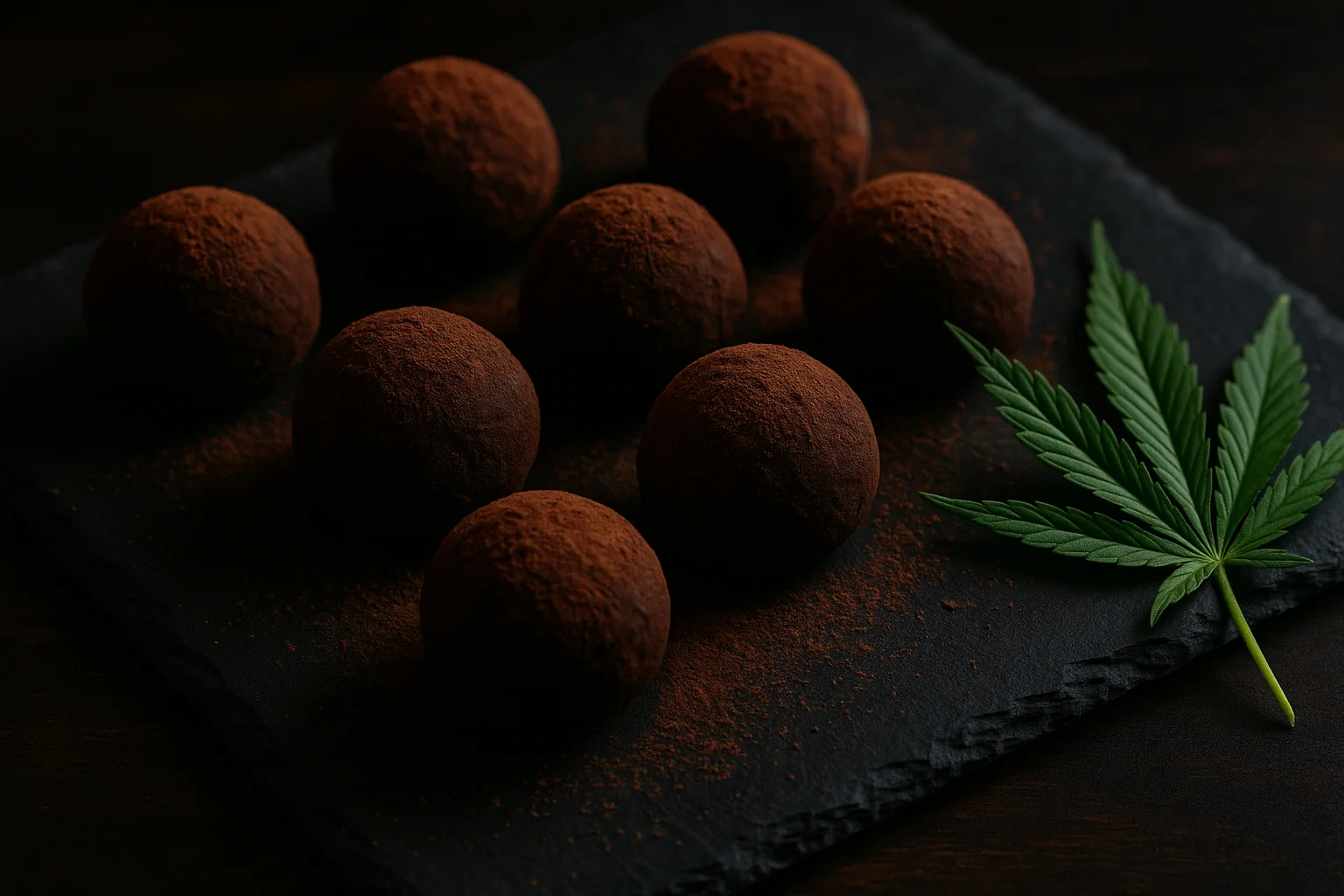
Chocolate truffles with CBD oil are a no-bake, no refined sugar dessert, requiring twenty minutes of active work and several hours of cooling. Cocoa butter is more than just flavor here: cannabidiol dissolves in fats, so the ganache acts as a carrier. Additionally, the flavor argument comes into play: dark chocolate masks the earthy taste of the oil better than any other carrier available in a home kitchen. Here you will find a step-by-step recipe, numbers from the USDA food composition database, and the legal basis for the THC threshold. You will not find a drop-to-truffle converter, and this is a conscious decision. The European Food Safety Authority set a provisional ceiling for CBD in 2026 so low that any measurement from the recipe would be misleading.
KEY INFORMATION
• Co-administration of fat increased systemic exposure to CBD in rats by about 3 times (Zgair et al., 2016).
• EFSA provides a provisional safe dose of CBD at 0.0275 mg/kg body weight per day, or about 2 mg for a person weighing 70 kg.
• Safety of CBD has not been established for individuals under 25 years of age, pregnant, breastfeeding, and those taking medications.
• 100 g of chocolate 70-85% cocoa contains 228 mg of magnesium (USDA, record 170273).
Why does chocolate carry CBD oil well?
Because cannabidiol dissolves in fats, and fat constitutes more than one-third of the ganache mass. Zgair and colleagues administered cannabinoids to rats along with lipids and achieved about 3 times higher systemic exposure for CBD and 2.5 times for THC than with a fat-free preparation.
This same work shows where the difference comes from. In laboratory conditions of lipolysis, over 30 percent of the administered CBD ended up in the micellar fraction, which is the form available for absorption, and both cannabinoids showed a high affinity for chylomicrons. The affinity for chylomicrons in rats and humans was comparable, so the authors assume that the effect will be similar in humans (Zgair et al., American Journal of Translational Research, 2016). This assumption by the authors is derived from an animal model, not measurements in humans.
The second argument is flavor and much simpler. Hemp oil has an earthy, slightly bitter taste, and dark chocolate has a similar bitterness profile, so both notes blend instead of contrasting. With milk chocolate, the sweetness pushes the hemp aroma to the surface, and the effect is the opposite of what is intended.
How much CBD can be safely consumed according to EFSA?
The EFSA panel, in an update on the safety of cannabidiol, derived a provisional safe dose of 0.0275 mg per kilogram of body weight per day, which for an adult weighing 70 kg gives about 2 mg daily. The uncertainty factor adopted in this calculation was 400.
The ceiling is conditioned by two requirements. It applies only to supplements with at least 98 percent purity of cannabidiol and without nanoparticles. The panel states explicitly that the safety of CBD cannot be established for individuals under 25 years of age, for pregnant and breastfeeding women, and for those taking medications (EFSA, EFSA Journal, 2026). The reason is repeated changes in the liver in animal studies and a hepatotoxic signal in human trials, most evident when medications are taken simultaneously.
Therefore, this recipe does not include a drop-to-truffle converter. A five percent oil contains 50 mg of cannabidiol per milliliter. Even one milliliter divided into twenty truffles gives in one serving more than the provisional ceiling set by EFSA for the entire day. How much oil you add to your batch is your decision and your responsibility, and if you are taking medications regularly, consulting with a doctor precedes this decision.
Are truffles with CBD oil legal in Poland?
Yes, if the oil comes from hemp. Cannabidiol is not listed in any controlled substance lists, and the threshold for hemp is 0.3 percent, calculated as the sum of delta-9-THC and tetrahydrocannabinolic acid, not as delta-9-THC alone.
The national basis is Article 4 point 5 of the Act of July 29, 2005 on Counteracting Drug Addiction (Journal of Laws 2023 item 1939) as amended by the Act of March 24, 2022 (Journal of Laws 2022 item 763), effective from May 7, 2022. The provision refers to flowering tops or fruiting bodies from which the resin has not been removed, and the sum is rounded to one decimal place. This distinction changes the result of laboratory testing, as some THC occurs in the plant in its acidic form.
The EU threshold has the same value but is a separate regulation: it is introduced by Article 4 paragraph 4 of Regulation (EU) 2021/2115, applicable from January 1, 2023. The Polish threshold does not derive from it, although it corresponds to it. Separately, there are limits for THC contamination in food from hemp seeds, expressed in milligrams per kilogram and established by Regulation (EU) 2023/915. The legal status described above is valid as of the date of this text’s update.
What do you need for the truffles?
The list is short, and the quality of the chocolate determines the outcome more than anything else. Take a bar with at least 70 percent cocoa content, preferably 85. The cream must have 30-36 percent fat, as a lighter cream will not bind the ganache enough to shape the balls.
- 200 g of dark chocolate, minimum 70% cocoa
- 100 ml of heavy cream 30-36%
- 2 tablespoons of butter (optional, for shine)
- 1 tablespoon of honey or maple syrup
- hemp CBD oil, amount according to your decision
- a pinch of sea salt
- for coating: natural cocoa, cocoa with cinnamon, or chopped nuts
Butter is optional, but it changes the appearance of the finished truffle: it adds shine and makes the mixture less crumbly when shaping. Honey adds moisture, so do not increase its amount beyond one tablespoon, as the ganache will lose its shape. Use natural cocoa for coating, as alkalized cocoa tastes milder and loses contrast with the truffle’s interior.
You can find CBD oils in several concentrations in the oils category. Before measuring anything, read the label: the percentage concentration and the volume of the bottle indicate how much cannabidiol is in a milliliter, and that is the only number worth considering.
How to make truffles step by step?
Truffles do not require an oven or a candy thermometer. There is about twenty minutes of active work, the rest of the time is spent cooling the mixture, which cannot be shortened without losing consistency. The six steps below yield 20-24 pieces.
- Heat the cream. Pour 100 ml of cream into a small pot and heat until it starts to steam, but do not boil. Boiling cream separates the ganache.
- Make the ganache. Chop 200 g of chocolate, place it in a heatproof bowl and pour the hot cream over it. Wait two minutes without stirring, then mix with a spatula from the center to the edges until the mixture is smooth and shiny.
- Add the rest. When the mixture cools to hand temperature, mix in the butter, honey, a pinch of salt, and the measured oil. Stir for a minute until the oil is evenly distributed.
- Chill the mixture. Cover the bowl with plastic wrap touching the surface of the ganache and place it in the refrigerator for two hours or in the freezer for 45 minutes.
- Form balls. Scoop portions of about 15 g with a spoon and shape them with cool hands. Work in batches of five, keeping the rest in the fridge, as the heat from your hands melts the mixture faster than you think.
- Coat and chill. Roll each ball in cocoa or nuts, place on paper, and refrigerate for half an hour.
What does one truffle provide?
A 15 g truffle contains about 80 kcal and 6 g of fat, as more than half of its mass is chocolate. The same portion provides about 20 mg of magnesium and 1 mg of iron, calculated from USDA records for chocolate containing 70-85 percent cocoa.
The choice of chocolate bar changes these numbers more than the size of the truffle. Chocolate 70-85 percent has 228 mg of magnesium and 11.9 mg of iron per 100 g, while milk chocolate has 63 mg and 2.35 mg, respectively. With 200 g of chocolate per batch, one substitution shifts the magnesium content in the entire batch by several hundred milligrams.
What flavor variations work best?
Ganache easily accepts additions, provided they do not dilute the mass. Three directions work consistently for us, each changing something different: orange zest breaks the bitterness, coconut milk replaces dairy, and sea salt flakes enhance the cocoa flavor.
In the orange version, add a teaspoon of grated zest to the warm ganache and let the mixture sit for fifteen minutes for the essential oils to infuse into the fat. In the plant-based version, instead of cream, use 250 ml of full-fat canned coconut milk, drained of water, and skip the butter. The mixture comes out softer, so chill it for an hour longer.
We noticed when comparing both chocolate bars that ganache made with 85 percent chocolate masks the taste of the oil significantly better than ganache made with 70 percent. With 70 percent, the hemp note is detectable as a separate accent, while with 85 percent, it fades into the background. A pinch of salt works similarly, shifting attention to the cocoa.
If you are looking for other desserts in the same style, check out hemp seed chocolates, a set of Valentine’s desserts with CBD, or the guide on how to make chocolate with CBD from scratch.
Frequently Asked Questions
Do CBD truffles get you high?
No. Cannabidiol is not psychoactive, and products from hemp contain less than 0.3 percent calculated as the sum of delta-9-THC and THCA (Article 4 point 5 of the Act on Counteracting Drug Addiction, Journal of Laws 2022 item 763). Cannabidiol itself is not listed in controlled substances.
When to add the oil to the ganache?
After the mixture has cooled to hand temperature. It is less about the cannabidiol and more about the oil in which it is dissolved: in hemp seed oil, the half-life of omega-6 acids drops from about three days at 25 degrees to seven hours at 85 degrees (Pratap Singh et al., 2020).
How much CBD per day is considered safe?
EFSA derived a provisional safe dose of 0.0275 mg per kilogram of body weight, which is about 2 mg for a person weighing 70 kg, and restricted it to supplements with at least 98 percent purity. Safety has not been established for individuals under 25 years of age, pregnant, breastfeeding, or taking medications.
What type of chocolate should be used for truffles?
At least 70 percent cocoa, preferably 85. A higher cocoa content gives a firmer mass, better masks the taste of the oil, and provides more magnesium: 228 mg per 100 g compared to 63 mg in milk chocolate (USDA, record 170273). Milk chocolate is also too soft for shaping.
How to store finished truffles?
In the refrigerator, in an airtight container, as the shelf life is determined by the cream used in the ganache, not the chocolate. Read the expiration date on its packaging and take it as the limit for the truffles. Food composition databases provide ingredient information but do not answer questions about storage.
This article is for informational and educational purposes and does not replace consultation with a doctor. If you are pregnant, breastfeeding, taking medications, or have chronic conditions, consult the use of supplements or herbs with a specialist.
Author: Michał Waluk · Published: 2026-05-19 · Updated: 2026-08-16