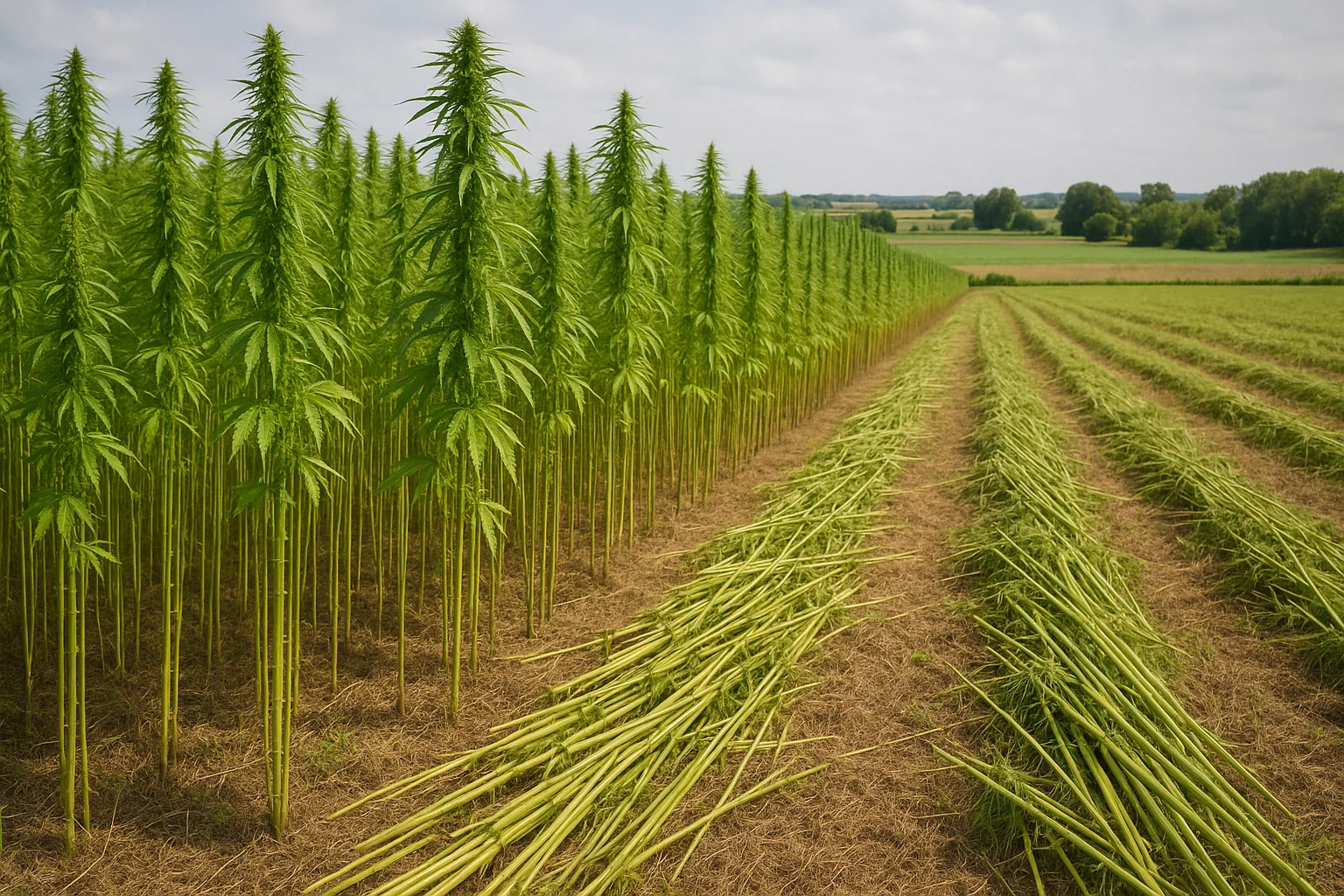

Industrial Hemp (Fiber): Applications in Industry and Ecology
Fiber hemp in industry and ecology: the 0.3% threshold as the sum of THC and THCA, KOWR registration instead of permission, three raw materials from one plant, and the real CO2 balance.
Fiber hemp has returned to European fields not because of a change in fashion, but because of a change in law and the bill for emissions. One plant provides three separate raw materials, and its straw binds carbon dioxide, which then remains in the building’s walls for decades. However, a lot of misunderstandings have arisen around this crop: about the THC threshold, about who grants permission for sowing, and about whether it is allowed to sow hemp on one’s own field. Below, I separate facts from repeated myths. Each statement about the law is supported by a specific provision of the Act on Counteracting Drug Addiction, and each number about the carbon footprint is backed by a source that can be opened and checked independently.
KEY INFORMATION
• One ton of harvested hemp straw corresponds to 1.6 tons of absorbed CO2, which, with a yield of 5.5-8 t/ha, gives 9-13 tons of CO2 per hectare (EIHA, Hemp a Real Green Deal).
• The 0.3% threshold is calculated as the sum of delta-9-THC and THCA, not just delta-9-THC (Article 4 point 5 of the Act on Counteracting Drug Addiction).
• Cultivation requires registration in the register maintained by KOWR, not permission from the voivodeship marshal.
• Cultivation for personal needs is allowed up to 1 ha per year (Article 45 paragraphs 5 and 6 of the same Act).
What are industrial hemp and how does the law distinguish it from marijuana?
It is the same species of plant, Cannabis sativa L. They are separated by one number. The total content of delta-9-tetrahydrocannabinol and tetrahydrocannabinolic acid in the floral or fruiting tops, from which the resin has not been removed, must not exceed 0.3% when calculated on a dry mass basis. Above this value, the same plant material ceases to be fiber hemp.
The definition is found in Article 4 point 5 of the Act of July 29, 2005 on Counteracting Drug Addiction (consolidated text Journal of Laws 2023 item 1939), as amended by the Act of March 24, 2022 (Journal of Laws 2022 item 763), effective from May 7, 2022. Previously, the threshold was 0.20%. The law adds one more detail that is easy to forget: the sum is subject to rounding to one decimal place.
The word “sum” is the most important here. In a living plant, THC is almost absent - its acidic form, THCA, predominates, which only converts to THC upon heating. A laboratory test measuring only delta-9-THC in raw material will therefore show a value significantly lower than that calculated by the regulation. The mirror definition in Article 4 point 37 works in the opposite direction: the herb of non-fiber hemp is the above-ground part of the plant with the same sum content above 0.3%.
The EU threshold has the same value but a different basis. From January 1, 2023, varieties of hemp eligible for support under the Common Agricultural Policy may contain up to 0.3% THC based on Article 4 paragraph 4 of Regulation (EU) 2021/2115. The previous regulation 1307/2013 established 0.2% and was repealed on the same day. The Polish threshold does not result from EU regulation - it only corresponds numerically.
What does one plant provide: fiber, hurds, and seeds?
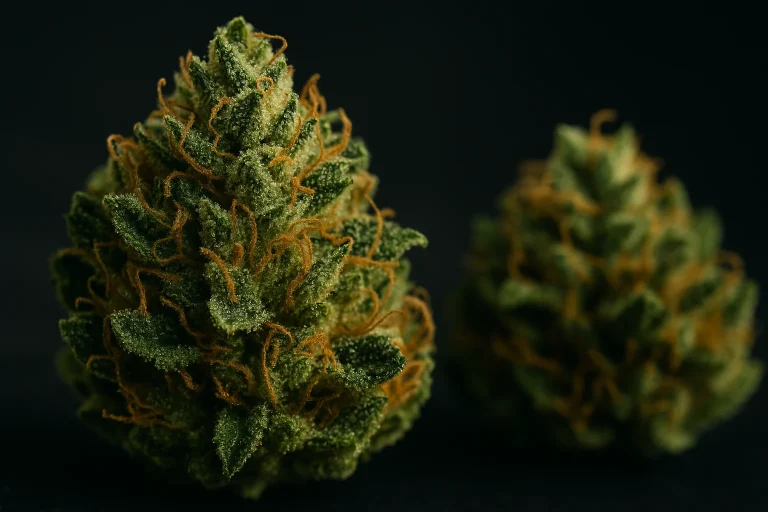
Fiber hemp is one of the few crops where a single stem provides two different technical raw materials, and the inflorescence provides a third, edible one. This separation determines the economics of cultivation: the grower does not sell one product but three streams with different recipients.
Hurd fiber comes from the outer layer of the stem. It is long, tensile, and flexible, making it suitable for fabrics, ropes, bags, geotechnical mats, and composite reinforcement. Hurds are the woody inner part left after separating the fiber. They have an open, spongy porosity and absorb water, which is why they are used for animal bedding, insulation, and hempcrete.
The third raw material is the seed, technically a nut. Callaway states in a 2004 review that seeds contain over 30% oil and about 25% protein, and the oil itself has over 80% polyunsaturated fatty acids, with an omega-6 to omega-3 ratio usually from 2:1 to 3:1 (Callaway, Euphytica 2004). The two main proteins in seeds are edestin and albumin, and the level of arginine is exceptionally high. It is worth adding that the 0.3% threshold refers to the floral tops of the plant, not the seeds, so the seeds and products derived from them are subject to separate food regulations.
| Part of the Plant | Raw Material | Main Applications |
|---|---|---|
| Stem, outer layer | Hurd fiber | Fabrics, ropes, geotextiles, composite reinforcement, paper |
| Stem, inner layer | Hurds | Hempcrete, insulation, animal bedding, bioplastics |
| Seeds | Grain, oil, protein | Food, edible oil, cosmetics |
| Roots and harvest residues | Biomass | Organic matter in soil, soil remediation |
What is it legal to grow fiber hemp for?
The law does not leave this to the discretion of the farmer. Article 45 paragraph 3 lists a closed catalog of purposes, and paragraph 4 prohibits the cultivation of hemp other than those mentioned, with the exception of the cultivation referred to in Article 49a. However, the catalog is broad and includes almost everything that industry does with hemp. It is worth reading it in full, as there is an opinion that only fiber and seeds are legal.
- Textile, chemical, pulp and paper, cosmetic, pharmaceutical, energy needs;
- Seed production and scientific research;
- Breeding of fiber hemp varieties, land reclamation, soil remediation;
- Food, veterinary, feed, beekeeping, fertilization, insulation purposes;
- Production of composite materials, building materials, natural plant protection products.
The last point answers the question that arises in every conversation about hempcrete: the legislator explicitly mentioned building materials, so cultivation for this technology does not require any interpretation. The third point does the same for soil cleaning, as soil remediation stands in the catalog next to the breeding of varieties.
A separate matter is the garden and one’s own field. Article 45 paragraph 5 allows cultivation for personal needs for the purposes of paragraph 3 point 4 and 5, and additionally for textile, energy, and for reclamation and remediation of soils. Paragraph 6 limits its area to 1 ha per year, and paragraph 7 allows processing such raw material on one’s own. The claim that home cultivation of fiber hemp is prohibited in Poland is therefore false. The limitation is the purpose and area, not the mere act of sowing.
How to register fiber hemp cultivation in KOWR?
Not through permission and not with the voivodeship marshal. The condition for conducting cultivation or purchasing fiber hemp is obtaining registration in the register of fiber hemp producers (Article 47a paragraph 2). The competent authority is the director of the regional branch of the National Support Center for Agriculture, according to the place of residence or seat of the applicant (Article 47b paragraph 1).
The application is submitted on a form available on the KOWR website, before the planned sowing. Registration is done within 14 days from the date of receipt of the application meeting formal requirements (Article 47c paragraph 1). The law does not provide for any fee for registration in this register. Cultivation for personal needs also goes through this route: Article 47b paragraph 4 point 5 letter a requires a declaration of the area used for personal cultivation to be included in the application.
Two material conditions are added to the application. The producer must not have been convicted of a crime under Article 63 or 64 or for a misdemeanor under Article 65 point 1, and in cultivation, they must use seed material of elite or qualified category as defined by seed regulations. The compliance of the register with the actual state is monitored by the same director of the KOWR branch (Article 47f paragraph 1), and control activities cover at least 10% of producers in a given harvest year.
The penalty for cultivation in violation of the regulations is sometimes described too harshly. Article 63 paragraph 1, which provides for up to 3 years of imprisonment, explicitly excludes fiber hemp. The appropriate provision is Article 65 point 1, which provides for a fine for cultivation or purchase of fiber hemp in violation of the provisions of the law. This is a misdemeanor, not a crime, and this difference determines the entire course of the case.
How much CO2 do hemp plants absorb and what remains in the building?
The European Industrial Hemp Association calculates this first per ton of harvested straw, and only then converts it to per hectare. One ton of harvested stem corresponds to 1.6 tons of absorbed carbon dioxide. With an average yield of 5.5 to 8 tons per hectare, this gives 9 to 13 tons of CO2 per hectare of harvest (EIHA, Hemp a Real Green Deal).
We have noticed that in Polish circulation this number circulates in an extended version of 8-15 tons and is signed as absorption in one growing season. Neither the lower nor the upper limit is supported by the EIHA material, and the association does not link its calculation to the length of the season, but to the mass of harvested straw. The difference is not cosmetic: the lower limit is one ton lower, and the upper limit is two tons higher than what the association actually states.
Sequestration makes sense only when the carbon remains somewhere. Ip and colleagues calculated the full life cycle of a hemp-lime wall under British conditions, taking as a unit 1 m2 of wall with a thickness of 300 mm with a wooden frame and a 100-year service life. Such a unit binds 82.7 kg of carbon dioxide, and the net balance of the entire life cycle results in a reduction of 36.08 kg of CO2 equivalent (Ip et al., Resources, Conservation and Recycling 2012). This value is after subtracting emissions from lime production, transport, and demolition, not just the absorbed mass.
Outside the building, there is still the soil. Hemp leaves a lot of harvest residues after harvesting, and the deep taproot loosens the soil profile, which is sometimes an argument for including them in crop rotation in organic farming. The Polish legislator has gone further than agronomy and included soil remediation in the catalog of permitted cultivation purposes.
Frequently Asked Questions
What is the difference between fiber hemp and non-fiber hemp?
The species is the same; they differ in cannabinoid content. Fiber hemp refers to Cannabis sativa L. plants in which the total delta-9-THC and THCA in the floral tops does not exceed 0.3% of dry mass. Above this value, the law refers to the herb of non-fiber hemp, with completely different legal consequences.
Does the 0.3% threshold result from EU regulation 1307/2013?
No. Regulation 1307/2013 established a threshold of 0.2% and was repealed on January 1, 2023. The Polish threshold of 0.3% results from Article 4 point 5 of the Act on Counteracting Drug Addiction, and the corresponding EU threshold is now in Article 4 paragraph 4 of Regulation (EU) 2021/2115. These are two separate regulations with the same value.
Who grants permission for the cultivation of fiber hemp in Poland?
No one grants permission. The condition for cultivation is registration in the register of fiber hemp producers, which is done by the director of the regional branch of KOWR within 14 days of receiving a correct application. The law does not provide for a fee for this registration, and inspections are conducted by the same body, not the quality inspection.
Can I grow fiber hemp for personal use?
Yes, within the limits set by the law. Article 45 paragraph 5 allows cultivation for personal needs, among others, for textile, energy, insulation, and soil remediation purposes, while paragraph 6 limits the area to 1 ha per year. Registration in the KOWR register is also required in this case.
How much carbon dioxide do industrial hemp plants absorb?
One ton of harvested hemp straw corresponds to 1.6 tons of absorbed CO2, which, with a yield of 5.5 to 8 tons per hectare, gives 9 to 13 tons of CO2 per hectare of harvest according to EIHA. The value of 8-15 tons often repeated on the internet is not supported by this material and overestimates the upper limit.
Is there a risk of imprisonment for growing fiber hemp?
For the mere cultivation of fiber hemp in violation of the law, a fine is imposed under Article 65 point 1, which means liability for a misdemeanor. The provision regarding a penalty of up to 3 years of imprisonment, namely Article 63 paragraph 1, explicitly excludes fiber hemp and does not apply to this cultivation.
The store at Bucha does not carry cold-pressed oil or hulled seeds. In the category of hemp food are hemp teas and herbal blends, as of August 16, 2026.
This article is for informational and educational purposes and does not constitute legal advice. The legal status described in the article is valid as of the date of publication: regulations regarding hemp may change. Before making a decision, consult a lawyer or current legal acts.
Author: Michał Waluk · Published: 2026-08-09 · Updated: 2026-08-11