
First CBD Purchase: How to Choose Product, Dosage, and Form (Oil, Flower, Gummies) in 2026
First CBD purchase step by step: form, concentration, spectrum, and batch certificate. What studies say about absorption and dosage, and what they don't.
The first CBD purchase appears to be a choice between percentages on the label, but in practice it is a choice between administration forms and between sellers who show batch test results and those who do not. The market calls for caution: in an analysis of 84 CBD extracts bought online, only 26 products, or 31 percent of the sample, had content matching the label. This guide leads you through six decisions you make before clicking the cart: why you buy, in what form, at what concentration, with what extract profile, with what batch certificate, and at what price per milligram. Separately, it shows what science still does not know about absorption and safe dosage, the second half of the picture that guides usually omit.
KEY INFORMATION
- A certificate of analysis for a specific batch is the only verifiable element of the offer; without it, product content remains the seller’s declaration.
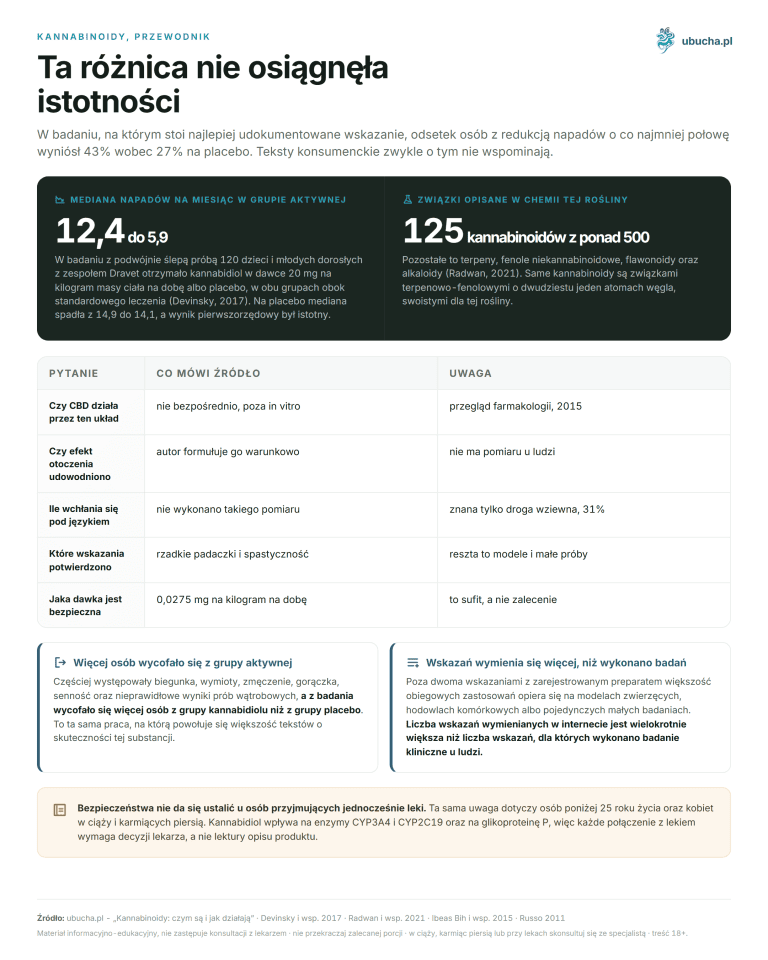
- A systematic pharmacokinetic review of CBD in humans reports absolute bioavailability only for smoking, at 31 percent (Millar 2018). For sublingual drops and capsules, it has not been established.
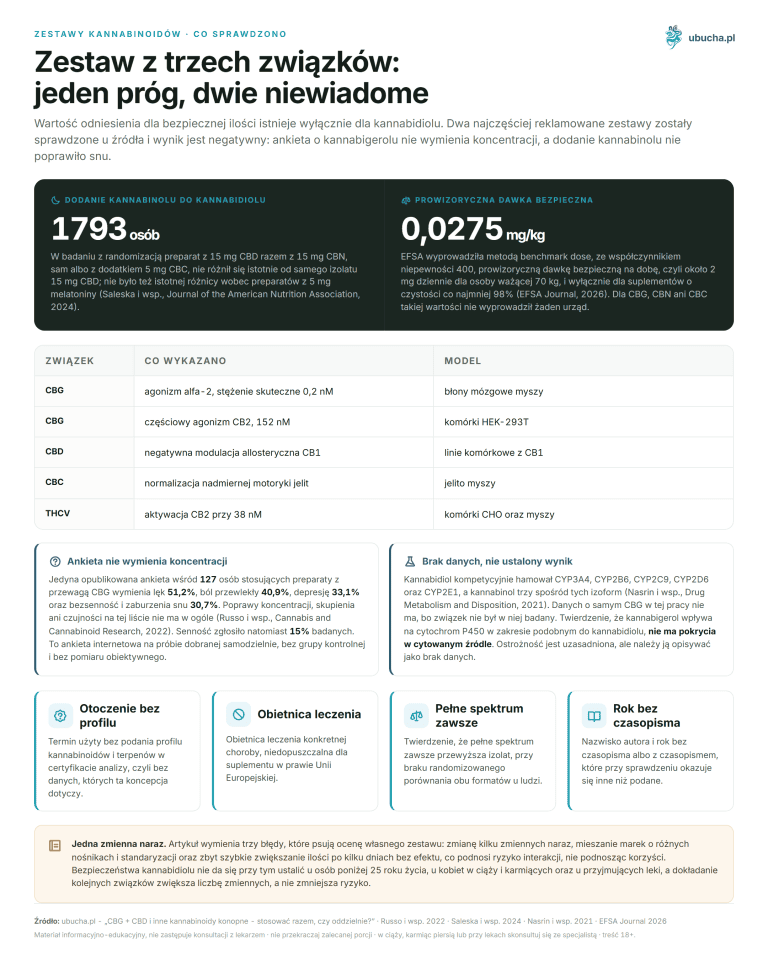
- EFSA derived in 2026 a provisional safe dose of 0.0275 mg per kilogram of body weight per day, about 2 mg daily for a 70 kg person (EFSA 2026).
- CBD safety cannot currently be established for people under 25, pregnant or breastfeeding women, and those taking medications.
- Compare products by price per milligram, not by package price; only this number shows how much you actually buy.
Where to start your first CBD purchase?
Start with two decisions: why you buy and how you want to use the product daily. Concentration, brand, and price follow from these answers, not the other way around. Someone seeking evening relaxation will buy a different product than someone wanting something for travel, even if both have the same percentage on the label.
The reason is practical. Administration forms differ mainly in how much effort they require from the user and how easily the same dose can be repeated. Drops allow measuring dose drop by drop but require a ritual with a pipette and getting used to the taste. Gummies are ready doses without measuring but cannot be divided. Flower requires equipment and a place where it can be used.
The second thing to establish before purchase is the horizon. A product bought for one evening and one bought for two months of daily use are two different calculations, including financial. For a single trial, the lowest entry cost matters; for continuous use, price per milligram and whether the seller will keep the same product in stock matter.
The third is honesty about your expectations. Published cannabidiol studies concern narrow, well-described situations and specific doses given in labs. None tells what happens after buying an online bottle of unknown content. Treat the first purchase as buying a product with a defined composition, not as buying a promised effect. If you seek help for a specific health problem, talking to a doctor is the first step, not the last.
A good complement to this decision is our guide to types of CBD oils, which breaks down differences between carriers and flavor versions.
How do oil, flower, gummies, capsules, and cosmetics differ?
They differ by administration route, thus by usage method, dose repeatability, and required equipment. Drops reach the oral mucosa and partly the digestive tract, gummies and capsules only the digestive tract, flower the lungs, and cosmetics remain in the skin. This distinction organizes the entire choice.
Oil is the most flexible form. A 10 ml bottle contains about 200 drops, so the dose can be changed gradually, not in jumps. However, remember to hold drops under the tongue for several seconds and accept the plant taste, which flavor versions do not completely remove.
Gummies and capsules are bought for convenience and repeatability. The producer measured the dose for you; nothing needs counting or holding under the tongue. The price is lack of flexibility: gummies cannot be halved in a controlled way, capsules cannot at all. Capsules have the advantage over gummies of containing no sugar or colorants.
Hemp flower requires a vaporizer and a place where it can be used. It is the least discreet form due to smell. Smoking flower, in a joint or pipe, carries the same risks as tobacco smoking and is not a recommended method. Cosmetics act locally and do not replace oral forms; they are bought for a specific skin area, not systemic purposes.
| Form | How to use | What it offers the buyer | What it requires |
|---|---|---|---|
| Oil | Drops under the tongue, held for several seconds | Liquid dose adjustment, drop by drop | Ritual with pipette, taste tolerance |
| Gummies | Eaten like candy | Ready, repeatable dose without measuring | Acceptance of sugar and no dose division |
| Capsules | Swallowed with water | Same without sugar and colorants | Taking whole capsule or none |
| Flower | Vaporization in a device with temperature control | Fastest onset among administration routes | Equipment, place to use, and smell acceptance |
| Cosmetic | Rubbed into skin | Effect limited to application site | Awareness it does not replace oral forms |
How much CBD from the dose reaches the bloodstream?
The honest answer is: for most forms, no one has measured this in humans. A systematic pharmacokinetic review of cannabidiol in humans covered 792 found studies, 24 of which reported pharmacokinetic parameters, and gave absolute bioavailability only for one administration route, smoking, at 31 percent (Millar 2018).
The authors wrote directly that no other study tried to establish absolute bioavailability for other administration routes, although intravenous forms exist that would allow this. This is important for buyers because popular tables comparing absorption percentages of drops, capsules, and gummies have no support in this review. Numbers circulating in guides are usually copied from other guides.
What the review really established is half-life and concentration-time profile. After oral mucosa spray, half-life ranged from 1.4 to 10.9 hours; after chronic oral administration, 2 to 5 days; after intravenous administration, 24 hours; and after smoking, 31 hours. Maximum concentration appeared between zero and four hours post-dose and increased with dose.
One practical tip from this work is well documented: maximum concentration rises after a meal and in fat-based forms. That is why producers use oil as a carrier, and taking oral products with fatty food makes sense. Other promises of much better absorption, including nanoemulsion marketing, go beyond what the review confirms.
Eight years later, the same conclusion was repeated by the food safety authority. In EFSA’s 2026 update, it was stated that pharmacokinetic studies confirmed variable cannabidiol bioavailability, depending on carrier matrix and food intake (EFSA 2026). Variability is thus a described property of the substance, not a gap to be filled by a better product. For buyers, this means one thing: promises about absorption percentages should be treated as advertising material, not technical parameters.
| Administration Route | Absolute Bioavailability | Half-life |
|---|---|---|
| Smoking | 31 percent | 31 hours |
| Oral mucosa spray | Not established | 1.4-10.9 hours |
| Oral, chronic administration | Not established | 2-5 days |
| Intravenous | Reference point for other routes | 24 hours |
What oil concentration to choose at start?
The percentage on the label does not indicate potency but cannabidiol density in the carrier. It directly translates to how many milligrams one drop contains, thus how precisely the dose can be measured and how long the bottle lasts. Low concentration gives precision; high concentration gives convenience and lower unit cost.
The arithmetic is simple and worth doing yourself for each offer. A 10 ml bottle contains about 200 drops. At 5 percent, it has 500 mg cannabidiol, about 2.5 mg per drop. At 10 percent, 1000 mg and about 5 mg per drop; at 20 percent, 2000 mg and about 10 mg. Producers report drop counts differently because it depends on carrier viscosity and pipette design, so treat it as an approximation.
For the first purchase, a technical argument applies, not a health one: at lower concentration, the same one-drop change is smaller, so it is easier to observe effects. High concentration bottles make sense for someone who already knows their reaction and wants to reduce the number of drops, not for beginners.
Do not transfer this arithmetic to daily dose conclusions. How many milligrams to take is a safety question, not a label one, and is addressed in a separate section below. More about concentrations is in our comparison of 5, 10, 20, and 30 percent oils.
| Concentration | CBD in 10 ml bottle | CBD per drop (approx. 200 drops) |
|---|---|---|
| 5 percent | 500 mg | about 2.5 mg |
| 10 percent | 1000 mg | about 5 mg |
| 15 percent | 1500 mg | about 7.5 mg |
| 20 percent | 2000 mg | about 10 mg |
| 30 percent | 3000 mg | about 15 mg |
Broad spectrum, full spectrum, or isolate?
These three words describe what besides cannabidiol remains in the extract. Isolate is pure cannabidiol of high purity. Broad spectrum retains other cannabinoids and terpenes but removes tetrahydrocannabinol. Full spectrum leaves the full plant profile, including trace tetrahydrocannabinol.
The argument selling full profile products is the so-called entourage effect. Its most cited study is Ethan Russo’s 2011 British Journal of Pharmacology review on hemp terpenes and their possible cooperation with cannabinoids (Russo 2011). It is worth reading how the author formulates the conclusion: he writes about synergy still needing proof and proposes methods to study it in future experiments.
In other words, the entourage effect is a well-founded hypothesis, not a measured quantity. No one has established how much stronger one preparation would be than another with the same cannabidiol content, and no such number exists in literature. If a guide gives you such a multiplier, it copied it from advertising.
The review has a strong observational basis. Russo reminds that hemp terpenoids are potent compounds influencing animal and even human behavior at blood concentrations of single nanograms per milliliter, reached by inhaling from the environment. This is a good argument for knowing the terpene profile at all, and simultaneously no argument for a specific product efficacy multiplier.
For buyers, a practical difference matters. Full spectrum products contain trace tetrahydrocannabinol, so for people subject to drug testing, broad spectrum or isolate are safer choices. The Polish threshold for industrial hemp counts the sum of delta-9-THC and tetrahydrocannabinolic acid, not delta-9-THC alone, and this value should be shown on the batch certificate. Differences between extracts are detailed in our distillate vs isolate comparison.
How to read a certificate of analysis?
A certificate of analysis, COA for short, is a laboratory test result for a specific product batch. It is the only offer element verifiable independently of the seller’s claims. The reason this check makes sense is measured and published.
A 2017 JAMA study analyzed 84 CBD extracts bought online. Content matching the label, i.e., within 10 percent of declared, was found in 26 products, 30.95 percent of the sample. In 36 products (42.85 percent), cannabidiol was higher than on the label; in 22 (26.19 percent), lower. Tetrahydrocannabinol was detected in 18 of 84 samples, 21.43 percent (Bonn-Miller et al., JAMA 2017).
Note the error distribution. Vaporizable liquids were most often misdescribed, with 21 products deviating from the label, while oils were most accurately labeled, with 18 of 40 matching. This distinction matters for the first purchase, indicating which category’s producer declaration was statistically most reliable.
Read the certificate by elements, not overall impression. Check the lab name and accreditation, batch number matching the package, test date, cannabinoid profile with separately listed tetrahydrocannabinol, and contamination tests: pesticides, heavy metals, microbiology, and solvent residues. A certificate without batch number or issued by the manufacturer’s lab does not fulfill its function, as it cannot be assigned to the bottle you hold.
Also know what the certificate does not resolve. The legal 0.3 percent threshold applies to plant material, i.e., the sum of delta-9-THC and tetrahydrocannabinolic acid in flower or fruiting tops with resin, dry weight basis, not to the finished product. The product certificate gives content in milligrams per milliliter or gram, and these two values are not the same measure. If a seller cites the plant threshold describing a finished oil, they confuse two different regulatory levels.
How to calculate if the purchase is worth it?
Divide the package price by the total cannabidiol content in milligrams. This single operation organizes offer comparison better than anything else, as packages differ in volume, concentration, and number of units, and the website price does not show these differences. A more expensive bottle can be cheaper per milligram.
An example without referring to a specific offer: a 10 ml oil at 5 percent contains 500 mg, and the same volume at 10 percent contains 1000 mg. If the more expensive costs less than twice the cheaper, it is more cost-effective per milligram, even if it looks pricier on the site. For gummies, multiply the number of pieces by declared content per piece, then divide the price.
Do not compare categories as if a milligram means the same everywhere. As the pharmacokinetics section shows, for most routes it is unknown how much dose reaches the bloodstream, so calculating price per absorbed milligram would be counting on an unmeasured factor. Price per declared milligram is an honest measure; price per absorbed milligram is a made-up measure.
The ranges below show order of magnitude in our store as of August 10, 2026, to give you a reference point when reading other offers. Individual product prices change faster than the article, so always check current amounts on the category page.
| Category | Price range, as of August 10, 2026 |
|---|---|
| Oils | 65-240 zł |
| Flower | 25-140 zł |
| Gummies | 10-90 zł |
| Capsules | 79-90 zł |
What mistakes repeat in the first purchase?
The most common mistake is buying by percentage on the label without checking how many milligrams are in the package and whether the batch has a test result. The second is comparing package prices instead of prices per milligram. Both are reversible and cost only because they become apparent after purchase.
The third is subtler: buying a form that does not fit the day. Drops require a place and moment of calm, gummies are discreet, flower requires equipment. An inconvenient product stays unused in a drawer, and then test results do not matter.
The fourth is relying on the seller’s narrative instead of the document. If the product description contains health claims, it is a warning sign itself, as health claims for cannabidiol are not authorized in the EU. A seller who offers a story about effects instead of a batch certificate tells you what is missing.
The fifth and most costly is skipping consultation with a doctor or pharmacist if you take any medications. This is not a formality added at the end of guides; it returns in the interactions section. The table below organizes all five.
| Mistake | Why it costs | What to do instead |
|---|---|---|
| Buying by percentage only | Percentage does not indicate package content | Calculate milligrams in the whole package |
| Comparing package prices | Hides volume and concentration differences | Convert price to per milligram |
| Form not fitting the day | Inconvenient product remains unused | Choose form matching your daily rhythm |
| Trusting description instead of document | Description is unverifiable | Request batch certificate |
| Skipping consultation when on meds | Interaction risk is real | Ask doctor or pharmacist before purchase |
What is known about safe CBD dose?
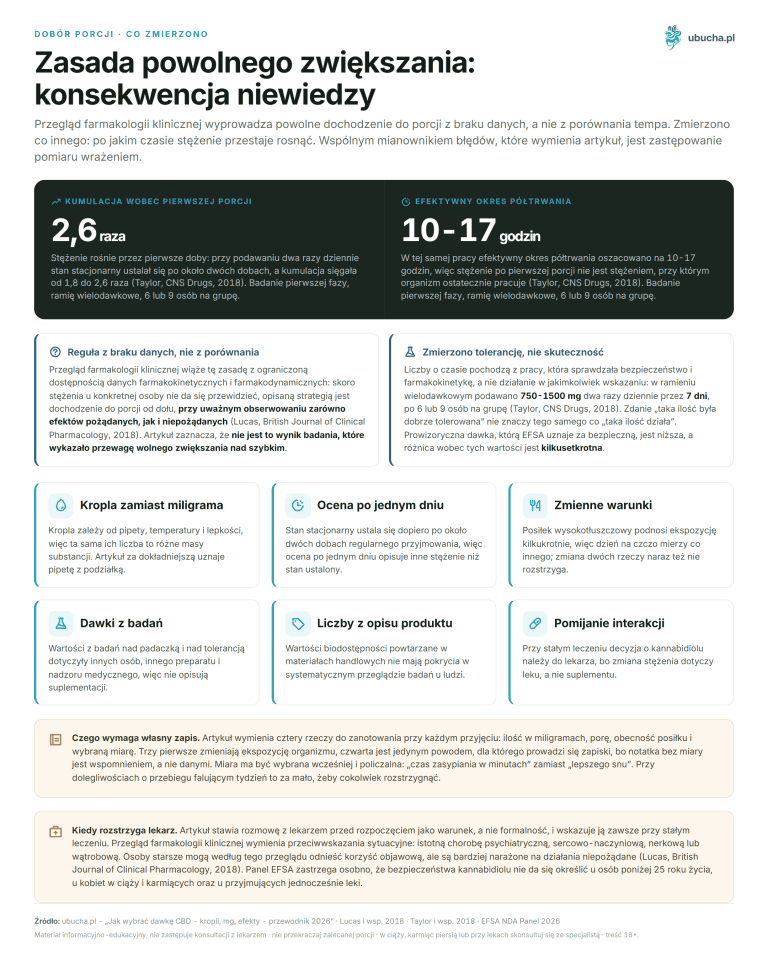
The freshest answer is EFSA’s 2026 update on cannabidiol safety as novel food. The panel derived by benchmark dose method, with uncertainty factor 400, a provisional safe dose of 0.0275 mg per kilogram of body weight per day, about 2 mg daily for a 70 kg person (EFSA 2026).
This value has a clearly defined scope. It applies only to supplements with cannabidiol purity at least 98 percent, without nanoparticles, safe production process, and excluded genotoxicity. It does not apply to other forms or products of unknown composition, i.e., most bought online without batch certificate.
The panel also indicated what it does not know. CBD safety cannot currently be established for people under 25, pregnant or breastfeeding women, and those taking medications simultaneously. Gaps noted in 2022 remain, as new studies have methodological limitations: nonstandardized protocols, short duration, and concomitant treatments.
For order, it is worth knowing doses tested in anxiety experiments, often cited as suggestions. In a simulated public speaking study, 57 healthy men received single doses of 150 mg, 300 mg, 600 mg cannabidiol, or placebo; anxiety decreased only with 300 mg, and higher dose had no effect (Linares et al. 2019). This is a single lab experiment, not a buyer’s guide.
Why the gap between those hundreds of milligrams and EFSA’s two milligrams? Because of the uncertainty factor 400, which the panel applied to the reference point derived from subchronic studies compliant with good laboratory practice. Such a large factor measures how much remains unknown, not substance harmfulness. The panel also noted gastrointestinal effects at higher doses and insufficient neurological and psychiatric safety data.
Who should consult CBD with a doctor?
Anyone taking prescription drugs, pregnant or breastfeeding, under 25 years old, or with liver disease. This is not a caution list added at the end but a reflection of what experts wrote about cannabidiol. Two groups of reasons underlie this recommendation.
First, interactions. An in vitro study on inhibition of liver cytochrome P450 enzymes by cannabinoids and metabolites showed cannabidiol competitively inhibits CYP3A4, CYP2B6, CYP2C9, CYP2D6, and CYP2E1, and acts mixed on CYP1A2 (Nasrin et al. 2021). These enzymes metabolize many drugs, so simultaneous use may alter blood drug levels.
Second, liver. EFSA’s assessment noted consistent liver toxicity in animal studies, with liver mass and histopathological changes as sensitive endpoints, and human studies indicated hepatotoxic potential, especially with other drugs. The panel also noted cannabidiol crosses the placenta and hormonal disturbances, including altered thyroid hormone levels.
The practical conclusion is short. If you take any prescription drug, talking to a doctor or pharmacist is a pre-purchase step, not post-purchase. Time gap between drug and cannabidiol product intake does not solve the problem, as enzyme inhibition lasts longer than the substance’s presence in the digestive tract.
Two additional findings from the same assessment are worth knowing before purchase. Prenatal exposure showed long-term, sex-dependent neurodevelopmental effects, a separate reason to avoid the product in pregnancy. Immunotoxicity was not studied at all: no work addressed this endpoint, although cannabidiol interacts with immune system pathways. Lack of study is not the same as a negative result.
Is CBD legal in Poland?
Cannabidiol itself is not listed in any controlled substance lists, and products from industrial hemp are legally traded in Poland. The decisive factor is the raw material and tetrahydrocannabinol content in the plant material from which the product was made, not the product’s trade name.
The industrial hemp definition states that the sum of delta-9-THC and tetrahydrocannabinolic acid in flower or fruiting tops, from which resin was not removed, does not exceed 0.3 percent dry weight, rounded to one decimal place. The basis is Article 4 point 5 of the Act of July 29, 2005 on counteracting drug addiction (consolidated text Journal of Laws 2023 item 1939), as amended by the Act of March 24, 2022 (Journal of Laws 2022 item 763).
Two things are worth separating here. The national threshold corresponds to the EU threshold but does not derive from it: the EU 0.3 percent for varieties eligible for support under the Common Agricultural Policy was introduced by Regulation 2021/2115, effective January 1, 2023, while the earlier EU threshold was 0.2 percent. These are two separate regulations with the same numeric value.
A separate matter is food status. Cannabidiol remains subject to novel food procedure in the EU, and sanitary notification is not authorization; EFSA’s 2026 opinion is a safety assessment with conditions, not market approval. Therefore, products are sold in categories other than dietary supplements, and descriptions cannot contain health claims.
Separate rules apply to food from hemp seeds, expressed in milligrams per kilogram, not percentages. The maximum allowed level is 3.0 mg/kg for hemp seeds and milled seeds and other processed products, and 7.5 mg/kg for hemp seed oil. The level refers to the sum of delta-9-THC and delta-9-THCA expressed as delta-9-THC, with a factor 0.877 for the acid. The basis is Annex I to Commission Regulation (EU) 2023/915 on maximum levels of certain contaminants in food, effective May 25, 2023.
Frequently Asked Questions
Does the oil concentration indicate potency?
No. The percentage on the label describes cannabidiol density in the carrier, not effect strength. It translates to how many milligrams one drop contains: about 2.5 mg at 5 percent, about 5 mg at 10 percent. Higher concentration means fewer drops, not a stronger product.
Which CBD form absorbs best?
For most forms, no one has measured this in humans. A systematic pharmacokinetic review reports absolute bioavailability only for smoking, at 31 percent, and notes no study has established it for other routes. Tables comparing absorption percentages of drops and capsules have no basis in this review.
How to recognize a reliable certificate of analysis?
By the fact it can be assigned to your package. It must include lab name and accreditation, batch number matching the package, test date, cannabinoid profile with separately listed tetrahydrocannabinol, and contamination tests. A document without batch number or issued by the manufacturer’s lab does not fulfill its function.
How to compare prices of two CBD oils?
Divide the package price by the total milligrams of cannabidiol it contains. A 10 ml bottle at 5 percent has 500 mg, at 10 percent 1000 mg. If the stronger costs less than twice the weaker, it is more cost-effective per milligram.
What is the difference between broad spectrum and isolate?
Isolate contains pure cannabidiol of high purity, broad spectrum retains other cannabinoids and terpenes but without tetrahydrocannabinol. The advantage of full profile, called the entourage effect, remains a hypothesis requiring proof, so no number describing potency difference between them is supported by literature.
How much CBD can be safely taken?
EFSA derived in 2026 a provisional safe dose of 0.0275 mg per kilogram of body weight per day, about 2 mg daily for a 70 kg person. This applies only to supplements with at least 98 percent purity without nanoparticles. For other forms, this value has not been established.
Does CBD interact with medications?
Yes. In vitro cannabidiol competitively inhibited enzymes CYP3A4, CYP2B6, CYP2C9, CYP2D6, and CYP2E1, which metabolize many drugs. EFSA also stated cannabidiol safety cannot be established in people taking medications. Consultation with a doctor precedes purchase.
Is CBD legal in Poland?
Yes, if the product comes from industrial hemp. The law defines it by the sum of delta-9-THC and tetrahydrocannabinolic acid not exceeding 0.3 percent dry weight, rounded to one decimal place. Cannabidiol itself is not listed as a controlled substance but is not authorized as novel food.
Checklist before first purchase
Go through these points one by one before choosing a specific product. Each concerns something verifiable before payment, not something you learn after a month. The order is intentional: it starts with questions about you and ends with questions about documents.
- Decide how you want to use the product in a typical day and how much time you have.
- Choose a form fitting that rhythm, not the promise in the description.
- Decide on the extract profile; avoid versions with trace tetrahydrocannabinol if drug testing.
- Calculate milligrams in the whole package and divide the price by it.
- Request a certificate of analysis for the batch number on the package.
- Check in the certificate cannabidiol, tetrahydrocannabinol content, and contamination tests.
- If you take any medications, consult the purchase with a doctor or pharmacist.
- Record what and when you bought to compare data, not impressions, next time.
A broader overview of what can be bought and what to watch for in descriptions is in our article on natural CBD supplements in Poland.
Current prices and composition of individual products can be checked in the oils category.
This article is informational and educational and does not constitute medical advice. Before starting cannabis or CBD for therapeutic purposes, consult a doctor, especially if you take other medications, are pregnant, or breastfeeding.
Author: Michał Waluk · Published: 2026-05-11 · Updated: 2026-08-10