
What is CBC? Cannabichromene - Action, Receptors, Applications 2026
Learn about CBC (cannabichromene): how it is produced in cannabis, how it acts on TRPA1 receptors, its applications in research, and whether it is legal in Poland.
If you are asking “what is CBC”, you have come across one of the most interesting cannabinoids, which just a few years ago was considered a laboratory curiosity. Today, cannabichromene is the third most abundant compound in cannabis, right after THC and CBD, and the market for products with minor cannabinoids in the USA, to which CBC belongs, is growing at a rate of about 15 percent per year and is expected to reach 33.3 billion dollars by 2030 (Grand View Research). CBC does not intoxicate, binds weakly to classical cannabinoid receptors, but strongly activates the TRPA1 channel and affects the level of natural endocannabinoids in the body. In this guide, we discuss the biosynthesis of CBC from CBGA, its receptor profile, evidence from preclinical studies, legal status in Poland, and the availability of products containing cannabichromene.
KEY INFORMATION
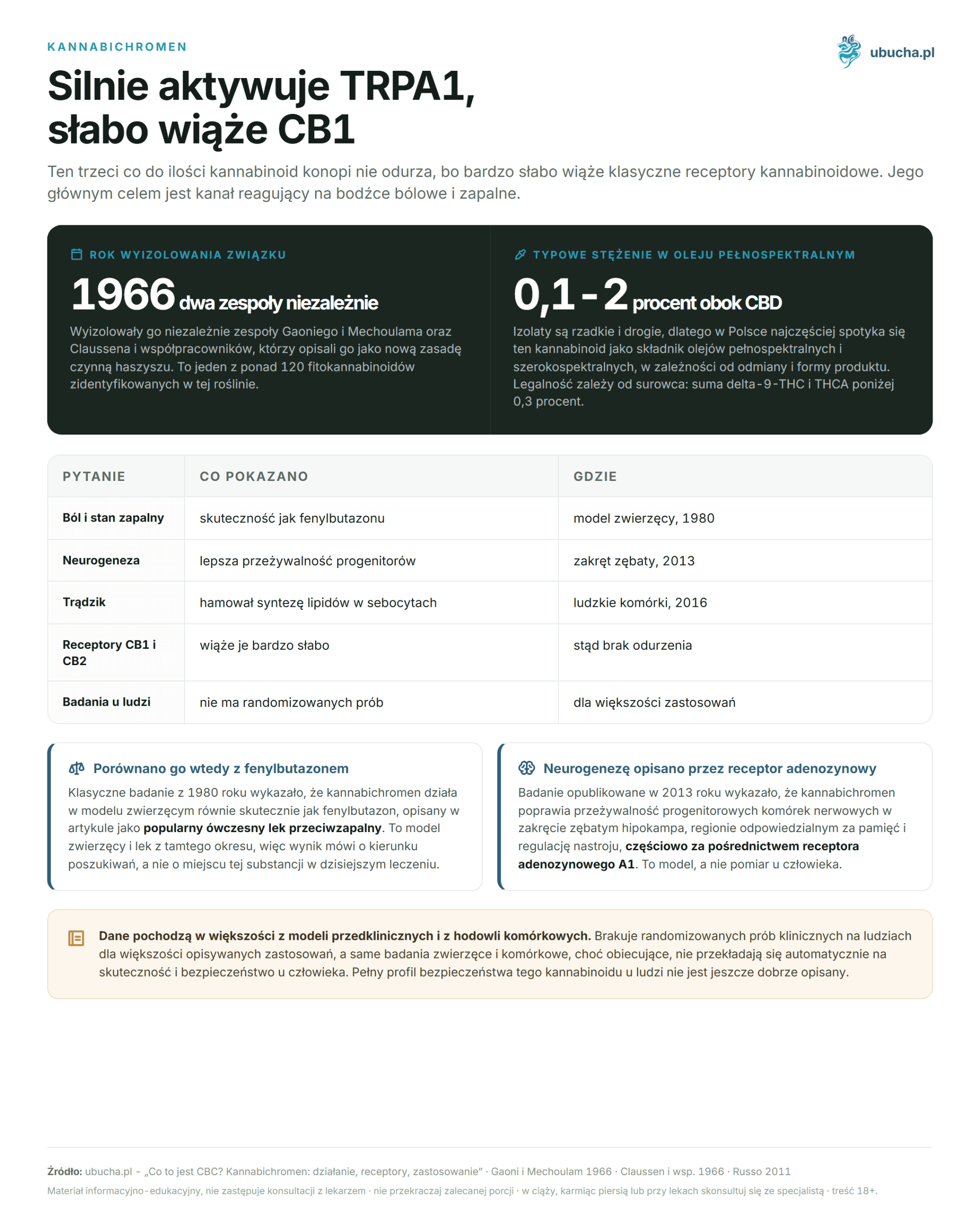
• CBC is the third most common cannabinoid in cannabis, isolated in 1966 by the teams of Gaoni and Mechoulam (Chemical Communications, 1966).
• CBC strongly activates the TRPA1 channel and weakly binds to classical CB1/CB2 receptors, so it does not intoxicate.
• Preclinical studies indicate anti-inflammatory, analgesic, and neurogenesis-supporting effects, but there is a lack of large clinical studies in humans.
• CBC is not listed on the Polish controlled substances list and is legal in products from industrial hemp below 0.3 percent THC.
What is CBC and where does it occur in the cannabis plant?
CBC, or cannabichromene, is one of over 120 phytocannabinoids identified in the Cannabis sativa L. plant. It was isolated in 1966 independently by two teams: Gaoni and Mechoulam and Claussen and colleagues, who described it as “a new active principle of hashish” (Chemical Communications, 1966). In a mature plant, CBC typically constitutes 0.1-2 percent of the flower mass, although strains selected for CBC achieve higher values. Chemically, CBC has the molecular formula C21H30O2, identical to CBD and THC: the differences lie in the geometry of the bonds, which determines the different receptor profile.
Cannabis plants produce CBC from cannabichromenic acid (CBCA), which is formed from CBGA, the mother of cannabinoids, through the enzyme CBCA synthase. The condensation of olivetolic acid and geranyl pyrophosphate yields CBGA, and further enzymatic transformation in trichomes leads to CBCA. CBCA is the acidic form, present in freshly harvested raw material; under the influence of heat, light, or prolonged storage, it loses the carboxyl group and converts to active CBC. Therefore, thermally processed products (oils, extracts, vaporized flower) mainly contain CBC, while raw flower mainly contains CBCA.
The amount of CBC increases as the plant matures: young plants have almost exclusively CBG and CBGA in their trichomes, and only at full bloom do synthase enzymes actively convert CBGA into CBDA, THCA, and CBCA. This means that early-harvested cannabis yields a raw material poorer in CBC than fully mature harvests. CBC is sometimes referred to as the “forgotten cannabinoid” because for decades researchers focused mainly on THC and CBD, although the number of publications on CBC is steadily increasing each year. Breeders looking for high CBC content must now deliberately select strains for this purpose, as standard selection over the years has favored only THC or CBD, pushing other cannabinoids to the background of laboratory analyses.
How does CBC act on receptors in the body?
CBC has an atypical receptor profile. A study by De Petrocellis et al. (2011, British Journal of Pharmacology) tested 11 pure cannabinoids and showed that CBC, CBD, and CBN are strong agonists and desensitizers of the TRPA1 channel, binding much more weakly to classical cannabinoid receptors CB1 and CB2. The same work showed that CBC inhibits the NAAA enzyme and the reuptake of anandamide (ACU) more effectively than CBD, which raises the concentration of the body’s own endocannabinoids in the synaptic space, rather than directly stimulating CB1/CB2 receptors.
TRPA1 is an ion channel known as the “mustard sensor”: it activates in response to irritants, such as allyl isothiocyanate from wasabi. Activation by CBC works on the principle of desensitization: after initial stimulation, the channel becomes less sensitive to subsequent pain stimuli, which explains the analgesic effect without the classical side effects of NSAIDs.
Interestingly, a second paper from the same team, De Petrocellis et al. (2012), directly describes CBC as a compound “inactive towards TRPV” in terms of direct channel activation: unlike CBD or THCV, CBC does not directly stimulate TRPV3 or TRPV4. Instead, in a mouse model of intestinal inflammation, CBC reduced the expression of mRNA for TRPV1, TRPV3, and TRPV4 in intestinal tissue, meaning it acted at the gene expression level rather than through direct channel activation. This is an important distinction: the receptor profile of CBC is narrower and more specific (TRPA1, enzymes metabolizing endocannabinoids) than a simple phrase like “activates all TRP channels” would suggest.
| Molecular Target | CBC Effect | Source |
|---|---|---|
| TRPA1 | Strong agonist and desensitizer | De Petrocellis et al., 2011 |
| CB1, CB2 | Weak binding compared to THC | De Petrocellis et al., 2011 |
| NAAA, anandamide uptake | Inhibition, increased endocannabinoid concentration | De Petrocellis et al., 2011 |
| TRPV1, TRPV3, TRPV4 (mRNA expression) | Reduction in inflammatory intestinal model, without direct channel activation | De Petrocellis et al., 2012 |
TRPV3 responds to mild heat and fragrant substances, such as thymol from thyme, and is densely distributed in the epidermis, where it participates in regulating the skin barrier. TRPV4 is responsible for regulating cell volume and response to mechanical stretching, among other things in the urinary tract and intestinal epithelium. CBC’s influence on the expression of these channels in inflammatory intestinal tissue is therefore of practical significance, although it does not directly open the channel.
What analgesic and anti-inflammatory effects does CBC have?
The anti-inflammatory action of CBC has been known for decades. A classic work by Wirth et al. (1980, Life Sciences) demonstrated in a rat paw edema test that CBC works as effectively as phenylbutazone, a popular anti-inflammatory drug of that era, at comparable doses. A newer study Izzo et al. (2012, British Journal of Pharmacology) confirmed the anti-inflammatory effect of CBC in a mouse model of excessive intestinal motility induced by inflammation.
The analgesic mechanism is based on TRPA1 desensitization, which reduces the transmission of pain signals to the central nervous system, and on the inhibition of anandamide uptake, which enhances the body’s natural pain relief system. In studies on rodents, the combination of CBC with THC produced a stronger analgesic effect than either cannabinoid alone, which is described as the entourage effect and is particularly studied in the context of neuropathic pain. In muscle pain after exercise, there are no clinical studies on CBC in humans yet, but the anti-inflammatory mechanism suggests potential worth further investigation.
Non-steroidal anti-inflammatory drugs work by inhibiting COX-1 and COX-2 enzymes and can cause side effects such as gastric mucosal damage or cardiovascular risk with chronic use. CBC acts through different pathways (TRPA1, endocannabinoid enzymes), so theoretically its safety profile may be more favorable, but there is a lack of long-term clinical studies comparing CBC with NSAIDs in humans. The difference in mechanism does not automatically mean lower risk: the lack of data means a lack of data in both directions, not proof of safety. Available data mainly comes from in vitro studies and animal models, so never replace prescribed medications with products containing CBC without consulting a doctor, especially with chronic diseases.
Does CBC support neurogenesis in the brain?
One of the more interesting discoveries regarding CBC is its impact on neurogenesis. A study by Shinjyo and Di Marzo (2013, Neurochemistry International) showed that CBC improves the survival of mouse neural progenitor cells (NSPC) during their differentiation in vitro: it increases the expression of the nestin marker, decreases the expression of the astrocyte marker GFAP, and stimulates ERK1/2 phosphorylation, partially through the adenosine A1 receptor. The study does not provide a single percentage number for “neuron growth” - the effect pertains to the survival and differentiation of progenitor cells, not directly the number of new neurons.
The dentate gyrus of the hippocampus, where this effect was studied, is one of two places in the adult brain where neurogenesis occurs, related to memory, learning, and emotional regulation. Reduced neurogenesis in this region is associated with depression and anxiety disorders, which is why substances supporting this process are being intensively studied as potential antidepressants.
In the context of depression, a study by El-Alfy et al. (2010, Pharmacology Biochemistry and Behavior) tested CBC in a mouse forced swimming test and tail suspension test. CBC significantly shortened the immobility time at a dose of 20 mg/kg in the swimming test and 40 and 80 mg/kg in the tail suspension test (p<0.01), which is an established marker of antidepressant activity in animal models. There are no clinical trials of CBC in humans for this indication yet.
Besides neurogenesis, CBC also shows neuroprotective potential: a study by Marsh et al. (2024) demonstrated that CBC, along with CBG and CBN, inhibits neurotoxicity induced by beta-amyloid in PC12 cells, a cell model used in Alzheimer’s disease research. All this data comes from in vitro studies and animal models: to confirm a real clinical effect in humans, randomized controlled trials are needed, which are currently lacking.
How does CBC affect the skin and acne?
The team of Oláh et al. (2016, Experimental Dermatology) tested five non-psychoactive phytocannabinoids (CBC, CBDV, CBG, CBGV, THCV) on human sebocytes of the SZ95 line. CBC and THCV inhibited excessive lipid synthesis induced by arachidonic acid, while CBG and CBGV enhanced it; all tested compounds exhibited significant anti-inflammatory activity. This suggests that CBC has potential as an ingredient in anti-acne cosmetics, although pure preparations with isolated CBC are still scarce in the European market.
Polish regulations allow the use of extracts from Cannabis sativa L. in cosmetics. Products containing CBC usually have it as part of a full-spectrum hemp extract, not as an isolate, at a typical concentration of 0.05-0.5 percent in the formulation; the label lists it as “Cannabis sativa extract” or “hemp extract” in INCI. It is worth looking at the quality of the entire extract, not just CBC itself: high-quality full-spectrum extracts contain a synergistic profile of cannabinoids and terpenes, which is why hemp cosmetics predominantly feature “full spectrum” or “broad spectrum” extracts rather than pure isolates.
In atopic dermatitis, a key role is played by the damaged skin barrier and immune hyperreactivity. A study by Kim et al. (2024) in a mouse model of atopic dermatitis showed that topical application of CBC significantly reduced the severity of skin lesions, epidermal thickness, and mast cell infiltration, as well as lowered the expression of Th2 cytokines (TSLP, IL-4, IL-13) and JAK/STAT pathway activity. This is still an animal model, not a clinical study in humans, but one of the most recent and well-documented research leads for CBC in dermatology.
How does the entourage effect with CBC work?
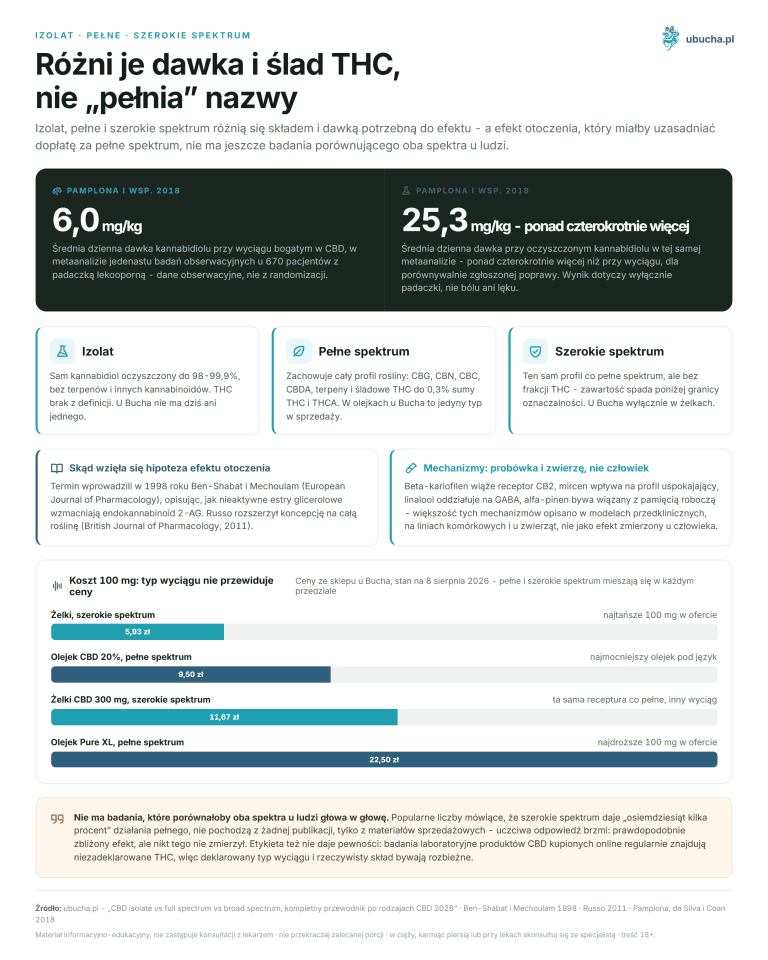
The entourage effect is a hypothesis proposed in 1998 by Shimon Ben-Shabat and Raphael Mechoulam, according to which cannabinoids and terpenes work more effectively together than separately. The most widely cited review of this hypothesis, Russo (2011, British Journal of Pharmacology), describes CBC, along with cannabigerol and tetrahydrocannabivarin, as a secondary cannabinoid with therapeutic action worth considering alongside the main THC and CBD.
In practice, this means that an oil primarily containing CBD, but also a small amount of CBC, may act differently than a pure CBD isolate of the same potency, because both compounds affect slightly different pathways: CBC mainly through TRPA1 and endocannabinoid enzymes, CBD through a broader set of molecular targets, including serotonin receptors 5-HT1A. Therefore, manufacturers of full-spectrum and broad-spectrum oils intentionally maintain the cannabinoid profile, rather than isolating individual compounds, hoping that the complex mixture will work more broadly than the sum of individual actions.
In the CBC and THC system, an enhancement of the analgesic effect is observed: the addition of CBC allows in animal studies to reduce the dose of THC needed to achieve a similar effect, which theoretically also reduces its psychoactive action. This is an important observation for cannabis medicine, as patients often seek the lowest effective dose of THC that provides pain relief without excessive intoxication during the day.
In Poland, medical marijuana (THC and CBD-based flowers) has been legal by prescription since 2017. These preparations also contain natural, trace amounts of CBC, which may contribute to the overall therapeutic profile of full-spectrum flower, unlike pure THC isolate with a narrower spectrum of action. This is one of the arguments why doctors and patients are increasingly asking about the full cannabinoid profile of a strain, rather than just the percentage of THC listed on the label.
Is CBC legal in Poland and how to buy it?
CBC is not listed in the catalog of psychotropic substances, narcotics, or new psychoactive substances (Regulation of the Minister of Health of August 17, 2018, i.e. Journal of Laws 2024 item 1139). Products containing CBC derived from industrial hemp Cannabis sativa L. are legal provided that the total content of delta-9-THC and THCA does not exceed 0.3 percent when calculated on a dry mass basis (Article 4 point 5 of the Act of July 29, 2005 on counteracting drug addiction, i.e. Journal of Laws 2023 item 1939).
It is worth distinguishing two facts that often blend in many materials about cannabis: the WHO Expert Committee on Drug Dependence report from 2018 formally reviewed CBD, not CBC, and it was found that CBD has no addictive potential and a favorable safety profile. CBC has not undergone a separate, formal WHO review, but like CBD, it is not listed on any controlled substances list, neither in Poland nor in most other jurisdictions.
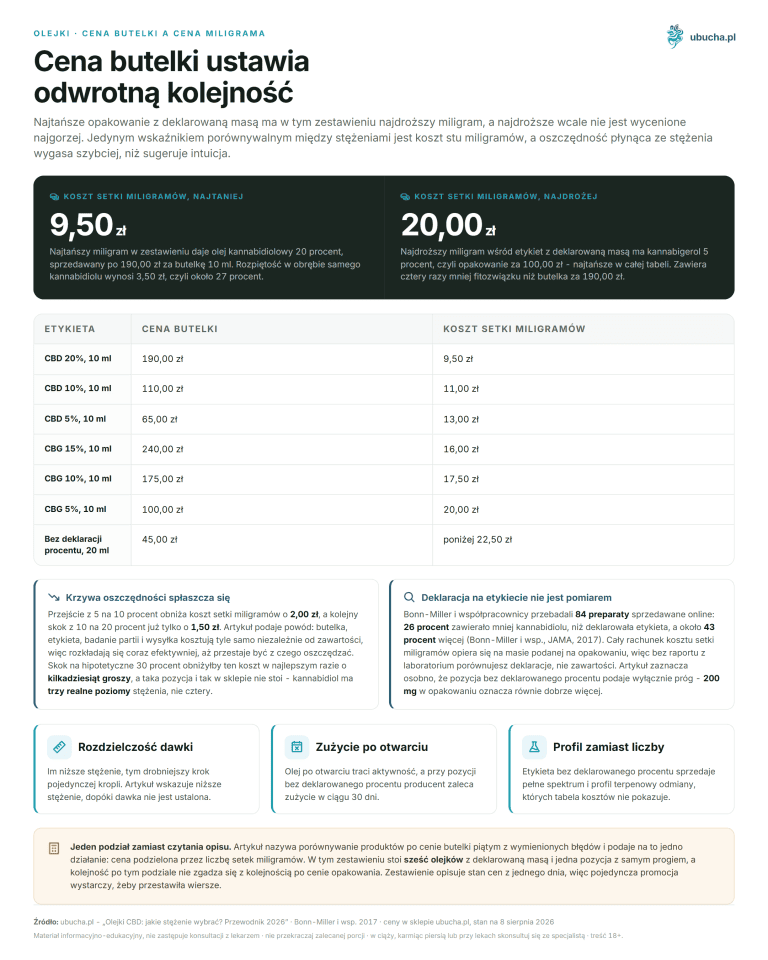
In practice, pure CBC isolates are rare and expensive in Poland, as their extraction requires advanced chromatography. Therefore, most consumers turn to broad-spectrum or full-spectrum products, in which CBC is present as a secondary cannabinoid alongside CBD.
| Product | Typical CBC Concentration | Notes |
|---|---|---|
| Full-spectrum CBD oil | 0.2-1 percent | Along with the main CBD fraction, it also contains THC up to 0.3 percent |
| Broad-spectrum CBD oil | 0.2-1 percent | Similar concentration, but without THC (removed chromatographically) |
| Full-spectrum flower | 0.1-3 percent | Depends on the strain and chemotype |
| CBC isolate | close to 100 percent | Rarely available in retail, mainly raw material for producers |
When buying hemp oil with the declaration “contains CBC”, check the certificate of analysis (COA) with a detailed cannabinoid profile. Lack of CBC in the COA means that the manufacturer refers to the general profile of the strain, not to a real measurement. Also check the cultivation certificates, as cannabis from uncontrolled sources may have contaminants such as pesticides or heavy metals.
The method of administration also matters. Sublingual oil usually acts faster than capsules and edibles, which must pass through the digestive tract before the substance enters the bloodstream. Full-spectrum flower vaporized retains a significant amount of CBC, as this compound is relatively thermally stable. Regardless of the form, the manufacturer should provide dosing in milligrams per serving, not just in percentage concentration.
Summary - what to know about CBC?
CBC is one of the lesser-known cannabinoids of cannabis, which is only now gaining attention from researchers and consumers. It is non-psychoactive, binds weakly to CB1 and CB2, but strongly activates the TRPA1 channel and affects the level of endocannabinoids, which explains its analgesic and anti-inflammatory effects observed in preclinical studies. The most promising research directions are neurogenesis in the hippocampus, potential applications in depression, and anti-inflammatory effects in the skin, including in models of atopic dermatitis.
In Poland, CBC is legal, provided it comes from industrial hemp with THC and THCA content below 0.3 percent in total. Isolates are rare and expensive, so practical access to CBC is obtained through full-spectrum, broad-spectrum oils, and hemp flowers. The entourage effect means that CBC acts differently in the presence of CBD, CBG, and terpenes than if administered in isolation, so it is worth choosing products with a full cannabinoid profile instead of pure isolates.
Remember that the data from studies mainly come from preclinical models and in vitro. There is a lack of randomized clinical trials in humans for most described applications, and the animal and cellular studies, while promising, do not automatically translate to efficacy and safety in humans. Do not treat CBC as a substitute for treatment, but as wellness support, always in consultation with a doctor, especially if you are taking other medications regularly or planning long-term use.
Frequently Asked Questions
What is CBC and how does it differ from CBD?
CBC (cannabichromene) is the third most abundant cannabinoid in cannabis, isolated in 1966 by the teams of Gaoni, Mechoulam, and Claussen. Unlike CBD, CBC binds very weakly to CB1 and CB2 receptors, but strongly activates the TRPA1 channel. Both cannabinoids are non-psychoactive and share the same precursor, CBGA.
Is CBC psychoactive and legal in Poland?
No, CBC is not psychoactive and does not cause a high. It is not listed on the Polish controlled substances list. Products containing CBC derived from industrial hemp Cannabis sativa L. are legal, provided that the total delta-9-THC and THCA does not exceed 0.3 percent. The market for minor cannabinoids in the USA, to which CBC belongs, is growing at a rate of about 15 percent per year (Grand View Research).
How does CBC affect pain and inflammation?
CBC activates the TRPA1 channel, which regulates the conduction of pain and inflammatory stimuli. A classic study from 1980 showed that CBC works in an animal model as effectively as phenylbutazone, a popular anti-inflammatory drug of that time. It works synergistically with THC and CBD, enhancing the analgesic effect within the entourage effect.
Does CBC support neurogenesis in the brain?
A study published in Neurochemistry International in 2013 showed that CBC improves the survival of neural progenitor cells in the dentate gyrus of the hippocampus, a region responsible for memory and mood regulation, partially through the adenosine A1 receptor.
Does CBC help with acne?
A 2016 study tested five phytocannabinoids on human sebocytes. CBC, along with THCV, inhibited excessive lipid synthesis induced by arachidonic acid and exhibited significant anti-inflammatory activity, suggesting potential in anti-acne cosmetics.
Can you buy pure CBC oil in Poland?
CBC isolates are rare and expensive, so in Poland, CBC is most often found as an ingredient in full-spectrum and broad-spectrum oils. Typical concentrations are 0.1-2 percent CBC alongside the main CBD fraction, depending on the strain and product form.
What is the entourage effect involving CBC?
The entourage effect, described in Russo’s review from 2011, posits that cannabinoids and terpenes work more effectively together than separately. CBC primarily acts through TRPA1 and enzymes metabolizing endocannabinoids, and in combination with THC and CBD, it can enhance their therapeutic effects.
What are the side effects of CBC?
Data on CBC mainly comes from preclinical studies, so the full safety profile in humans is not yet well described. In practice, the most commonly reported side effects of full-spectrum products with CBC include dry mouth, drowsiness, or mild dizziness. There is a lack of long-term clinical studies in humans dedicated solely to CBC.
This article is for informational and educational purposes only and does not constitute medical advice. Before starting to use cannabis or CBD for therapeutic purposes, consult with a doctor, especially if you are taking other medications, are pregnant, or breastfeeding.
Author: Michał Waluk · Published: 2026-04-27 · Updated: 2026-08-10