
Decarboxylation of Marijuana - What Is It? Chemistry, Temperatures, and Methods
How long does decarboxylation take at 110, 130, and 145 degrees, why is CBDA twice as slow as THCA, and where did the mythical terpene table come from.
Decarboxylation sounds like a laboratory term, but it determines something quite mundane: whether the herb mixed with fat will actually work. In the raw plant, cannabinoids are almost exclusively present in acidic forms, which need to be heated to convert to neutral forms. This text is based on a single kinetic study that actually measured this process at five temperatures, and what this measurement implies for the oven. I also show which popular numbers circulating in guides have no source, even though they are attributed to specific scientific works, and where their repetition leads to the selection of incorrect processing parameters. Finally, I describe the legal status, as in Poland, processing herb exceeding the THC content threshold is a punishable act.
KEY INFORMATION
• Decarboxylation is the removal of a carboxyl group and the release of carbon dioxide with a mass of 44 g/mol. Therefore, from 358.47 g/mol of tetrahydrocannabinolic acid, 314.46 g/mol of THC remains, which is 87.7 percent of the initial mass.
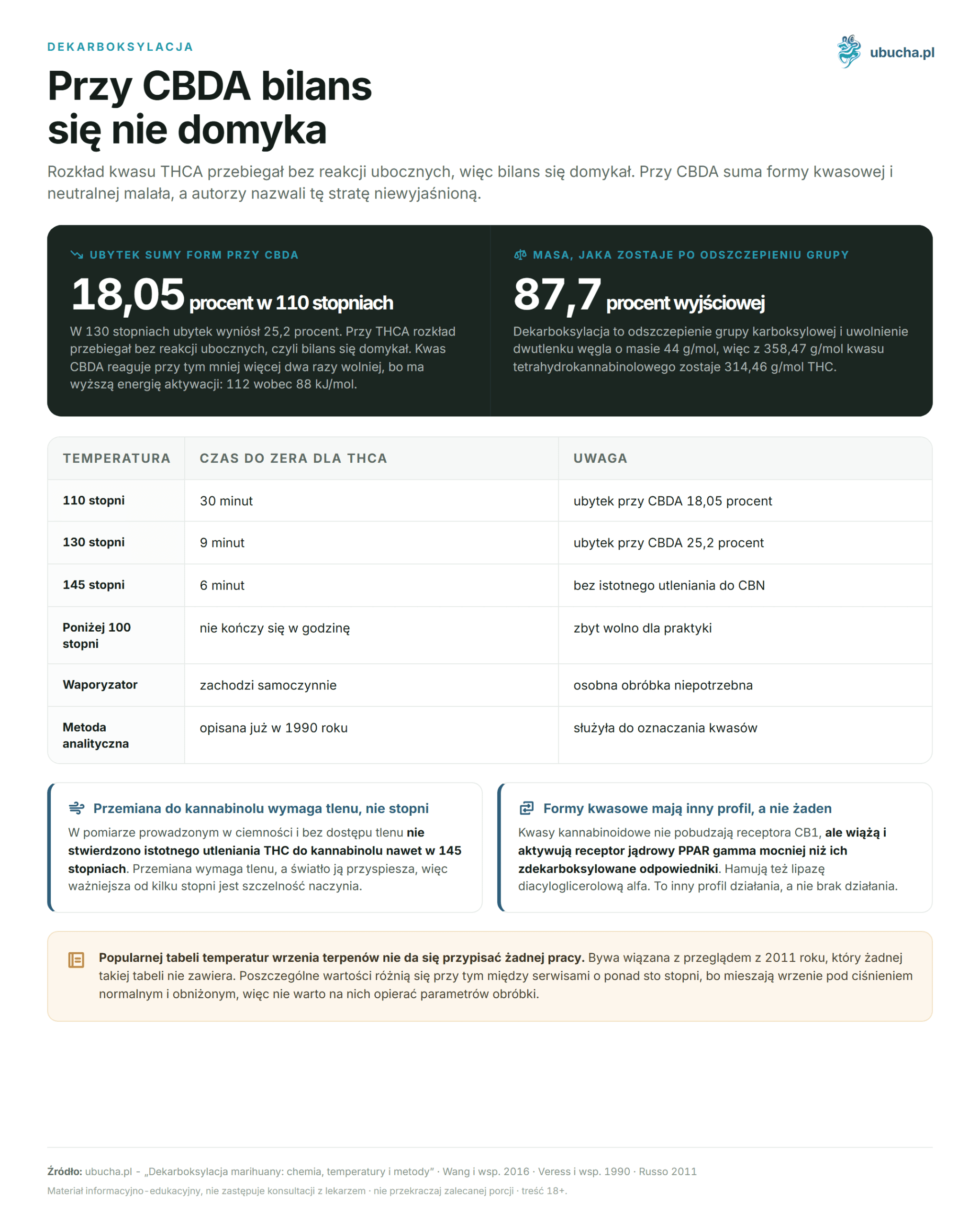
• In kinetic measurements, the concentration of THCA dropped practically to zero after 30 minutes at 110 degrees, after 9 minutes at 130 degrees, and after 6 minutes at 145 degrees. Below 100 degrees, the reaction did not complete within an hour (Wang et al., 2016).
• CBDA reacts roughly twice as slowly as THCA because it has a higher activation energy: 112 versus 88 kJ/mol.
• The popular boiling temperature table for terpenes, attributed to Russo’s work from 2011, does not appear in that work. We did not find a source for it.
• In Poland, processing cannabis other than fiber hemp is prohibited. The article is educational in nature.
What is decarboxylation and what happens in the molecule?
It is the removal of a carboxyl group from the cannabinoid acid molecule, resulting in the release of carbon dioxide. Tetrahydrocannabinolic acid converts to THC, cannabidiolic acid to CBD, and cannabigerolic acid to CBG. The mass calculation is simple and verifiable without a laboratory.
The THCA molecule weighs 358.47 g/mol, the THC molecule 314.46 g/mol. The difference is 44.01 g/mol, which corresponds exactly to the mass of the released carbon dioxide. The ratio of these masses, which is 0.877, is the same coefficient used when converting the acidic form content to the equivalent of the neutral form in laboratory measurements.
The reaction does not require fire or reagents. It occurs under the influence of heat alone and also slowly during long storage. The work dedicated to the pharmacology of THCA describes this directly: phytocannabinoids are produced in the plant in acidic form and undergo decarboxylation under the influence of heating, processing, and storage (Nadal et al., 2017).
The reaction can be summarized in one line: THCA yields THC plus carbon dioxide. Similarly, CBDA and CBGA behave. However, each of these three acids has its own activation energy, so they react at different rates at the same temperature. This difference is what determines the choice of parameters.
Why do acidic forms act differently than neutral ones?
The carboxyl group changes the shape of the molecule enough that it no longer fits into the cannabinoid receptor CB1 pocket. Therefore, THCA does not produce a psychoactive effect regardless of the amount consumed. Only the neutral form binds to this receptor and provides the classic effects of cannabis.
However, it would be a mistake to consider acids as ballast. A study comparing six phytocannabinoids showed that cannabinoid acids bind to and activate the nuclear receptor PPAR gamma more powerfully than their decarboxylated counterparts. THCA itself increased mitochondrial mass in immature neuroblastoma cells and acted neuroprotectively in mice in a model of striatal damage, and this effect depended on PPAR gamma (Nadal et al., British Journal of Pharmacology, 2017).
Acids also have their own interactions with the enzymes of the endocannabinoid system. In a systematic comparison, both CBDA and CBGA, as well as THCA, inhibited diacylglycerol lipase alpha, an enzyme that produces one of the endocannabinoids (De Petrocellis et al., 2011).
The practical conclusion is that decarboxylation is not an improvement of the raw material, but a transformation of one pharmacological profile into another. Stopping the process halfway gives a mixture of both forms. I describe more about the differences between them in the text about acidic forms of cannabinoids.
How quickly does decarboxylation occur at specific temperatures?
The answer comes from a single measurement that is worth knowing in the original, as guides quote it in a distorted version. Wang’s team heated cannabis extracts in a vacuum oven at five temperatures: 80, 95, 110, 130, and 145 degrees Celsius, for periods up to 60 minutes, and measured the content of both forms using supercritical chromatography coupled with mass spectrometry.
The result had an exponential form, indicating a first-order or pseudo-first-order reaction. Below 100 degrees, the reaction did not complete within an hour. Above this threshold, the concentration of THCA approached zero after 30 minutes at 110 degrees, after 9 minutes at 130 degrees, and after 6 minutes at 145 degrees (Wang et al., Cannabis and Cannabinoid Research, 2016).
| Temperature | Time to Exhaust THCA | Note from Measurement |
|---|---|---|
| 80 and 95 degrees | over 60 minutes | reaction did not complete |
| 110 degrees | about 30 minutes | lowest temperature with full conversion |
| 130 degrees | about 9 minutes | greater losses with CBDA |
| 145 degrees | about 6 minutes | highest tested temperature |
One caveat changes the way to read this table. The measurement was conducted on extracts in a vacuum oven, not on whole buds in a home oven. Dry herb conducts heat worse than extract, so the real time in the kitchen can be longer, especially with a thicker layer of material.
Why does CBDA need more time than THCA?
Because it has a higher energy barrier. From the measurements of the variability of rate constants as a function of temperature, the activation energies were calculated: 88 kJ/mol for THCA, 112 kJ/mol for CBDA, and 109 kJ/mol for CBGA. The higher the value, the more energy must be supplied for the reaction to proceed at the same speed.
This translates into a simple rule. The rate constants for THCA were consistently about twice as high as for CBDA and CBGA. At 110 degrees, they were 1.83 and 0.83 thousandths per second, respectively.
The practical conclusion for CBD-rich dry herb is direct: at the same temperature, you need about twice as much time as for THC-rich material. Shortening the process to parameters given for THC leaves a significant portion of CBDA in the unactivated form.
An alternative is to raise the temperature instead of extending the time, but this path has its price, described in the next section. The situation with CBGA is similar to that with CBDA, as its activation energy is almost identical. Cannabigerol is, after all, the precursor for over 120 other cannabinoids produced by the plant (Walsh et al., 2021).
Do you lose some cannabinoids during decarboxylation?
With THC, practically not, with CBD, yes. This is one of the more interesting observations from this study and also the one that guides most often omit. The breakdown of THCA occurred without side reactions or by-products, meaning the sum of the acidic and neutral forms remained constant.
With CBDA and CBGA, the authors observed something different. The sum of the molar concentrations of the acid and neutral forms decreased as time and temperature increased. In extracts, the loss reached 18.05 percent at 110 degrees and 25.2 percent at 130 degrees. The authors called this an unexplained loss of reagents or products and concluded that the chemistry is more complex than a simple transition from CBDA to CBD.
For someone processing CBD dry herb, this has specific implications. Choosing a higher temperature to shorten the process costs more than just aroma: part of the material disappears from the balance. The difference between 110 and 130 degrees was about seven percentage points in this measurement.
Hence the recommendation for a lower temperature and longer time for CBD-rich material. This is not an aesthetic preference, but a conclusion from the mass balance. With THC-rich material, this concern is eliminated, as the balance closes.
Does high temperature convert THC to CBN?
No, not just from the temperature. This is one of the most commonly repeated simplifications in guides about decarboxylation, and this study allows us to correct it. Heating was conducted in darkness and without access to oxygen, in a vacuum oven, and under these conditions, no significant oxidation of THC to cannabinol was observed, even at the highest tested temperature of 145 degrees.
The conversion of THC to CBN is an oxidation reaction. Oxygen is needed for it to occur, and light accelerates it. Heat itself facilitates it, but without an oxidizer, there is nothing to oxidize. Therefore, the same temperature gives a different result in an open tray than in a closed container.
The practical conclusion is the opposite of the common belief. Instead of obsessively monitoring not to exceed 145 degrees, it is more important to limit contact with air and light, both during heating and when storing the finished material. An airtight, opaque container makes more difference than two degrees on the thermometer.
Cannabinol itself is not a useless product. In a review of the pharmacology of minor cannabinoids, CBN is described as a compound acting on cannabinoid receptors and on TRP family channels, being a strong agonist of the TRPA1 channel (De Petrocellis et al., 2011). However, it is something different from THC, not a stronger version of it.
How to perform decarboxylation in the oven?
The oven is the simplest tool, but it has one drawback that you need to know before your first attempt: the built-in thermostat shows the air temperature at one point in the chamber, not the temperature of the material on the tray. Discrepancies of several degrees are typical, so a separate oven thermometer is essential equipment, not an accessory.
The parameters below correspond to Wang’s measurement, with a time buffer for poorer heat conduction in whole buds.
- Preheat the oven to 110 degrees and wait fifteen minutes for the temperature to stabilize. Check it with your own thermometer, not the dial reading.
- Break the material into pieces the size of a grain of rice. Do not grind it to powder, as the smallest particles burn at points.
- Spread it in a single layer on a tray lined with baking paper. A layer thicker than one piece heats unevenly.
- Cover with aluminum foil, loosely folding the edges. The cover limits contact with air and equalizes the temperature.
- Keep for 40 minutes for THC-rich material and 70 to 80 minutes for CBD-rich material, according to the twice slower kinetics of CBDA.
- Remove and leave covered until completely cool. Opening the hot tray releases what has condensed under the foil.
- Assess the result visually: the material darkens to a beige or golden-brown shade. Black color indicates overheating.
The most common mistake is setting 150 degrees or more in the belief that the process will go faster. It will, but with CBD-rich material, this increases the documented loss balance, and with an open tray, it promotes oxidation. Another common mistake is using wet raw material, where heat first evaporates the water and only then raises the temperature of the material.
Does sous-vide yield better results than the oven?
It provides a more stable temperature, but at the cost of time. A immersion circulator maintains the water bath within a narrow range and heats the material through water, not air, which eliminates the problem of hot spots. A vacuum bag also cuts off access to oxygen, which is the factor that actually contributes to the formation of cannabinol.
The limitation is physical. Water under normal pressure will not exceed 100 degrees, and kinetic measurements indicate that below this threshold, the reaction does not complete within an hour. Therefore, a water bath requires significantly longer than 30 minutes given for 110 degrees, especially with THC-rich material. With CBDA, which reacts twice as slowly, the difference increases even more.
In practice, this means a procedure lasting many hours instead of minutes. Those who accept this time get in return repeatability and better-preserved aroma. Those who do not accept it should stick to the oven with a thermometer.
It is also worth honestly stating what we do not know. We did not find a published measurement that compared the degree of conversion in sous-vide and in the oven on the same material. The numbers circulating on forums, describing the alleged accuracy of one method or the other, have no support in published literature to which one could refer.
Does the jar method really protect the aroma?
The mechanism makes sense, although its scale has not been measured. Material in a sealed jar heats up in a closed volume, so volatile compounds that evaporate condense on the cooler walls of the container and partially return to the herb after cooling. In an open tray, the same fraction leaves the oven along with the vapor.
A closed container also limits the amount of available oxygen, which is important for the oxidation of THC. This is a stronger argument than aromatic, as it concerns the content of the active substance, not just the smell.
The procedure is short. Fill the jar loosely to about two-thirds of its volume, screw the lid on lightly so that steam can escape, place the container in a cold oven, and only then turn on the heat. After finishing, leave the jar to cool without opening.
The safety principle is one and there is no exception: put glass in a cold oven and take it out after it has cooled. A sudden temperature change can break the container, and a tightly sealed lid turns it into a pressure vessel. Use jars designed for thermal processing.
What does decarboxylation do to terpenes?
Here we need to start with a correction, as at this point common knowledge diverges from sources. A table of boiling temperatures for terpenes circulates in guides, usually attributed to Ethan Russo’s 2011 work on the synergy of cannabinoids and terpenoids. We checked this work: it does not contain any boiling temperature table or specific thermal thresholds for individual terpenes.
We also did not find a publication from which this table originates. Numbers such as 167 degrees for myrcene or 119 degrees for beta-caryophyllene are repeated between services without reference to a measurement. Some of them are internally contradictory, as for the same compound different sites provide values differing by over a hundred degrees, depending on whether it concerns boiling under normal or reduced pressure.
What actually follows from Russo’s work is concrete. Terpenoids are volatile compounds and interact with cannabinoids, and beta-caryophyllene turned out to be a selective full agonist of the CB2 receptor at a concentration of 100 nM, making it the first documented phytocannabinoid outside the cannabis genus (Russo, British Journal of Pharmacology, 2011).
Practically, there remains a qualitative, not numerical rule. Terpenes are more volatile than cannabinoids, so any heating removes some of them, and the higher the temperature and the more open the container, the greater the loss. Those who value the aromatic profile choose a lower temperature, longer time, and a closed environment. I describe more about the compounds themselves in the text about terpenes in cannabis.
Why is the microwave a bad idea?
Because of the way microwaves deliver energy. The radiation primarily excites water molecules, so wetter fragments heat up much faster than adjacent dry fragments. Instead of a uniform temperature, you get a mosaic of overheated and barely warm spots.
The second drawback is the lack of any control over the parameter that matters. Setting power and time does not translate to the temperature of the material, as the result depends on its moisture, mass, shape of the container, and the design of the device itself. Therefore, it is impossible to repeat a successful trial because it is unclear what actually happened in it.
Since all the kinetics described above is a function of temperature and time, a method that does not allow you to set either one or the other falls out of comparison by itself. It is not that it gives a worse result, but that it gives an unknown result.
The same note applies to improvisations like using an iron or a frying pan. A vaporizer is a separate case, as it operates at a set temperature and decarboxylates the material during inhalation; I describe this in the text about choosing the vaporization temperature.
Why doesn’t the content on the label increase after decarboxylation?
This is the most common conceptual trap in this topic. Heating does not produce new THC or new CBD, it only transforms molecules that were already in the material. The amount of active substance is therefore established at the time of harvest, and thermal processing only determines in what form this amount occurs.
Moreover, the mass slightly decreases. Since from each acid molecule carbon dioxide with a mass of 44.01 g/mol is released, from 358.47 g/mol of THCA, 314.46 g/mol of THC remains, which is 87.7 percent of the initial mass. The same calculation applies to CBDA and CBGA, with slightly different molecular weights.
This is why laboratory results are reported in two variants. The neutral form content alone describes the state of the material at the time of measurement. The total value adds to it the acidic form converted using the coefficient 0.877 and describes the potential of the material after full decarboxylation.
This coefficient is not an arbitrary industry convention. The same value of 0.877 for converting tetrahydrocannabinolic acid to the equivalent of delta-9-THC appears in the Commission Regulation (EU) 2023/915 regarding THC content limits in food from hemp seeds. Knowing both values allows one to read the test result correctly and avoid the impression that heating added something to the material.
What does Polish law say about decarboxylation?
This is determined by the THC content in the starting material, not the act of heating itself. Fiber hemp is defined as plants in which the sum of the content of delta-9-THC and tetrahydrocannabinolic acid in the flowering or fruiting tops, from which resin has not been removed, does not exceed 0.3 percent when calculated on a dry mass basis, rounded to one decimal place.
The basis is Article 4 point 5 of the Act of July 29, 2005 on Counteracting Drug Addiction as amended by the Act of March 24, 2022 (Journal of Laws 2022 item 763), in force since May 7, 2022. Material exceeding this threshold is cannabis other than fiber hemp within the meaning of Article 4 point 37 of the same Act, and its possession and processing are subject to criminal liability.
Two details of this definition are often stated incorrectly. First, the threshold concerns the sum of delta-9-THC and its acidic form, not just delta-9-THC itself; a product that is within the norm when measuring only the neutral form may exceed it when adding the acid. Second, the national threshold corresponds to the EU threshold, but it does not derive from it: these are two separate regulations with the same numerical value.
A separate path is medical cannabis available by prescription. A patient with a valid prescription prepares products from pharmaceutical material according to the doctor’s recommendations. Pharmaceutical products are standardized, so they usually do not require home thermal processing.
How to use decarboxylated dry herb?
All further products share one principle: cannabinoids dissolve in fats and alcohol, not in water. The carrier therefore determines how much active substance actually passes from the material to the product, and is more important than the recipe itself.
- Hemp butter is made by slowly heating the chopped material with clarified butter and water for several hours at a temperature below boiling. After straining and cooling, the fat separates from the water and forms a ready block.
- The oil carrier works the same way, and coconut oil and MCT oil are more convenient for dosing than butter, as they remain liquid at room temperature.
- An alcohol tincture requires high-concentration drinking alcohol and several weeks of maceration in a dark place, with daily shaking, followed by straining.
- Adding the material directly to chocolate or honey is possible, but without a significant fat content, absorption will be weaker.
It is worth remembering that ready-made hemp oils from the store contain cannabinoids already in neutral form, as decarboxylation occurs at the producer during extraction. Home thermal processing makes sense only when working with raw plant material. I discuss the difference between raw and decarboxylated preparations in the text about RAW and decarboxylated oils.
If you are looking for plant material that meets the THC content standard, you will find it in the hemp dry herb category. Historically, it is worth noting that controlled thermal decarboxylation was described as an analytical method as early as 1990, when it was used to determine cannabinoid acids by converting them to neutral forms (Veress et al., Journal of Chromatography, 1990).
Frequently Asked Questions
Is decarboxylation necessary if the material is smoked or vaporized?
No, because it occurs automatically. At the glowing point, the temperature significantly exceeds the thresholds described in kinetic studies, and the vaporizer operates at a range higher than 110 degrees, which is above the temperature of full conversion. Separate thermal treatment applies only to edibles.
What temperature is best for CBD-rich dry herb?
About 110 degrees, but for a significantly longer time than for THC. CBDA reacts roughly twice as slowly because it has a higher activation energy: 112 versus 88 kJ/mol. Raising the temperature instead of extending the time increases the documented loss balance of the material.
Does THC convert to CBN above 145 degrees?
Not just from the temperature. In measurements conducted in darkness and without access to oxygen, no significant oxidation of THC to cannabinol was observed even at 145 degrees. The transformation requires oxygen, and light accelerates it, so the airtightness of the vessel is more important than a few degrees.
How many cannabinoids do I lose during decarboxylation?
It depends on the raw material. The breakdown of THCA occurred without side reactions, meaning the balance was maintained. For CBDA, the sum of the acidic and neutral forms decreased: by 18.05 percent at 110 degrees and by 25.2 percent at 130 degrees. The authors called this loss unexplained.
Is the boiling temperature table for terpenes reliable?
We did not find a source for it. It is usually attributed to Russo’s work from 2011, which does not contain such a table. Individual values differ between services by over a hundred degrees because they mix boiling under normal and reduced pressure. It is not worth basing parameters on them.
Are acidic forms useless before heating?
No. Cannabinoid acids do not stimulate the CB1 receptor, but they bind to and activate the nuclear receptor PPAR gamma more strongly than their decarboxylated counterparts. They also inhibit diacylglycerol lipase alpha. This is a different action profile, not a lack of action.
How long should decarboxylated material be stored?
There is no published measurement that provides a specific period for home conditions, so treat the numbers given in guides with caution. It is known, however, what drives degradation: oxygen and light. An airtight, opaque container in a cool place limits both factors.
The article is informational and educational in nature and does not constitute legal advice. The legal status described in the article is valid as of the publication date: regulations regarding cannabis may change. Before making a decision, consult a lawyer or current legal acts.
Author: Michał Waluk · Published: 2026-05-10 · Updated: 2026-08-10