
CBD for Athletes: Muscle Recovery, Sleep, and Post-Workout Pain
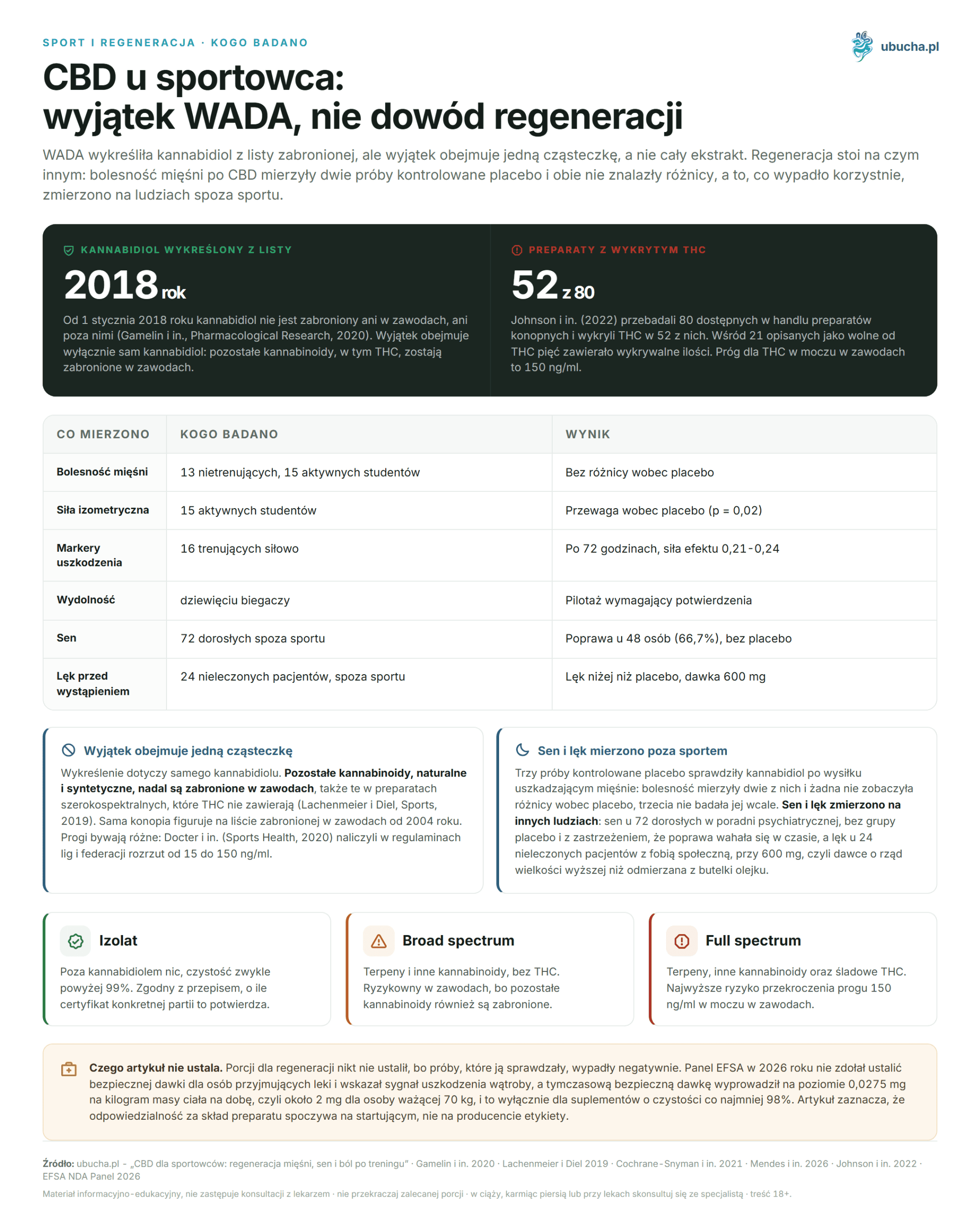
WADA allows CBD since 2018, but other cannabinoids do not. What do clinical trials say about muscle recovery, post-workout pain, and athlete sleep?
Supplement stores today place CBD alongside creatine and magnesium, with labels promising faster recovery and less pain after a tough session. The decision by the World Anti-Doping Agency on January 1, 2018, indeed opened the door for athletes to cannabidiol. The rest of the promises look much more modest when looking at the results of human trials: three placebo-controlled studies tested CBD after muscle-damaging exercise, and none of the two that measured soreness saw a difference compared to placebo. Additionally, there is a trap that manufacturers remain silent about: the anti-doping exception applies only to cannabidiol itself, not to the other cannabinoids in the extract. Below you will find what can be defended by data and what is better not to buy before a competition.
KEY INFORMATION
• WADA removed cannabidiol from the prohibited list as of January 1, 2018, in competitions and out of competition (Gamelin et al., Pharmacological Research, 2020).
• Other cannabinoids, including THC, remain prohibited in competitions. The threshold for THC in urine is 150 ng/ml.
• Muscle soreness after CBD was measured in two placebo-controlled trials, and both found no difference (Cochrane-Snyman 2021; Mendes 2026).
• Of 80 tested products, THC was detected in 52 (Johnson et al., 2022).
Does WADA allow athletes to use CBD?
Yes, since January 1, 2018, cannabidiol is not prohibited in competitions or out of them. This was noted by Gamelin et al. (Pharmacological Research, 2020), while also reminding that cannabis itself has been on the prohibited list in competitions since 2004.
This is where the part that marketing skips begins. The exception applies to one molecule, not the entire extract. Lachenmeier and Diel (Sports, 2019) state it bluntly: apart from cannabidiol, all other cannabinoids remain prohibited. This also applies to those that seem innocuous and appear on the labels of broad-spectrum products.
The ban applies in competitions, not year-round: outside the competition period, cannabis does not fall under this category of anti-doping regulations. National law, however, is a separate matter, and it does not distinguish between competition periods, as possession of cannabis other than industrial hemp remains illegal in Poland regardless of the competition calendar. In competitions, there is a threshold for THC in urine of 150 ng/ml, and threshold values vary between sports organizations: Docter et al. (Sports Health, 2020) noted a range from 15 to 150 ng/ml in league and federation regulations. You can check the current content of the regulation on the WADA prohibited list.
This same work states that in eleven studies involving over 46 thousand athletes, about 23% of respondents admitted to using cannabis in the past year. The scale of use is therefore real, and knowledge of what is actually allowed clearly does not keep pace with it. The practical conclusion is uncomfortable: the exception does not protect the athlete if the product contains anything other than cannabidiol, and the responsibility for the composition lies with the competitor, not the label manufacturer.
What do studies say about CBD and muscle recovery?
Less than the packaging suggests. Three placebo-controlled trials tested cannabidiol after muscle-damaging exercise. Two of them measured soreness, and none saw a difference compared to placebo; the third did not measure it at all. Two noted minor differences in markers of damage or in strength recovery, with small or moderate effect sizes and a few participants.
| Study | What was given | Result |
|---|---|---|
| Cochrane-Snyman et al., 2021 (13 untrained men) | 150 mg of oil after exercise and after 24 and 48 hours | No difference compared to placebo in soreness, arm circumference, and strength |
| Mendes et al., 2026 (15 active students) | 2 g of gel on the quadriceps and hamstring for 72 hours | No difference in DOMS and myoglobin, advantage in isometric strength (p = 0.02) |
| Isenmann et al., 2021 (16 strength-trained) | Single oral dose after resistance training | Small differences after 72 hours in creatine kinase and myoglobin (effect size 0.21-0.24) |
The result of Cochrane-Snyman et al. (Medicine and Science in Sports and Exercise, 2021) is the most telling: 150 mg of oil given three times over two days did not affect any of the four measured parameters. Mendes et al. (Journal of Cannabis Research, 2026) received one signal worth further investigation, in isometric strength between 24 and 72 hours, but pain perception and myoglobin concentration remained unchanged. Isenmann et al. (Nutrients, 2021) conclude their article with the statement that more data is needed before anything can be determined.
Why is sleep the strongest argument for CBD in sports?
Because the effects of sleep deprivation on an athlete are well-documented, and the mechanism does not require belief in cannabinoids. Leproult and Van Cauter (JAMA, 2011) restricted sleep to five hours a day for a week in ten healthy young men and noted a decrease in daily testosterone by 10-15%. Anything that improves sleep also improves recovery conditions.
Does CBD improve it? The most frequently cited work is a retrospective review of patient charts: Shannon et al. (The Permanente Journal, 2019) described 72 adults, with sleep scores improving in the first month for 48 of them, or 66.7%. However, the authors add a sentence that disappears in marketing summaries: the improvement varied over time. This was not a placebo trial, but an observation in a psychiatric clinic.
Caution is confirmed by the authors of the broadest review in this field. McCartney et al. (Sports Medicine Open, 2020) state that case reports suggest improved sleep after CBD, but solid evidence is still lacking. In other words: this is the best-justified path among all sports applications, and yet it stands on weaker ground than the label suggests.
Practice looks banal and does not depend on the product. A consistent bedtime even on non-training days, a cool bedroom, and an hour without screens before bed provide an effect that no oil can replace. If you want to read more about dosing in the evening, we described it in the article CBD oil for sleep: dosing.
Does CBD help with pre-competition stress and improve performance?
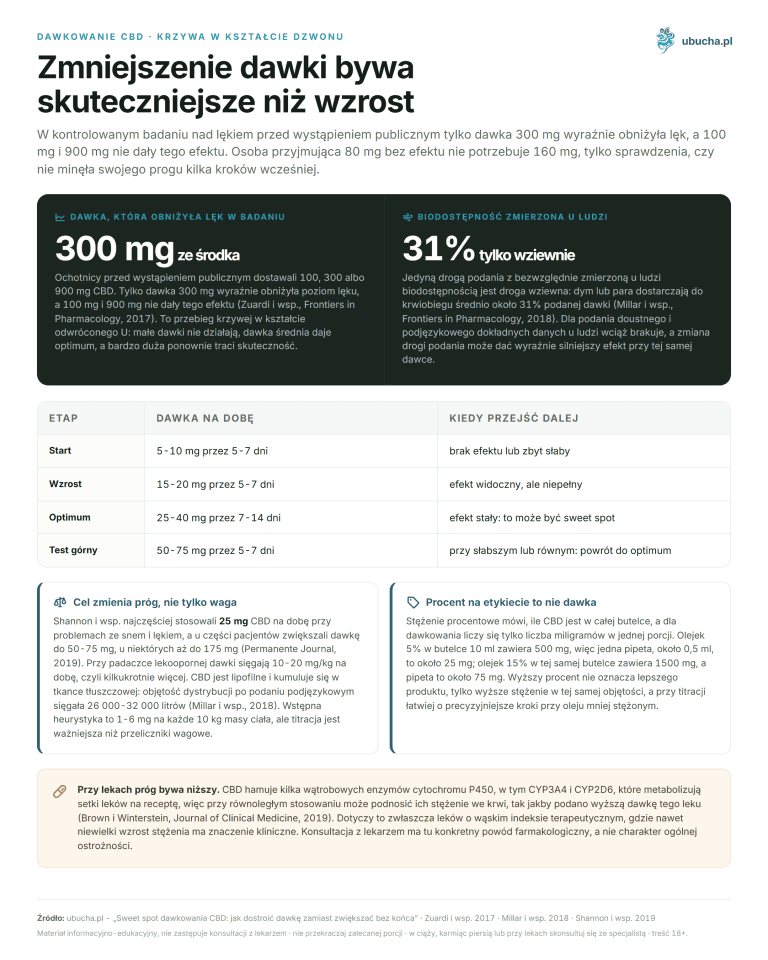
There is data on stress, but from completely different doses than consumer amounts. Bergamaschi et al. (Neuropsychopharmacology, 2011) assigned 24 untreated patients with social phobia to two groups of twelve. One received a single dose of 600 mg of CBD, the other placebo, an hour and a half before a simulated public speaking event. In the group with cannabidiol, anxiety, discomfort, and cognitive disturbances were lower than in the placebo group.
Six hundred milligrams is a dose an order of magnitude higher than what is measured from a bottle of oil. No one has studied consumer amounts in this context, so transferring the conclusion from a clinical trial to the evening before a competition is an overinterpretation. The research situation here is similar to that described in the article about CBD for pain: the mechanism sounds reasonable, the doses from studies are high, and the translation to practice remains open.
With performance, the matter is simpler, as there is almost no data. Sahinovic et al. (Sports Medicine Open, 2022) administered 300 mg to nine trained runners before a one-hour run and a test to exhaustion. They observed slight increases in oxygen uptake, lactate, and subjective enjoyment of effort, but they themselves described it as a pilot study requiring confirmation. Burr et al. (Sports Medicine, 2021) note in a review dedicated to cannabis in sports that CBD is being studied for recovery, not performance. For comparison, the impact of smoking cannabis on training is described separately in the article about cannabis before training.
If despite these reservations you want to try cannabidiol before a competition, test it first during a control training session at a similar time of day. Individual responses vary enough that the average from a dozen-person trial will tell you little about your reaction.
How to choose a CBD product to avoid failing a THC test?
The choice for a competing athlete is narrower than commonly thought. Only an isolate with a certificate of analysis for a specific batch is compliant. Broad-spectrum products are excluded not because of THC, but because of the other cannabinoids that are also on the prohibited list in competitions.
| Type of product | What it contains besides cannabidiol | Status in competitions |
|---|---|---|
| Isolate | Nothing, purity usually above 99% | Compliant, as long as the batch certificate confirms it |
| Broad spectrum | Terpenes and other cannabinoids, without THC | Risky, other cannabinoids are prohibited |
| Full spectrum | Terpenes, other cannabinoids, and trace THC | Highest risk of exceeding the threshold of 150 ng/ml |
The label itself guarantees nothing. Johnson et al. (Drug and Alcohol Dependence, 2022) tested 80 commercially available cannabis products and detected THC in 52 of them, in concentrations ranging from 0.008 to 2.071 mg/ml. Among 21 labeled as THC-free, five contained detectable amounts. Lachenmeier and Diel report that over 30% of products on the German market delivered more than 2.5 mg of THC daily. Differences between types of extract are discussed in more detail in the post about isolate, broad and full spectrum.
We noticed while reviewing offers that the certificate of analysis is sometimes issued for one old batch and attached to the entire assortment. For an athlete subject to testing, this is useless. Ask for the batch number from the packaging you have in hand, and if the seller cannot match it to the document, put the product down.
How to incorporate CBD into a training plan?
Cautiously and without expecting an effect that studies have not confirmed. No one has established dosages for recovery, as trials that tested them yielded negative results. A sensible approach is to treat cannabidiol as an evening supplement supporting sleep, not as a remedy for sore muscles.
The comparison with what athletes use daily is ambiguous for CBD. Non-steroidal anti-inflammatory drugs work on pain more strongly and quickly, but with regular use, they burden the stomach and kidneys. A cold bath provides relief in a few minutes and does not interact with anything. Cannabidiol has no documented advantage over any of these solutions in the context of post-exercise soreness, and its own safety profile with prolonged use is described worse, not better: the EFSA panel in 2026 could not establish a safe dose for people taking medications and indicated a signal of liver damage.
If you still want to try cannabidiol on yourself, do it outside the competition period and outside the day when something important depends on your reaction. Keep a simple record: time of intake, quality of sleep the next morning, well-being during training. Without such a record, you will not distinguish the effect of the product from ordinary variability in performance.
There is, however, a limit that is better not to exceed. In a statement from 2026, the EFSA panel derived a temporary safe dose of cannabidiol at 0.0275 mg per kilogram of body weight per day, or about 2 mg for a person weighing 70 kg, and noted that this number applies only to supplements with a purity of at least 98%. The same document states directly that safety cannot be established in individuals under 25 years of age, in pregnant and breastfeeding women, and in people taking medications (EFSA NDA Panel, 2026).
One thing remains unchanged regardless of supplementation. Sleep, nutrition, and load distribution in the microcycle account for recovery to a degree that no product can surpass. Cannabidiol can at most facilitate falling asleep after an evening session.
Frequently Asked Questions
Is CBD allowed for athletes?
Yes. WADA removed cannabidiol from the list of prohibited substances as of January 1, 2018, in competitions and out of competition (Gamelin et al., 2020). The exception applies only to cannabidiol itself. Other cannabinoids, both natural and synthetic, remain prohibited in competitions.
Does CBD reduce muscle pain after exercise?
So far, there is no evidence for that. Cochrane-Snyman et al. (2021) administered 150 mg of oil after eccentric exercise with no difference compared to placebo. Mendes et al. (2026) tested a topical gel for 72 hours, also with no effect on soreness.
How much CBD should I take after exercise?
There is no confirmed dosage for recovery, as trials that tested it yielded negative results. Thirteen untrained men were given 150 mg of oil orally, and fifteen active students received 2 g of gel on the skin for 72 hours. This is a description of two studies, not a recommendation for you.
Is broad spectrum safe before competitions?
Not in terms of anti-doping regulations. Broad spectrum does not contain THC, but it contains other cannabinoids, which remain on the prohibited list in competitions (Lachenmeier and Diel, 2019). Only an isolate with a batch certificate is compliant with the rules.
Does CBD improve performance?
There is no evidence. The only exercise trial measuring performance involved nine runners and was a pilot study (Sahinovic et al., 2022). McCartney et al. (2020) stated directly that there is a lack of direct research on CBD and sports performance.
Can CBD cause a positive THC test?
It can, if the product is poorly labeled. Johnson et al. (2022) tested 80 products and detected THC in 52 of them. Among 21 labeled as THC-free, five contained detectable amounts. The threshold for THC in urine is 150 ng/ml.
If you are looking for a product for the evening after training, check out the section oils at Bucha.
This article is for informational and educational purposes and does not constitute medical advice. Before starting to use cannabis or CBD for therapeutic purposes, consult a doctor, especially if you are taking other medications, are pregnant, or breastfeeding.
Author: Michał Waluk · Published: 2026-05-14 · Updated: 2026-08-14