
CBD for Migraine - A Way to Treat Attacks and Prevention in 2026
The only randomized study on migraine attacks showed that CBD alone did not perform better than placebo. We gather data, interactions with medications, and alarm symptoms.
Migraine is one of the most common neurological disorders in the world. A review of 357 population studies estimates its prevalence at 14 percent of adults, and headaches lasting at least 15 days a month at 4.6 percent (Stovner et al., The Journal of Headache and Pain, 2022). Some patients seek support outside standard pharmacotherapy, and for several years, cannabis products have appeared on this list. This text gathers what research says about cannabinoids in migraine and separates it from market promises. You will find the results of the only randomized study on acute attacks, data from large observational datasets, significant interactions with migraine medications, and symptoms for which urgent diagnostics are needed instead of a supplement. You will not find dosages, as that is the decision of the attending physician, not the article.
KEY INFORMATION
• The only randomized study of cannabinoids in migraine attacks involved 92 people and 247 attacks. Vaporized flower with THC and CBD performed better than placebo, while a preparation with only CBD did not (Schuster et al., Headache, 2026).
• In archival data from the Strainprint app, 7441 migraine sessions were associated with a reported pain intensity reduction of about half, but with increasing tolerance (Cuttler et al., The Journal of Pain, 2020).
• The EFSA states that the safety of CBD cannot be established in individuals under 25 years of age, pregnant or breastfeeding women, and those taking medications.
• CBD inhibits the enzymes CYP3A4 and CYP2C19 and P-glycoprotein, so it may alter the concentration of drugs used in migraine prevention (Brown and Winterstein, Journal of Clinical Medicine, 2019).
• This article does not provide any dosage. A sudden, worst headache of life or headache with fever and neck stiffness requires urgent contact with a physician.
What is migraine and why does standard prevention often fail?
Migraine is a recurrent headache with sensitivity to stimuli and nausea, whose mechanism is associated with the activation of the trigeminovascular system. The scale is large: in a review of 357 population studies, migraine was found in 14 percent of adults, and any active headache in 52 percent (Stovner et al., The Journal of Headache and Pain, 2022). The authors note that estimates vary between studies due to methodological reasons, and data from lower-income countries are still lacking. From the same review comes the number that best reflects the scale of the phenomenon: every day, 15.8 percent of people worldwide experience headaches.
The practical problem is not the lack of medications, but adherence to them. In the Spanish PERSEC study, 7866 individuals who were first started on oral migraine prophylaxis were tracked. After six months, 32.4 percent remained on treatment, and after one year, 30.4 percent (Irimia et al., The Journal of Headache and Pain, 2022). Antidepressants (46.3 percent), anticonvulsants (22.1 percent), and beta-blockers (17.8 percent) were most commonly prescribed, while non-steroidal anti-inflammatory drugs (57.6 percent) and triptans (28.2 percent) were used as needed. The first prophylaxis was most often initiated by primary care physicians in 76.8 percent of cases, and neurologists in 15.5 percent.
This same study showed that discontinuing prophylaxis is not neutral. Those who did not adhere to treatment had more visits to primary care and more days of sick leave than those who continued therapy. This gap between the number of patients and the number of effectively treated individuals is why patients seek anything additional. However, it is not a reason to consider every supplement as effective.
What connects the endocannabinoid system with migraine?
The connection is real, but described at the mechanistic level, not effectiveness. The clinical endocannabinoid deficiency hypothesis suggests that in some individuals, the endocannabinoid tone is lowered, promoting pain syndromes with central hypersensitivity. Ethan Russo includes migraine, fibromyalgia, and irritable bowel syndrome in this set and cites documented, statistically significant differences in anandamide levels in cerebrospinal fluid in individuals with migraine (Russo, Cannabis and Cannabinoid Research, 2016).
A group from Pavia described this more precisely. Anandamide, one of the two main endocannabinoids, is lowered in the cerebrospinal fluid and plasma of individuals with chronic migraine, and this reduction is associated with enhanced pain conduction in the spinal cord. Anandamide is broken down by the FAAH enzyme, so its inhibition is a therapeutic target being studied in migraine pain (Greco et al., Frontiers in Neuroscience, 2018). Anandamide is produced on demand in inflammatory conditions and acts through cannabinoid receptors, so its deficiency describes susceptibility to an attack rather than the attack itself. This is a research target, not a mechanism of action for hemp oil available in stores.
This same group measured the CGRP peptide, considered a mediator of migraine pain. In the plasma of 28 individuals with chronic migraine and medication overuse, CGRP levels were higher than in 27 individuals with episodic migraine, and a two-month hospital detoxification reduced both CGRP and the studied microRNA (Greco et al., The Journal of Headache and Pain, 2020). After adjusting for age, sex, and duration of illness, the difference for CGRP alone ceased to be significant, which the authors honestly note. This leaves an image of a system that works differently in some patients, rather than a ready therapeutic hint.
What did the only randomized study of cannabinoids in migraine attacks show?
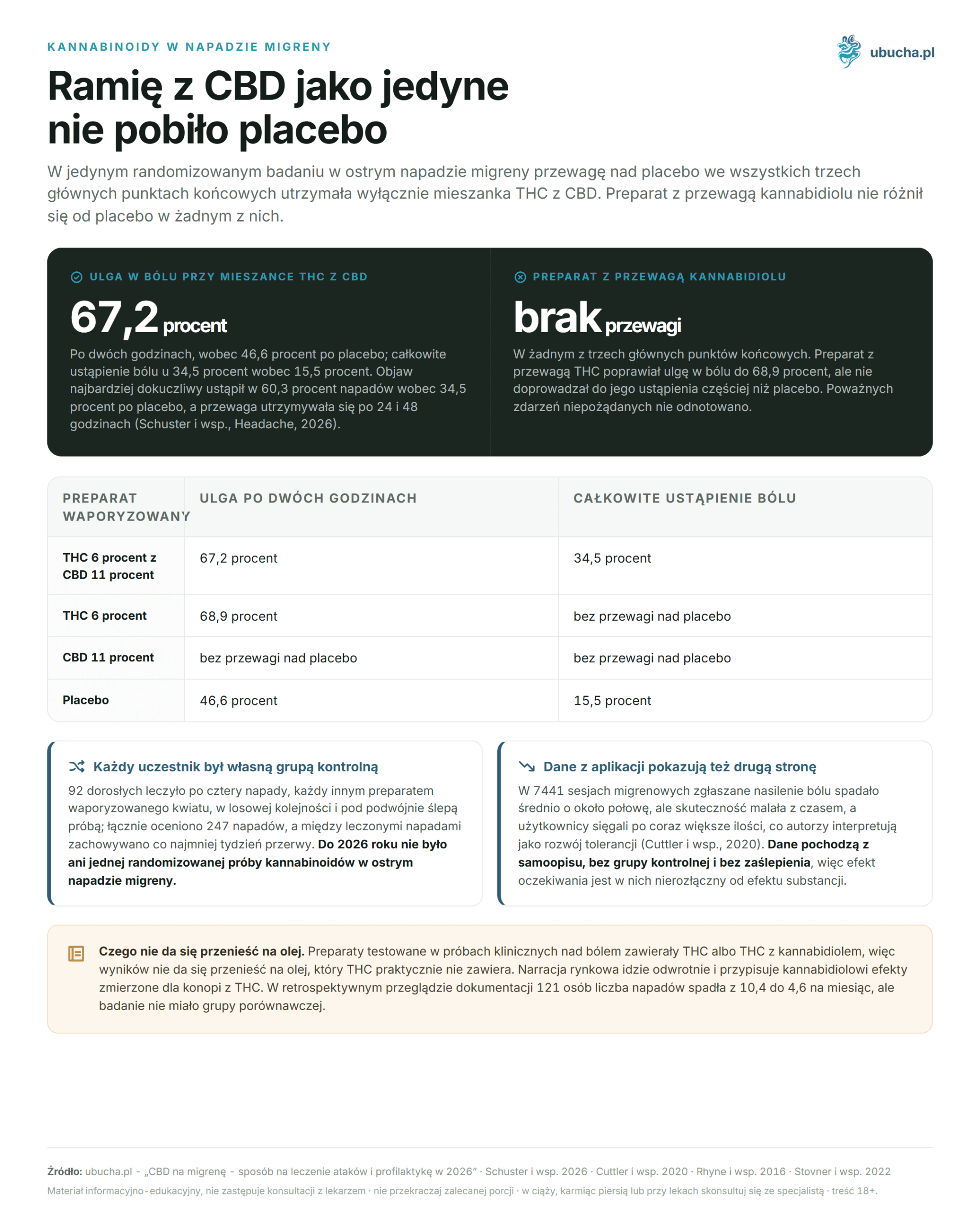
It showed that cannabidiol alone did not perform better than placebo. As of 2026, there had not been a single randomized trial of cannabinoids in acute migraine attacks. This changed with a study from California: 92 adults treated four attacks, each with a different vaporized flower preparation, in random order and under double-blind conditions. A total of 247 attacks were evaluated (Schuster et al., Headache, 2026).
| Vaporized Preparation | Pain Relief After 2 Hours | Total Pain Relief After 2 Hours |
|---|---|---|
| THC 6 percent with CBD 11 percent | 67.2 percent | 34.5 percent |
| THC 6 percent | 68.9 percent | no advantage over placebo |
| CBD 11 percent | no advantage over placebo | no advantage over placebo |
| Placebo | 46.6 percent | 15.5 percent |
Only the mixture of THC and CBD maintained an advantage over placebo in all three main endpoints. The THC-dominant preparation improved pain relief but did not lead to pain cessation more often than placebo. The CBD-dominant preparation did not differ from placebo in any of the three main points. No serious adverse events were reported. For a reader looking for CBD oil, this is the most important sentence in the entire article.
It is worth knowing the structure of this study, as it determines the strength of the conclusion. Each participant was their own control group, the order of preparations was randomized, and at least a week was kept between treated attacks. Besides the pain itself, the cessation of the most bothersome symptom, namely nausea, photophobia, or sound sensitivity, was also assessed: after the THC and CBD mixture, it ceased in 60.3 percent of attacks compared to 34.5 percent after placebo. The advantage of this mixture also persisted after 24 hours for total pain cessation and after 24 and 48 hours for the most bothersome symptom.
Do observational data confirm the effectiveness of cannabis in migraine?
They suggest a benefit, but are a weaker form of evidence. The largest dataset comes from the Strainprint app, where patients recorded symptom severity before and after using cannabis. The analysis included 12,293 headache sessions and 7441 migraine sessions. Reported pain intensity decreased by about half on average. In headache cases, men reported greater reductions than women, and concentrates more than flower (Cuttler et al., The Journal of Pain, 2020).
This same work describes the other side. Effectiveness decreased over time, and users reached for larger amounts, which the authors interpret as the development of tolerance. The data come from self-reporting, without a control group and without blinding, so the placebo effect is inseparable from the substance effect. The authors also checked whether the outcome was influenced by sex, product form, THC or cannabidiol content, and portion size; in the results description, they mention sex and product form as differentiating factors.
The second frequently cited dataset is a review of records of 121 adults from two clinics in Colorado who were recommended medical marijuana by a physician. The number of migraine attacks decreased from 10.4 to 4.6 per month, with improvement noted in 39.7 percent of patients and adverse effects in 11.6 percent, most often after edible forms (Rhyne et al., Pharmacotherapy, 2016). Most patients used more than one form and reached for it daily to prevent attacks, and inhaled forms were described as interrupting an already started attack. This study was retrospective without a comparison group. A review of 34 publications from Cureus concludes that medical cannabis shortens the duration of attacks and reduces their frequency, while also noting the poverty of clinical data (Poudel et al., Cureus, 2021). Practical conclusions from these observations are also developed in the text about CBD for headaches and migraines.
Does CBD work for pain like cannabis with THC?
There is no data for this, and those that exist suggest rather THC. A meta-analysis of randomized studies of cannabis-based medications in chronic pain included 43 trials and 2437 patients, of which 24 trials and 1334 individuals entered the meta-analysis. The effect versus placebo was minus 0.61, but the authors state directly that the clinical significance of this result remains uncertain, and most individual studies did not show an effect (Aviram and Samuelly-Leichtag, Pain Physician, 2017). The signal mainly concerned neuropathic pain, not migraine. The clearest effect, minus 0.93, was noted for inhaled administration, and the included trials were described by the authors as extremely heterogeneous, with a risk of insufficient blinding due to the perceptible effects of cannabis.
In this literature, there are almost no studies on isolated cannabidiol. The preparations tested in clinical trials contained THC or THC with CBD, so the results cannot be transferred to oil that contains virtually no THC. The randomized study on migraine attacks described above is the most direct in this regard: the CBD-dominant arm was the only one that did not outperform placebo.
The market narrative goes the other way and attributes effects measured for cannabis with THC to cannabidiol. A narrative review from Modena cautiously summarizes the state of knowledge: the endocannabinoid system participates in modulating trigeminal excitability, clinical data on endocannabinoid deficiency in migraine are suggestive, and studies on phytocannabinoids and synthetic cannabinoids are still preliminary (Lo Castro et al., Journal of Clinical Medicine, 2022).
What is known about cannabinoids in medication-overuse migraine?
There is one small randomized study, and it concerns a prescription medication, not store oil. Medication-overuse migraine develops in individuals who reach for acute medications too often and is one of the most commonly indicated factors for the transition from episodic to chronic migraine. Treatment involves discontinuing the overused medication and introducing prophylaxis, and there is little evidence for the effectiveness of individual regimens.
At a center in Modena, 30 individuals with long-term, refractory medication-overuse migraine received nabilone and ibuprofen in an alternating regimen, each for 8 weeks, with a one-week break between periods. 26 individuals completed the study. Improvement was noted after both medications, but nabilone more effectively reduced pain intensity and the number of analgesics taken, and was the only one to reduce medication dependence by 41 percent and improve quality of life (Pini et al., The Journal of Headache and Pain, 2012).
Three caveats must be made alongside this result. Nabilone is a synthetic analog of THC available only by prescription, not cannabidiol. The group consisted of 30 individuals, so the authors themselves call the result preliminary. Finally, the regimen from this study describes the course of a clinical trial under supervision, not a way to proceed on one’s own. We do not provide dosages here intentionally. If you reach for acute medications several days a month, the appropriate address is a neurologist, not a change of supplement.
Does CBD help with anxiety and insomnia associated with migraines?
CBD is most often sought for this reason, not for pain itself. Data in this area are somewhat better than in migraine, although still not from randomized studies. A frequently cited case series included documentation of 103 adult patients from a psychiatric clinic, to whom cannabidiol was added to their existing treatment, and monthly assessments of symptom severity were conducted using tools with confirmed reliability.
The final analysis included 72 individuals: 47 reported mainly anxiety, 25 mainly poor sleep quality. Anxiety severity decreased in the first month in 57 patients, or 79.2 percent, and remained at a reduced level throughout the observation period. Sleep assessment improved in the first month in 48 individuals, or 66.7 percent, but fluctuated over time. Cannabidiol was well tolerated by all patients except three (Shannon et al., The Permanente Journal, 2019).
Three limitations must be read alongside these numbers. It was a retrospective analysis, without a control group and without blinding, and cannabidiol was added to the treatment that patients were already receiving. The subjects did not suffer from migraines, so transferring the result to headache attacks is a guess, not a conclusion. The authors themselves conclude with a call for controlled studies. For a person with migraines, this means that anticipatory anxiety and poor sleep are real problems worth discussing with a physician, but do not constitute evidence of anti-migraine action.
How does CBD interact with medications used in migraines?
Through the same liver enzymes that metabolize some migraine medications. A review of data from product characteristics containing cannabidiol indicates inhibition of cytochrome P450 enzymes, including CYP3A4 and CYP2C19, and an effect on P-glycoprotein responsible for drug excretion. The authors emphasize that cannabidiol can be both the party changing the concentration of another drug and the party whose concentration is changed by another drug. They recommend considering lowering the doses of drugs metabolized by these pathways, monitoring adverse effects, and seeking alternatives in patients taking multiple medications (Brown and Winterstein, Journal of Clinical Medicine, 2019).
This has direct implications for migraines. The three most commonly used groups of preventive medications are antidepressants, anticonvulsants, and beta-blockers, and each includes substances that are metabolized by the liver. Overlaying such a regimen with a preparation that inhibits liver enzymes is a decision for the attending physician, as the result may be an increase in the concentration of the drug, not cannabidiol itself. We have described this separately in the text about combining cannabis with antidepressants.
A 2017 review of the safety of cannabidiol formulates this as a research gap: further studies are needed on the impact of CBD on liver enzymes, drug transporters, and interactions with other substances (Iffland and Grotenhermen, Cannabis and Cannabinoid Research, 2017). The EFSA panel goes further and states that the safety of cannabidiol cannot be established in individuals under 25 years of age, pregnant or breastfeeding women, and those taking medications. A patient with migraine treated pharmacologically falls into this last group.
What adverse effects have been reported with cannabidiol?
The most common are mild, but the list is not empty. A review of clinical data lists fatigue, diarrhea, and changes in appetite and body weight as the most frequently reported symptoms, mainly in studies on epilepsy and psychotic disorders. Compared to medications used for these indications, the adverse effect profile of cannabidiol is more favorable (Iffland and Grotenhermen, Cannabis and Cannabinoid Research, 2017).
An analysis of product characteristics presents a sharper picture. Adverse effects occurred in nearly half of individuals taking cannabidiol and were dose-dependent, with more frequent mentions of increased aminotransferase activity, drowsiness, sleep disturbances, infections, and anemia (Brown and Winterstein, Journal of Clinical Medicine, 2019). The difference from the previous paragraph arises because this refers to medicinal products administered in therapeutic doses, not a supplement.
The latest European position is the most cautious of the three. The EFSA panel notes consistent liver toxicity in animal studies, signals of hepatotoxicity in human studies, especially with the concurrent use of other medications, concerns about reproductive and developmental issues after prenatal exposure, and insufficient data on neurological and psychiatric safety (EFSA Panel NDA, EFSA Journal, 2026). This document concerns supplements with a purity of cannabidiol of at least 98 percent and without nanoparticles. The provisional safe value was derived by the panel using the benchmark dose method from subchronic studies, applying an uncertainty factor of 400, which in itself indicates how great the uncertainty of this estimate is. A meta-analysis of studies on cannabis medications adds a practical observation: gastrointestinal adverse effects occurred more frequently after oral and mucosal administration than after inhalation.
What is known about the absorption of cannabidiol from different forms?
Less than suggested by tables circulating on the internet. A systematic review of the pharmacokinetics of cannabidiol in humans found 792 publications, of which only 24 contained pharmacokinetic parameters. Absolute bioavailability was measured only after smoking and was 31 percent. No study has established it for any other route of administration, including oral and sublingual, despite intravenous forms being available for such measurement (Millar et al., Frontiers in Pharmacology, 2018).
It is worth stating this clearly, as a popular table with values of 6 percent for capsules and 13-19 percent for sublingual oil does not come from this work, although it is attributed to this review in Polish texts about cannabis. The review states the opposite: that data is lacking.
What the review actually provides is the half-life: from 1.4 to 10.9 hours after aerosol administration to the oral mucosa, from 2 to 5 days after chronic oral administration, 24 hours after intravenous administration, and 31 hours after smoking. Maximum blood concentration increases with dose, is higher after meals, and is higher in forms containing fat, and the time to reach it ranges from 0 to 4 hours. The authors conclude with a statement about the lack of data, not a summary of recommended forms.
What does Polish law say about cannabis products?
It separates two markets that are often conflated in marketing texts. Industrial hemp refers to plants in which the total content of delta-9-THC and tetrahydrocannabinolic acid in flowering or fruiting tops does not exceed 0.3 percent when calculated on a dry weight basis, rounded to one decimal place. The basis is Article 4 point 5 of the Act on Counteracting Drug Addiction as amended by the Act of March 24, 2022 (consolidated text Dz.U. 2023 poz. 1939). The threshold is calculated as the sum of the two compounds, not just delta-9-THC, which changes the result of the laboratory test.
Two things often confuse at this threshold. It refers to the plant, not to the finished product on the shelf, and it has been in effect at this level since May 7, 2022, when the amendment raising it from the previous value came into force. Cannabidiol is not listed in any of the controlled substance lists maintained by the Minister of Health. Therefore, products from industrial hemp are available without a prescription, but they are not medications and do not have a registered indication for migraine.
The second market looks different. Cannabis other than industrial hemp is a pharmaceutical raw material in Poland for the preparation of prescription medications, dispensed only by prescription. For this position, prescription regulations require a personal examination of the patient, and a prescription for a narcotic retains its validity for 30 days. This has practical significance for the outcome of the study described above: the preparation that was the only one to outperform placebo in migraine attacks was vaporized flower with THC, and thus in Polish conditions, a pharmaceutical product after a physician’s assessment, not a store item.
How to check what is really in the product?
Through a certificate of analysis, as the label may not match the content. A study published in JAMA included 84 cannabidiol products purchased online from 31 companies and tested independently. 30.95 percent of products had content consistent with the declaration, 42.85 percent had lower content than labeled, and 26.19 percent had higher content (Bonn-Miller et al., JAMA, 2017).
The second number from this work is more important for a person driving a car or undergoing workplace testing. THC was detected in 18 of 84 samples, or 21.43 percent. The authors note that the detected amounts may be sufficient for some individuals to induce a psychoactive effect, especially in children. The study concerned the American market before regulations, but the mechanism is general: without independent testing, it is unknown what is in the bottle.
Practically, this means three questions to ask the seller. Does the product have a certificate of analysis from a laboratory outside the company, with a date and batch number? Does the report provide THC content, not just cannabidiol? Does the batch number from the report match the number on the packaging? The absence of any of these answers is an answer in itself. The composition matters not only beyond the declared potency: a pharmacokinetic review notes higher maximum concentration after meals and in forms containing fat, so the same cannabidiol content in two preparations does not necessarily mean the same exposure. We dedicated a separate text to the nausea accompanying migraine attacks about CBD and nausea.
When does a headache require urgent diagnostics?
When any of the alarm symptoms described in neurology as red flags appear. The SNNOOP10 list, published in Neurology, collects fifteen such signals indicating the possibility of secondary headache due to another disease (Do et al., Neurology, 2019). No supplement is an answer to these symptoms.
On the list are: systemic symptoms including fever, a history of cancer, neurological deficit or altered consciousness, pain with sudden and severe onset, the first life attack after age 65, a change in the previous pain pattern, or a completely new pain, pain dependent on body position, pain triggered by coughing, sneezing, or exertion, swelling of the optic nerve head, increasing pain with an atypical course, pregnancy and postpartum, painful eye with vegetative symptoms, pain after head injury, immune system diseases, including HIV infection, and medication overuse or a new medication started together with the pain.
The authors of the review note that secondary headaches constitute a minority of cases, and the predictive value of individual symptoms has not been well studied. Systematically going through the list with a new patient, however, increases the chance of detecting a cause other than migraine. For a person keeping a headache diary, this means a simple rule: a change in the nature of the pain is a reason for a visit, not a change of supplement. The presence of a symptom from the list indicates the possibility of a secondary cause, not certainty, and does not replace a medical examination. The authors add that a validated screening tool could reduce the number of unnecessary imaging studies.
Frequently Asked Questions
Does CBD treat migraines?
There is no evidence for this. In the only randomized study on acute migraine attacks, involving 92 people and 247 attacks, a cannabidiol-dominant preparation did not perform better than placebo in any of the three main endpoints (Schuster et al., Headache, 2026). Only the mixture of THC and CBD maintained an advantage.
How much CBD should be used for migraines?
This article does not provide dosages because migraine is a medical indication. The EFSA panel states that the safety of cannabidiol cannot be established in individuals taking medications, pregnant or breastfeeding women, and those under 25 years of age. The selection of any regimen is up to the attending physician.
Can CBD be combined with migraine medications?
Only after consultation. Cannabidiol inhibits the enzymes CYP3A4 and CYP2C19 and affects P-glycoprotein, so it may increase the concentration of drugs metabolized by these pathways (Brown and Winterstein, Journal of Clinical Medicine, 2019). In migraine prevention, antidepressants, anticonvulsants, and beta-blockers are most commonly used.
Do vaporized cannabis help with a migraine attack?
In a 2026 study, vaporized flower with THC and CBD provided pain relief after 2 hours in 67.2 percent of treated attacks compared to 46.6 percent after placebo. In Poland, such flower is a pharmaceutical raw material dispensed by prescription, and regulations require a personal examination of the patient before issuing it.
Do cannabis reduce the number of days with migraines?
Observational data suggest this. In a review of records of 121 adults from Colorado, the number of migraine attacks decreased from 10.4 to 4.6 per month (Rhyne et al., Pharmacotherapy, 2016). The study was retrospective, without a control group and without blinding, so it does not determine a causal relationship.
Do cannabinoids help with medication-overuse migraine?
There is one small randomized study. In 30 individuals with medication-overuse migraine, nabilone reduced pain intensity and analgesic consumption more effectively than ibuprofen, and was the only one to reduce medication dependence (Pini et al., The Journal of Headache and Pain, 2012). Nabilone is a prescription medication, not cannabidiol.
How to know if a headache requires urgent help?
By alarm symptoms from the SNNOOP10 list: sudden and severe onset of pain, fever, neurological deficit, swelling of the optic nerve head, the first attack after age 65, and a change in the previous pain pattern (Do et al., Neurology, 2019). In such situations, diagnostics are needed, not a supplement.
What does this mean for a person with migraines?
A cautious conclusion arises that differs from sales promises. Cannabinoids have reasonable mechanistic foundations in migraine: anandamide is lowered in individuals with chronic migraine, and the endocannabinoid system participates in modulating trigeminal excitability. There are also initial randomized data, but these data indicate a mixture of THC with cannabidiol, not cannabidiol alone.
Observational datasets show large, repeatable reductions in reported pain and frequency of attacks, but without a control group and with increasing tolerance in the background. This is material for a hypothesis worth testing in studies, not for replacing prophylaxis prescribed by a neurologist.
Three things remain practical regardless of what future studies bring. First, if you are taking medications, discussing cannabidiol belongs to the physician, as interactions through liver enzymes are documented, and the EFSA position states that safety cannot be established precisely in this group. Second, a product without a certificate of analysis is an unknown also in terms of THC content, which has consequences for driver testing. Third, alarm symptoms from the SNNOOP10 list direct to diagnostics, not to the store. The broader context of cannabinoid action is described in the text about cannabinoids in anxiety disorders.
This article is for informational and educational purposes and does not constitute medical advice. Before starting to use cannabis or CBD for therapeutic purposes, consult a physician, especially if you are taking other medications, are pregnant, or breastfeeding.
Author: Michał Waluk · Published: 2026-04-27 · Updated: 2026-08-10